Every bird you bring home carries an unknown health history, and that single fact shapes everything about how you introduce new chickens to your flock. Done right (a 30-day quarantine, a proper see-but-not-touch phase, and a managed first mixing), most integrations end with nothing worse than a few days of posturing. Skipped or rushed, the same process can cost you birds you already have.
Below is the full sequence, from the moment a new bird arrives through the weeks it takes for everyone to sort out the new order. We also share what we track in our own coop during integrations, because the numbers matter as much as the steps.
Why quarantine every new bird for 30 days?
The short answer: any new bird can carry disease while looking completely healthy, and 30 days is the minimum window that reliably catches the infections with the longest incubation periods. University of Maryland Extension and Mississippi State University Extension both specify 30 days as the standard - after purchase and after returning from shows or fairs.
Birds that have recovered from an illness can remain silent carriers, shedding pathogens that will devastate a naive flock. Thirty days is the minimum because many respiratory and bacterial diseases have incubation periods of 10 to 21 days. A two-week quarantine (sometimes cited as a floor) can miss a bird that is incubating Mycoplasma or infectious bronchitis and only shows signs in week three. A full month gives you a real look at the bird.
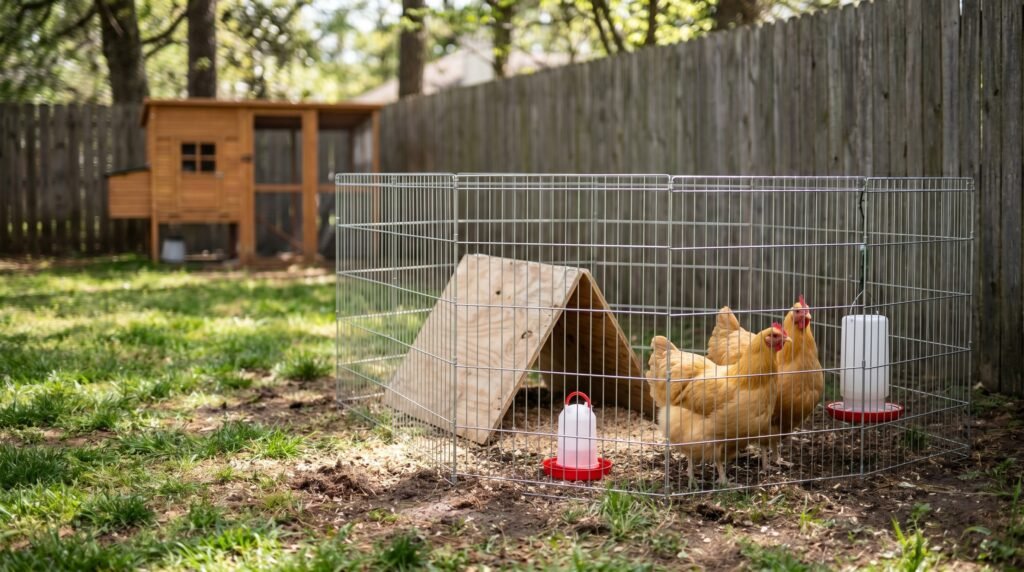
Your quarantine space needs to be genuinely separate, not just across the run but out of airborne range. A garage stall, a small shed, or a pen on the far side of the yard all work. Extension literature commonly describes a working rule of thumb of at least 30 to 50 feet between the quarantine pen and your main coop, though the practical goal is keeping shared airspace to a minimum rather than hitting an exact number. Feed and water the quarantine birds last, after your main flock, and change footwear or slip on boot covers between visits. Workers should move from the existing flock to the new birds, never in the opposite direction, unless they have changed clothing and showered (eXtension biosecurity guidance).
Watch the quarantined birds daily. Any bird that develops nasal discharge, rattling breath, lethargy, watery eyes, or loose droppings should not be integrated. Contact a poultry vet before making any decisions. If one bird in the quarantine group falls sick, the clock resets for all of them.
When sourcing new birds, look for hatcheries and breeders enrolled in the National Poultry Improvement Plan (NPIP). NPIP-certified flocks are tested for Pullorum disease, fowl typhoid, and avian influenza, which significantly reduces (though does not eliminate) the risk of buying in a diseased bird. The NPIP certification does not replace quarantine; it reduces what you are quarantining for.
What is the see-but-not-touch phase and why does it matter?
The see-but-not-touch phase is a five-to-seven-day window of controlled visual contact through a wire barrier, after quarantine and before any shared space. It lets both groups build social familiarity before the first physical encounter, so the pecking order negotiation is already underway when the barrier finally comes down.
Once your new birds have cleared quarantine with no health concerns, run this phase before any direct contact happens.
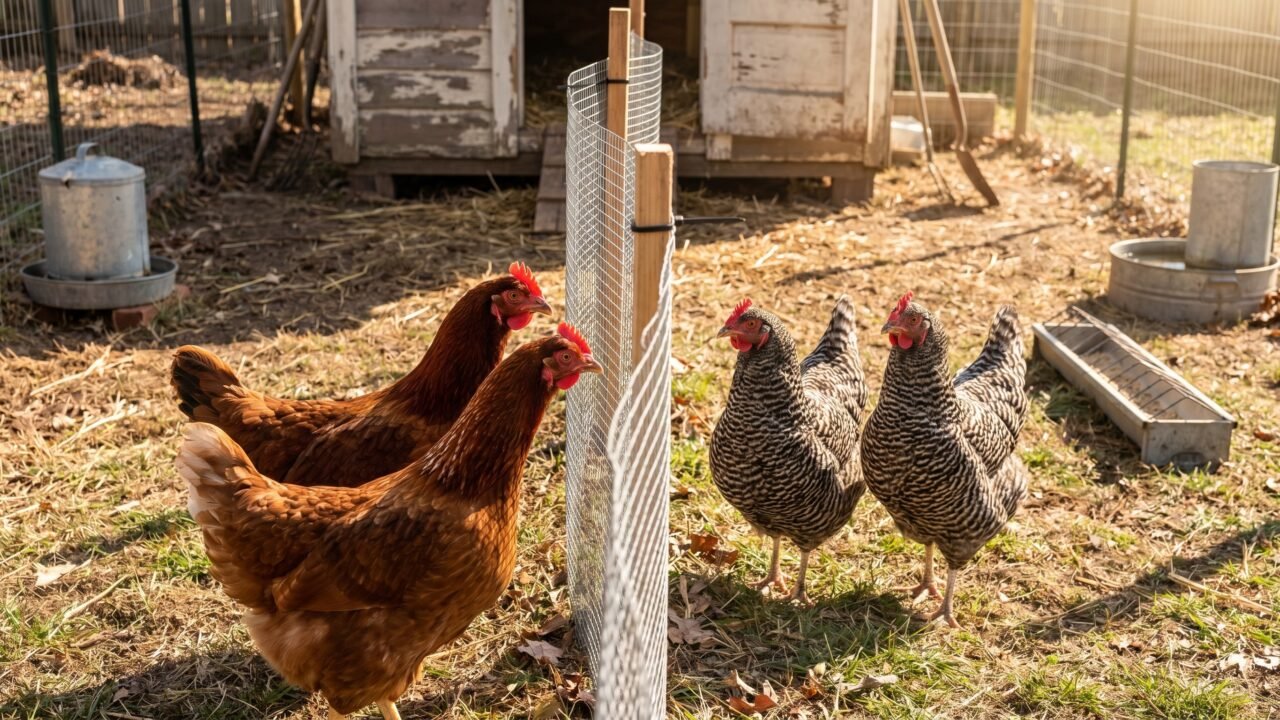
A wire partition inside a shared run, or a temporary panel of hardware cloth between two adjacent pens, works well. The birds will posture, pace, and peck at the mesh. That is normal and useful. They are establishing a social map without the risk of real injury.
The science behind this comes down to individual recognition. Research summarized by poultry.extension.org shows that laying hens can recognize around 30 individuals. When a stranger appears without warning, the existing flock has no social slot to put it in and defaults to aggression. Controlled visual exposure over five to seven days gives the established birds time to process the newcomers as familiar before they ever share the same ground.
During this phase, check that each group has its own feed and water. Competition at the station (even through a wire) is stressful and can prime birds to fight harder when the barrier comes down.
What to expect when the pecking order resets
Chickens form their social hierarchy early. Fighting to determine rank starts as young as 16 days of age in chicks, and in a female-only group the order is usually established within the first few months of life. When you introduce new birds, that hard-won structure gets disrupted, and the flock restarts the ranking process.
Some chasing and pecking during the first 48 to 72 hours is completely normal. You want to see brief confrontations that end with the loser moving away. What you do not want is prolonged, bloody fighting where one bird is pinned, or a group of birds that pile on a single individual. Drawn blood is a serious threshold. Chickens are strongly attracted to the color red and will intensify attacks on a wound, which can escalate to cannibalism quickly.
In our coop, the worst of the fighting during a typical introduction of four to five new hens into a flock of 18 lasts two to four days, with occasional skirmishes for another week or two as the new birds find their positions. After that, the new order holds.
A dominant bird displacing a subordinate at the feeder is the social hierarchy functioning normally. The key is making sure the subordinate birds have room to retreat and access to food regardless of their rank.
How to do the first mixing
Timing and environment make a significant difference in how the first unsupervised contact goes.
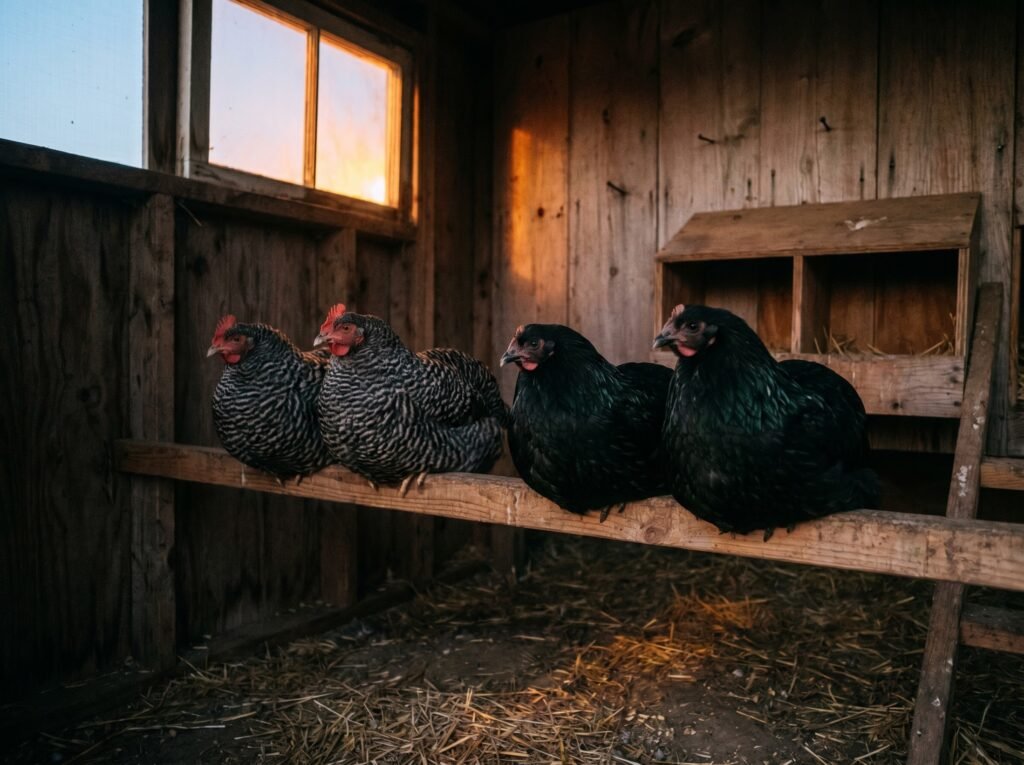
Do it at dusk. Placing new birds on the roost after dark, when the established flock is already settled, reduces the intensity of the first encounter. By morning the birds have spent a night together and the novelty has partially worn off. The first mixing works best in the evening when all birds are settling down, with close monitoring for aggression in the hours after (Ask Extension eXtension poultry guidance).
Introduce more than one newcomer at a time. A single new bird absorbs all the social pressure from every existing flock member. Two or three new birds spread that pressure and give the dominant birds multiple targets, which paradoxically reduces the severity of any one bird's experience. Adding a pair into a flock of 15 is gentler than adding them one at a time.
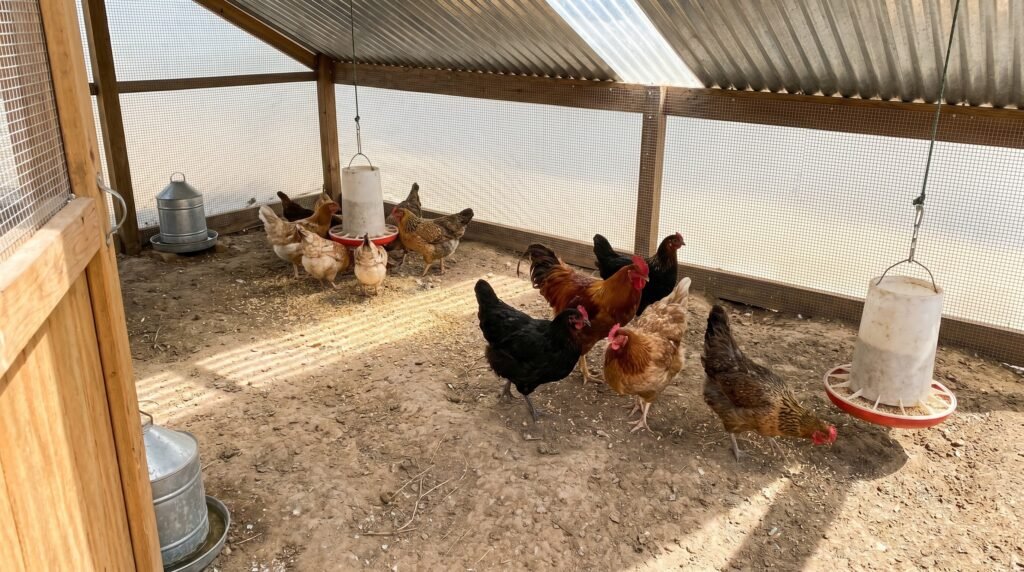
Add space and distractions. Open the run wider if you can, hang a head of cabbage, scatter scratch in several spots. When birds are occupied foraging and navigating space, they have less bandwidth for sustained aggression. Overcrowding is one of the documented triggers for feather pecking and cannibalism, and inadequate floor space increases competition and the incidence of injurious pecking (poultry.extension.org), so extra space at integration is cheap insurance.
Add extra feed and water stations. The lowest-ranking new birds will be blocked from the main station repeatedly. A second or third feeder placed away from the primary one gives subordinates access to food and water without having to challenge a dominant bird for it.
Watch for blood. Check the flock morning and evening for the first five days. Any bird with a wound needs to be removed and treated before returning. An open wound in a mixed flock is a serious risk. A plain, diluted wound spray to obscure the color is a standard management step while the wound heals.
Special cases: chicks joining an adult flock
Introducing young chicks to adult hens is a different calculation. A 10-week-old pullet is physically outmatched by an adult hen, and even a mild peck to the head can kill a small bird. The minimum workable age for direct integration depends on the size gap, but Ask Extension's poultry guidance suggests chicks should be eight weeks or older before entering a "get to know you" area adjacent to the main flock.
Our approach in the coop: run the see-but-not-touch phase longer for chicks, two to three weeks instead of one, and do the first mixing only after the pullets are fully feathered and roughly two-thirds the body size of the smallest adult hen. Waiting until 12 to 14 weeks is often safer than the bare minimum of eight.
The move from brooder to outdoor integration is its own transition. Before starting the integration sequence, confirm your pullets have hit the feathering and temperature milestones that make outdoor living viable - rushing that step creates a second set of problems on top of the social pressure.
One thing to avoid with chicks: mixing very young birds with heavily feathered breeds like Cochins or Silkies. The feathering on the feet and head makes those breeds targets for curious pecking by birds of any age, and a small chick that learns to pull feathers on a tolerant Cochin can become habituated to feather-pulling that is very hard to stop.
Managing persistent aggression
Some fights go on too long. A few practical interventions:
- Remove the aggressor, not the victim. Pulling the bully out of the coop for three to five days can reset its social status. When it returns, it often re-enters lower in the hierarchy than it left, reducing the intensity of its attacks.
- Apply a dark-colored wound spray to any injury to mask the red that draws attention. Do not return a visibly wounded bird to the flock before the wound closes.
- Use pinless peepers on the worst aggressors. These are small plastic blinders that fit on the beak and restrict forward vision without affecting eating or drinking. They reduce targeted aggression substantially and are humane when fitted correctly.
- Check your light levels. Bright, continuous lighting beyond 16 hours per day has been linked to increased pecking (Mississippi State Extension). Dimming a very bright coop during the integration period may help reduce irritability in both established and new birds.
- Add visual barriers inside the run (a piece of plywood, an old crate, a hay bale). Anything that breaks sight lines lets a chased bird get out of view and end the interaction.
Persistent aggression that does not resolve after two weeks, or any injury that draws blood repeatedly, warrants isolating the aggressor and reassessing whether the birds are compatible. Some individuals (usually cockerels with cockerels) simply will not coexist. That is a management reality, not a failure.
The integration timeline at a glance
| Phase | Duration | What you are doing | Watch for |
|---|---|---|---|
| Quarantine | 30 days minimum | Separate housing, separate tools, daily health checks | Respiratory signs, lethargy, loose droppings, eye discharge |
| See-but-not-touch | 5-7 days (longer for chicks) | Wire barrier between groups in shared or adjacent space | Stress behaviors, inadequate feed/water access |
| First mixing | Start at dusk; supervise for 3-5 days | Combined space, extra feeders/waterers, distractions | Drawn blood, one bird being mobbed, sustained pinning |
| Settling period | 2-4 weeks | Normal flock management; monitor for injuries | Feather loss, weight loss in new birds, wounds |
Biosecurity habits that carry past integration day
Good biosecurity does not end when the birds are mixed. A few habits that make ongoing disease management easier:
Keep your flock closed as much as possible. Every new bird is a new risk, and every visit from a neighbor's poultry (or equipment shared between flocks) is a transmission pathway. The primary way disease spreads between flocks, according to extension biosecurity research, is through new birds, shared equipment, and contaminated vehicles. A dedicated pair of coop shoes that stays at the coop door is one of the simplest biosecurity upgrades available and it costs almost nothing.
Avoid mixing species without thought. Ducks and chickens can coexist, but they foul waterers fast and have different disease susceptibilities. If you keep mixed species, be aware that waterfowl can carry avian influenza strains that devastate chickens while showing mild or no symptoms themselves. Mississippi State Extension advises against mixing multiple species, particularly ducks and chickens.
Record what you purchase and when. A simple log of purchase dates, sources, and quarantine start dates means that if a disease problem appears in your flock three months from now, you have a paper trail to help a vet or extension agent identify whether a recently introduced bird is the likely source.