For most chicken run walls and coop openings, the answer is 1/2-inch galvanized hardware cloth at 19-gauge minimum - full stop. Chicken wire was designed to keep chickens in, not to keep predators out. Raccoons pull it apart. Weasels squeeze straight through it. Foxes bite through the thin strands in minutes. Hardware cloth, by contrast, is welded-square galvanized mesh that stops all of those animals when it's sized and installed correctly. This article breaks down why chicken wire fails, which gauge and mesh size actually work, what the price difference really looks like over time, and the one job where chicken wire earns its keep.
Below is the full reasoning - and a comparison table to use at the hardware store.
Why chicken wire fails against predators
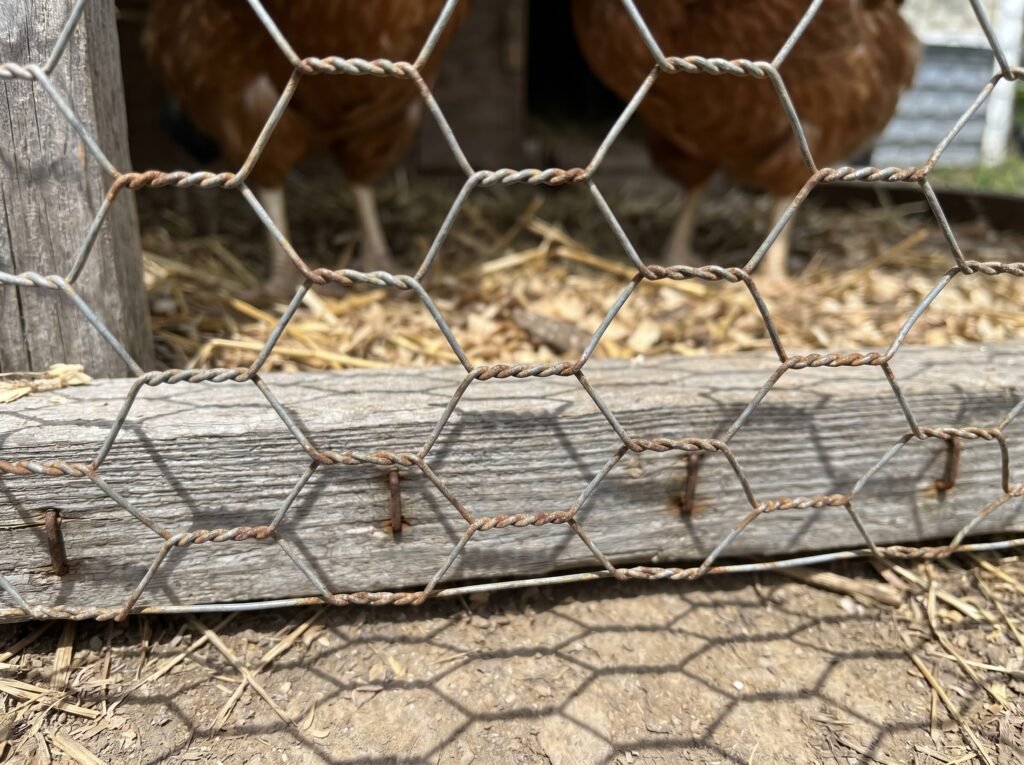
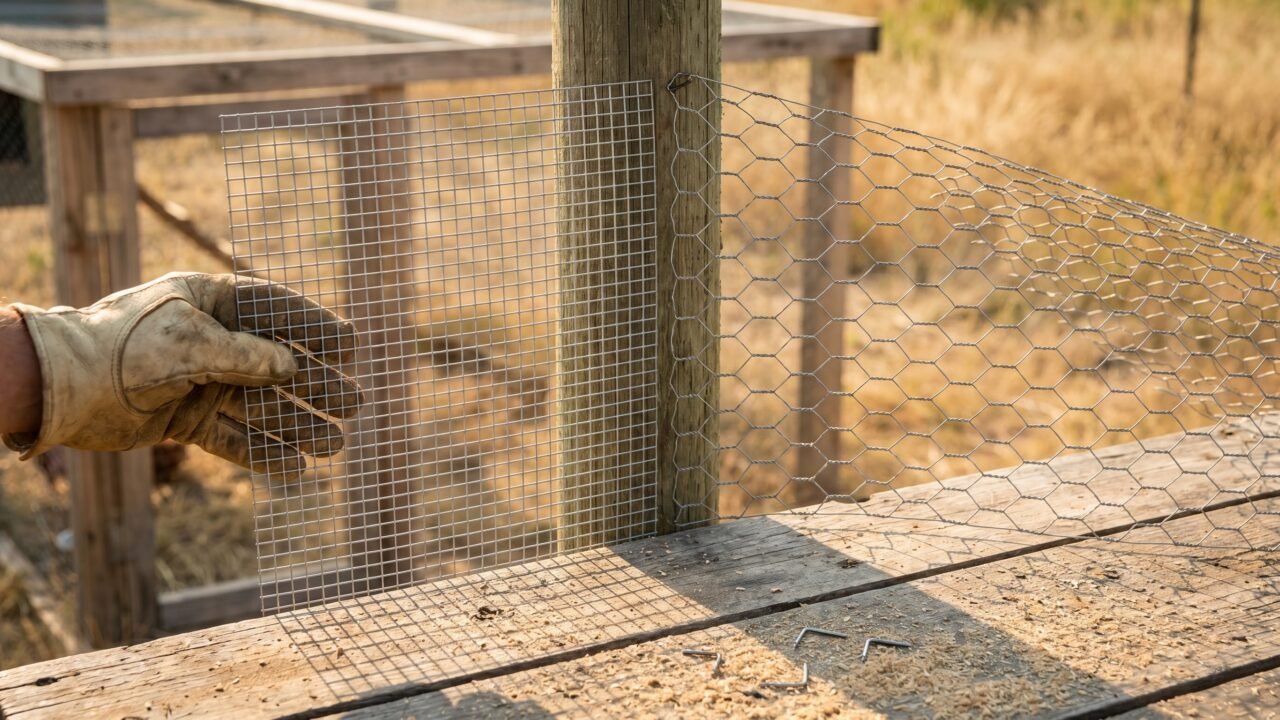
Standard hexagonal poultry netting is typically 20-gauge wire - about 0.032 inches (0.81 mm) thick - with 1-inch openings. Those openings are the first problem. A raccoon's front paw fits through a 1-inch gap, and raccoons are notorious for grabbing a bird through the wire, pulling limbs or heads through the openings, and leaving the rest of the carcass on your side of the fence. Anything larger than an inch in diameter can let a weasel through - Cornell Cooperative Extension confirms a weasel "can kill tens of chickens in one go." The least weasel is the most extreme example: it can squeeze through holes as small as 1/4-inch in diameter and will get through standard chicken wire without difficulty.
The second problem is structural. Hexagonal netting is woven rather than welded, meaning the wires twist around each other at every intersection without being fused. A determined predator - a raccoon, a large dog, even a persistent opossum - can unravel those twisted joints or stretch the openings wide enough to push through. Woven wire is not the best choice for predator protection. Hardware cloth, made by welding wires together at every crossing, holds its shape even under sustained pulling and gnawing pressure.
The third problem is corrosion. Cheap hexagonal netting is often lightly galvanized. Once the zinc coating wears through at bends and cut edges, the thin wire rusts fast, especially near waterers or in humid climates. A rusted wire can snap under pressure that solid hardware cloth would shrug off.
None of this means chicken wire is useless - but its legitimate jobs are narrow. See the comparison table below.
Gauge and mesh size: what the numbers mean
Two numbers define any wire product: gauge (the wire's thickness) and mesh size (the opening between wires). For hardware cloth, a higher gauge number means thinner wire - 19-gauge wire is approximately 0.91 mm (0.036 inches) in diameter, while 16-gauge is approximately 1.27 mm (0.050 inches). For backyard poultry, 19-gauge is the practical minimum for walls and runs; 16-gauge is worth the extra cost for ground-level aprons and floors where digging predators apply sustained force.
Mesh size determines which animals you exclude:
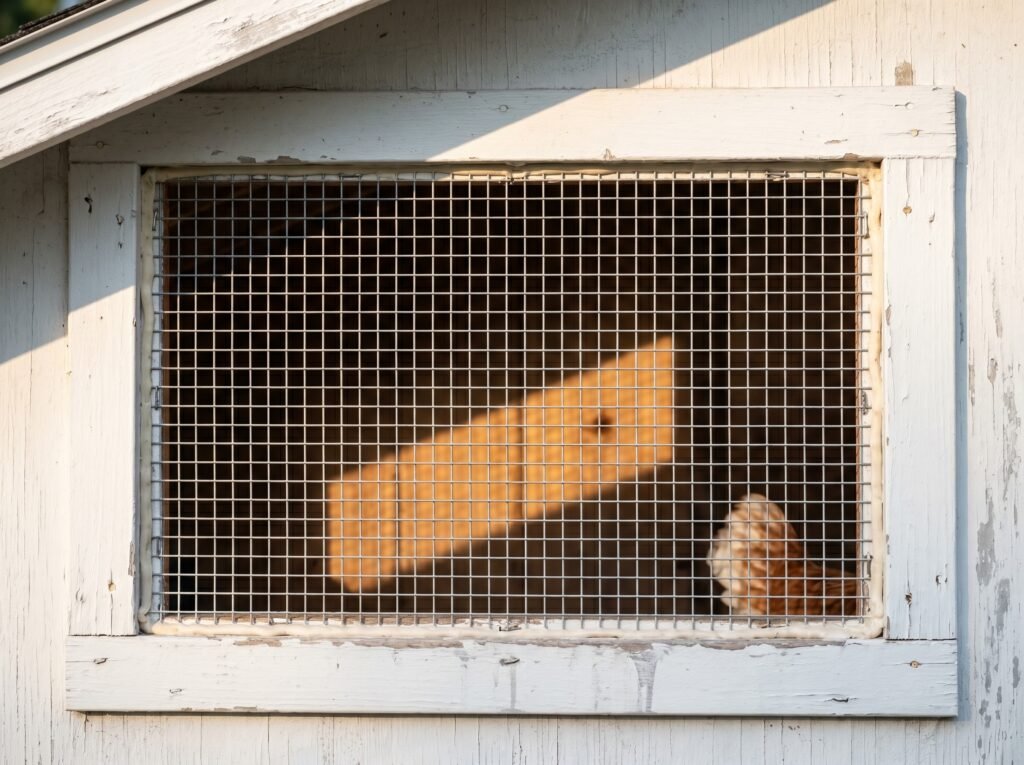
- 1/4-inch mesh - excludes snakes, mice, and the smallest weasels. Extension.org's guidance notes that snakes able to pass through gaps of 1/4-inch or smaller do not cause predation damage, so 1/4-inch is the gold standard for brooder boxes and night coop ventilation where small reptiles are common. It is also the most expensive option per linear foot.
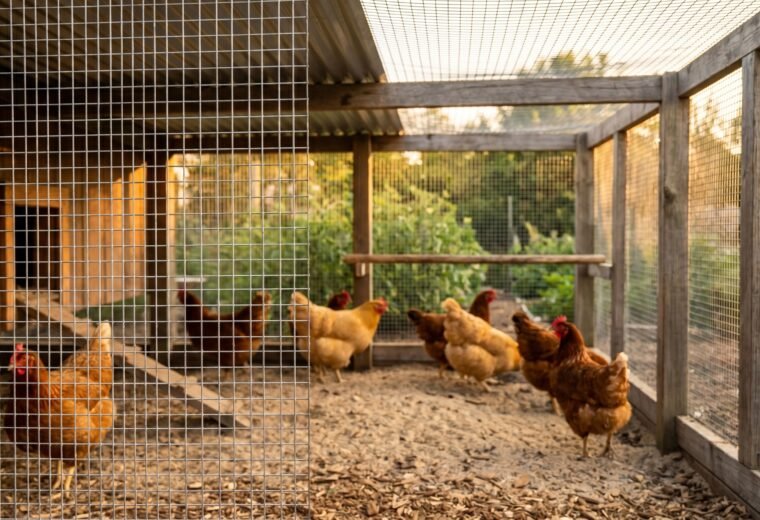
- 1/2-inch mesh - the best all-around choice for run walls and coop openings. Small enough to stop raccoon paws from reaching through, snakes from entering, and weasels from squeezing past. UF/IFAS Extension recommends hardware cloth for all openings and specifies that a 1-inch-by-1-inch square is the absolute maximum acceptable opening - 1/2-inch gives you a safety margin.
- 1-inch mesh - acceptable for upper run walls above 3 feet where only larger predators (dogs, coyotes) are the concern, but it still lets in weasels and the raccoon-reach problem remains. Colorado State University Extension found fewer bird losses with 1-by-2-inch welded mesh versus the wider 2-by-3-inch option, underscoring that smaller is consistently safer.
Electric netting, chain link, and other mesh options for chicken runs each have different trade-offs worth understanding before you buy.
The comparison table: hardware cloth vs chicken wire side by side
Use this to match the job to the right product at the store. The "verdict" column reflects what multiple university extension sources collectively recommend for each application.
| Feature | Hardware cloth (welded) | Chicken wire (hexagonal netting) |
|---|---|---|
| Construction | Wires welded at every intersection | Wires twisted/woven at intersections |
| Common gauges | 16, 19, 23, 24, 27 (lower = stronger) | 20, 22 (thinner than hardware cloth) |
| Typical mesh sizes | 1/4", 1/2", 1" | 1" hexagonal (standard) |
| Raccoon resistance | Yes (1/2" or smaller) | No - paws fit through; joints pull apart |
| Weasel resistance | Yes (1/4" or 1/2" mesh) | No - weasels pass through 1" openings |
| Snake resistance | Yes (1/4" mesh) | No |
| Dog/fox resistance | Yes (16-gauge+) | Marginal - thin wire bends and tears |
| Approx. cost (4 ft x 100 ft roll) | $60-$120 (19-gauge, 1/2") | $25-$45 (20-gauge, 1" mesh) |
| Lifespan (hot-dip galvanized) | 10-20+ years typical | 3-7 years before rust failure |
| Legitimate uses | Run walls, coop vents, apron, floor | Temporary garden fencing, run-within-a-run dividers, decorative trellis |
| Verdict for predator protection | Required for any secure structure | Insufficient; do not rely on it as primary predator barrier |
Note on cost: prices shift with steel markets and vendor. The figures above reflect common retail ranges for hot-dip galvanized product in the US as of mid-2026; verify at purchase. The lifespan gap is where the real math lives - replacing failed chicken wire twice over ten years often costs more than buying hardware cloth once.
Installation details that determine whether hardware cloth actually works
The mesh is only as good as how you attach and bury it. Several extension programs agree on the basics, with slightly different numbers on burial depth:
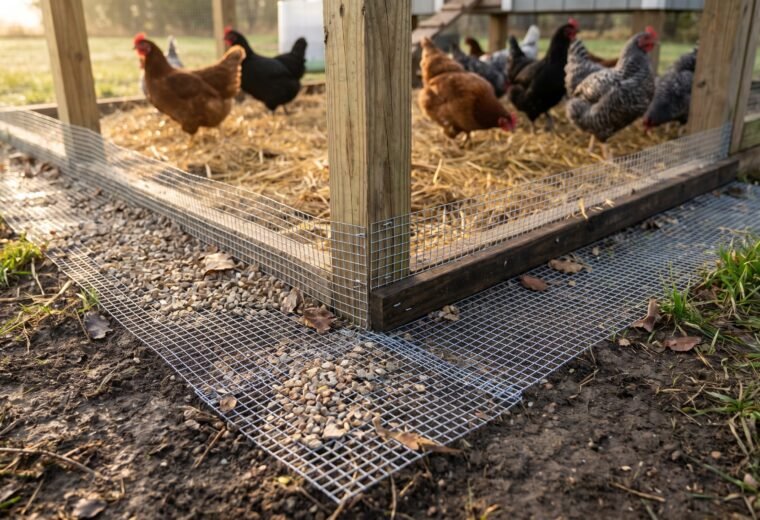
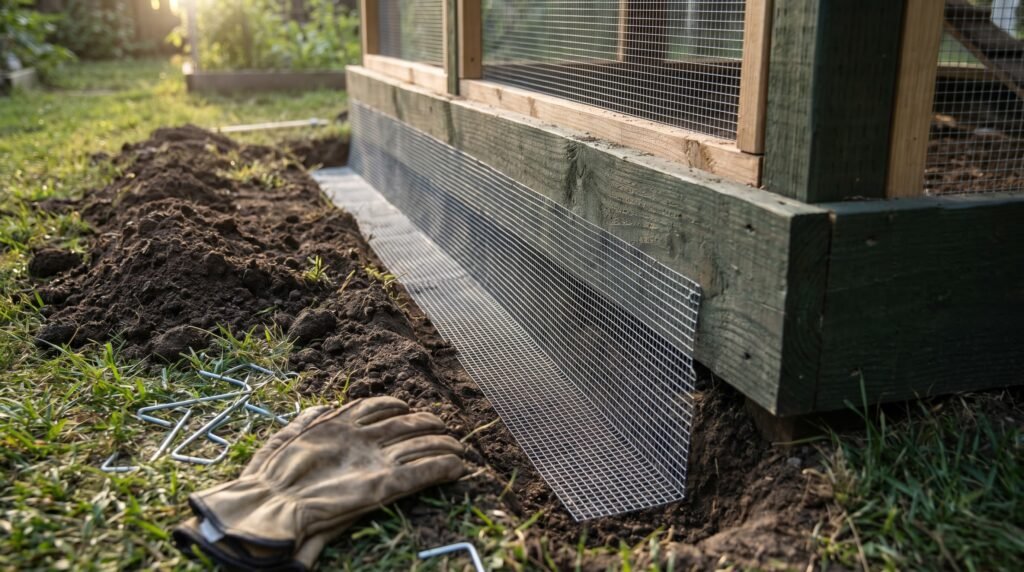
Burying the apron. Extension.org recommends burying hardware cloth at least 12 inches straight down to stop diggers. The University of Maryland Extension adds the L-shape detail: go down at least 12 inches, then bend the mesh outward 8-10 inches underground. UF/IFAS Extension specifies 12-18 inches in an L-shape as the burial standard for high-pressure predator areas. Combining the Extension.org minimum (12 inches straight down) with the UMD outward bend (8-10 inches) gives a practical L-shape that covers the vast majority of diggers - foxes, skunks, and raccoons - without requiring a trench that is hard to backfill cleanly.
An alternative to trenching: the surface apron. Lay hardware cloth flat on the ground around the outside of the run, extending 12-18 inches outward from the base of the wall. Peg it with landscape staples and cover it with a few inches of soil, gravel, or pavers. Predators that start digging hit the wire immediately and typically give up. This approach is faster to install and equally effective for most backyard situations.
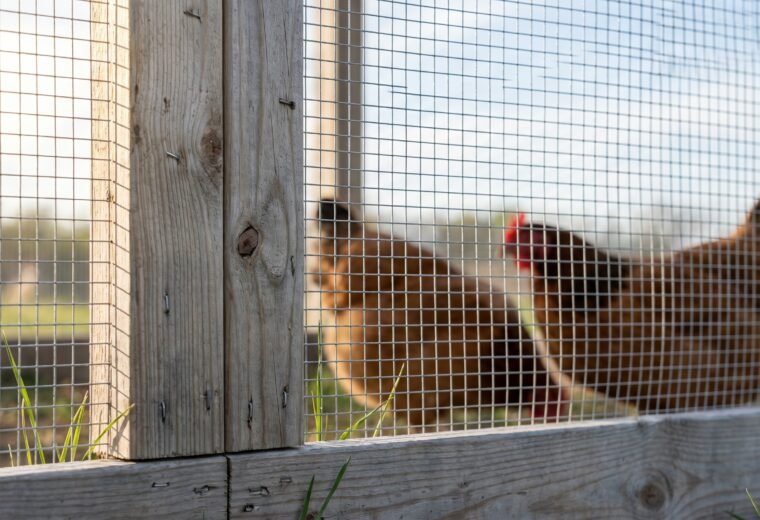
Fastening matters. Use 1/2-inch galvanized staples (not just zip ties) to attach hardware cloth to wooden framing, placed every 4-6 inches along the frame. Zip ties alone can fail under sustained predator pressure; use them to join two cloth panels to each other, then also staple those panels at each frame member. Every gap or loose edge is an invitation.
Covering the top. A hardware cloth roof on the run stops hawks, climbing raccoons, and climbing foxes. If a solid roof is not practical, 2-inch welded wire mesh across the top at least stops aerial attacks - the full trade-offs of open versus covered tops depend on your local predator mix, and those trade-offs are laid out in the predator-proof chicken run roofing section.
Hardware and latches. Raccoons can open simple hook latches and even carabiner clips with enough time. Use two-step or locking latches on any door that a raccoon could reach.
Where chicken wire does earn a place
Chicken wire is not worthless - it just belongs in a narrow set of jobs where predator pressure is not the concern:
- Temporary dividers inside the run. If you're introducing new birds and need a see-through partition for a week or two, chicken wire is fine. The predators are already outside.
- Garden fencing around raised beds. Keeping chickens out of the lettuce patch? Chicken wire is perfectly adequate.
- Decorative trellis or plant support. No predator-proofing required.
- Short-term brooder skirts. If you're brooding chicks in a barn or garage where large predator entry is already blocked, chicken wire as an inner chick-containment ring is acceptable - though hardware cloth is still better.
The one rule: never use chicken wire as the primary barrier between your flock and the outdoors or the night. Hardware cloth is the appropriate barrier for all coop openings; hexagonal poultry netting is a containment product - useful for keeping birds where you want them, inadequate for stopping what wants to reach them.
Frequently asked questions
Can raccoons tear through 19-gauge hardware cloth?
Sustained pulling by a determined raccoon can deform loosely fastened hardware cloth, but properly stapled 19-gauge welded mesh resists tearing. A raccoon cannot force its paw through a 1/2-inch opening the way it can with 1-inch hexagonal netting. If raccoons are a serious local problem, step up to 16-gauge for the lower 3 feet of the run walls.
Is 1/2-inch or 1/4-inch mesh better for a chicken coop?
Use this decision rule: if you live in an area with rat snakes, garter snakes, or other slender species that hunt eggs, go 1/4-inch for every ventilation opening and brooder box. If your region's snakes are thick-bodied (corn snakes, rat snakes over 18 inches) and your coop is already well-sealed, 1/2-inch is sufficient for those openings and will cost noticeably less. A second trigger for upgrading to 1/4-inch is active rodent pressure - mice can squeeze through a 1/2-inch opening, so if you are already fighting a rodent problem in or near the coop, 1/4-inch at the walls seals that entry route. For everything else - run walls, doors, aprons - 1/2-inch at 19-gauge is the right default.
What is the best way to stop foxes from digging under a run?
Bury a hardware cloth apron at least 12 inches down with an outward L-bend of 8-12 inches, or lay a surface skirt 12-18 inches wide, pegged flat and covered with soil or gravel. Foxes dig hardest in late winter and early spring when they are denning - that is the season to inspect and reinforce any loose edges before pressure peaks. One addition that makes a measurable difference: a single strand of electric wire run 4-6 inches off the ground along the outer base of the run. Foxes that probe the perimeter touch the wire before they start digging and quickly learn to avoid the area. A continuous, fully secured apron combined with the electric deterrent is the most reliable combination. Wire placement and energizer sizing are covered in the predator-proof chicken run section on electric deterrents.
How long does galvanized hardware cloth last outdoors?
Hot-dip galvanized hardware cloth (look for double zinc coating on the product spec) typically lasts 10-20 years in outdoor use before corrosion becomes a structural concern. Electroplated galvanized wire - the cheaper version - has a thinner zinc layer and may begin showing rust in high-humidity or high-rainfall environments within 3-5 years. The spec page for the wire matters: look for "hot-dipped galvanized" or "double zinc coating."
Can I use hardware cloth on the floor of the run?
You can, but it is not ideal for the birds' feet if they spend extended time on it. A better approach is to use hardware cloth as a buried apron or a flat skirt around the run perimeter while keeping the run floor as natural dirt or a softer substrate like sand or wood chips. For coops with raised floors, a hardware cloth floor below the structure is excellent at stopping diggers from coming up through the bottom. See our chicken run overview for more on flooring options.