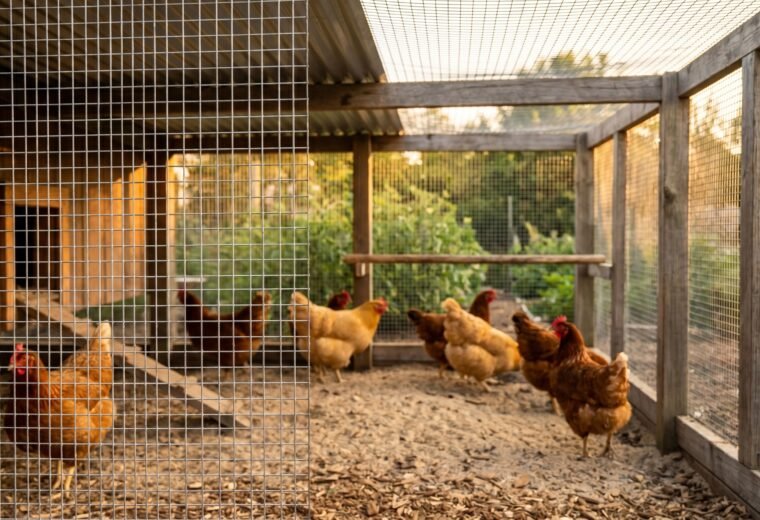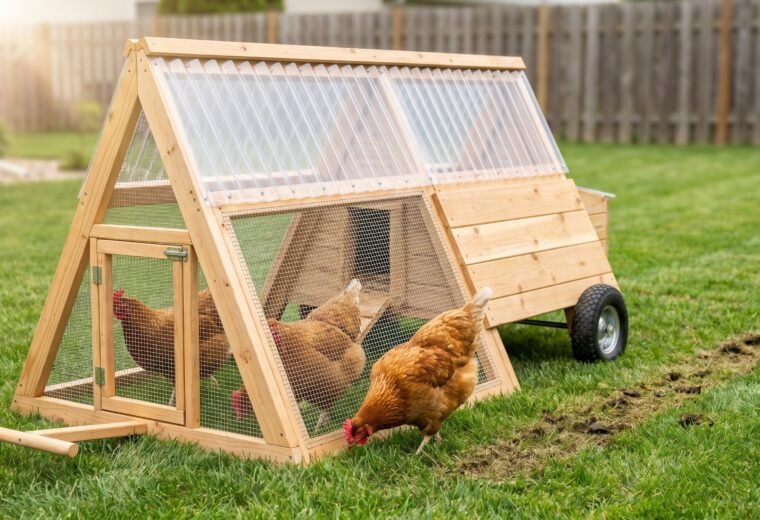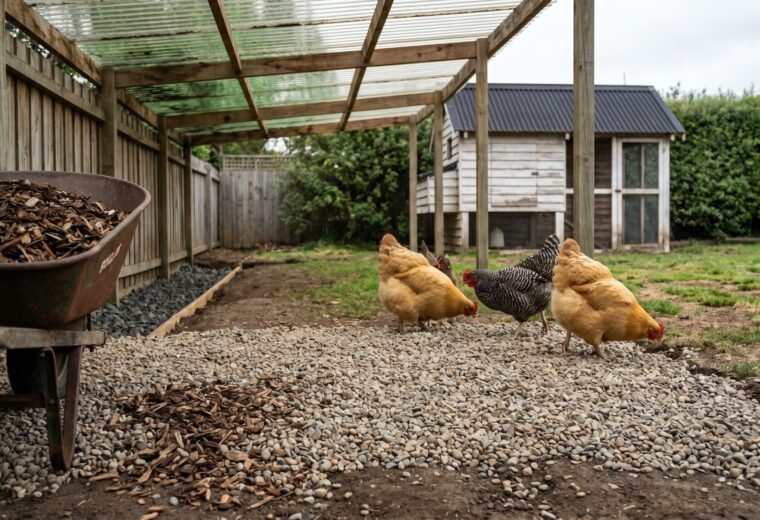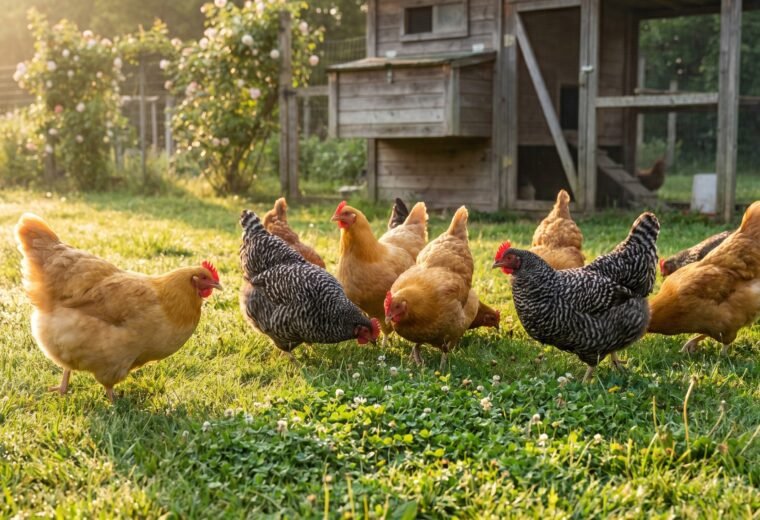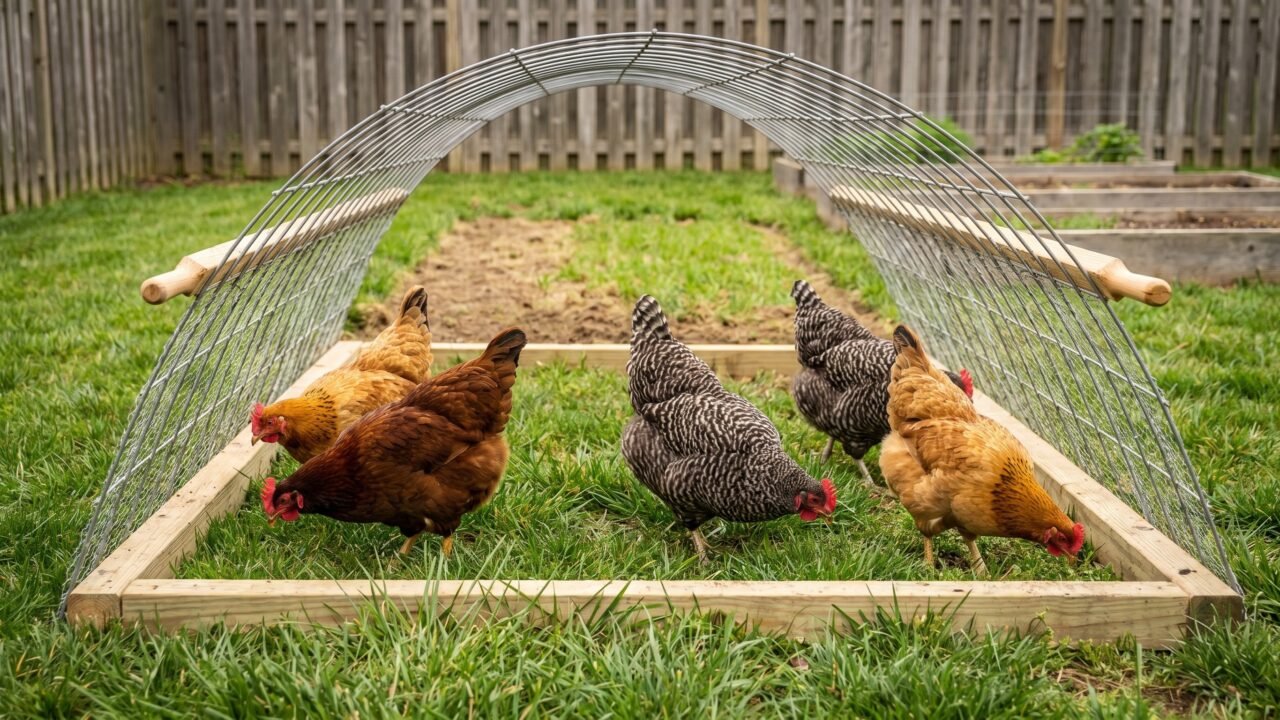
Every patch of ground a stationary run sits on turns to bare dirt within weeks. A movable chicken run - sometimes called a chicken tractor, hoop run, or portable pen - solves that problem by letting you drag or wheel the whole structure a few feet whenever the grass gets thin. The birds get fresh foraging. The vacated ground gets a rest. The manure spreads evenly instead of piling up in one corner. After seeing both fixed and portable setups side by side, the HenAcre team thinks rotation is one of the highest-return changes a backyard keeper can make - if the structure is built with the right tradeoffs in mind.
Penn State Extension puts the space minimum for pastured birds at 1.5 square feet per bird inside a movable pen - far less than the 10 square feet per hen that Extension.org's poultry housing guides recommend for a roomy fixed outdoor run. That gap is intentional. A movable pen rotates before crowding becomes a problem, so a tighter footprint is acceptable as long as the moves are frequent enough.
Why rotation matters for your lawn and your flock
Chickens are hard on ground. Scratch, peck, and manure combine to strip vegetation faster than most people expect. The rule of thumb for grass health is straightforward: avoid removing more than 50% of the forage above ground at any one time, because heavier grazing cuts into root reserves and slows recovery significantly (Penn State Extension, pastured broiler guidance). When a portable run moves before that threshold is crossed, the exposed soil has a real chance to regrow.
Regrowth speed depends heavily on season. Penn State Extension's rotational grazing data shows cool, moist spring conditions allow recovery in 10-14 days, while hot and dry summer stretches can push that to 40-60 days. For backyard flocks on a lawn rather than a managed pasture, a practical working range is 3-4 weeks of rest between visits to any one patch during the warm months - longer if the summer is brutal and shorter during a wet spring flush. Watch the grass height, not the calendar.
There is a bonus on the egg side too. Penn State researchers who rotated a flock of 25 hens through grass, red clover, white clover, and alfalfa on two-week intervals found that legume-dominant passes produced 18% more omega-3 fat in eggs than grass-only pasture. The longer the birds spent on diverse forage, the more vitamins accumulated. Rotating a pen through different lawn areas - even if those areas are just sections of a mixed suburban yard - puts the same principle to work at a small scale.
Manure distribution is the other quiet win. A fixed run concentrates nitrogen until it burns the soil and becomes a fly and odor problem. A moving run spreads that same nitrogen as free fertilizer. If you are already thinking about the costs and effort of a permanent setup, the chicken run planning guide covers both fixed and portable options in one place.
Three movable-run builds that actually work
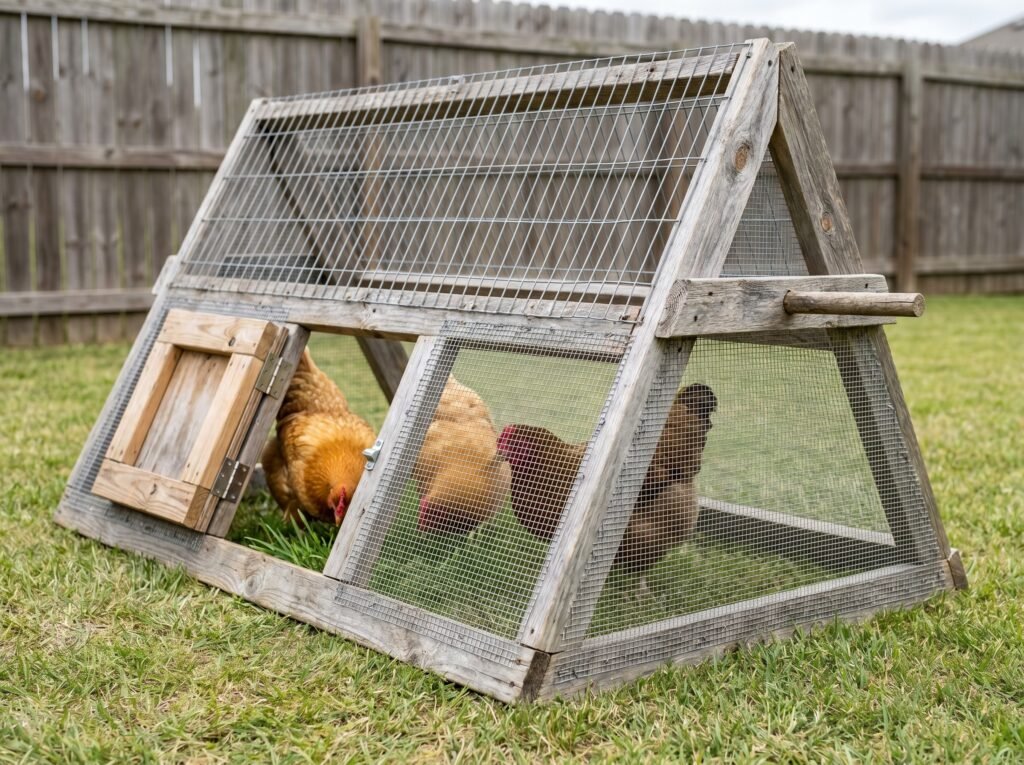
The right build depends on flock size, how often you want to move the structure, and how much predator pressure you are dealing with. Below is a comparison of the three formats the HenAcre team has watched work consistently.
| Build style | Typical footprint | Approx. bird capacity | Relative weight | Move method | Best for |
|---|---|---|---|---|---|
| Low Salatin-style cage | 10 ft x 12 ft x 2 ft tall | Up to 80 meat birds (at 1.5 sq ft/bird); ~15 standard laying hens (at 8 sq ft/bird) | Heavy - lumber frame | Skid rails, tow rope, or ATV | Meat-bird batches; large flocks on open pasture |
| A-frame tractor | 5.5 ft x 10 ft x 5.5 ft tall | ~36 meat birds; 5-6 standard hens (10 sq ft standard) | Medium - walk-in access | Handles at each end, two adults | Small backyard laying flocks; easy daily moves |
| Hoop / cattle-panel run | Variable; common 8 ft x 12 ft | ~35 birds (35-bird UMN hut design) | Light-medium if on wheels | Wheels or skids; one adult on flat ground | Yards with obstacles; keepers who move solo |
A few notes on that table. The "10 sq ft per hen outdoor" figure from Extension.org's poultry housing guide is the comfort standard for fixed runs, not a hard minimum inside a daily-move tractor. The Penn State 1.5 sq ft figure applies specifically to pastured meat birds moved on a tight schedule. For laying hens in a tractor that moves every 2-3 days rather than daily, sizing toward 4-6 sq ft per bird is a reasonable middle ground - enough room to reduce stress without making the structure too heavy to drag. Pick the number that fits your move frequency, not just the smallest you can get away with.
Salatin-style cage. A low, open-bottom cage built on skid rails is the classic commercial design. The 10-ft x 12-ft x 2-ft frame gives about 120 sq ft of total floor space. At 1.5 sq ft per bird it holds 80 meat birds, but a backyard laying flock using a more generous 8 sq ft each fits about 15 hens. The low profile means no roosting height - fine for daytime grazing moves, but birds need a proper coop to sleep in at night unless the tractor includes a raised shelter section. The lumber-heavy frame makes it genuinely heavy; most keepers use a tow rope tied to an ATV or truck hitch for daily moves over distance.
A-frame tractor. At 5.5 ft x 10 ft x 5.5 ft tall, this design is more backyard-friendly. The angled roof sheds rain, the walk-in height makes egg collection and bird checks practical, and handles at each end let two adults move it without equipment. Oregon State University Extension ran 25 birds per tractor, moving each unit down an orchard row every two to three days across a one-acre orchard, with four tractors running in parallel. That cadence - a few days on, then move - suits a layer flock well.
Hoop run. A cattle-panel or PVC arch over a lumber base creates a rounded tunnel run. University of Minnesota Extension's tested mobile hut design holds 35 birds and came in at under $375 to build. Wheels or skids on the base runners let one person push it across flat ground. The UMN design uses hardware cloth on the lower half and lighter wire on the upper section - the right call, since hardware cloth resists the teeth and claws of raccoons far better than standard chicken wire. If your yard has gates or garden beds to navigate around, this build's narrower profile is often easier to thread through tight spots. For more on floor material choices when you do add a base, the chicken run flooring guide walks through options from dirt to concrete to rubber mats.
The floorless run: real predator tradeoffs
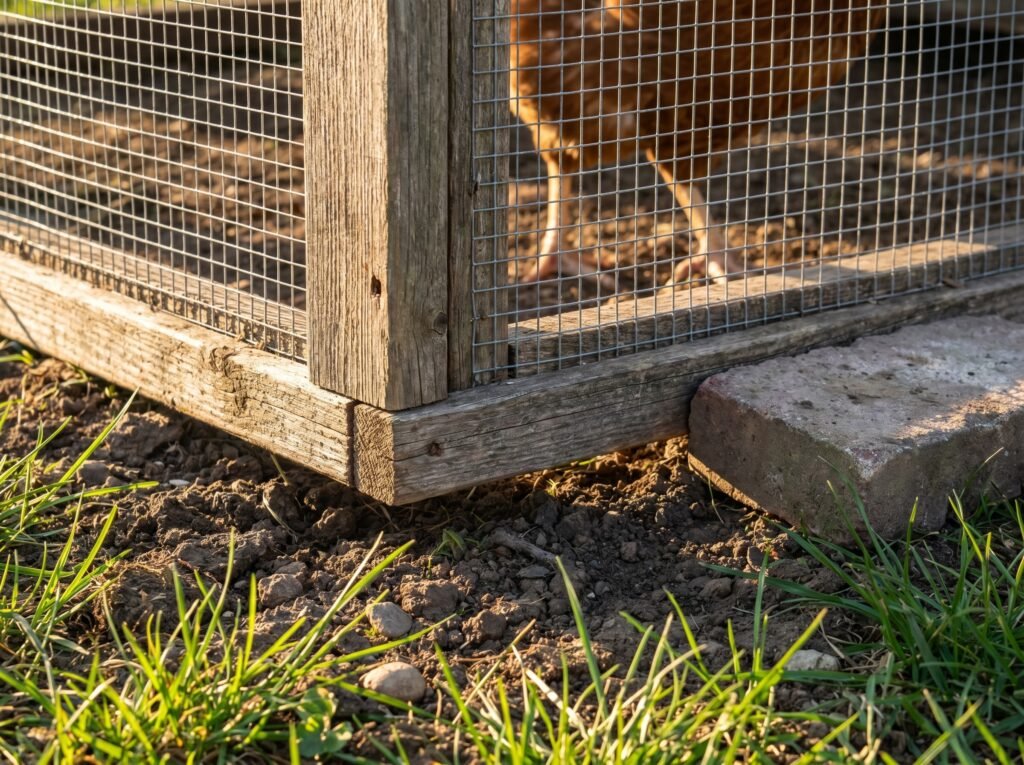
A floorless run is what makes rotation practical - there is no floor to remove, no ground to relay. Birds scratch real soil, eat real bugs, and the pen slides rather than lifts. But floorless means ground-level entry is always available to anything willing to dig. That tradeoff is worth being direct about.
Extension.org's poultry predator management guide is plain: "such enclosures may not be sufficient to protect the flock in some cases, and additional peripheral fencing may be needed." Raccoons dig. Foxes dig. Least weasels - the smallest of the weasel family - can squeeze through holes as small as 1/4 inch and will get into gaps where a tractor's edge doesn't sit flush with irregular ground. A tractor that rocks on a slope or has a gap at one corner becomes an entry point overnight.
Three layers of protection work together for a floorless run:
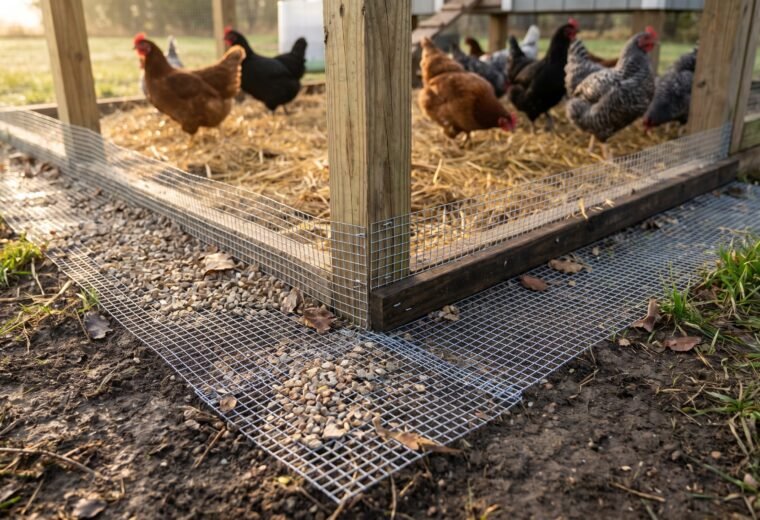
- Wire quality at the base. Use 1/2-inch hardware cloth for the lower 18-24 inches of all four sides. Standard chicken wire has gaps large enough for a raccoon to reach through and grab a bird. Hardware cloth costs more but stops that.
- Flush contact with the ground. A tractor that lifts on slopes or uneven terrain leaves gaps. Weighting the base edge with boards or bricks at each new location closes the gap quickly. Move birds back to a secure coop at night if the ground is uneven.
- Electric net perimeter for high-pressure yards. Penn State Extension recommends surrounding a tractor field with movable electric net fencing in areas with high predator density. Electric poultry netting runs 4 inches off the ground, positioned about 1 foot outward from the tractor's edge. This stops burrowing before it starts. An overview of all movable netting types lives in the electric poultry netting guide.
Hawks and owls are a separate problem for floorless runs without overhead netting. Both are federally protected under the Migratory Bird Treaty Act, so lethal control is not legal. Covering the run with 2-inch poultry mesh overhead, or weaving a 3-4 ft grid of wire or twine above the pen, blocks aerial approach. Orange netting is reportedly effective because raptors may see that wavelength well - some keepers report that a visually conspicuous barrier discourages approach rather than waiting for a strike.
For keepers who want a deeper look at what hunts chickens and when, the what kills chickens at night guide covers predator behavior by species.
How to time your pasture moves
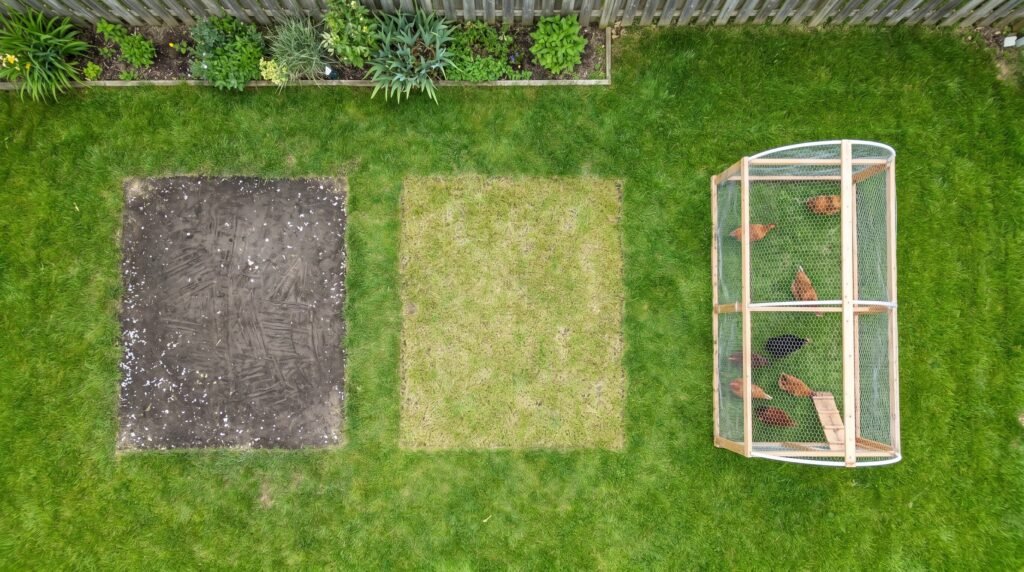
Timing is where most first-time portable-run keepers go wrong. Moving too infrequently turns the tractor into a small, smelly fixed run. Moving so often that the pen barely stops anywhere deprives birds of the foraging benefit. The table below gives practical decision triggers rather than fixed-day rules, because season and lawn conditions matter more than a number on a calendar.
| What you see on the ground | What it means | Action |
|---|---|---|
| Grass still 50%+ of original height; soil surface clean | Good coverage, acceptable manure load | Hold position another day or two |
| Grass flattened or grazed below ~2 inches; bare patches forming | Approaching overuse threshold | Move the run today |
| Visible manure mat; mud at any corner; smell noticeable | Overdue - pasture damage likely starting | Move immediately; rest this patch extra time |
| Previously rested patch has regrown to 4+ inches | Ready to reuse | Move run back if needed (spring: ~10-14 days; summer dry: wait 40-60 days) |
For a flock of 10 standard laying hens in a tractor that gives each bird 8 sq ft of total run space, the math works out to an 80 sq ft footprint. Moving that footprint to a fresh patch every 2-3 days and resting each patch for a minimum of 3 weeks (longer in summer heat) means you need at least four or five patches in a rough rotation to keep grass alive. A 50 x 50 ft yard can run that rotation comfortably by treating each quarter of the yard as a paddock. Smaller yards may need more frequent moves and longer rests, or a flock size reduction to stay inside a healthy grazing budget.
One thing worth knowing: the PSU broiler guide recommends moving fast-growing commercial meat birds up to twice daily during their final weeks, while the two-to-three-day cadence from the OSU orchard study suits layers well. Layer hens graze more steadily and with less concentrated impact than meat birds, so they are more forgiving of a slower move schedule - as long as you are watching the grass rather than watching the clock.
If you are weighing a movable run against just letting the birds out entirely, the free-range chickens guide lays out the pasture, predator, and garden tradeoffs of full free-range versus managed rotation.
A note on flock size and yard math
One of the most common mistakes is sizing the tractor for the number of birds on the wishlist rather than the yard available. A movable run only works as a rotation system if there is enough total yard area to actually rotate. Here is a quick check: multiply your flock size by 80-100 sq ft to get the minimum total lawn area needed for a sustainable rotation through the warm season. A flock of four hens needs 320-400 sq ft of lawn in the rotation - roughly a 20 x 20 ft section - to keep grass ahead of the birds. Eight hens need 640-800 sq ft minimum.
If your yard falls short of that, a smaller flock makes the system work, or you accept that some patches will need extra rest and reseeding in fall. Penn State Extension's rotational grazing principle is clear on this: the number of paddocks needs to match the combination of grazing days and rest days required, or the math breaks down and the pasture degrades regardless of how good the tractor is.
For keepers whose yard is simply too small for rotation and free-range is also off the table, a solid fixed run with deep-litter management and occasional access to a scratch area is often the more honest choice than a movable run used too infrequently to matter. That fixed-run design and sizing question is covered in the main chicken run guide.