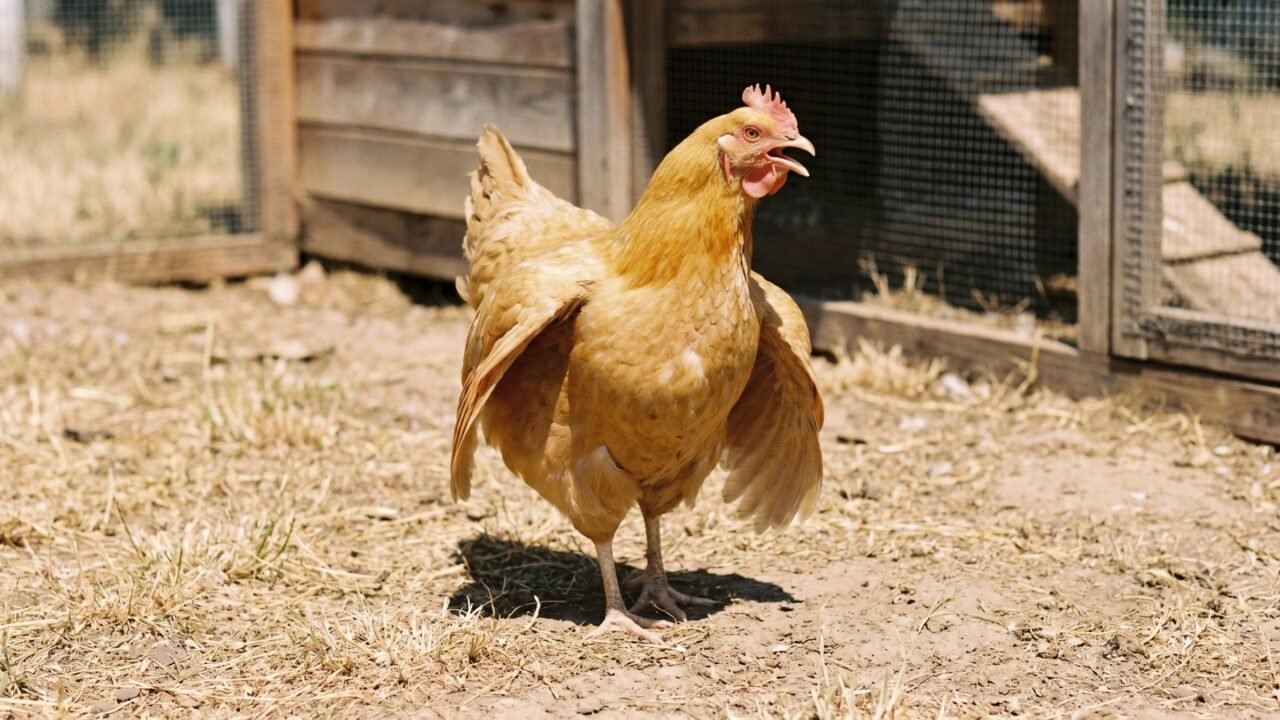
Panting with an open beak and wings held out from the sides of the body: that is a chicken trying to shed heat. On a muggy afternoon above 85°F, the question changes from "is my bird hot?" to "how close is she to the edge?" Backyard flocks can go from visibly uncomfortable to in serious danger faster than most keepers expect, and the window between moderate distress and a dead bird can be less than an hour.
Knowing the progression helps you act at the right moment. Penn State Extension notes that heat stress in poultry "typically begins when the ambient temperature climbs above 80 degrees Fahrenheit and becomes very apparent at temperatures around 85 degrees Fahrenheit." What you see at 82°F on a dry day looks very different from 88°F at 70% humidity, so temperature alone tells only half the story.
What heat stress actually looks like: reading the progression
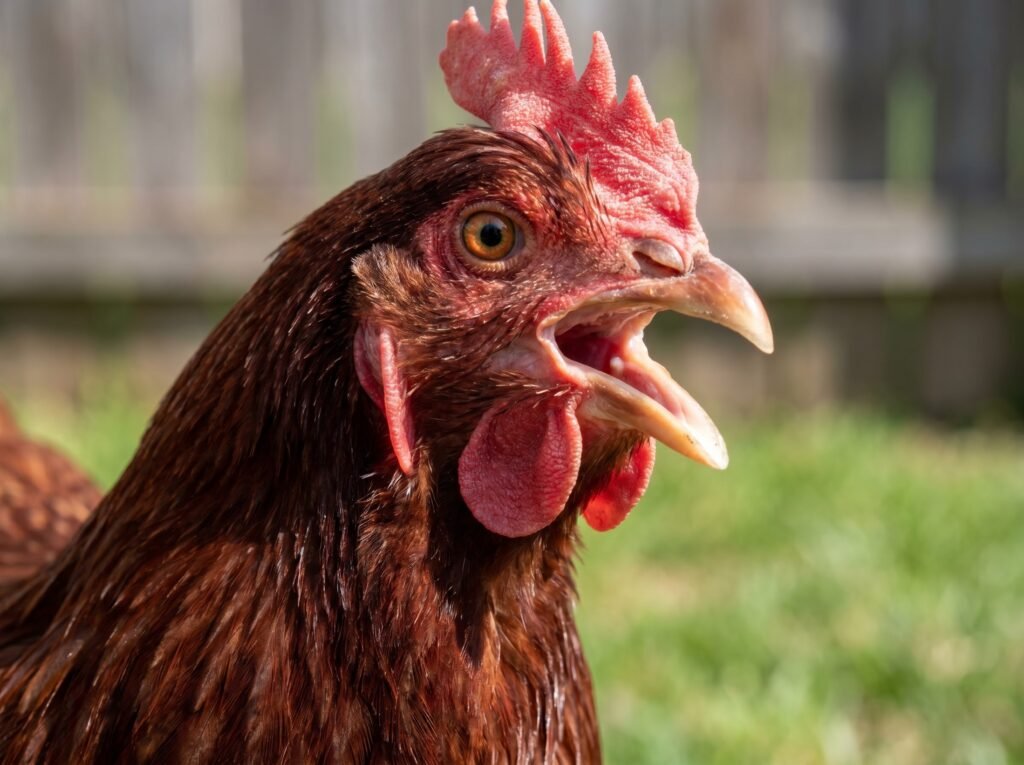
Chickens cool themselves almost entirely through panting and by routing blood flow toward unfeathered skin (wattles, shanks, and the bare patches under their wings). They cannot sweat. That constraint means the symptoms of heat overload appear in a clear, predictable order.
The three-stage breakdown below draws on guidance from University of Minnesota Extension and the poultry extension team at Extension.org. Note that stage three is a genuine emergency.
| Stage | Approximate ambient temp | What you see | Urgency |
|---|---|---|---|
| Mild | 80-85°F | Light panting with mouth slightly open; otherwise acting normally; may drink more than usual | Provide more shade and fresh cool water immediately |
| Moderate | 85-95°F | Heavier panting; wings held away from body; squatting low; feed intake drops; fewer trips to the feeder | Urgent: cool the environment; check all birds for worse signs (above 90F: check heavier and darker birds immediately) |
| Severe (emergency) | 95°F+ or any temp with high humidity | Rapid open-mouth breathing; wings drooped and extended; pale or blueish wattles and comb; lethargy; staggering; collapse or unconsciousness | Act within minutes: treat each affected bird individually; see emergency steps below |
Penn State Extension puts the risk curve plainly: at 90-95°F, heat exhaustion becomes a real danger for layers and heavier birds; above 100°F, "survival is a concern." Humidity matters as much as the thermometer. When humidity climbs, panting becomes less effective because water evaporates more slowly from the respiratory tract. A 90°F day at 80% relative humidity is more dangerous than a 95°F day in dry air.
One behavioral clue that keepers often miss: lethargy itself. Research published in Frontiers in Physiology found that "chickens kept at high temperatures become lethargic, spending more time resting (e.g., squatting close to the ground) and less time feeding and walking." A bird that simply sits still in a corner on a hot day, even without dramatic panting, deserves a second look.
Which birds are most at risk
Not every bird in a mixed flock suffers equally. Several traits compound heat sensitivity, and knowing them helps you monitor the right individuals first.
- Large and heavy breeds. More body mass means more heat to shed; Brahmas, Jersey Giants, and similar birds struggle before a small-framed hen does.
- Dark-feathered birds. Black and dark-brown plumage absorbs more solar radiation in direct sun.
- Birds with small, dense combs (pea or rose). The comb is a heat-radiating surface; a small one limits passive cooling.
- Older birds. Reduced cardiovascular efficiency makes thermoregulation harder.
- Feather-footed breeds. Thick foot feathering reduces heat loss through the shanks.
- Actively laying hens. Egg production is metabolically expensive; the extra heat load from laying stacks on top of ambient temperature.
Ask Extension's poultry specialists specifically call out "larger birds, older birds, dark colored birds, and birds with pea combs" as the groups needing closest attention during a heat event. If your flock includes a mix of these, check those individuals first when temperatures climb.
For a list of breeds that handle summer naturally better than others, our guide to heat-tolerant chicken breeds covers body type, comb size, and track records in warm climates.
Why panting backfires at the extremes
Panting is the only active cooling tool a chicken has, but the mechanism breaks down under sustained heat. Increased respiratory rate expels carbon dioxide faster than the blood can replenish it. The result is respiratory alkalosis: blood pH climbs as CO2 levels fall (UF/IFAS Extension, VM019). In laying hens, this matters beyond comfort. Alkalosis reduces blood ionized calcium, which directly weakens eggshell formation. A flock under sustained heat stress often shows soft or thin-shelled eggs days before any keeper notices a bird in visible distress.
Panting also burns muscle energy, which generates more body heat. So the harder a bird pants to cool off, the more internal heat it creates. It is a feedback loop that explains how quickly a moderate situation turns critical. On top of that, every exhaled breath carries water. University of Minnesota Extension documents that during heat stress, birds "increase their water intake by 2 to 4 times the normal amount" and that water loss is driven by the cooling attempt itself, not optional.
Heat stress also strips potassium and other electrolytes from the body, as UF/IFAS Extension explains: "Heat stress depletes potassium and other minerals in the body, altering the delicate electrolyte balance." This is why plain water alone is sometimes not enough to recover a badly stressed bird.
Cooling a stressed bird: what to do and in what order
For a bird showing moderate signs (heavy panting, wings out, reduced movement), move her to the coolest spot available. A shaded corner of the run, a garage, or an air-conditioned room all work. Offer fresh cool water immediately. Do not force her to drink.
For a bird showing severe signs (pale comb, collapse, or unconsciousness), move to the emergency steps without delay:
- Remove her from heat immediately. Carry her indoors or to deep shade.
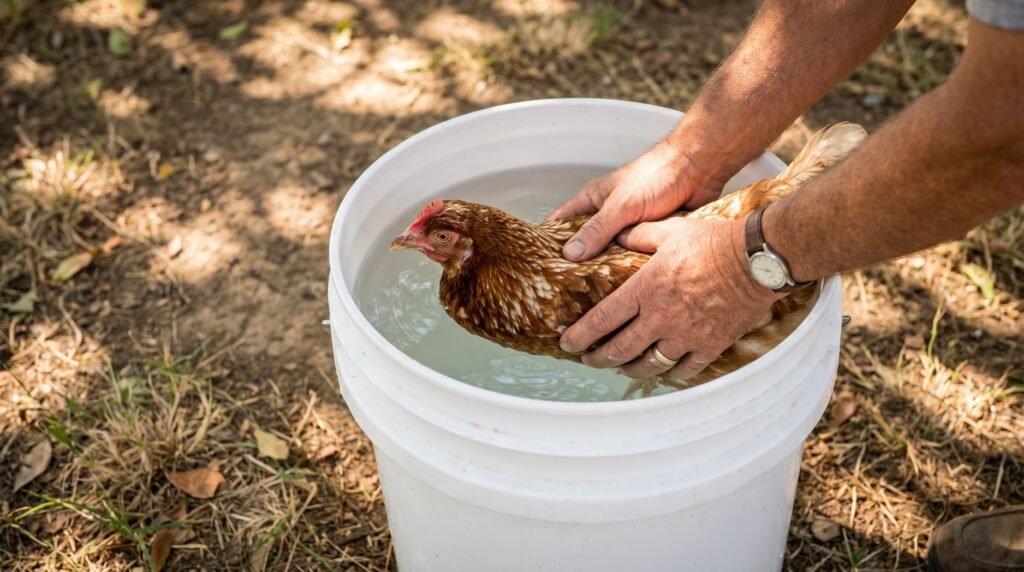
- Submerge her body in cool water. Extension.org's guidance is specific: "Submerge her body up to her neck (not her head) in a bucket of cool (not icy) water." Icy water can cause vascular shock; cool tap water is the target. Hold her there, supporting her body, until her breathing visibly slows.
- Towel-dry her gently and move her to a calm, dimly lit, cool area. Do not put her back outside.
- Offer cool water with electrolytes once she is alert enough to drink on her own. Do not try to make an unconscious bird swallow anything.
- Watch her closely for several hours. A bird that collapses from heat is not fully recovered just because she stands up again.
On electrolyte timing: Extension.org recommends offering the electrolyte-spiked water "for only a few hours, then remove it and replace with fresh, plain water." Sustained electrolyte supplementation beyond a few days is not advised without veterinary guidance. Extension guidance supports a commercial poultry electrolyte mix added to the drinking water at the label rate during a heat event, with short-term electrolyte support typically limited to a few days. Commercial poultry electrolyte packets at label rates follow this principle.
If a bird does not regain consciousness, continues to have labored breathing despite cooling, or deteriorates after you bring her indoors, contact a poultry-experienced vet. Heat-related organ damage is possible in severe cases, and that requires a professional assessment beyond what home cooling can address.
For everything about keeping the whole flock comfortable through a summer, our summer cooling guide covers ventilation, run shade, misting, and daily routines in detail.
Preventing heat stress before it starts
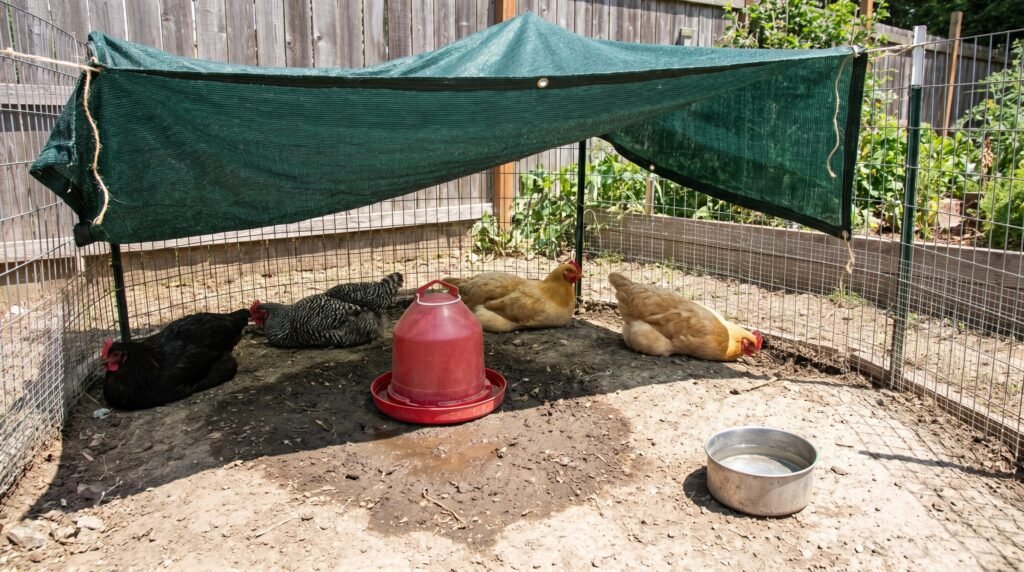
Most heat deaths in backyard flocks are preventable. Shade, airflow, and cold water cover the majority of situations. The details, however, matter a great deal.
Water: quantity, placement, and temperature
Because water intake spikes so sharply during heat stress, the waterer you rely on in March may be nowhere near adequate in July. A flock of 15 birds could drain a standard three-gallon waterer in a few hours on a hot day. Multiple water stations placed in shade (not in the sun where water warms quickly) give birds constant access without competition. Ice added to waterers extends the cool window. Our waterer guide includes options that maintain cooler temperatures longer than standard plastic drinkers.
Ventilation over everything else
A closed, poorly ventilated coop can reach temperatures 10-20°F above the outside air on a hot afternoon. Cross-ventilation matters far more than insulation in summer: openings on opposite walls let a breeze move through at bird level. Hardware-cloth panels that open wide are more useful than small vents. If natural airflow is limited, a box fan pointed through a large opening (not blowing hot exhaust into the coop) moves air effectively without the fire risk of a heat lamp.
Shade in the run
Direct sun on bare dirt or gravel in a run turns the floor into a radiant heat source. Shade cloth rated for 70-80% UV block stretched over at least half the run gives birds a place to rest on cooler ground. Dense vegetation around (not inside) the run also helps, since grass and leaves absorb less solar radiation than packed dirt or gravel.
Adjust the feeding window
Digesting feed generates body heat, and the peak of that metabolic load arrives several hours after the meal. University of Minnesota Extension suggests withdrawing feed roughly six hours before the expected hottest part of the afternoon to reduce the heat load when ambient temperatures are already climbing. Offer feed again in the evening when it cools down, which is also when laying hens are more likely to eat enough to maintain production.
The humidity factor
Keep an inexpensive indoor-outdoor thermometer with a humidity display near the coop during summer. When the temperature-humidity combination puts you in the 90°F / 60%+ humidity range, treat it as equivalent to a higher dry-air temperature. Many keepers only track the thermometer and are caught off guard on a "merely" hot day with high moisture in the air.