Most laying slumps come down to one of six things: molt, too few daylight hours, age, stress, a nutrition gap, or a hen that has gone broody. Pinpointing which one is happening is usually straightforward once you know what to look for, and the fixes are solid management steps, not guesswork. If your birds suddenly look rough and the nest boxes are empty, start with molt. If it is October and the coop seems fine, start with light. Read on and you will know exactly where to look.
One quick reality check: a hen's body is not a machine. Egg formation takes roughly 24 to 26 hours, so even a bird in peak condition skips a day now and then as her internal cycle drifts later each morning. That is normal physiology, not a problem. What concerns keepers is a sustained drop across the flock.
Molt: the most common reason, and the one that surprises new keepers most
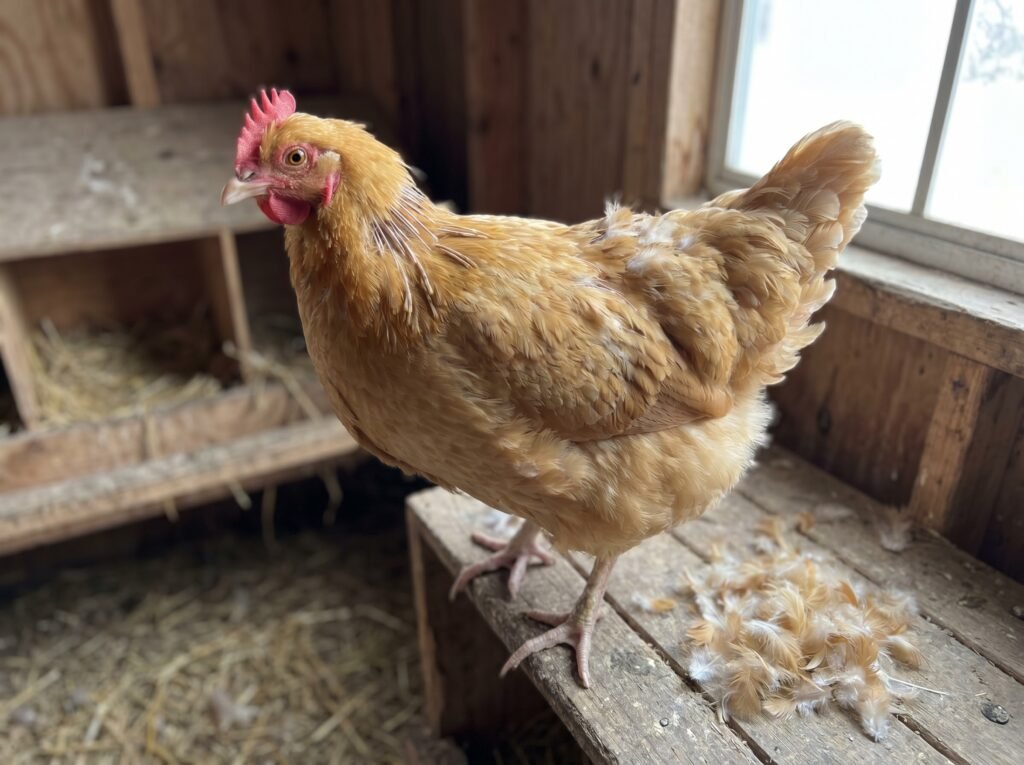
Molt is the most likely cause when a previously productive flock suddenly drops off and the birds look ragged. Hens stop laying while regrowing feathers - a process lasting two to three months in good layers and up to four to six months in slower ones. Feather loss typically starts at the head and neck, working down the body. First molt usually hits around 18 months of age.
Every hen molts annually. Feathers come out, new ones grow in, and laying stops while the body redirects energy toward rebuilding the plumage. Mississippi State University Extension explains that feathers fall out in a predictable sequence: head first, then neck, breast, body, wings, and tail. A bird partway through a molt can look alarmingly ragged, with bare patches and pin feathers poking through like quills. She is not sick. She is working.
The first full adult molt typically hits around 18 months of age, which catches new flock owners off guard because it arrives just as the birds are hitting their stride. The molt is triggered primarily by the shortening days of late summer and fall, not by cold temperatures - a fact Texas A&M Veterinary Medicine & Biomedical Sciences confirms. After the molt, production resumes, though it takes time. Mississippi State University Extension's research shows that better-laying hens tend to be late molters: they lay for 12-14 months before dropping feathers, lose them quickly, and return to production in roughly two to three months. Poorer producers often molt early and take four to six months to finish.
What helps during molt: switch to a higher-protein feed. Texas A&M recommends around 20% protein to support feather regrowth. Handle birds minimally while pin feathers are coming in, since those new shafts contain blood and bruise easily - extension literature widely recommends against handling during active pin-feather growth because contact with blood-filled shafts causes discomfort and slows the process. Once new feathers are fully in and days lengthen, laying restarts on its own.
For a detailed week-by-week look at what molt looks like from start to finish, the full sequence - including what each feather zone reveals about a hen's progress - is at /chicken-molting-guide.
Daylight hours: the control switch most keepers underestimate
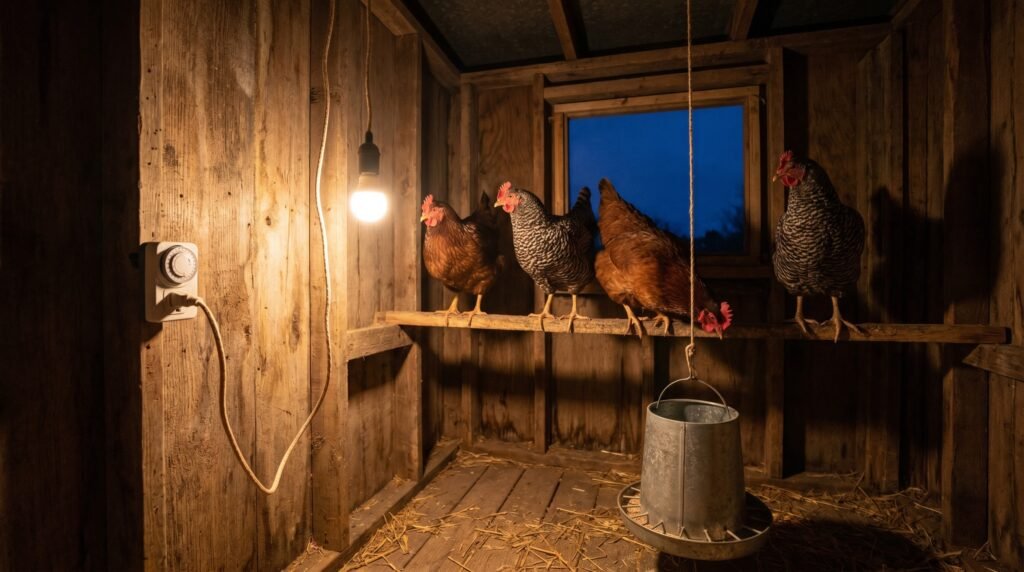
Light duration is the single most controllable factor in winter laying slumps. Hens need about 14 hours of daylight to maintain production and reach their peak at 16 hours. When natural days shorten below that range in fall and winter, output drops - often to near-zero without any other change in management. A timer-controlled LED added before sunrise reliably restores production in birds that have finished their molt.
A hen's reproductive cycle is regulated by light reaching the eye and stimulating the pituitary gland. University of Florida Extension is clear on the threshold: hens need about 14 hours of day length to maintain egg production, with maximum production happening at 16 hours. Poultry science literature generally identifies fewer than 12-14 hours as the range where production falls off sharply, which is why a flock that was laying beautifully through August can go nearly silent by November without any other change in management.
Supplemental lighting fixes this. Penn State Extension recommends aiming for 16 hours of light per day for mature layers. The practical setup: add light in the morning before sunrise using a timer, so the birds still roost naturally at dusk. Michigan State Extension advises keeping intensity just bright enough to read a newspaper at bird level - a single warm-white LED bulb in a small coop is sufficient. Penn State also cautions to shift the schedule slowly, increasing or decreasing by no more than one hour per week to avoid stressing the flock.
A few things to know before you flip the switch. Young pullets not yet at laying maturity should not be pushed into an accelerated light schedule, since stimulating early production before their bodies are physically ready can cause lasting reproductive issues; wait until they are approaching laying age naturally. Also, supplemental light works best on hens that have completed their molt; birds still growing feathers back will not respond the way you expect. Some keepers choose to skip supplemental light deliberately, accepting a winter rest as a natural reset. That is a legitimate choice. The debate about whether continuous year-round production shortens a hen's total laying lifespan is ongoing, and reasonable people fall on both sides.
Lighting setup, timer types, and which breeds respond best to supplemental light are covered in depth at /encouraging-winter-laying.
Age: what the numbers actually look like
Age-related decline is gradual, predictable, and irreversible. University of Florida Extension data shows production drops to about 65% of peak after the first 12 months of lay, then continues falling each successive year. There is no supplement or management fix that reverses this; the practical response is planning flock turnover - adding young pullets every couple of years to offset the decline in older birds.
Peak production happens in the first full laying year. University of Florida's data shows production drops to around 65% of peak after 12 months of lay. The level of egg production, egg size, and shell quality decrease each successive year, according to University of Wisconsin Extension. A hen that laid 280 eggs in year one might lay 230 in year two and 180 in year three. She is not broken; she is aging normally.
For a backyard flock of ten hens, this means a keeper who wants consistent production over time needs to plan for flock turnover - adding young pullets every couple of years to offset the natural decline in older birds. There is no husbandry fix that reverses age-related decline, only planning that accounts for it. A hen can live six to eight years, but most will have dropped to occasional laying by year four or five.
Shell defects - thin walls, wrinkled surfaces, soft or missing shells - often track directly with flock age and calcium intake. What each defect indicates, and when to pay attention, is covered at /chicken-eggs.
Stress: the silent production killer
Any sudden disruption - a predator visit, a flock move, a hot week without shade - can cut production within days. Heat is the most underestimated summer stressor: Penn State Extension documents that egg production drops sharply above 95-100°F, and chickens cannot sweat. Water deprivation compounds heat stress quickly and is one of the hardest disruptions for a flock to recover from. Remove the stressor, restore consistent water and feed, and give the flock time to settle.
Stress shuts down laying faster than most people realize. Virginia Tech Extension lists the common culprits: moving the flock, changes to the social group, predator visits, handling, parasites, and heat. Any sudden disruption can cause a drop within days.
Heat deserves its own mention because it catches summer keepers off guard. Penn State Extension notes that heat stress begins above about 80°F and becomes very apparent at 85°F. At 95-100°F, egg production and feed consumption drop sharply, according to Penn State's research on hot-weather poultry management. Chickens cannot sweat; they cool through panting and heat loss from wattles and shanks. High humidity compounds this by reducing evaporative cooling.
Water access is closely tied to heat stress and often gets missed as a standalone stressor. A hen denied water for even a few hours will slow production - Virginia Tech Extension notes effects appear "within several hours" of deprivation. Extended water cutoffs of 24-72 hours can cause suppression that lasts weeks to months, according to poultry extension literature, because the stress response disrupts the hormonal cycle governing ovulation. The severity depends on duration and ambient temperature, but recovery after serious dehydration is rarely quick. Check waterers daily - a frozen waterer in winter or a tipped waterer in summer is enough to tank output across the whole flock.
Predator pressure also stresses birds even when no kills occur. Hens that heard a fox prowling at night, or that watched a hawk circle overhead, may stop laying for several days. If your stress audit turns up nothing obvious inside the coop, look outside it.
Nutrition: the gaps that quietly erode production
Nutrition problems are almost always self-inflicted: too many treats diluting a balanced layer feed, or no oyster shell available to cover calcium demand. University of Florida Extension identifies methionine as the amino acid most often deficient in laying rations, and inadequate calcium directly causes production drops. If more than roughly 10% of the diet is coming from scratch, scraps, or other extras, cut back before looking elsewhere.
Layer feed is formulated to cover a laying hen's needs, but it only works if the hens are actually eating enough of it and not having their diet diluted by excessive treats. University of Florida Extension identifies methionine as the amino acid most often deficient in laying rations, and notes that inadequate calcium directly causes decreased egg production. Virginia Tech Extension recommends layer feed containing 16-18% protein with oyster shell offered free-choice on the side.
The practical version of this: if more than about 10% of the diet is coming from scratch, table scraps, or other treats, you are likely diluting the protein and calcium the hens need. A flock getting a big daily handful of scratch grain is essentially getting a less-complete meal. Cut back on supplemental treats before blaming the feed.
Calcium specifically matters for eggshell formation. Hens that cannot access enough will pull it from their own bones, which you may see as thin-shelled or soft-shelled eggs before production drops further. Free-choice oyster shell is cheap insurance. Our layer-feed guide covers the protein and calcium specs to look for on a feed label, and when switching brands might be worth trying.
Broodiness: one hen can fool you into thinking the whole flock stopped
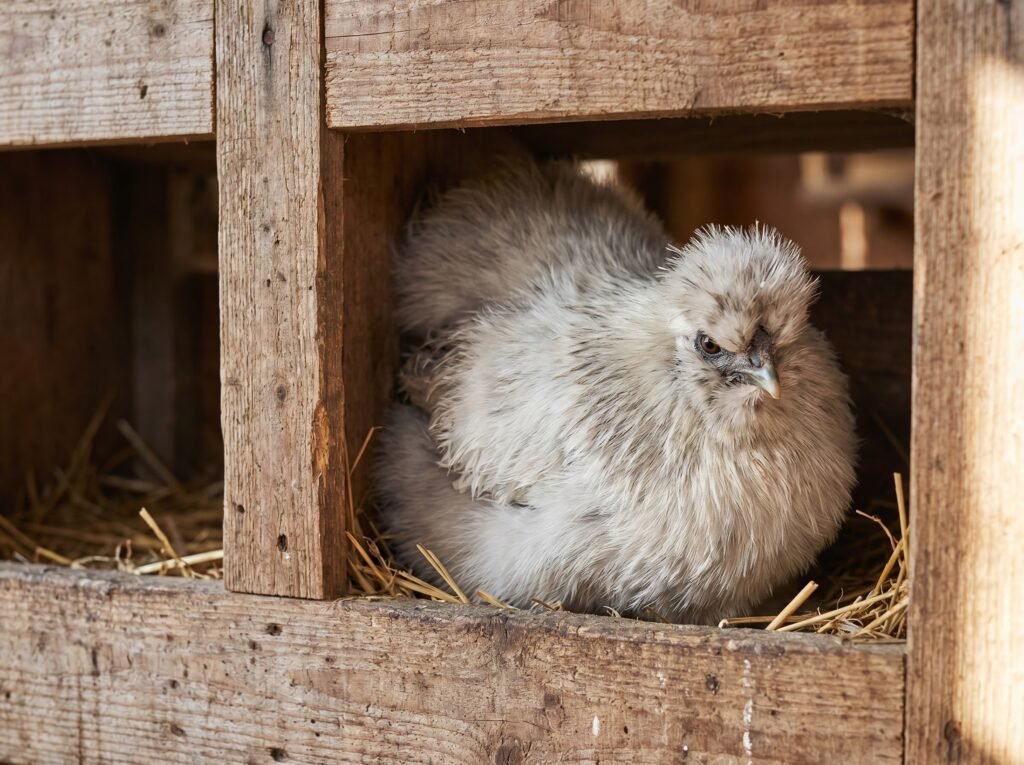
A broody hen stops laying entirely and sits on the nest full-time. In a small flock, one broody bird can account for a large share of the missing eggs. Virginia Tech Extension's remedy is simple: remove her from the nest consistently for several days, and the hormonal drive to brood fades. In breeds prone to broodiness - Silkies, Buff Orpingtons, heritage dual-purpose types - prompt egg collection helps prevent it from starting.
A broody hen stops laying entirely. She sits on the nest, fluffs up, and guards the eggs - or a bare nest - with fierce dedication. In a small flock of five or six birds, one broody hen going silent is a significant percentage of your expected daily count, and it is easy to conclude something is wrong with the whole group.
Virginia Tech Extension's guidance is simple: if a hen insists on sitting for extended periods, remove her from the nest for several days. After that time, the hormonal drive to brood fades and she returns to laying. A wire-bottomed "breaker" pen elevated off the ground speeds this process; the cool air circulation interrupts the hormonal feedback loop. Collect eggs often - leaving a clutch in the nest encourages more hens to go broody, especially in breeds already prone to it (Silkies, Buff Orpingtons, and many dual-purpose heritage breeds).
If you want a broody hen to hatch eggs rather than breaking the behavior, managing her safely through a hatch - including nest setup, feed, and chick introduction - is covered at /broody-hen-what-to-do.
Triage table: matching symptom to cause
Use this to narrow down what is happening in your flock before changing anything. Most situations fit one row clearly.
| What you observe | Most likely cause | First thing to do |
|---|---|---|
| Feathers all over the coop, birds look ragged | Molt | Switch to 20% protein feed; reduce handling |
| Production dropped in September-November, no feather loss | Short daylight hours | Add morning supplemental light to reach 14-16 h/day |
| Gradual year-over-year decline, older flock | Age | Plan pullet additions; no fix reverses normal aging |
| Sudden drop after a change (new birds, move, hot week, predator scare) | Stress | Identify and remove the stressor; confirm water access |
| Soft or missing shells plus lower count | Calcium / nutrition gap | Check treats ratio; add free-choice oyster shell |
| One hen glued to the nest, puffed up, pecking at you | Broodiness | Remove from nest consistently for several days |
| Drop with no obvious explanation, birds look unwell | Possible disease or parasites | Inspect for mites/lice; contact a poultry vet |
One note on disease: a production drop is often among the first signs that something is wrong health-wise, before other symptoms appear. If you have ruled out all six husbandry causes and birds are looking off, that is a conversation for a poultry vet, not a home remedy.
When the fix is not obvious: hidden causes to check
A few causes do not show up in the main categories but fool keepers regularly.
Free-ranging hens sometimes move their laying location. A quick scan of hedgerows, under the coop, and in any covered corner of the property can find a hidden clutch that explains the vanishing eggs with no apparent reason. This is especially common after a disruption that made hens uneasy about the nest boxes.
Egg eating by hens themselves is another one. It usually starts after a thin-shelled egg cracks in the nest box, and some birds learn quickly that eggs are edible. The only reliable indicator is catching it happening; evidence is absent because the eggs disappear entirely. Prevention is much easier than breaking the habit: keep shells strong with oyster shell, collect eggs frequently, and use roll-away nest boxes if the problem becomes established.
Finally, molt does not always look dramatic. A partial or "soft" molt - especially in hens entering their second or third year - can involve subtle feather changes that a keeper misses, while production quietly drops for six to eight weeks. If you cannot find another explanation and birds appear slightly rough around the neck or saddle area, gentle inspection of those feathering zones often reveals pin feathers growing in.