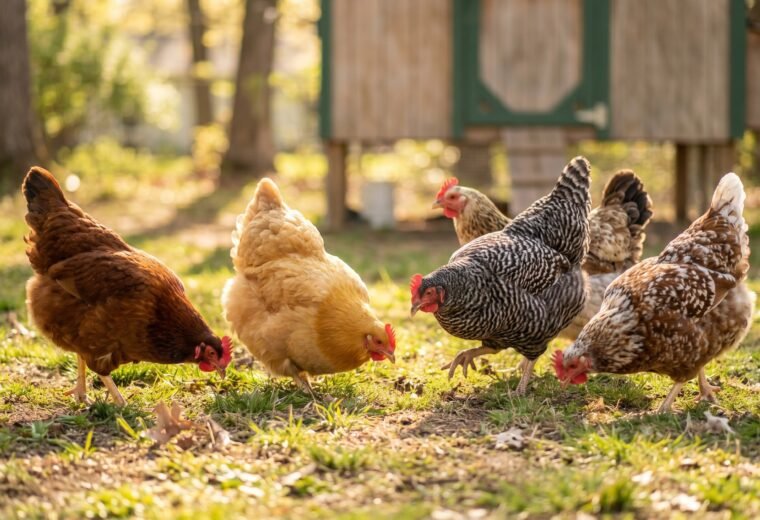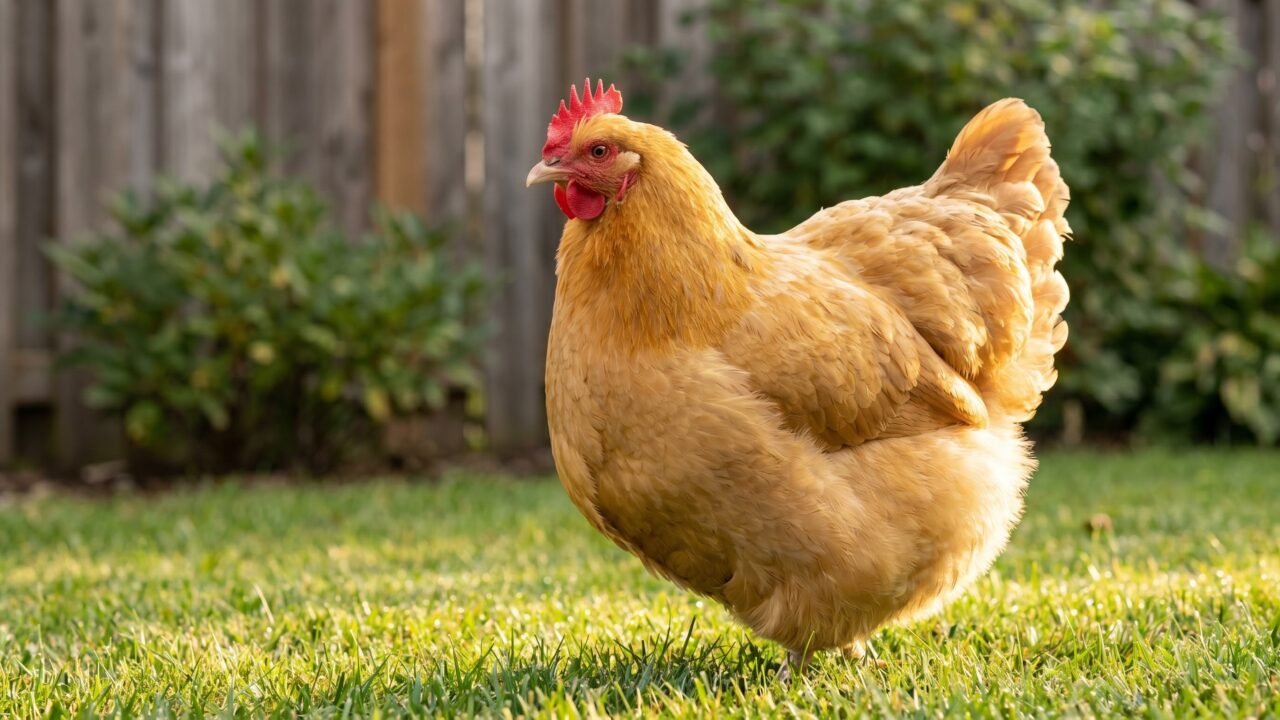
A three-year-old can walk straight up to a Buff Orpington and the hen will usually just stand there, or maybe follow the child back across the yard looking for a treat. That kind of temperament is genuinely rare in poultry, and it is the single biggest reason this breed has been a backyard staple since the Victorian era. Breed reviewers across the industry sum them up as "Docile, Calm, Gentle, Friendly" - and that description holds across decades of keeper experience.
That temperament comes bundled with some genuine limitations. Buff Orpingtons are large, heavily feathered birds that struggle in humid heat, go broody often enough to dent your egg count in spring, and can get pushed around in a flock that includes assertive production breeds. Getting the fit right before you buy makes a significant difference. This profile covers the numbers, the honest tradeoffs, and the care details that matter.
Origin and APA standing
The Orpington breed traces back to one man: William Cook, a breeder working out of the town of Orpington in Kent, England. In the mid-1880s Cook crossed Minorca roosters with Black Plymouth Rock hens, then mated the offspring to clean-legged Langshan chickens. His goal was a practical dual-purpose bird - good on the table, good in the egg basket, and capable of handling England's damp winters. The Black Orpington debuted publicly in 1886, and the breed reached American shores by 1891. The Buff variety caught on fastest among Midwestern farmers, who valued both its table qualities and its distinctive golden color.
The American Poultry Association admitted the Buff Orpington to the Standard of Perfection in 1902, placing it in the English Class. APA standard weights are: cock 10 lbs, hen 8 lbs, cockerel 8.5 lbs, and pullet 7 lbs (confirmed by hatchery breed data against the APA Standard). The breed carries a single medium comb, white skin, and produces brown eggs ranging from light to dark. Four color varieties are recognized by the APA - buff, black, blue, and white - though buff remains by far the most common in backyard flocks.
Worth noting: from the mid-20th century onward, the breed's production levels declined as selection shifted toward conformation and feather volume rather than laying performance - a documented pattern across many dual-purpose breeds that moved heavily into the show ring. The Livestock Conservancy had the Orpington on its watch list before numbers recovered; the breed "graduated from The Livestock Conservancy's endangered species list in 2016."
Eggs: what 200-250 per year actually means in practice
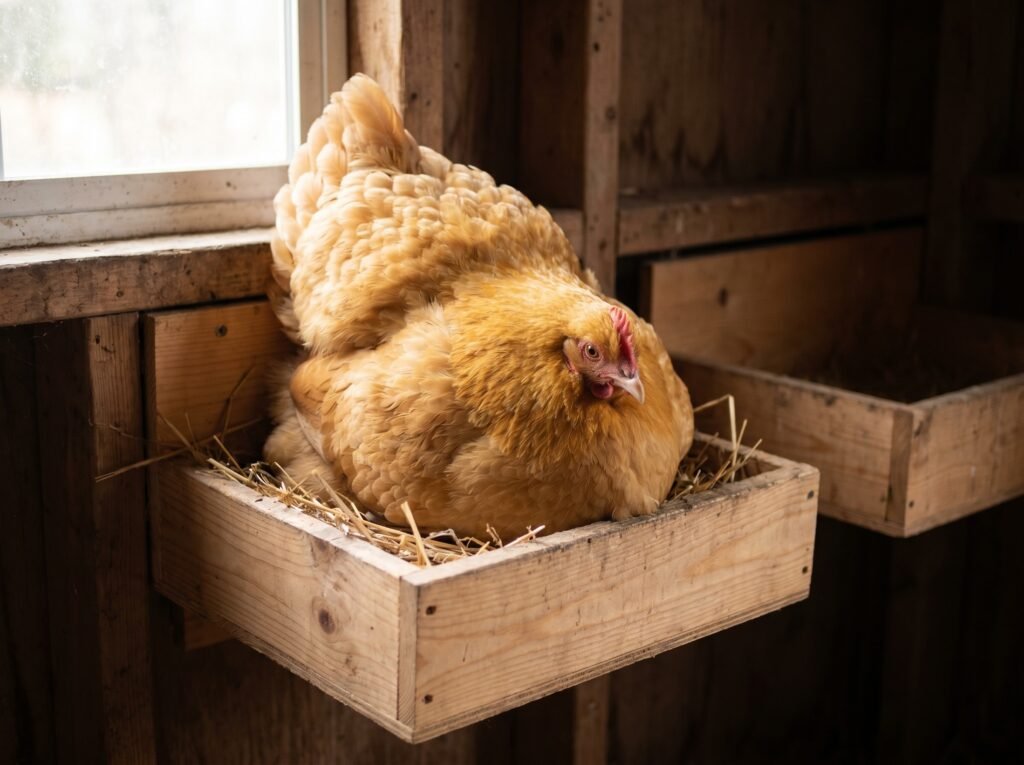
Buff Orpingtons are decent layers, not exceptional ones. Hatchery data puts peak-year production at 200-250 medium brown eggs annually. One major hatchery supplier records 220 medium brown eggs per year for their production strain - right in the middle of that band. Expect a full-season pullet to average roughly four eggs per week in her first laying year, easing to three or fewer per week by year three.
Two things compress that number reliably: broodiness and molting. Buff Orpingtons go broody often - APA breed data classifies them as "Setters" - and a hen sitting a clutch produces zero eggs for that entire three-week stretch plus a week or two of recovery afterward. In a warm spring-summer season you might see two or three broody episodes from an enthusiastic hen. The annual fall molt adds another six to ten weeks of reduced or zero production. Plan your egg math around perhaps 180-200 usable eggs per year from a typical hen once broodiness and molt are factored in, rather than the theoretical peak figure.
One genuine upside: Buff Orpington hens will sit and hatch eggs reliably, and they are attentive, protective mothers. If you want a breed that can naturally incubate and brood chicks without equipment, this is one of the best choices in the standard-size world. Some hatchery strains have had broodiness partially bred out for higher production - if reliable natural hatching matters to you, ask your source about their flock's actual brood rate before ordering.
Pullets typically start laying between 20 and 24 weeks. Signs to watch: the comb and wattles shift from pale pink to bright red, and the hen starts spending time inspecting nest boxes. First eggs are often smaller than the breed average; size normalizes within a few weeks.
Buff Orpington quick-reference
The table below consolidates the most-referenced breed specs. Figures are drawn from APA standards and verified hatchery breed data. The "judgment" column records where a tradeoff is worth weighing before you commit.
| Trait | Spec / range | Judgment / what it means in practice |
|---|---|---|
| Hen weight (APA) | 8 lbs | Large bird; needs slightly more coop floor space than a production layer |
| Cock weight (APA) | 10 lbs | Significant weight; roosters need sturdy roost bars at appropriate height |
| Egg production (peak year) | 200-250 medium brown eggs/year | Decent, not outstanding; broodiness and molt reduce real-world count |
| Egg color | Brown (light to dark) | Consistent, nothing exotic - straightforward to sell or give away |
| First lay age | 20-24 weeks | Later than production hybrids (~16-18 wk); factor into your planning timeline |
| Broodiness | Often (APA: "Setter") | Asset if you want natural hatching; liability if consistent eggs matter most |
| Temperament | Docile, calm, gentle, friendly | Excellent with children; can be bullied by assertive breeds in mixed flocks |
| Cold hardiness | Good | Dense feathering and large body help; single comb carries moderate frostbite risk, lower than large-combed breeds |
| Heat tolerance | Below average | Heavy feathering causes heat retention; needs management above 80°F |
| APA classification | English Class | Recognized in APA Standard of Perfection since 1902 |
| Comb type | Single, medium | Modest comb size reduces (but does not eliminate) frostbite exposure |
| Purpose | Dual-purpose | Good meat bird historically; most backyard keepers keep for eggs and companionship |
Temperament and flock fit
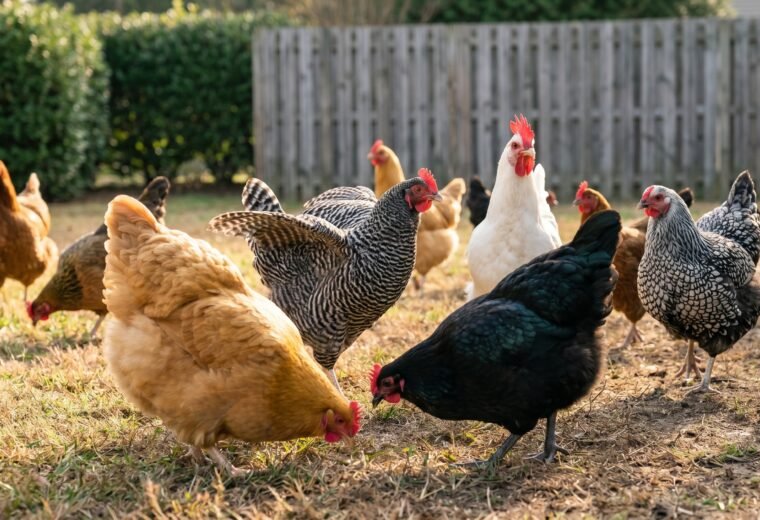
Buff Orpingtons are so consistently calm that new keepers sometimes take it for granted and then run into trouble when they add a Rhode Island Red or a production Leghorn to the same pen. The assertive bird eats first, gets the best roost spot, and the Buff Orpington simply moves aside. Over time that means a bird that looks healthy but is consistently getting less feed and fewer good sleeping positions. Keep Buff Orpingtons with similarly easygoing companions: Australorps, Cochins, Brahmas, Speckled Sussex, or other Orpington varieties. You will get a calmer flock overall and fewer subordinate birds.
With children they are genuinely excellent. Their size and weight make them stable when handled, they rarely peck defensively, and they move slowly enough that a toddler can approach without startling them. Basic chicken hygiene still applies regardless of temperament - wash hands before and after handling birds, and supervise young children around any flock. But in terms of choosing a breed where an eight-year-old can learn to catch, hold, and carry a bird without drama, Buff Orpingtons are among the best.
Roosters of the breed are generally calmer than roosters of production or game-adjacent breeds, but individual rooster temperament varies regardless of breed. Any rooster can become territorial around a perceived threat to his flock, so treat individual rooster disposition as something to watch rather than assume. The breed tendency toward docility is genuine; it does not override individual personality entirely.
Cold hardiness and heat tolerance
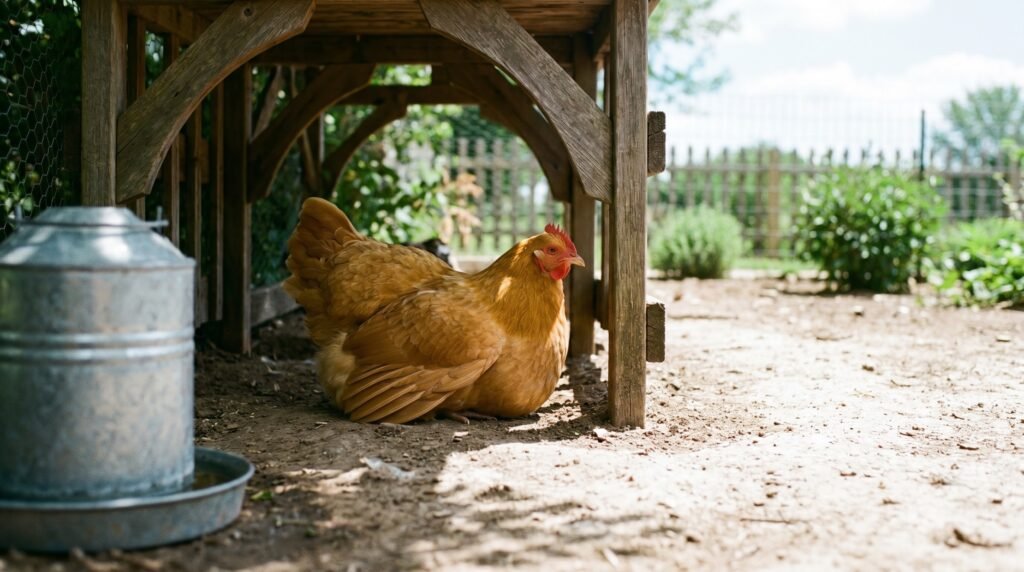
The fluffy, thick plumage that makes a Buff Orpington visually distinctive is genuinely effective insulation. Hatchery marketing typically rates them "Cold and Heat Hardy," but the heat side of that rating deserves closer reading. The dense feather coat that traps warmth in winter traps body heat in summer just as efficiently, making Buff Orpingtons more vulnerable to heat stress than a leaner Mediterranean breed would be.
University of Minnesota Extension research puts the thermoneutral zone for poultry at 60-75°F. At around 85°F, birds start reducing feed intake and showing early stress behaviors. NC State Extension data is more specific: "heat stress can occur in your poultry and small ruminants in temperatures as low as 78-80°F, depending on the humidity levels." For Buff Orpingtons, with their extra feather insulation, the practical caution threshold is closer to the lower end of that range, especially when humidity is high.
Signs to watch during warm weather: open-mouth panting, wings held away from the body, reduced activity, and drinking two to four times the usual water volume. If a hen is sitting still and panting heavily with a pale, washed-out comb, she needs immediate intervention - move her to a cool spot and offer cool (not icy) water.
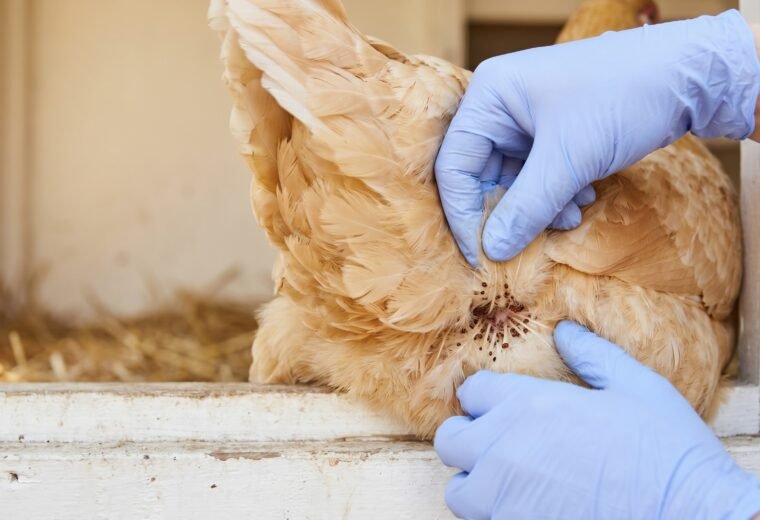
For summer management in most US climates, three things matter most. First, shade positioned where it covers the run from midday through afternoon - the hottest part of the day. Second, cool water in multiple locations refreshed frequently; add ice on extreme days. Third, airflow through the coop: open vents, crack doors, and if temperatures are severe, a fan pointed across the floor of the coop. Heavy-feathered breeds also need their coop inspected more carefully for mites and lice during warm months - the dense plumage hides infestations until they are well advanced. Part the feathers near the vent and at the base of the tail during monthly checks; dark crusting at the skin and tiny moving specks are the signals to act on. The chicken mites guide walks through identification and treatment step by step.
For winter, the same feathering that creates summer management work pays off. Their large bodies retain heat well, and most keepers in cold-climate states find their Buff Orpingtons handle outdoor temperatures fine as long as the coop stays dry and has adequate ventilation. Ventilation beats heat in a chicken coop - moisture from respiration is the real winter problem, not ambient cold. A coop that is sealed against drafts but lacks airflow will develop damp bedding and respiratory issues far faster than one that breathes. The heat-in-winter article examines this ventilation-versus-warmth tradeoff in detail.
Housing and daily care
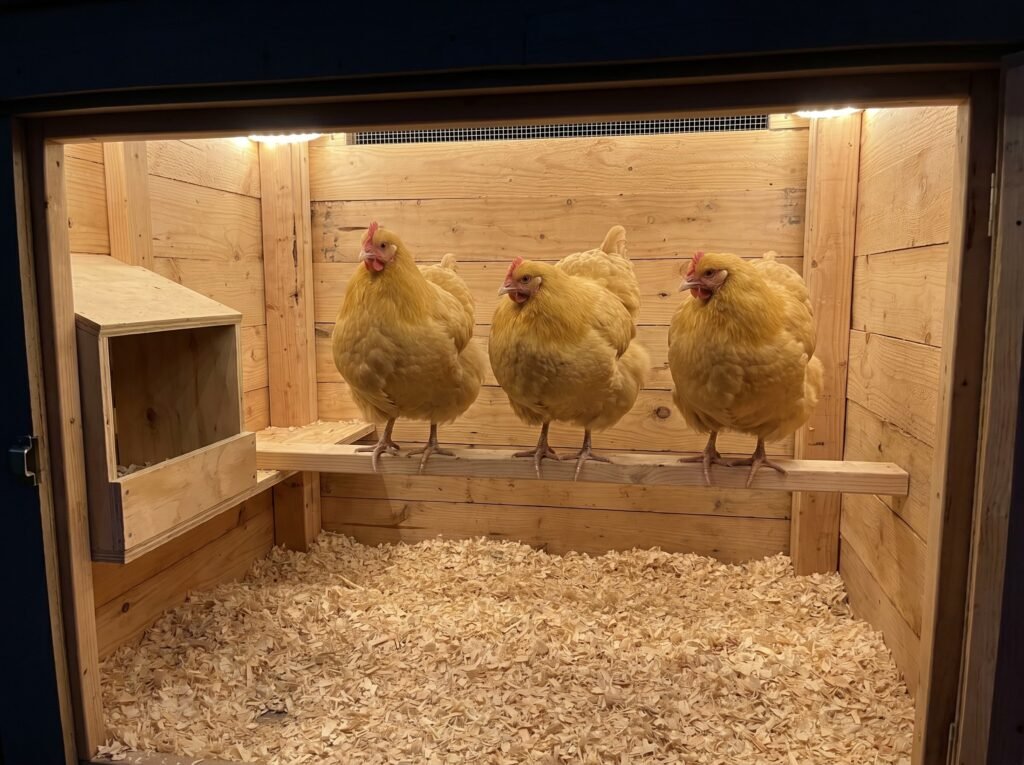
Buff Orpingtons are large birds, and their housing needs reflect that. Standard guidance for most chickens runs about three to four square feet of indoor coop floor per bird - for a big, heavily feathered Orpington, erring toward the upper end of that range prevents crowding stress and reduces litter moisture issues in the area immediately around the bird at night. Eight to 10 square feet per bird in the outdoor run is the standard target. If your flock is primarily Buff Orpingtons and similarly large breeds, sizing up from those minimums is a sound investment.
Roost bars for large, heavy birds need to be wide and low. A flat 2x4 laid wide-side-up is the standard recommendation for heavy breeds because it lets the bird sit flat and cover its feet with breast feathers - important in winter and comfortable year-round. Roost height between 18 and 24 inches off the ground works well for Buff Orpingtons; anything higher than 30 inches increases the risk of keel injury from heavy birds dropping down. Each bird needs about 10 inches of linear roost space, and roost bars should sit higher than nest boxes to prevent birds from sleeping in the nest and fouling the eggs.
Nest boxes at roughly one per three to four hens, sized around 12x12 inches, handle this breed well. Buff Orpingtons do not need anything oversized despite their bulk - a standard nest box fits them fine. Keep bedding dry and clean; damp nest boxes are the single fastest path to soft-shelled or soiled eggs and to bacterial foot problems like bumblefoot, which heavy birds are more susceptible to than light ones.
Feed a quality layer ration (about 16% protein with roughly 3.5-4.5% calcium) starting at first egg or around 18 weeks, whichever comes first. Offer oyster shell free-choice on the side rather than relying solely on what is in the layer ration - Buff Orpington hens are large and benefit from reliable calcium access, especially during peak laying. Grit is needed if the birds are not free-ranging on natural ground. Treats are fine in moderation but should stay under about 10% of the daily diet - scratch grains, fruit scraps, and vegetables are the usual choices. Foods to avoid entirely include avocado, raw or dried beans, onion in quantity, chocolate, and anything moldy. The complete feed guide has the full safe-and-unsafe list.
Buff Orpingtons are adaptable to both confined runs and supervised free-ranging, though they are not strong foragers compared to active breeds like Leghorns or Easter Eggers. They tend to stay near the coop and explore methodically rather than ranging widely, which makes them easier to contain but also means the area directly around the coop sees heavier traffic and faster bare-earth development. If you range them, rotate access to give ground a chance to recover.
Who the Buff Orpington is actually right for
The breed fits a specific profile well: a family flock where temperament and ease of handling matter more than maximum egg output, where winters are cold enough that cold-hardiness earns its keep, and where the keeper wants the option of natural brooding without equipment. Families with children in the eight-and-under range consistently find Buff Orpingtons the easiest breed to introduce poultry keeping with. If you are sorting through your options, our guide to the best breeds for beginners places Buff Orpingtons alongside four other reliable starter choices, with comparative egg numbers across all five.
The breed is less ideal if consistent year-round egg production is the primary goal, if your summer regularly pushes above 90°F with high humidity and you cannot provide reliable shade and water management, or if you plan a mixed flock that includes assertive breeds. Production hybrids like Golden Comets will out-lay a Buff Orpington by 60 to 80 eggs per year without the broody interruptions. That is a meaningful gap if eggs are the point.
For a broader look at how the Buff Orpington compares to the full range of breed options across egg color, size, and temperament, the HenAcre breed directory covers more than 30 breeds with consistent spec data for side-by-side comparison.