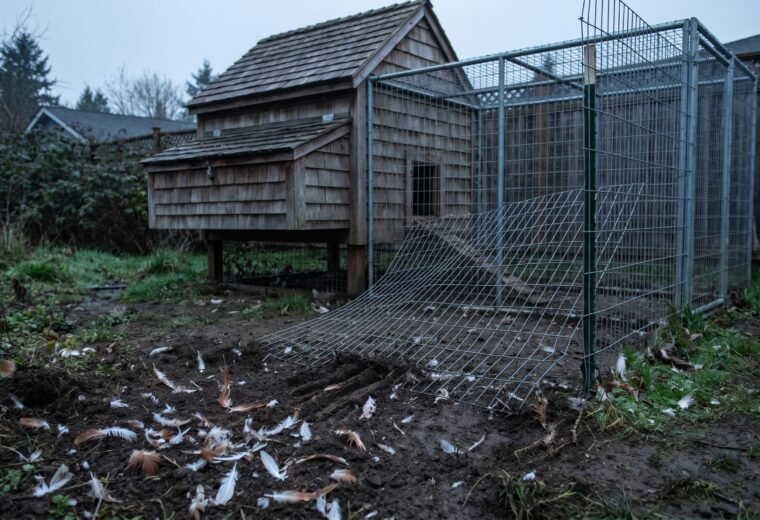
Most flock losses happen at night, and most happen because of one weak point - a single flimsy latch, one gap nobody measured, or a pop door left open past dusk. Securing a chicken coop against predators is not about buying an expensive product. It is about layering several simple defenses so that no single failure costs you birds. This guide covers the five layers that matter: the right wire for every opening, the gaps that look minor but are not, latches that raccoons cannot work open, a floor or apron that stops diggers, and an automatic door that closes even on the nights you forget.
University of New Hampshire Extension sums up the priority plainly: keeping chickens indoors at night is the most important and effective way of protecting a free-range flock, because many predators are most active between dusk and dawn. Everything below is about making that nighttime enclosure genuinely secure.
For a broader look at which predators visit your region and how to identify which one caused a loss, see our guide to common chicken predators.
Why hardware cloth is the material that actually holds
Standard chicken wire is designed to keep chickens in, not to keep predators out. Its hexagonal openings can be two inches or wider, a raccoon paw fits through easily, and dogs or foxes can tear the lightweight twisted wire apart. The extension.org poultry consortium, representing land-grant universities across the country, is direct on the small-predator problem: least weasels can squeeze through holes as small as 1/4-inch in diameter, and consequently they typically can get through chicken wire.
The right material is galvanized hardware cloth with a 1/2-inch welded mesh opening. That 1/2-inch gap stops raccoon paws, weasels, snakes, and rats. It allows airflow through ventilation openings while excluding the animals most likely to reach through or slip in. For corrosion resistance, galvanized-after-weld (GAW) is worth the modest premium: the zinc is applied after the wires are welded, which seals the joints - the most vulnerable point on any mesh.
Cover every opening with hardware cloth: vents, windows, pop-hole frames, and any gap where wall panels meet the roof line. Use staples every four to six inches along the frame edge and back them with a thin wood batten screwed over the top, or use screws with metal washers directly through the cloth. A staple alone can pull out when a dog pushes against the wire. A staple backed by a lath strip cannot.
University of New Hampshire Extension also recommends making sure mesh openings are smaller than one inch to prevent predators from reaching through, and confirms that solid-sided coops are best because they prevent predators from reaching inside.
The detailed comparison between hardware cloth gauges, mesh sizes, and cost tradeoffs lives in our article on hardware cloth vs. chicken wire.
Finding every gap before a predator does
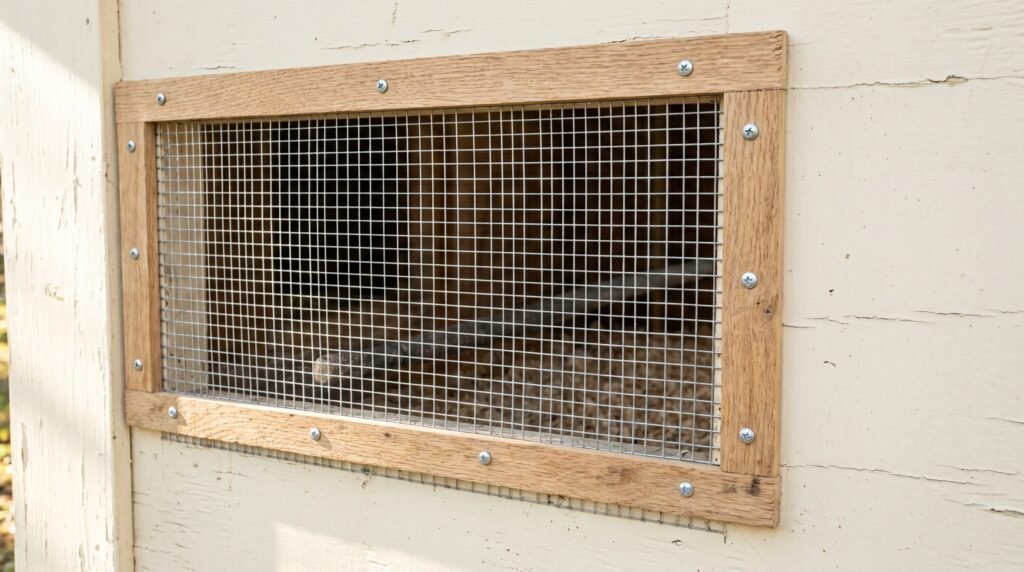
Hardware cloth on the windows does nothing if there is a half-inch crack behind the roost bar, a knothole in the siding, or a board that cupped over winter and left a gap along its edge. The gap audit is not glamorous work, but it consistently finds the entry point everyone missed.
Do it in daylight: close all doors and get inside the coop with a flashlight. Have someone outside shine sunlight along the walls. Every pinpoint of light is an opening worth sealing. Poultry Extension notes that snakes able to enter through gaps 1/4-inch in diameter or smaller do not generally cause predation damage - which means even gaps that look cosmetic can matter.
The spots most commonly missed, in order of frequency:
- The pop-hole door frame, where the door no longer seats flush after seasonal wood movement
- The triangle where the wall meets the roof overhang at each corner
- Gaps between the bottom wall board and the floor or foundation
- Ventilation openings with stapled wire that has worked loose at one edge
- The wall penetrations where a water nipple line or feeder cord passes through
- Any knot hole or split in a board that was not there last season
Seal gaps with hardware cloth, not expanding foam or caulk. Rats chew through both within days. Stuff any void larger than 1/4 inch with steel wool first, then cover with wire and secure with screws. A small square of hardware cloth and two screws costs about three minutes per gap; leaving the gap costs a bird.
Colorado State University Extension adds a practical structural note: keep the henhouse floor tight and patch any holes that snakes and rats can get through. That means inspecting the floor itself - where boards meet the wall base, where a screw pulled out and left a hole, and anywhere the floor material has worn thin near the doorway.
Raccoon-proof latches: what the flock is actually relying on at night
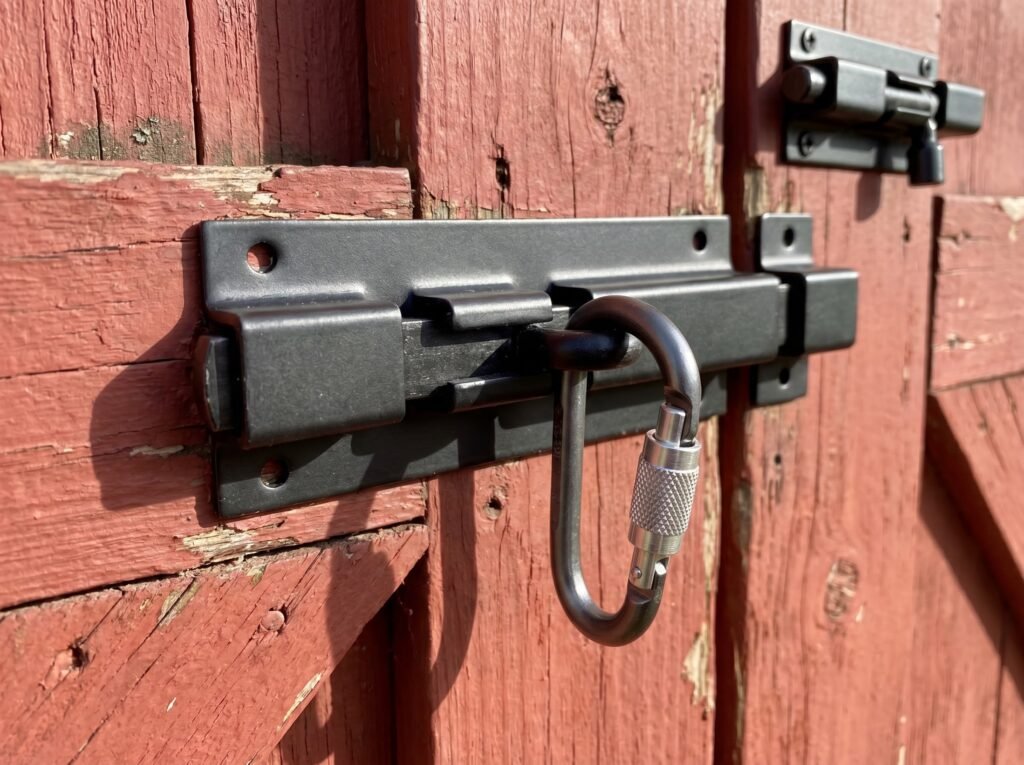
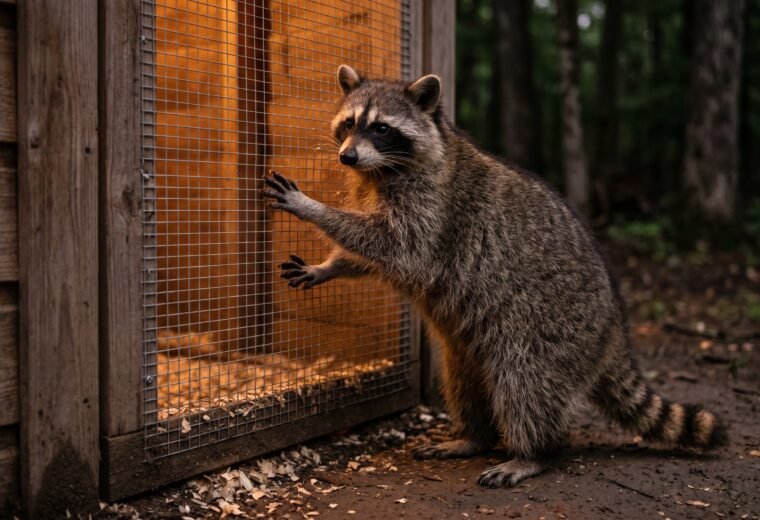
Raccoons are why simple latches fail. Research reported in The Conversation and drawing on neuroscience work found that raccoon forepaws are mapped onto the cerebral cortex in a similar manner as human hands - which helps explain the dexterity that makes single-action latches ineffective. A hook-and-eye, a simple spring bolt, or a standard barrel slide is a puzzle a raccoon may solve on the first night it tries.
Poultry Extension documents the resulting damage: raccoons enter poultry houses and take several birds in one night, and they sometimes pull a bird's head through the wires of an enclosure and eat only the head, with two raccoons occasionally working together - one scaring the birds while the other reaches through. The latch is the one mechanism standing between that behavior and your flock.
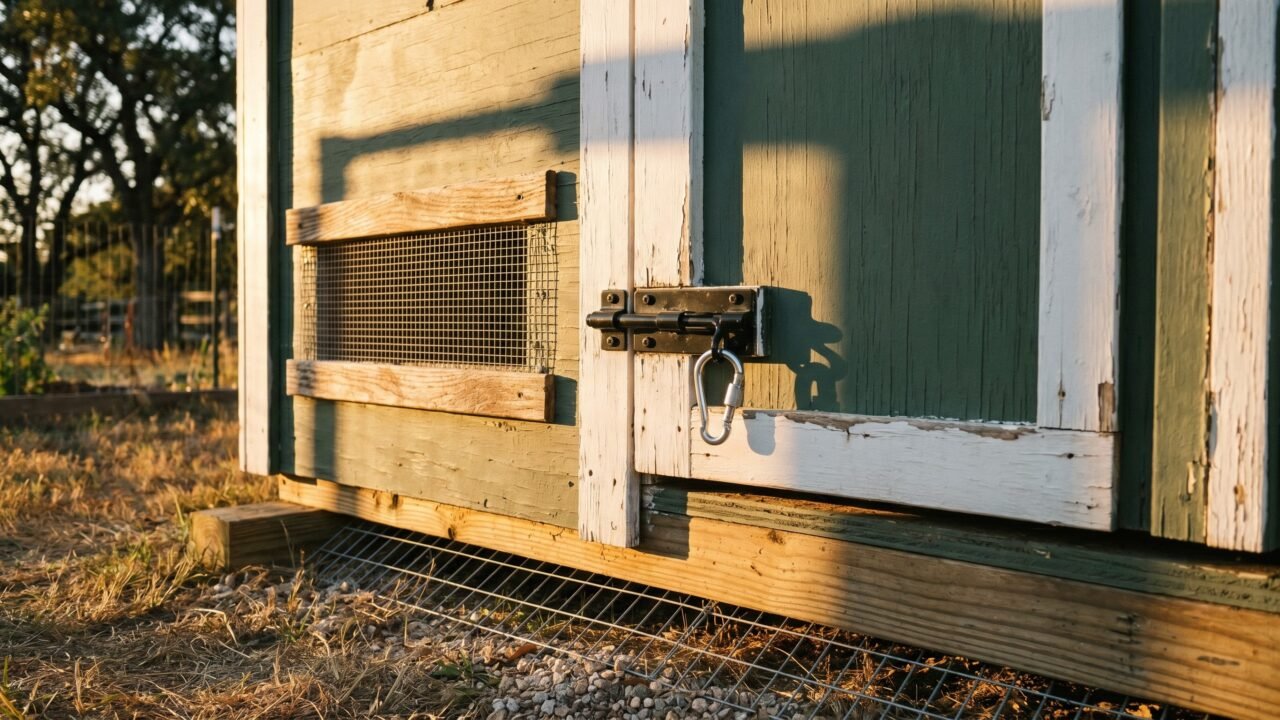
What holds reliably is a two-step system: two independent mechanical actions that must occur in sequence. A raccoon that can slide a bolt cannot simultaneously unclip a carabiner through the bolt eye. Options proven in extended field use:
- Sliding barrel bolt plus a locking carabiner clipped through the bolt eye. The bolt slides AND the carabiner must be opened before the door moves. Use a screw-collar carabiner (the kind that requires unscrewing before the gate opens) rather than a simple spring-gate clip, which persistent paws can work open.
- Two barrel bolts at different heights. A raccoon working the lower one cannot simultaneously reach the upper. Both must be slid before the door opens.
- Padlock through a hasp. Absolute security, but slower for daily access. Best on a run gate or secondary door rather than the main coop door opened twice a day.
Apply the same logic to nest-box lids. Raccoons learn a nest box location quickly and will return to it nightly once they have found eggs. A single hook latch on a nest lid is easy to open. A barrel bolt and carabiner on the nest box takes five minutes to install and closes that vulnerability permanently.
Check every hinge as well. A raccoon that cannot defeat the latch may try prying the hinge-side frame. Use 2.5-inch to 3-inch screws into solid framing lumber on all door hinges so the hinge plate cannot be ripped loose by leverage.
The full guide to which predators target the coop at night and what signs each one leaves is in our article on what kills chickens at night.
The floor and the apron: stopping diggers before they reach the wall
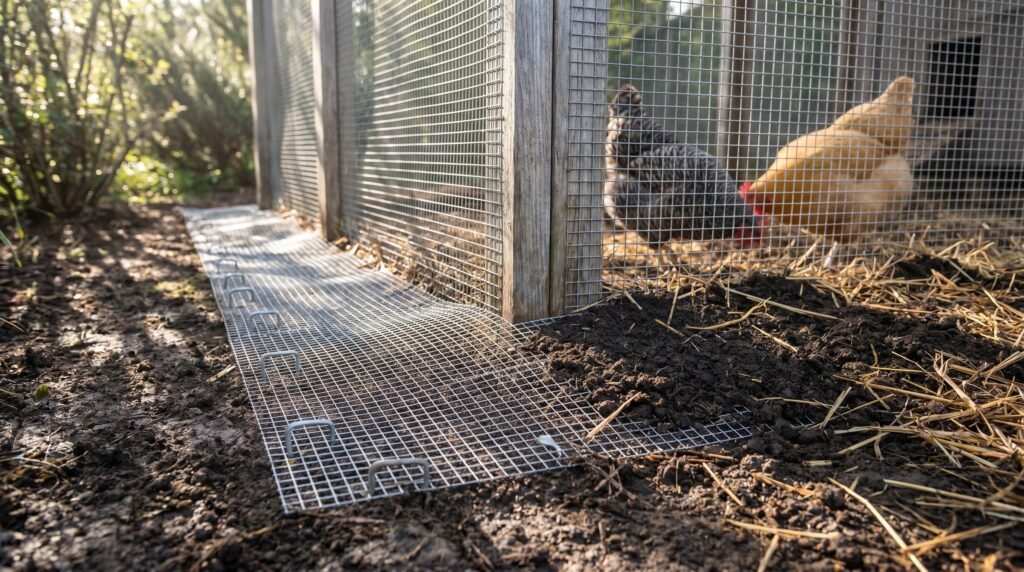
Foxes, dogs, coyotes, and motivated raccoons all dig. The question is whether the coop stops them at the surface or underground. There are two proven approaches - the right one depends on the type of run you have.
Buried wire apron. Hardware cloth buried 12 inches straight down around the run perimeter is the Poultry Extension recommendation and the University of New Hampshire Extension standard for a new build. The reason it works: a predator that hits wire immediately when it begins digging at the wall base will usually give up rather than dig outward to find the edge of the barrier.
Horizontal surface apron. For an existing coop where digging a trench is not practical, lay hardware cloth flat on the ground extending 12 to 18 inches outward from the fence base, then cover it with a few inches of soil or landscape rock. The mechanism is the same - the predator starts digging at the base of the fence, immediately hits wire, and stops. Secure the apron flat with landscape staples every 12 inches so it cannot be folded back.
The table below compares the three main approaches to digging defense so you can match the right method to your setup.
| Method | How to install | Best for | Main tradeoff |
|---|---|---|---|
| Buried vertical apron | Trench 12 inches deep, bend bottom edge outward 6 inches, backfill | New builds; permanent runs on soil | Labor-intensive to retrofit; roots can disrupt in established yards |
| Horizontal surface apron | Lay cloth flat, 12-18 inches out from fence base; cover with soil or stone; landscape-staple every 12 inches | Existing coops; portable runs; rocky soil | Can shift over time from frost heave or root growth; needs periodic inspection |
| Solid floor (concrete or hardware cloth deck) | Concrete slab or hardware cloth stapled to coop frame | Small permanent coops; urban setups | Concrete requires more cleaning; birds need adequate bedding; run still needs apron outside |
Colorado State University Extension recommends raising the coop itself about a foot off the ground to discourage rats, skunks, and snakes from taking up residence beneath it. Elevation removes the sheltered den space those animals seek. A raised coop still needs an apron on the run fence - the elevation addresses what lives under the coop, not what digs at the run wall.
For a detailed look at fox-specific digging behavior and run security, see our article on foxes and chickens.
Automatic doors: the one upgrade that closes the most common gap
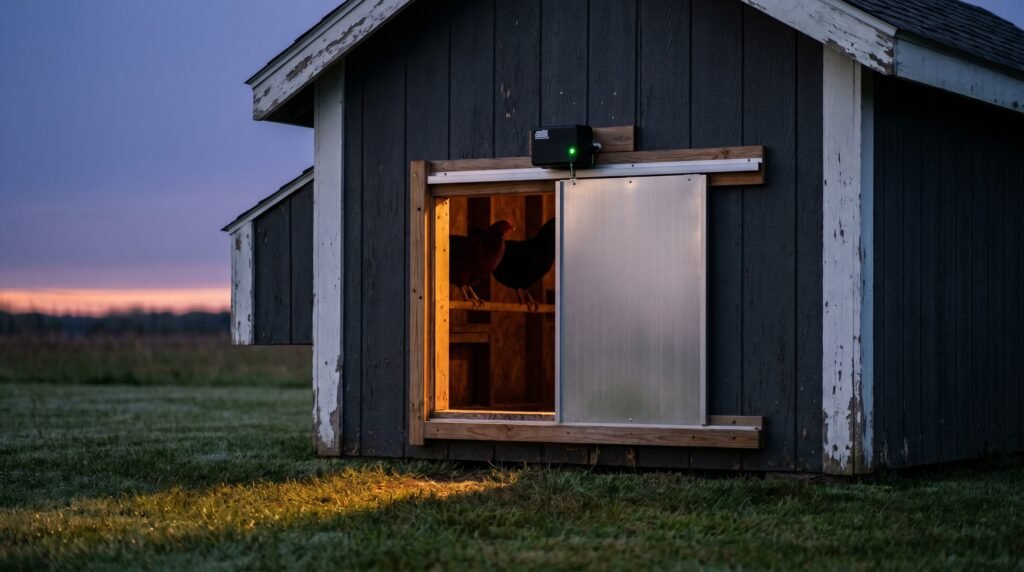
Automatic doors exist because human reliability is the weakest link in an otherwise well-built coop. One late evening, one distracted night, one overnight trip - and a predator that has been watching the coop's routine gets its window. An automatic door removes that variable entirely.
Light-sensing units open at civil dawn and close shortly after civil dusk, adjusting with the season automatically. Timer-based units work but need seasonal reprogramming as day length changes. Many current units offer both modes together: set a time as backup, let the light sensor trigger closure as the primary, and whichever threshold arrives first closes the door. That combination handles cloudy evenings that fool a pure light sensor and avoids the season-drift problem of a timer alone.
The safety features to confirm before purchasing any unit:
- Obstruction sensor / auto-stop. The door reverses immediately if it contacts resistance during closing. A door that only stops (rather than reverses) can still trap a bird. Confirm this feature in the manufacturer's spec sheet. ChickenGuard's Pro model is one example where the auto-stop behavior is explicitly documented: the door continuously monitors for resistance and reopens when any is detected.
- Self-locking panel. A sliding aluminum panel that locks into its side rails when fully lowered cannot be pried up from outside. Units where the panel is held by gravity or a light track can be lifted by a raccoon using leverage at the bottom edge.
- Cold-weather operating range. Quality units list a tested low-temperature limit. The ChickenGuard Pro spec page cites operation down to -4 degrees F. Budget units without a specified rating often fail below 10 degrees F when motor grease thickens.
- Pop-hole fit. The door panel must fill the opening with no gaps at the sides when fully closed. A panel one inch narrower than the frame has added an automatic feature and left two predator entry points.
One detail that often gets missed: some models have a winter mode that increases motor force to push through ice or frost. This mode typically reduces obstruction sensitivity as a tradeoff. Only enable it when ice is actually the problem - the reduced bird-safety sensitivity should not run year-round.
An automatic door is an addition to a secure coop. If the coop has gaps or the apron is missing, a predator that cannot use the pop-hole will find another entry. For reviewed units, see our guide to the best automatic coop doors.
A quick-assessment checklist for any coop
Use this table to audit an existing coop or evaluate a coop you are building. The column on the right is the pass standard; every item that does not pass is a task to complete before the next dusk. Items are ordered by frequency of failure, not alphabetically.
| Layer | What to check | Pass standard |
|---|---|---|
| Latches - doors | Main coop door, run gate, pop-hole frame | Two independent mechanical actions required to open every door where birds sleep |
| Latches - nest boxes | All nest box lids or doors | Same two-step standard; padlock or barrel bolt plus carabiner |
| Wire type - coop body | Vents, windows, pop-hole frame | 1/2-inch galvanized hardware cloth, not chicken wire; edges secured with battens or screw-washers |
| Wire type - run walls | All run panels to at least 6 feet height | Hardware cloth or 1x2-inch welded wire; openings smaller than 1 inch |
| Gap audit | Full interior inspection with flashlight | No pinhole of light showing through any permanent wall surface |
| Digger defense | Floor or perimeter apron | Solid floor OR apron extending 12-18 inches outward from the fence base, anchored flat |
| Pop-hole closure | Method of closing at dusk | Automatic unit with obstruction sensor, or padlock at minimum; closed before dark |
| Coop elevation | Space beneath the coop | Approximately 12 inches clearance, or no gap at all (slab floor); no sheltered cavity beneath |
| Overhead cover | Run roof or bird netting | Wire or rated netting present if hawks or owls are active in the area; orange netting visible to raptors |
| Hinges | All door hinges | 2.5-inch or longer screws into solid framing lumber; no stripped or short screws |
On hawk and owl predation: Colorado State University Extension notes that bobcats and coyotes can clear a 4-foot fence easily, and owls can grab birds right at dusk - slightly before full dark. Poultry Extension confirms that hawks and owls are federally protected species; you may not legally shoot, trap, or euthanize these birds. The only effective responses are overhead cover and closing the coop early enough. Orange netting over the run is the recommended visual barrier because hawks and owls see orange well.
More on aerial predator defense and run coverage in our article on predator-proofing the chicken run.