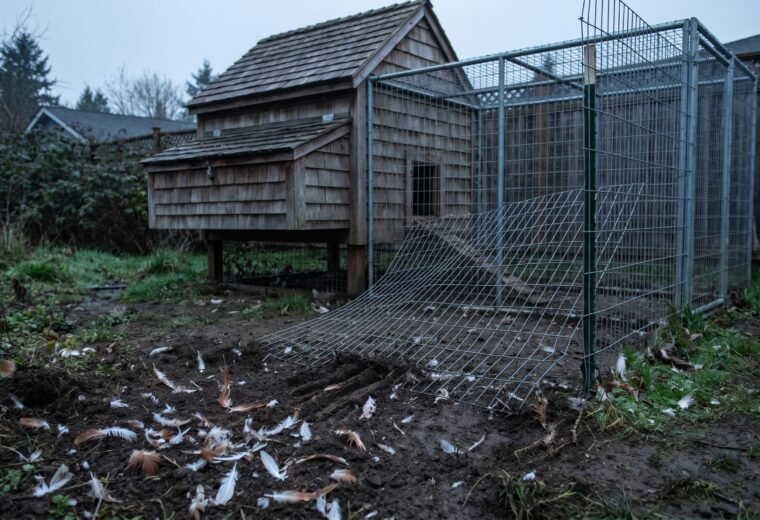
Many chicken keepers lose their first bird to a raccoon before they even realize raccoons are the problem. The evidence is distinctive and grim: heads missing, bodies otherwise untouched, or birds pulled halfway through wire mesh. Raccoons are primary suspects whenever a flock of eight or twelve birds suffers repeated overnight losses - and understanding why they are so effective is the first step toward stopping them.
What makes raccoons such dangerous coop predators
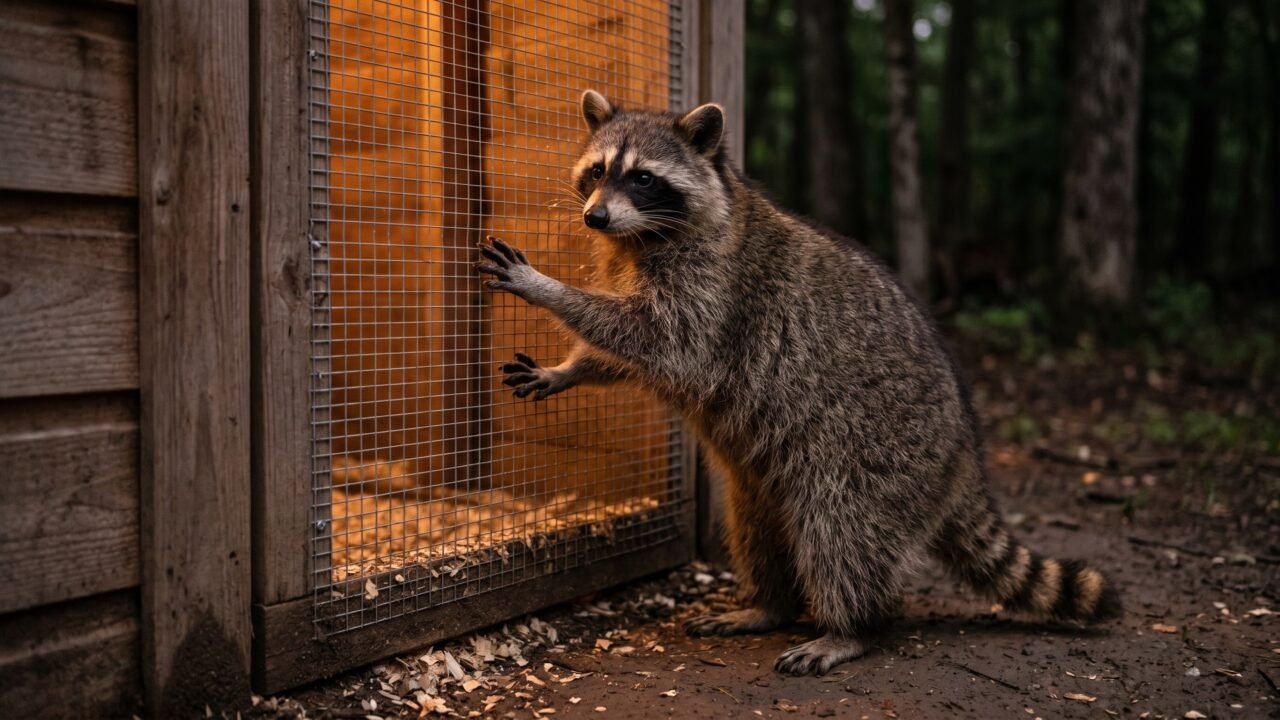
Raccoons combine hand-like dexterous paws, genuine climbing ability, and strong learned persistence. They can reach through standard chicken wire to grab roosting birds, manipulate and open simple latches in one night, and scale an uncovered run with ease. Those three traits together make them the most common cause of coop losses across the continental United States.
Raccoons weigh between 10 and 30 pounds and measure 28 to 38 inches from nose to tail, according to the Pennsylvania Game Commission - that range covers the full spectrum from small females to exceptionally large males, with most adults falling in the 10 to 20 pound range. Even a mid-sized animal has enough mass to overpower a standard hen through hardware cloth if it gets a grip on her. But raw size is not the main threat. The paws are.
The forepaws of a raccoon resemble slender human hands - five long digits, a flexible wrist, and an extraordinary density of sensory receptors, including specialized touch hairs called vibrissae along the undersides. Virginia Tech Extension describes these paws as containing "a large number of sensory receptors and special hairs ('vibrissae') that enhance a raccoon's sense of touch." In practice, this means a raccoon can feel what it cannot see, probing and manipulating latches, bolts, and wire mesh with the same kind of feedback a person gets when working in the dark by feel.
The Oregon State University coastal ecology program documents that raccoons can "unscrew jars, uncork bottles, open door latches and knobs, and even complex locks." That description is not hyperbole. A hook-and-eye latch or a simple slide bolt typically takes a habituated raccoon less than a minute to defeat. They learn. If a technique works once, they remember it and repeat it.
Add climbing ability - the Animal Diversity Web (University of Michigan) confirms they are agile climbers that can descend trees headfirst and are not bothered by drops of 35 to 40 feet - and you have an animal that can scale an uncovered run, reach over a low fence, or pull birds through gaps that look far too small to be a problem.
Raccoons are primarily nocturnal, rarely active during daylight hours. That timing is the single biggest reason keepers underestimate them: the raid happens after dark, the bodies are found at dawn, and by then the raccoon is long gone. For a broader look at which animals are killing birds at night and how to identify each one, the guide on what kills chickens at night covers the full lineup of nocturnal predators and their signatures.
How raccoons get into coops - the four main entry routes
Raccoons do not usually smash their way in. They find weaknesses that are already there. The Extension.org predator management program, run by the land-grant university cooperative extension network, identifies the attack pattern clearly: raccoons can "pull a bird's head through the wires of an enclosure and then can eat only the head, leaving the majority of the body behind." This happens because standard chicken wire has hexagonal openings large enough for a raccoon to reach through several inches and grab.
The four routes they exploit most often:
- Reaching through wire. Chicken wire and 1-inch mesh are both wide enough for a raccoon paw. The bird presses against the wall at night (chickens roost against warm surfaces and shy away from open air), the raccoon reaches in, and the result is partial consumption through the mesh without ever entering the structure.
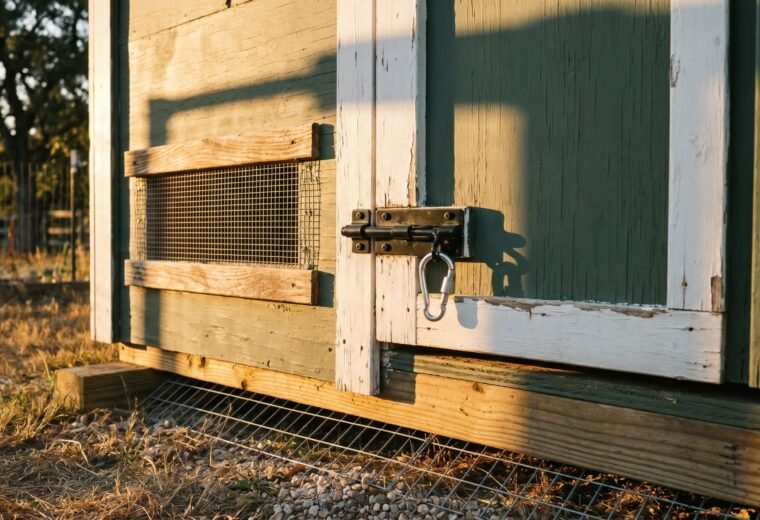
- Unlatching doors. Any single-action latch is a solved puzzle. Hook-and-eye closures, simple barrel bolts, and spring-loaded handles all fall to raccoon paws. Extension.org documents that their paw dexterity is sufficient to manipulate enclosures and open latches. One night of experimentation is usually enough for them to learn an unfamiliar latch design.
- Digging under. Raccoons dig, though they dig less reliably than foxes. A run with no buried apron or floor is vulnerable if other entry points are blocked and the animal is motivated by the smell of birds or feed inside.
- Climbing over. An uncovered run is an invitation. Raccoons climb wood, wire, and rough-surfaced plastic with ease; smooth metal poles give them more trouble, but most backyard coops offer plenty of grip.
Raccoon attacks often involve more than one animal. The Extension.org guide describes a documented cooperative pattern: "one scaring the chickens to the far end of a pen and the other picking off the birds' heads." This is unusual behavior, but it matters because a coop that resists a single raccoon may still lose birds if two work it together from different sides.
The raccoon-proof latch: what actually works
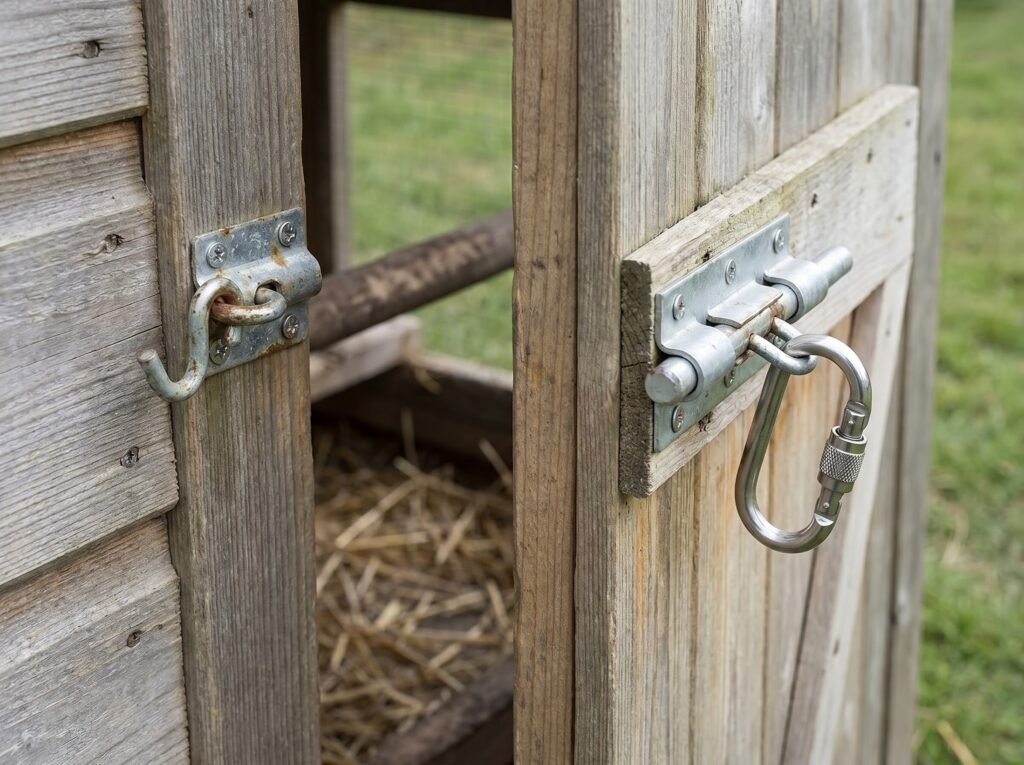
This is where most predator-proofing fails, and where a keeper with eight or ten birds can spend very little money and solve the problem almost completely. The core rule: any latch that requires only one independent physical action can be opened by a raccoon. Defeat requires at least two separate steps that must happen in the correct sequence.
The table below shows the most common latch types, how raccoons defeat them, and the minimum upgrade needed. Ratings are based on documented raccoon behavior and keeper-reported field results gathered from extension sources and backyard flock communities.
| Latch type | How raccoons defeat it | Raccoon-proof rating | Minimum fix |
|---|---|---|---|
| Hook and eye | Lift hook with one paw | Fails within days | Replace entirely |
| Simple slide bolt | Slide bolt open with paw or snout | Fails within days | Add carabiner or padlock |
| Spring-loaded barrel bolt | Depress spring, slide - one fluid motion | Fails in 1-3 weeks | Add a locking pin through the barrel |
| Slide bolt + locking-sleeve carabiner | Screw collar must be turned AND carabiner opened - two distinct actions | Holds reliably | This combination is sufficient for most situations |
| Spring bolt + padlock | Cannot open padlock | Holds reliably | Best for high-pressure areas; also protects against theft |
| True two-step latch (spring-loaded with separate locking pin) | Requires depressing spring AND withdrawing pin simultaneously - exceeds paw coordination | Holds reliably | Standard on quality prefab coops; check that BOTH steps engage |
One practical note: apply this upgrade to every access point without exception - the main coop door, the pop door, the nest box lid, the run gate, and any cleanout panels. A raccoon that finds one latched door will immediately test every other opening. The nest box lid is the most commonly overlooked point; it typically uses only a hook-and-eye because it is convenient to lift one-handed when collecting eggs.
Securing the run against raccoons
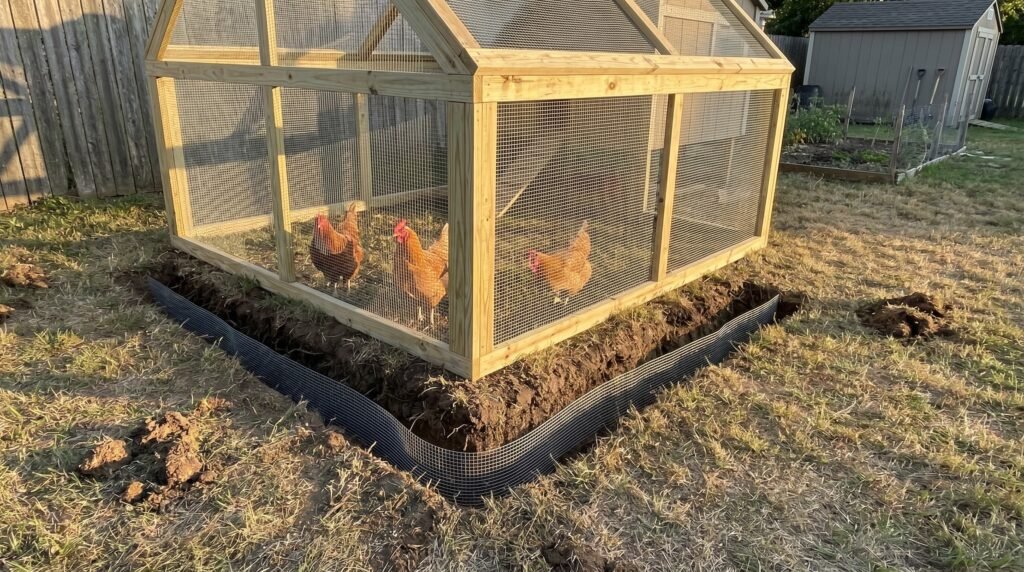
A secure latch on the coop door is necessary but not sufficient. Raccoons will work the run itself, and a run that keeps birds in but does not keep predators out is a feeding station with a fence around it.
Wire mesh choice. Half-inch welded hardware cloth is the minimum that actually stops raccoons from reaching through. The hexagonal openings in standard chicken wire are wide enough for a raccoon paw and forearm. Hardware cloth with 1/2-inch square openings blocks paw access and also stops rats, most snakes, and weasels. For full context on why mesh choice matters across different predators, the comparison in our hardware cloth vs chicken wire article lays out the differences in strength, opening size, and cost. The gauge matters too: 19-gauge galvanized hardware cloth is the practical minimum; 16-gauge is noticeably more resistant to being bent or pulled away from staples.
Buried apron. Extension.org recommends burying hardware cloth at least 12 inches (30.5 cm) into the ground around the perimeter to stop digging predators. An L-shaped apron - where the mesh bends outward underground at 90 degrees - works equally well without full burial and is easier to retrofit on an existing run. The outward bend means a digging animal hits the buried flap before it reaches the wall, which stops most attempts.
Covered top. An open-top run is an open-top run, regardless of how solid the sides are. Raccoons climb. Hardware cloth on the top of the run also protects against hawks and owls, making it a genuine dual-purpose upgrade. For the full case on covering vs. leaving runs open, the article on covered vs open run walks through the tradeoffs in detail.
Electric deterrent. Virginia Tech Extension notes that "low voltage electric fencing will deter predators to enter the run." A single hot wire run at 6 to 8 inches above ground around the exterior of the run - baited once with a peanut-butter smear so the animal contacts it on the first visit - teaches avoidance very quickly. This is more commonly used in rural settings or where raccoon pressure is high enough that hardware cloth alone has not solved the problem.
Lighting. Motion-activated lights can startle raccoons on first encounter. Community reports vary: some keepers find lights effective for weeks, others report habituation within a week or two. Lights are a useful layer in combination with physical barriers, not a replacement for them.
Feed management. Raccoons are drawn by smell as much as opportunity. UNH Extension recommends storing all feed in "air-tight, odor-free containers" and removing uneaten feed from the run by dusk. Open compost or kitchen scraps near the coop are an advertisement. A raccoon that comes for spilled scratch or suet will notice the birds on the same visit.
Closing the coop before dark - the step that matters most
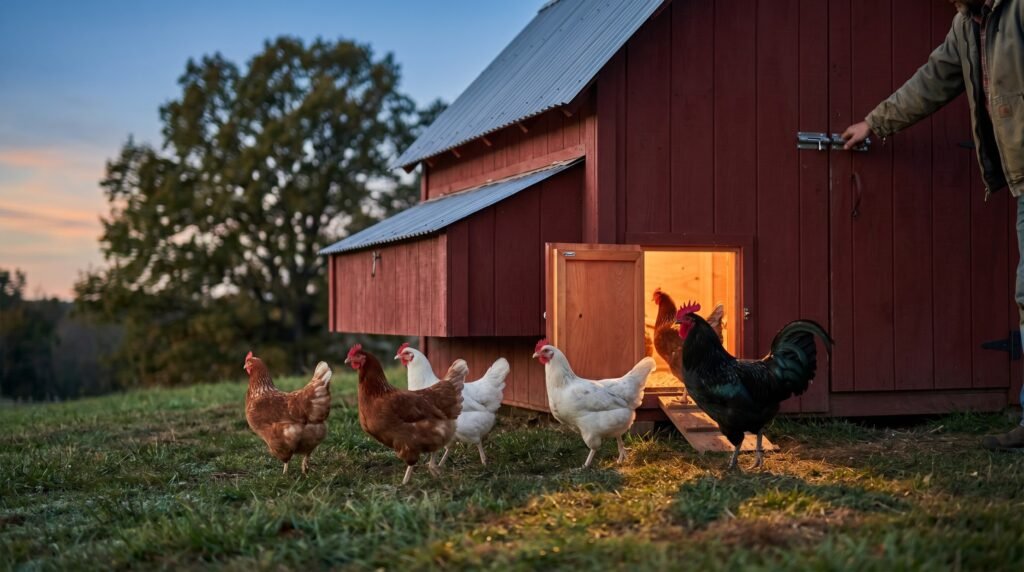
Physical barriers at their best still depend on one human action: getting the birds locked in before raccoons become active. UNH Extension is direct about this, calling it "easily the most important and effective way of protecting free range birds." A perfectly secured coop with the door standing open at 10 p.m. is just a warm den.
Chickens return to the coop naturally at dusk. With a small flock of five to seven birds, a nightly headcount takes under a minute. The habit most keepers develop is walking the run at last light to verify everyone is in and all latches are engaged. Automatic pop doors handle the timing reliably if the schedule is inconsistent - a useful option covered in the article on best automatic coop doors, which includes notes on which models use sensors vs. timers and which seal tightly enough to resist prying.
Raccoon pressure tends to increase in spring (kits being weaned, mothers hunting aggressively for calories) and in late fall when the animals are building body fat before winter. Those are the seasons to be especially consistent about dusk lockup and to check every latch. The broader seasonal predator context is covered in the chicken predators overview, which includes the full list of species and their peak activity patterns.
After a raccoon attack: what to check and do next
If a raccoon has already accessed the coop, two things are nearly certain: it will return the following night, and it will have identified every weak point in the enclosure. Animals that successfully raid a food source repeat the behavior. Waiting to see if it comes back is not a strategy.
Immediately after an attack:
- Check every latch and wire panel for damage or pry marks. Note where the entry actually occurred, not just where the damage to birds is visible.
- Repair breaches before the following night - even a temporary fix with heavy staples and an extra carabiner is better than leaving the same opening available.
- Remove any carcasses from the run promptly. The smell draws additional predators, and raccoons will return specifically to finish what they left.
- Inspect the wire carefully along the base and at all corners. Raccoons will test previously-worked areas first.
For surviving birds, a veterinarian visit is worth considering even for birds that appear physically uninjured. Bite wounds can be small and hard to find under feathering, and stress-related complications - internal injury, secondary infection - are genuine risks. If a bird shows labored breathing, obvious wounds, or extreme lethargy after an attack, see a poultry vet. We do not diagnose or recommend treatment, but the "wait and see" approach has cost keepers birds that appeared fine at dawn.
Lethal trapping and relocation are regulated differently by state. USDA Wildlife Services operates in most states and can provide advice on legal options; contact information is available through your state's cooperative extension service.