Most backyard flocks lose at least one bird to a predator before the keeper figures out what got in and how. The good news is that every major threat - raccoon, fox, hawk, weasel, or owl - leaves a recognizable calling card, and a layered defense that costs far less than a replacement flock will stop nearly all of them. This guide covers how to read that evidence, which threats deserve the most attention in a typical yard, and the specific hardware that keeps a small backyard flock safe through every season.
How do you identify which predator killed your chicken?
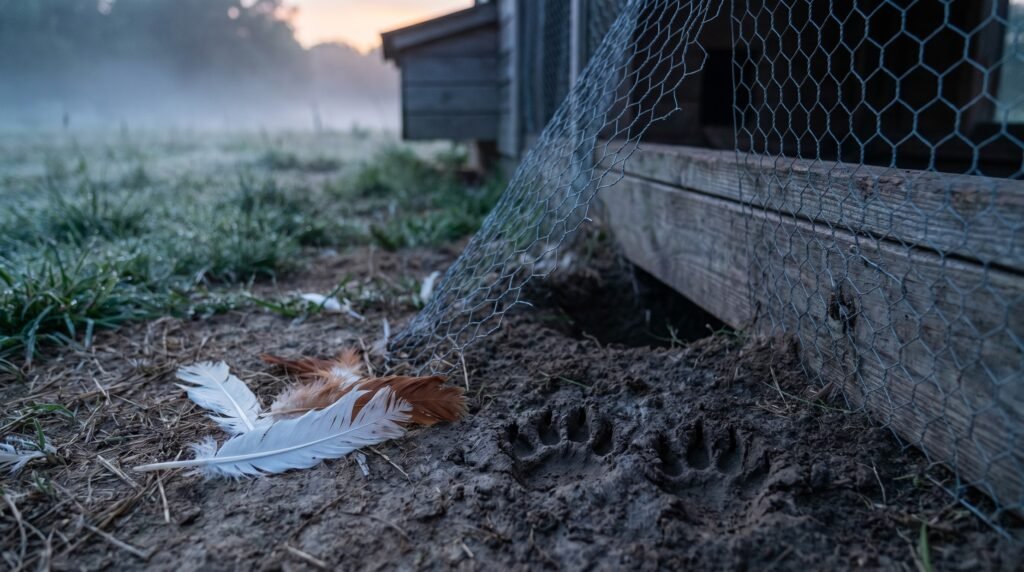
Look at what the attack left behind: the location of the body, what was eaten, what was not, and when it happened. Extension poultry specialists use a short evidence checklist to narrow the suspect list before recommending a fix, because the fix for a hawk problem is very different from the fix for a weasel problem. The table below covers the most common patterns.
| What you find | Most likely culprit(s) | Time of attack |
|---|---|---|
| Bird gone entirely, no body, few feathers | Hawk, owl, fox, coyote, bobcat | Day (hawk) or night/dusk (owl, fox, coyote) |
| Head and neck missing, body left behind | Raccoon, hawk, owl | Night (raccoon/owl), day (hawk) |
| Dead birds not eaten, bodies bloodied | Weasel or mink | Night, rarely day |
| Multiple dead birds lined up or piled | Weasel or mink (surplus killing) | Night |
| Missing small chicks only, larger birds untouched | Snake, rat, house cat, raccoon | Night/early morning (snake, rat, raccoon); any time (cat) |
| Eggs missing or punctured (one end pried open) | Skunk, snake, rat, opossum, crow | Night (skunk/opossum), day (crow) |
| Birds mauled, bitten all over but not eaten | Dog | Day or night |
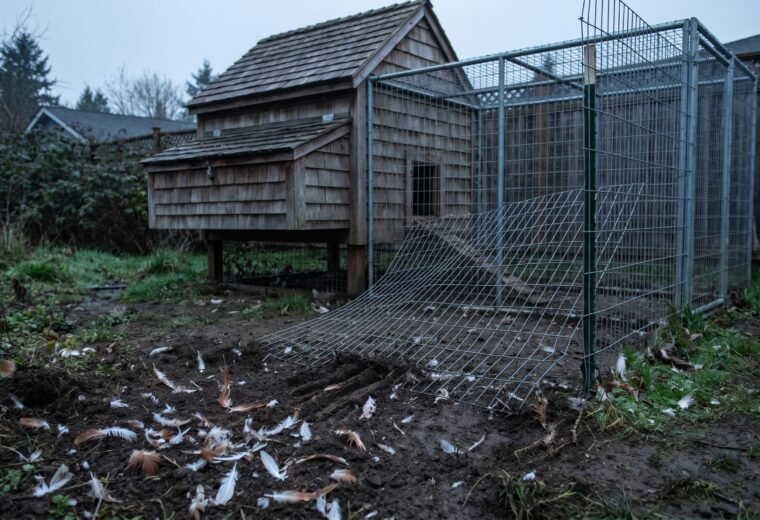
| Wire bent inward, feathers at fence line | Raccoon (reaching through), coyote (forced entry) | Night |
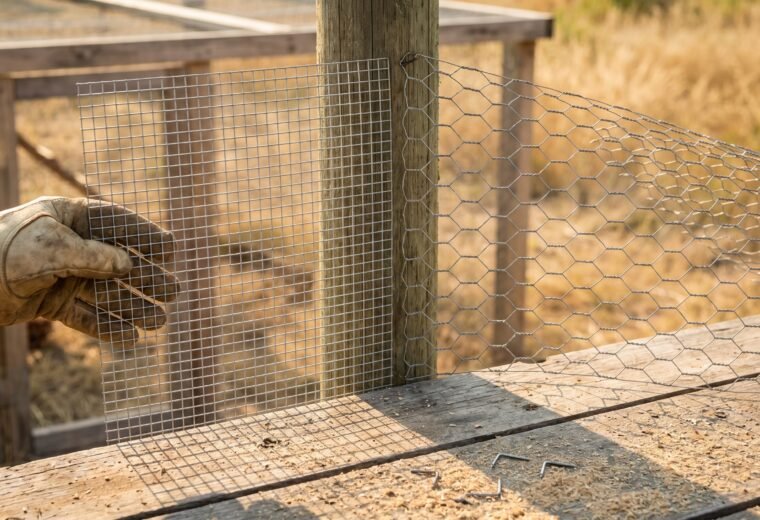
One detail that surprises many new keepers: raccoons often pull a bird's head through the wire without ever entering the coop. If the body is inside and the head is gone, standard chicken wire gave the raccoon exactly enough grip. That pattern alone is one of the strongest arguments for replacing chicken wire with proper hardware cloth on every wall. The hardware cloth vs. chicken wire comparison breaks down gauge, cost, and the specific scenarios where each fails.
Which predators most commonly target backyard chickens, and how do you tell them apart?
Raccoons, foxes, and raptors account for the majority of backyard flock losses across most of the United States. Each leaves a distinct evidence signature and requires a different response. Understanding the threat first prevents wasting money on the wrong fix.
Raccoons
Smart, persistent, and surprisingly strong: raccoons are the predator most small-flock keepers encounter first. They work the seams of a coop methodically, trying latches and pulling at loose mesh. Standard spring-clip latches and hook-and-eye fasteners will not stop a determined raccoon. Latches that require two sequential movements (a slide then a lift, or a squeeze then a turn) are far more effective. Electric fencing strung at the top of a perimeter fence stops climbing attempts entirely, which standard wooden fencing does not.
Foxes
Red foxes hunt at dawn and dusk as well as deep in the night, and they are capable of removing several birds in a single visit. The evidence is usually scattered feathers and a handful of footprints; foxes are tidy workers. They dig readily when a fence meets soft ground, so burying a perimeter apron is essential wherever foxes are present. Gray foxes are also good climbers, which makes a fully covered run worth the investment if you live where both species are common. Cornell Cooperative Extension documented a fox clearing a standard 4-foot perimeter fence without effort, so that height offers little real protection.
Hawks and owls
Red-tailed hawks, Cooper's hawks, and great horned owls are the most frequent raptor threats for backyard flocks. Hawks take prey during the day; great horned owls hunt at night and sometimes begin well before full dark. Both can carry away a standard-sized laying hen if they are determined enough, though they more often target juveniles and bantams.
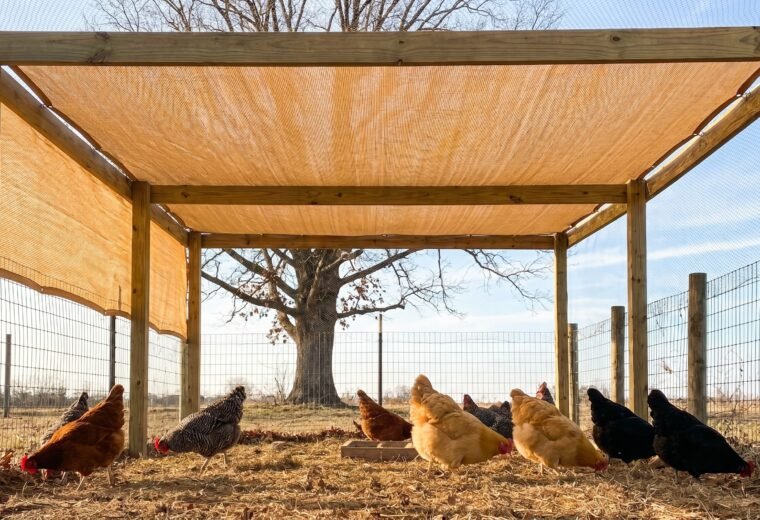
The critical legal point: all hawks and owls in the United States are protected under the Migratory Bird Treaty Act. Killing or relocating them without a federal depredation permit is a federal offense; non-lethal deterrents are your only legal tools. A fully covered run, overhead hawk netting (orange netting works particularly well because raptors see that color vividly), and providing natural cover like dense shrubs give birds places to hide. The hawks article lists the specific deterrents - from monofilament grids to reflective tape - that have measurable results in extension trials.
Weasels and mink
Pound for pound, the weasel family causes some of the most disturbing losses. They kill by biting the back of the neck or head and sometimes kill many birds in a single night, leaving them lined up rather than scattered. The nightmare detail: a weasel can push through a gap as small as 1/4 inch in diameter. Standard chicken wire, which has openings of about 1 inch, gives them an easy path in. Hardware cloth is the reliable fix: 1/2-inch mesh stops larger predators and most weasels, but because the smallest least weasels can work through a 1/2-inch opening, step down to 1/4-inch hardware cloth wherever weasels are a known local problem. (Mink are semi-aquatic members of the same family and far less common in suburban backyards; if you live near a creek or wetland, mink present the same entry risk and the same hardware solution.)
Snakes
Large rat snakes are the primary snake threat to a backyard flock. They do not attack adult hens; instead they swallow eggs whole and take chicks younger than about a month old. A snake in the coop is usually discovered because eggs keep disappearing with no other evidence. Hardware cloth with 1/2-inch mesh stops juvenile rat snakes, but adult snakes entering for eggs need gaps under roughly half their body width. For most adult rat snakes that means ensuring no openings larger than 1 to 2 inches in any run wall or coop floor. The 1/4-inch gap standard cited for weasels does not apply to snakes; adults can pass through openings of several inches.
Dogs and coyotes
A roaming dog often mauls birds without eating them, leaving bodies scattered across the yard. Coyotes are primarily nocturnal and work alone or in pairs; they dig under fences or force their way through weak points. Unlike foxes, coyotes typically leave obvious evidence of forced entry: bent wire, disturbed soil, clear tracks. Both threats are addressed by the same perimeter fencing upgrades that stop foxes - height of at least 6 feet for coyotes, plus a buried apron.
What does a layered defense against chicken predators actually look like?
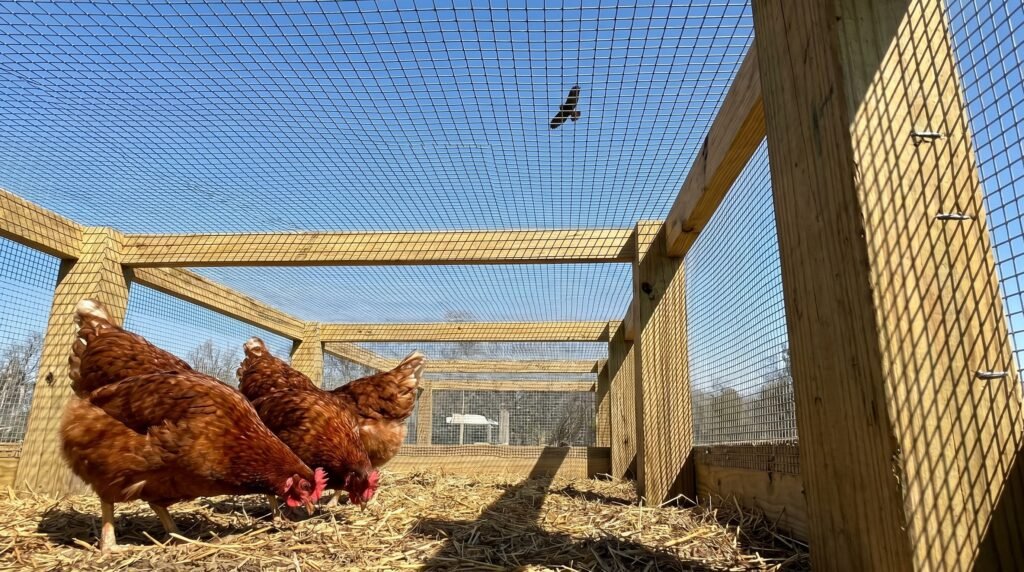
No single measure stops everything. A buried apron will not help if the pop door is left open at night. A good automatic door will not help if the run wire is chicken wire. Effective predator management stacks multiple independent barriers so that a predator getting through one layer still faces two more. Six layers cover the full threat spectrum.
Layer 1: The coop itself
The coop is your birds' final sanctuary. Its walls, floor, and roof need to exclude every predator on the list above. The key specifications:
- Wire: hardware cloth with 1/2-inch mesh (Cornell Extension cites a 1-inch maximum opening to exclude weasels; 1/2 inch is the safer default, and 1/4-inch mesh closes even the tiniest gaps a least weasel could use). Chicken wire (the hexagonal light-gauge kind) is not a predator deterrent. Raccoons tear it, foxes bite through it, and weasels walk through it.
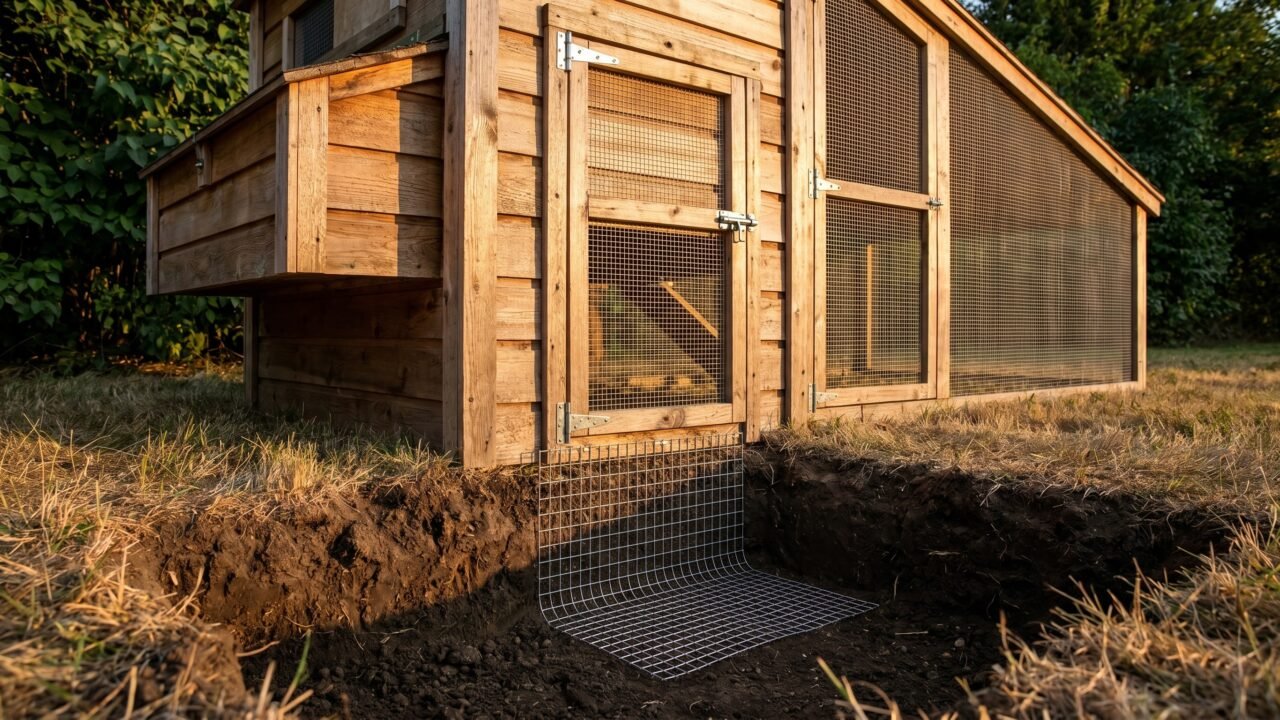
- Floor: hardware cloth flooring or a solid wood/concrete floor stops digging under the coop. If the coop sits directly on soil, a buried skirt of wire around the perimeter is the alternative.
- Ventilation openings: any vent or window opening must be covered with hardware cloth, not screen. Screens are decorative to a determined mink.
- Elevation: raising the coop 12 inches off the ground eliminates the sheltered cavity that skunks, snakes, and rats colonize.
The predator-proof coop article runs through door frame specs, flooring choices, and the exact fastener schedule that keeps raccoons from pulling panels loose.
Layer 2: The pop door and hardware locks
The pop door is the most-exploited weak point. Birds come in through it, and it needs to close completely every night before predators begin their rounds. The single most effective protective measure: keep chickens indoors at night, because most predators are most active between dusk and dawn. (University of New Hampshire Extension)
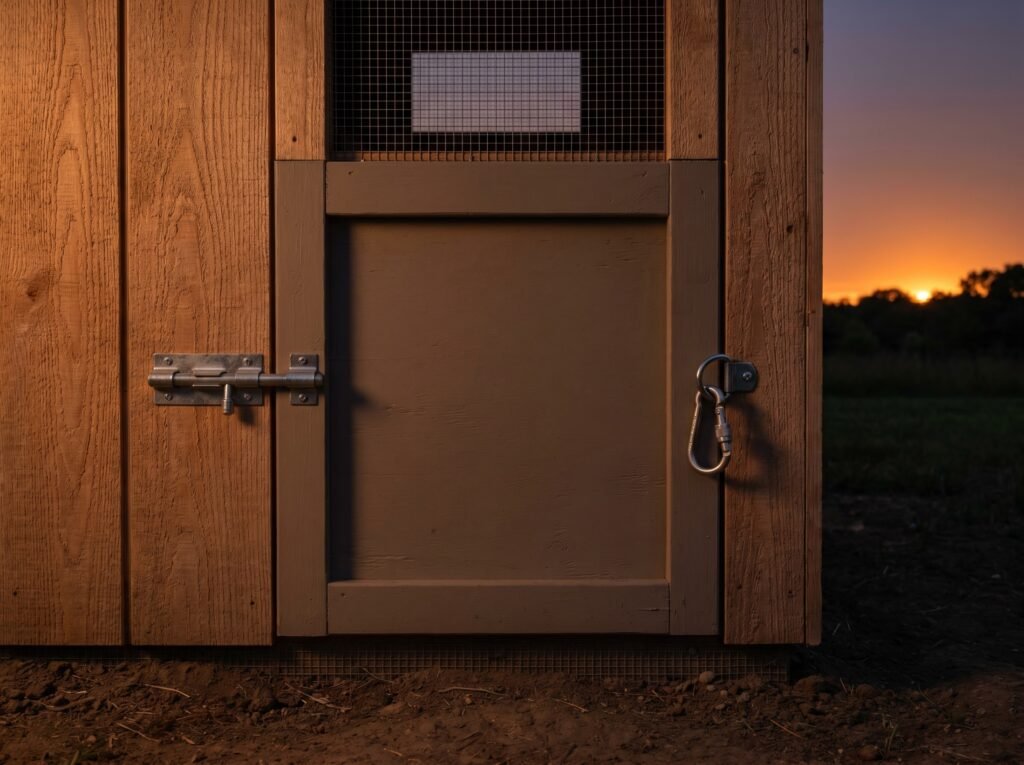
Automatic pop doors (timed or light-sensor triggered) remove the human error that leads to most preventable losses. When evaluating one, check that the fully lowered door has a positive lock mechanism. A door that simply drops under gravity can sometimes be nudged up by a persistent raccoon.
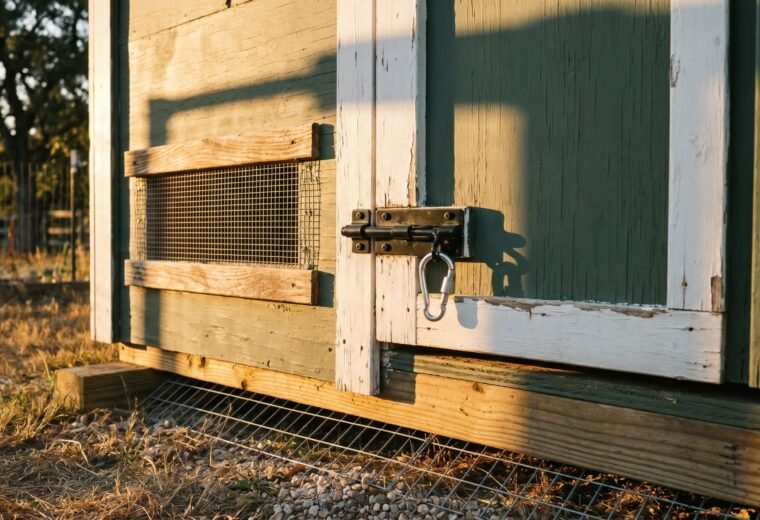
For manual latches, use hardware that requires two sequential actions to open. Raccoons readily work simple hook-and-eye latches and spring clips. A latch that slides before it lifts, or a carabiner-style gate clip used in combination with a secondary latch, forces a level of dexterity that stops most persistent raccoons.
Layer 3: The run perimeter
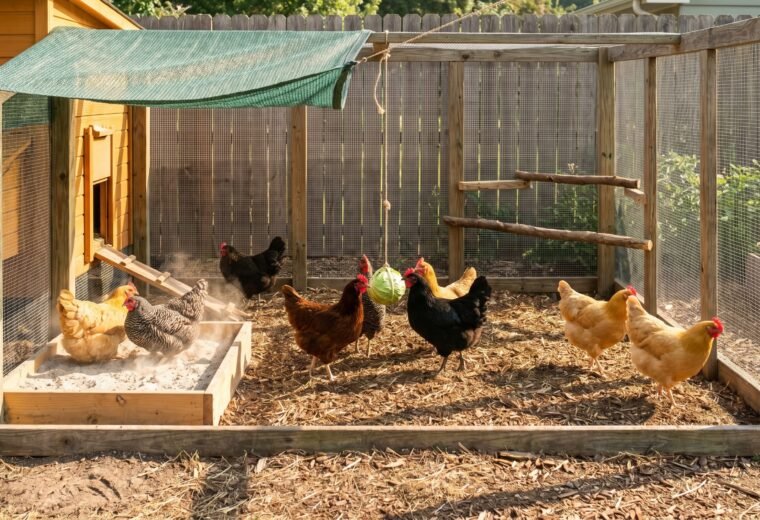
A good run gives your flock daytime outdoor access without exposing them to ground and aerial threats. The wire standard matches the coop: hardware cloth, not chicken wire, covering all four sides. Fence height matters too; bobcats and coyotes clear 4-foot fencing without effort. A run height of at least 6 feet, with the top covered, is the safer spec for areas where those predators are present.
The chicken run overview compares full-roof versus partial-cover layouts, and the run ideas piece shows how to adapt each to a narrow or irregular yard.
Layer 4: The buried apron
Digging predators (foxes, coyotes, dogs, badgers, and skunks) attack fences at the base. There are two proven approaches:
- Vertical burial: extend the fence wire 12 inches straight down into the ground. This is the most common recommendation and stops moderate diggers.
- L-shaped apron: run the wire 12 inches down, then turn it 90 degrees outward underground for another 8-10 inches. When a predator digs inward and hits the horizontal section, it has no way to go deeper. University of Maryland Extension considers this the more reliable approach for persistent diggers like foxes.
UF/IFAS Extension recommends extending the outward buried section up to 2 feet in areas with a heavy fox or coyote presence. The additional material cost is minor compared to replacing lost birds.
Layer 5: Overhead coverage
Hawks hunt by sight from above. An open run is an easy target. Covering the run with hardware cloth, welded wire, or hawk netting removes the aerial approach entirely. If a fully covered run is not feasible, overhead wires strung in a grid pattern (even fishing line at 12-inch intervals) disrupt a hawk's attack angle enough to deter most strikes. Orange bird netting provides visual deterrence because hawks and owls perceive that wavelength clearly.
Dense shrubbery inside or alongside the run gives birds a place to duck quickly if a raptor does circle overhead. A flock that has cover behaves very differently from one with nowhere to hide.
Layer 6: Nighttime discipline
Close the pop door before dusk, not after dark. Great horned owls sometimes begin hunting well before full darkness, and a coop door left open for an extra 30 minutes is a meaningful risk window. If your schedule makes reliable dusk closings difficult, an automatic door is worth the cost: it is cheaper than a single vet visit for a wounded bird and far cheaper than rebuilding a flock. The what kills chickens at night article maps each nocturnal species to its typical strike window and the coop evidence it leaves.
What secondary deterrents are worth adding once the physical layers are in place?
Motion-activated lights, electric fencing, and livestock guardian dogs each add a meaningful extra layer but none replaces the physical barriers. Motion-activated lights startle nocturnal predators and interrupt their approach, though a habituated raccoon or a determined coyote will eventually learn to ignore them. They are most useful as an early-warning layer on top of solid physical barriers, not as a substitute for them.
Livestock guardian dogs are highly effective but require a real commitment. Breeds like the Great Pyrenees, Anatolian Shepherd, and Maremma Sheepdog were developed over centuries for exactly this work. A well-trained guardian dog reduces most mammalian predator pressure to near zero. The important caveat from extension specialists: young dogs must be raised alongside poultry under supervision, and should never be left alone with birds until fully trained. An untrained or poorly socialized dog can become a predator itself.
Electric fencing adds a meaningful deterrent for perimeter runs, especially against raccoons and foxes. A single hot wire at 8-10 inches above ground on the outside of the run fence, kept clear of vegetation, delivers a deterrent shock without harming animals. Keep vegetation trimmed; grass contact drains voltage and a hot wire touching weeds stops being effective within days.
What single habit reduces chicken predator losses the most?
Every hardware upgrade in the world is undone by leaving the pop door open after dark. Extension specialists and keeper surveys consistently find that late closings account for a disproportionate share of overnight losses. The night-time discipline piece is simple, consistent, and free - and it is the single highest-return habit a flock keeper can build. Automate it if you cannot reliably do it manually.
If you are still designing your coop and run from scratch, the chicken coop guide covers sizing and framing first, and the predator-proofing overview picks up where it leaves off with the hardware and closure details that make every layer in this article easier to implement.