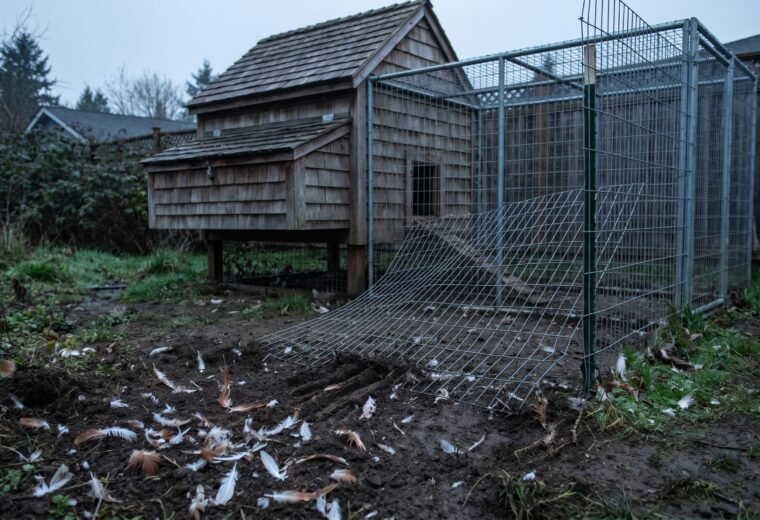
A covered run and a few habitat changes eliminate most hawk risk - that is the core answer. A missing bird with no trace, or a pile of cleanly plucked breast feathers beside a scattered flock, are the two signatures of a daytime raptor attack. Here is what actually works, what fades fast, and one legal fact every keeper needs to know before reaching for a rifle.
Why hawks are especially hard to stop
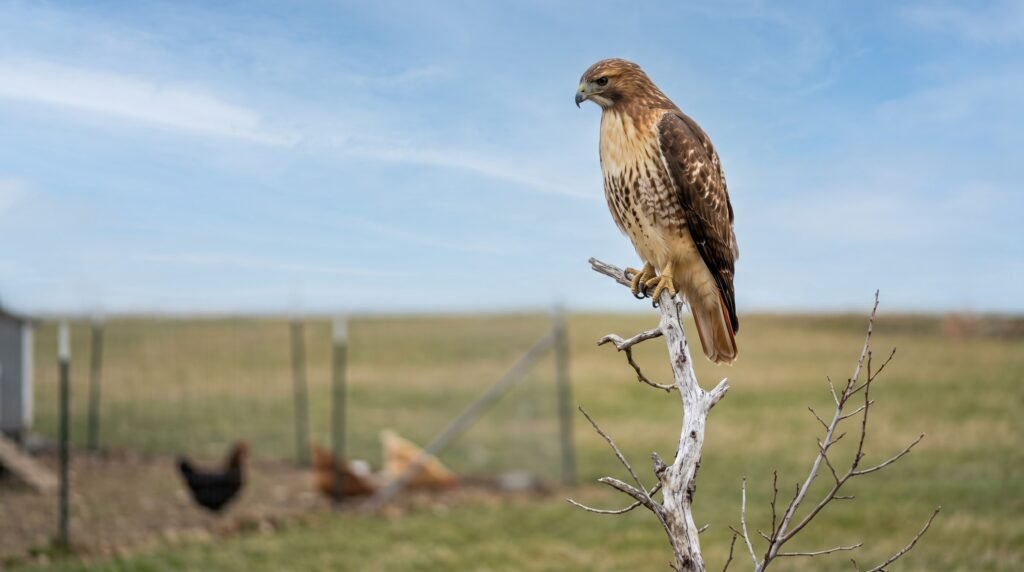
Red-tailed hawks, Cooper's hawks, and Red-shouldered hawks hunt only during daylight. A Red-tail scans from an elevated perch using extraordinary eyesight, drops fast, and strikes with its talons, often killing on impact. Cooper's hawks use close-quarter pursuit through brush. Because the species differ in tactics, no single deterrent stops both - which is why the layered approach below matters.
All three species hunt exclusively during daylight, which catches many keepers off guard - people tend to worry about night predators and leave the daytime run wide open. If a hawk eats a bird on-site, it plucks the breast feathers cleanly before eating; if the bird simply vanishes, the hawk carried it off whole.
Cooper's hawks deserve special mention because they are built for close-quarter pursuit through brush and tree cover. Where Red-tailed hawks are open-country soaring hunters that use thermals and high perches to locate prey, a Cooper's will thread between branches and dive into a partially covered run if there is a gap. Their tactics differ enough that no single deterrent stops both reliably.
Beyond the immediate flock, hawks also face a hard legal barrier: all three species are federally protected under the Migratory Bird Treaty Act. Shooting, trapping, or even harassing a hawk is illegal, with penalties that range from $5,000 to more than $250,000 plus possible jail time. Non-lethal deterrence is not just the ethical choice - it is the only legal one. (See the section below on what federal law does and does not allow.)
The broader picture of chicken predators covers night hunters and diggers alongside aerial threats, so it is worth reading if hawks are not your only concern.
Overhead cover: the most reliable fix
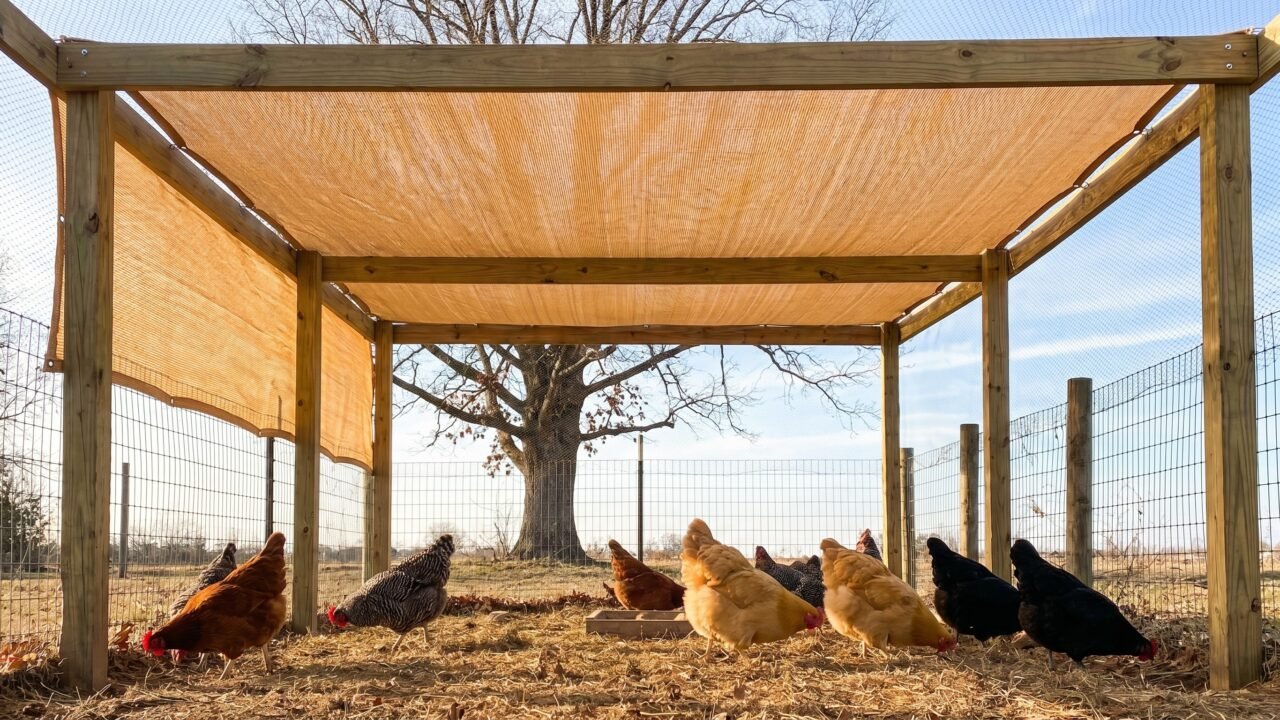
A secure top layer over the run is the single highest-return investment for any flock with hawk exposure. A hawk cannot take a bird it cannot reach, so full overhead cover stops attacks outright. Welded wire is the most durable option; polypropylene netting is lighter and cheaper for large spans; crisscross monofilament lines reduce dive angle over very large open areas. There are several options at different price and permanence points.
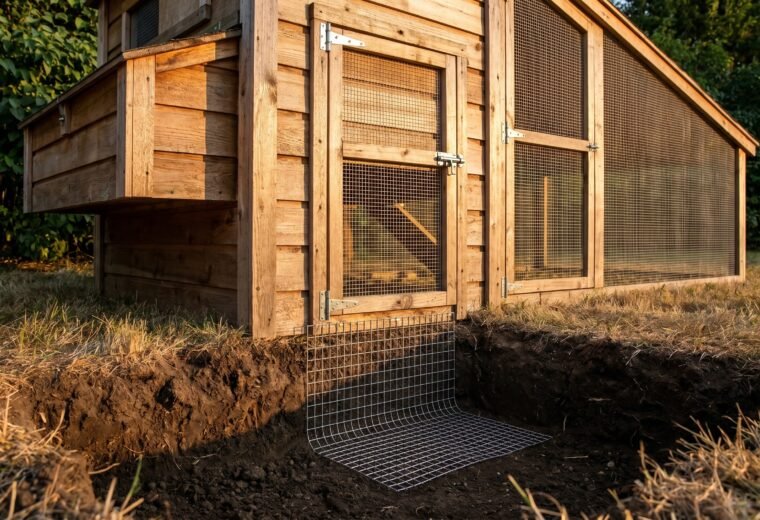
Welded wire or hardware cloth: The most durable solution. A rigid 1-inch or 2-inch welded-wire top carries snow load, lasts decades, and keeps out every aerial predator. Colorado State University Extension specifically recommends covering runs with welded-wire fencing, chicken wire, or game-bird netting - and welded wire sits at the strong end of that range. Hardware cloth (1/2-inch mesh) doubles as ground-level apron material for the same run, so you can buy one roll type and use it for both purposes.
Netting: Lighter and cheaper to span large areas. Polypropylene or nylon bird netting handles most backyard runs for a fraction of the cost of wire. One practical note from the Extension predator guide: orange netting is recommended over black or green because hawks and owls can see orange clearly, making the barrier more detectable to them. Whatever color you choose, inspect tension and anchor points regularly - hawks will find and exploit any loose or weak spot.
Double-layer netting: For flocks that have already had a persistent hawk visitor, a second layer of netting spaced several inches above the first adds meaningful protection. Some keepers report that Great Horned Owls and occasionally Cooper's hawks can reach through single-layer netting to grab a bird roosting or standing directly underneath.
Crisscross wire lines: If you manage a very large free-range area and full cover is not practical, running monofilament or wire lines back and forth at 2-3 foot intervals over the yard breaks up the hawk's dive angle and makes it difficult to build speed for a strike. This reduces exposure meaningfully on open acres, though it leaves some risk in place.
Our covered-vs-open-run comparison goes deeper into the trade-offs between a fully enclosed top and a partially open design, including ventilation, shade, and cost considerations for different flock sizes - the article at covered vs open run is a practical starting point if you are still deciding.
Hiding spots and ground-level habitat
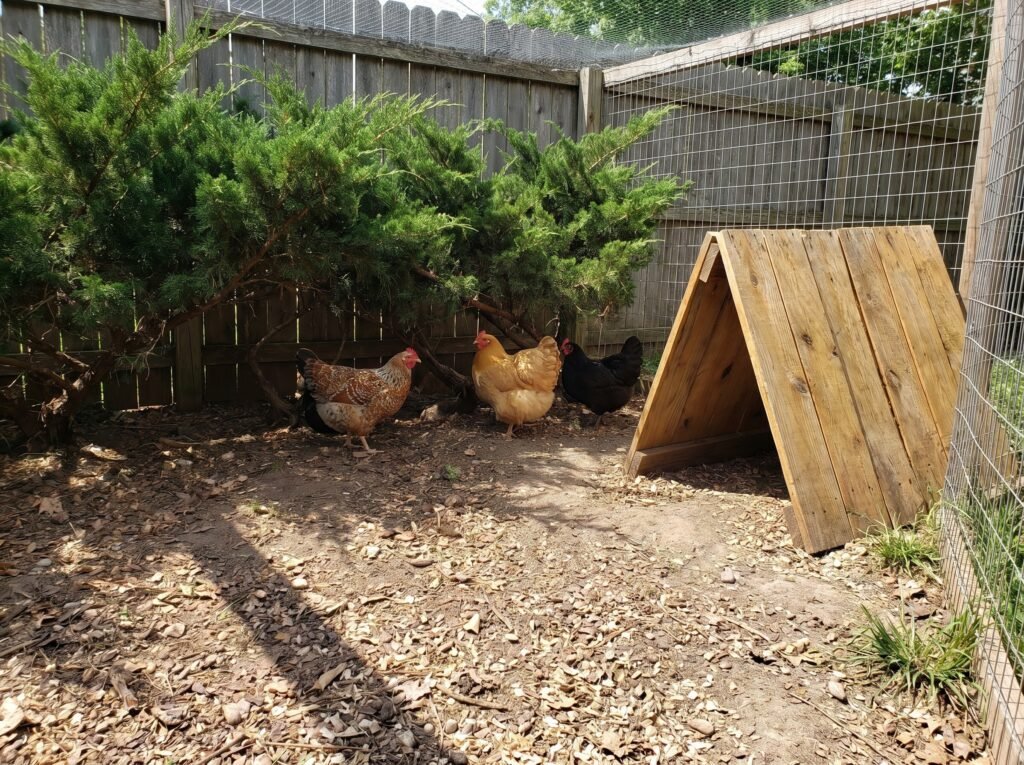
Overhead cover stops the strike. Ground-level cover gives chickens somewhere to bolt after the first alarm call. Dense shrubs, simple lean-to shelters, and pallets stood on edge all work - the key is providing a refuge a bird can reach within two or three seconds of hearing an alarm.
Dense, low-growing shrubs inside or near the run give birds a fast refuge. University of Maryland Extension confirms that "tall leafy vegetation provides cover for birds to hide." Holly, juniper, or any thick-canopied shrub works well. In the run itself, a simple lean-to shelter, a pallet stood on its side, or a plywood A-frame gives every bird in a 12-15 bird flock somewhere to duck under in time.
Pallets and low structures also double as perch enrichment and shade in summer, so they pay rent in multiple seasons. The key geometry is sightline: a hawk needs a clear angle to commit to a dive. Break up that angle with objects at irregular heights and you raise its risk enough to push most hawks to easier hunting grounds.
One counterintuitive detail: the perimeter immediately outside the run fence should be kept relatively open. Dense vegetation right against the fence gives ground predators - foxes, raccoons, weasels - a concealed approach path. Keep the outer 3-4 feet clear while keeping cover dense inside the run.
What works and what does not: deterrents compared
Keepers try many deterrents, with very mixed results. Physical barriers are the only options that stop attacks outright; everything else buys time or reduces frequency at best. The table below reflects what holds up across multiple extension-confirmed sources and keeper reports, and what fades quickly.
| Deterrent | How it works | Realistic verdict |
|---|---|---|
| Overhead netting / welded wire | Physical barrier; hawk cannot enter | Highly effective - stops attacks outright when fully secured |
| Monofilament crisscross lines | Disrupts dive angle over open runs | Useful for large areas; reduces but does not eliminate risk |
| Dense shrubs / low shelters | Refuge once alarm is raised | Works well alongside a rooster or alert hen |
| Perch removal (within ~100 yards) | Removes the hawk's scanning post | Solid and free; often skipped but genuinely reduces visits |
| Guardian dog (active patrol breeds) | Presence and movement deter low passes | Effective when dog stays outdoors and actively patrols; passive dogs provide little deterrence |
| Reflective tape / CDs on wire | Flash and movement startle hawks | Works briefly; hawks habituate within days to weeks |
| Owl or hawk decoys | Imply territory already claimed | Short-lived; must be moved every 2-3 days to retain effect |
| Plastic predator eyes / mirrors | Flash simulation | Minimal lasting effect; same habituation problem |
| Noise devices | Startle response | Largely ineffective; the Extension predator guide notes they have not been shown to be overly effective against raptors |
On decoys specifically: a stationary owl or hawk silhouette can generate a few hawk-free days, but a Cooper's or Red-tail that revisits your property daily will clock the decoy as non-threatening within a week. Move it to a completely different location every two or three days if you use one. Some keepers report better results pairing a hawk-silhouette kite - which actually moves in the wind - with the occasional stationary decoy. Even so, physical cover remains the only thing that stops an attack outright; decoys add a small margin around it.
Perch removal is one deterrent that does not wear off. The Extension predator guide recommends eliminating perch sites within about 100 yards of the flock by removing isolated trees and other elevated surfaces a hawk would use to scan for prey. That is a significant radius - but even removing the two or three highest, most isolated trees closest to the run makes a real difference because it forces any visiting hawk to hunt blind rather than from a chosen vantage point.
The rooster's role (and its real limits)
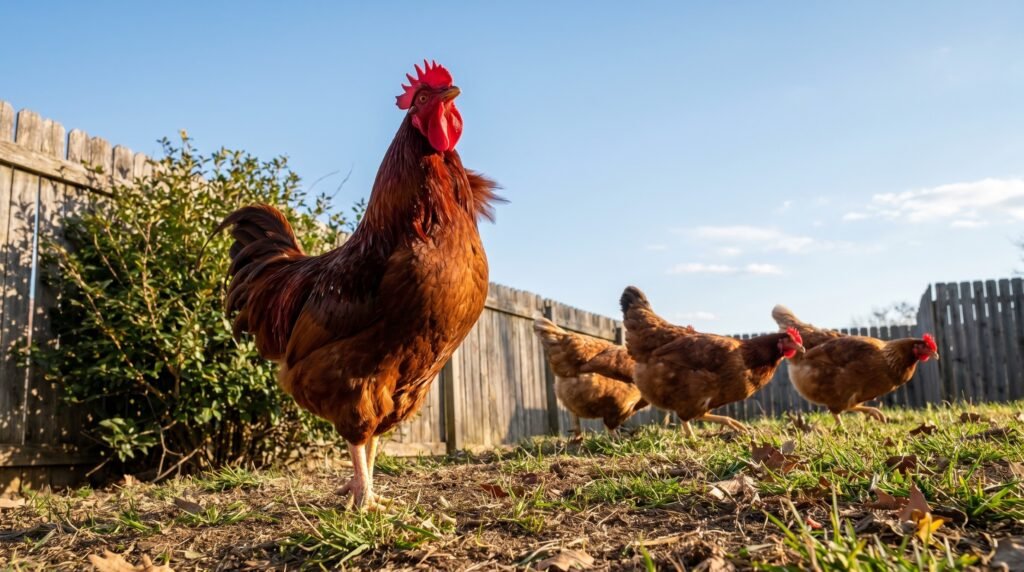
A mature rooster produces a specific high-pitched aerial alarm that differs from his ground-threat call, and hens respond by crouching and moving toward cover fast. Cornell Cooperative Extension confirms that mature roosters can alert the flock to overhead danger. His value is as an early-warning system, not a shield - he cannot stop a committed dive, but he buys the flock critical seconds to reach cover.
What a rooster cannot do is stop a committed hawk strike. He will stand his ground and occasionally bluff a circling bird, but a Red-tail that has already committed to a dive will not be deterred by posturing. His value increases dramatically when the flock also has overhead cover and hiding spots to run to after his alarm - without those, the warning call alone does not save many birds.
Small flocks of eight hens or fewer will see proportionally more benefit from a rooster than a large flock, because he can keep visual track of every bird. In a 20-25 bird flock ranging across a half-acre, one rooster cannot monitor the sky and the perimeter simultaneously.
One constraint worth flagging: many urban and suburban ordinances ban roosters. Check your local codes before adding one. If roosters are not an option, a calm, observant hen will often take on a scanning role, though the alarm calls are less reliable and less likely to prompt rapid cover-seeking behavior.
Federal protections: what the law actually says
All hawks found in North America are federally protected under the Migratory Bird Treaty Act. Killing, trapping, possessing, or harassing any hawk is illegal regardless of circumstances, with fines up to $250,000 and possible jail time. Depredation permits exist in principle but are rarely granted for backyard flocks; non-lethal deterrence is both the ethical and the only practical legal path.
Every species - Red-tailed, Cooper's, Sharp-shinned, Red-shouldered, Broad-winged, and all others - is covered under the MBTA, which was extended to include raptors in 1972. The law makes it illegal to kill, capture, possess, harass, or harm any hawk in any way, regardless of what it did to your flock.
The question keepers most often ask is whether they can get a depredation permit. Technically, the U.S. Fish and Wildlife Service can issue permits for lethal control when nonlethal methods have been tried and failed. In practice, such permits for backyard poultry situations are rarely granted, and the application process requires documented evidence that all non-lethal options have already been exhausted. Shooting a hawk in the moment of an attack is not covered; that remains a federal offense.
The practical upshot: plan your deterrence before a hawk discovers your flock, because afterward your options are limited to physical barriers and harassment (using noise or movement to chase the bird away - not injuring it). A hawk that returns repeatedly to the same hunting ground is following food; the only reliable way to break that pattern is to remove the food source with covered housing or to remove its ability to hunt effectively by cutting off perch access and adding overhead barriers.
For a full picture of which predators target chickens at different times of day - including the nocturnal hunters that are behind most overnight losses - the chicken predators guide covers identification and defense by species.
Quick FAQ
Which hawk species actually attacks backyard chickens - and how do I tell them apart?
Red-tailed hawks are the most common culprit: large, broad-winged soaring birds with a distinctive rust-red tail visible from below. Cooper's hawks are crow-sized, with a long rounded tail and short rounded wings - built for speed through cover. Sharp-shinned hawks look similar to Cooper's but are smaller, roughly jay-sized. Red-shouldered hawks are mid-sized with barred rufous underparts. Size of the killed or missing bird is often the fastest clue: a Sharp-shin rarely takes anything larger than a young bantam; a Red-tail will take a full-grown hen.
What time of year is hawk risk highest?
Hawk pressure on backyard flocks typically peaks in two windows. In autumn, large numbers of migratory Red-tails and Sharp-shins move south and settle temporarily in residential areas before dispersing to winter territory - this is when many keepers first notice daily visits. Late winter into early spring brings a second spike as resident birds establish breeding territories and feeding pressure rises for nesting pairs. Midsummer is usually lower risk, though resident birds remain year-round in most of the US.
What sizes or breeds of chickens are most vulnerable?
Smaller and lighter birds face the greatest risk. Bantams, young pullets, and small breeds such as Silkies, Seramas, and Dutch bantams are well within the carrying capacity of a Red-tail or Cooper's hawk. Standard hens above 5-6 pounds are harder to carry off but can still be killed on the ground. Heavy breeds such as Jersey Giants or Brahmas are rarely taken by hawks; their size is effective passive protection. Chicks and juveniles under eight weeks old are at maximum risk regardless of breed.
Will a guardian dog stop a hawk?
A dog that actively patrols the run area and stays outdoors during the day will deter many hawks by its presence and movement. A dog that sits passively or spends most of the day inside provides little deterrence. Livestock guardian breeds (Great Pyrenees, Anatolian Shepherd) tend to maintain consistent outdoor patrol - small companion breeds rarely do. The dog works best alongside overhead cover, not instead of it.
My hen is missing but there are no feathers. Is it a hawk?
Probably yes, if the disappearance happened during daylight hours. Hawks frequently carry smaller and medium-sized birds off entirely, leaving no feathers at the site. A disappearance at night with no evidence suggests a different predator - a raccoon, fox, or weasel. The timing of the disappearance is the fastest diagnostic clue.
What if a hawk keeps returning despite deterrents?
A persistent hawk has identified your yard as reliable hunting ground. The only things that reliably break that pattern are (a) removing access by covering or confining the flock, and (b) removing its scanning perch. Do not rely on reflective tape or decoys against a bird that has already made multiple visits - it has learned to ignore them. Contact your state wildlife agency for guidance; they can advise on legal hazing methods appropriate to your situation.
Most hawk problems resolve themselves within a week or two if you remove the food opportunity completely. A hawk with a reliable food source will keep coming back; one that finds an empty hunting ground moves on.