You can have friendly, hand-tame chickens with almost any breed - but "almost" is doing real work in that sentence. Temperament varies more between breeds than most new keepers expect, the window for easy socialization is shorter than it looks, and a few common handling mistakes undo weeks of progress in seconds. Get those three things right and most backyard flocks become genuinely approachable within a month or two. Get them wrong and you end up chasing birds around the run every time you need to check on someone.
Everything below unpacks the why and the how - starting with the biology that makes chickens hard to tame in the first place.
Why chickens resist human contact in the first place
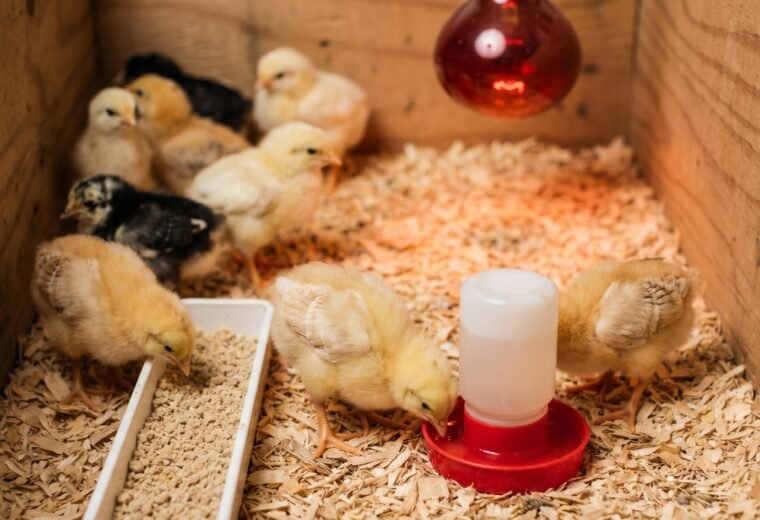
Chickens are prey animals with a hard-wired overhead-threat response. Research published in behavioral journals shows that chicks react to a rapidly expanding shape above them with immediate escape behavior - a reflex tuned to hawks and owls, not to a person reaching into a brooder. That same ceiling-mounted heat lamp you're adjusting? To a three-day-old chick, it moves like a predator. Knowing this changes everything about your approach.
Fear in chickens also has two distinct alert modes. The Alabama Cooperative Extension notes that chickens use separate alarm calls for aerial versus ground threats, and the behavioral responses differ for each. Approach from the side at ground level and you look like a foraging animal. Reach straight down from above and you look like a hawk. That single difference explains why the most common beginner mistake - hand plunging into a brooder box from directly overhead - frightens chicks even when done gently and slowly.
Beyond instinct, individual fearfulness tracks closely with genetics. A large multi-breed peer-reviewed study found that tonic immobility duration - a standard measure of fearfulness in poultry - ranged from a median of 58 seconds in Lohmann Brown commercial layers to 600 seconds in German Creeper ornamentals. That is a tenfold gap in fear intensity, driven almost entirely by breed. So the advice that "any chicken can be tamed" is broadly true but skips the fact that your starting point matters enormously.
The chick window: why weeks one through eight are everything
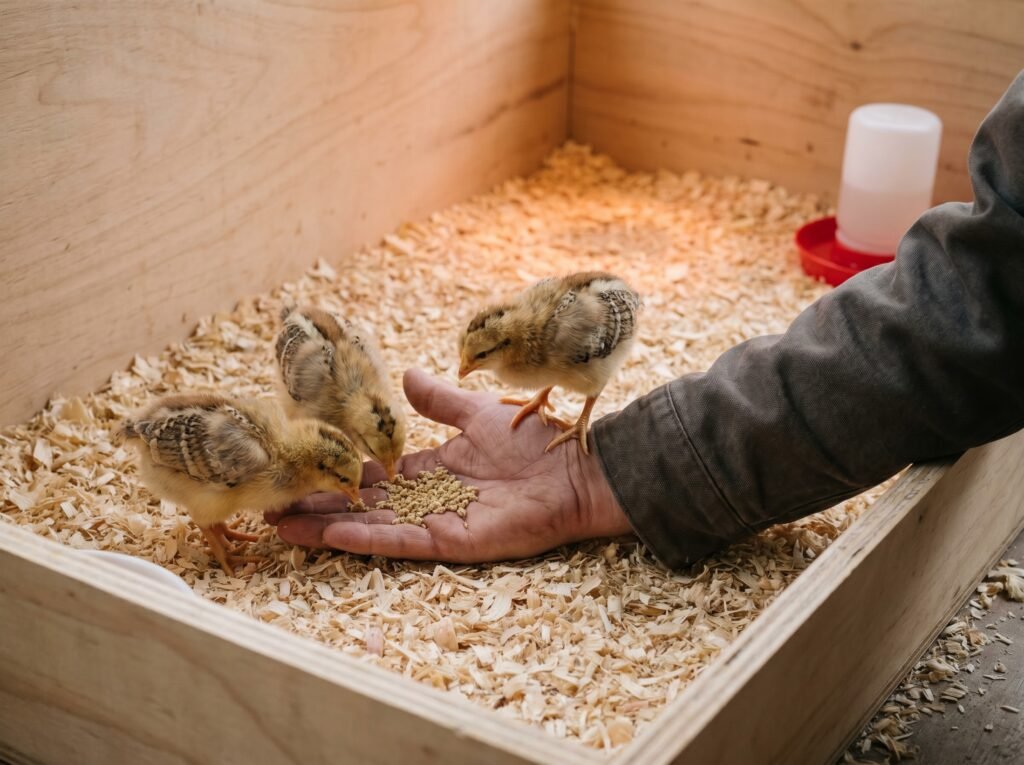
Research from land-grant university extension programs found that contact with a human hand as early as 15 minutes after hatching reduces the number of distress calls chicks produce. Early exposure does not just calm individual birds in the moment - it shapes how they classify humans long-term. Chicks that experience calm, regular handling during brooding tend to stay approachable as adults. Birds raised without it can still be gentled, but it takes considerably longer and some individuals never fully relax.
During weeks one through eight, aim for at least one calm, brief handling session per day per bird. Keep each session under two minutes at first. Sit down on the floor next to the brooder rather than reaching in from above - this lowers your profile from "aerial predator" to "interesting ground-level thing." Let chicks walk onto your hand voluntarily by placing it flat inside the brooder at bedding level. A small pinch of crumbled chick starter on your palm gets them investigating quickly. Once a chick steps on and eats calmly, you've made the first deposit in a trust account you'll be drawing on for years.
Our guide to raising baby chicks week by week covers the full brooder timeline - temperatures, feed transitions, and when chicks are ready to move outside - which runs parallel to your socialization work.
Treats as a practical tool, not a bribe
Animal behavior research at the University of Rhode Island confirmed that chickens can be trained using operant conditioning with food rewards - "the same psychological principles used in professional animal training contexts, from dogs to zoo animals," in the words of the researchers running those studies. You don't need a clicker or a formal training session. You just need consistency and timing.
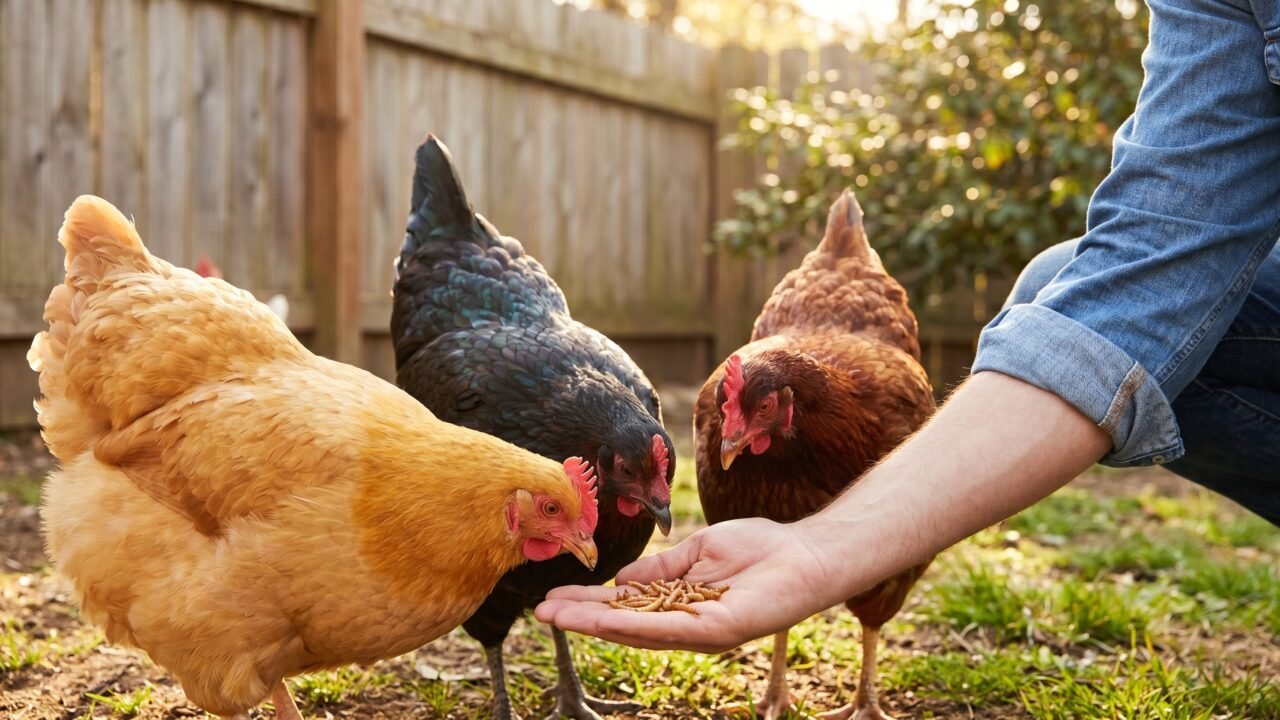
The mechanics are simple. Bring the same treat in the same container every time you approach. Call out a distinctive sound or word as you approach. Within a week or two, most flocks learn that the sound means food is coming, and they'll move toward you rather than away. You've converted an approach from "threat" to "food delivery." From there, you can extend contact time gradually: let them eat from a flat open palm, then sustained contact while eating, then from a hand that also gently touches a back or wing.
The treats that work best for this are small, odorous, and high-value relative to everyday feed. Dried mealworms are nearly universal favorites. Small pieces of fruit or scrambled egg work well too. What you use matters less than the fact that it's distinctly better than their regular ration - which pulls them in even when they're ambivalent about being near you.
One firm limit: treats should stay below 10% of total diet. Texas A&M Extension is clear on this point. Use them for short sessions, not as a food substitute. A bird that fills up on mealworms and ignores its balanced layer feed is heading toward nutritional problems, and an overfed bird loses motivation to work toward the treat anyway.
The daily routine that actually builds tameness
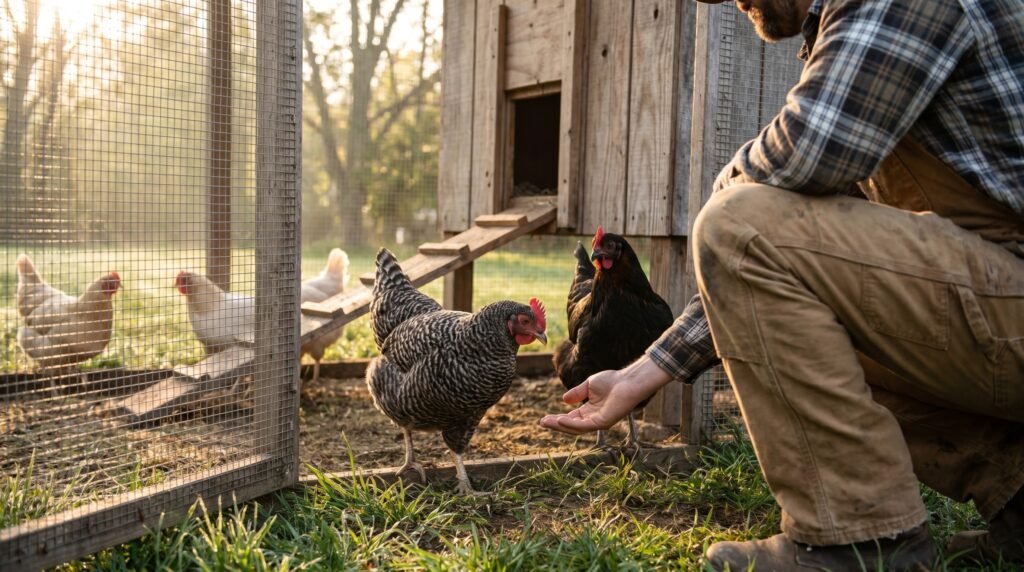
Consistency matters more than session length. A 2022 peer-reviewed study found that exposing broiler chickens to a calm, stationary human twice daily for just five minutes each time reduced measurable fear of humans by 35 days of age. The human did not try to catch or touch the birds - presence alone, repeated reliably, shifted their response. That finding holds a practical lesson: showing up regularly in a predictable, non-threatening way is more valuable than occasional intense interaction.
Build these habits into your existing flock visits:
- Knock or call out before entering the coop or run - the Merck Veterinary Manual specifically notes that giving birds a cue before entering "helps to decrease surprise" and reduces fear reactions.
- Move slowly and at a consistent pace. Rapid or jerky movements trigger startle responses even in birds that are otherwise relaxed around you.
- Squat or sit rather than standing at full height when you want to interact - this reduces your silhouette and makes you less threatening.
- Offer the treat before you try to touch. Let the bird eat, step back slightly, then slowly extend a hand toward the back or side - never toward the face.
- End every session before the bird wants to leave. A chicken that walks away voluntarily after eating is still progressing. A chicken you had to chase to catch is a setback.
For a flock of around 15 birds, plan five to ten minutes twice a day during the socialization phase. That's a realistic commitment and it produces visible results within two to three weeks with cooperative breeds.
Breed differences: what the research actually shows
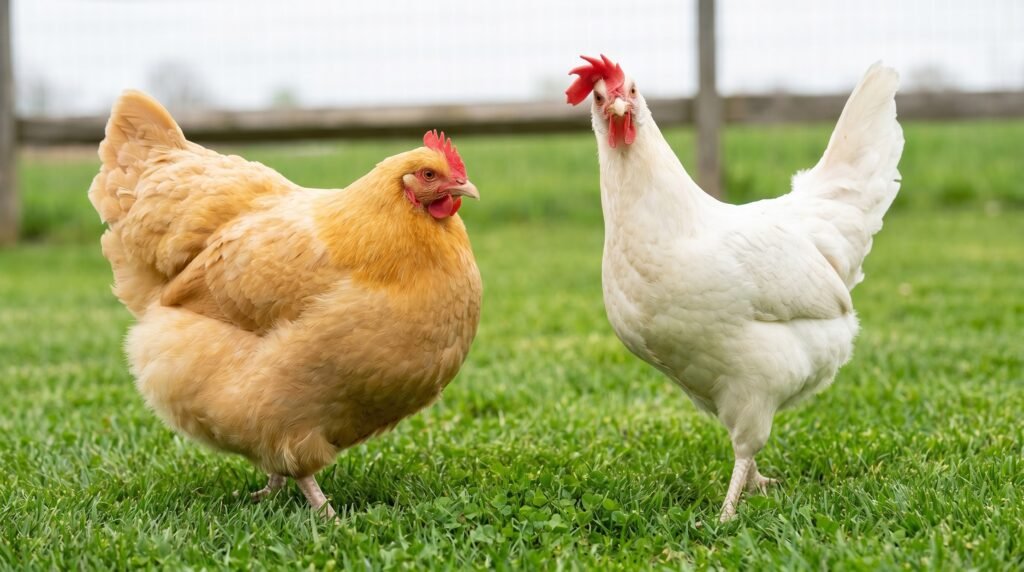
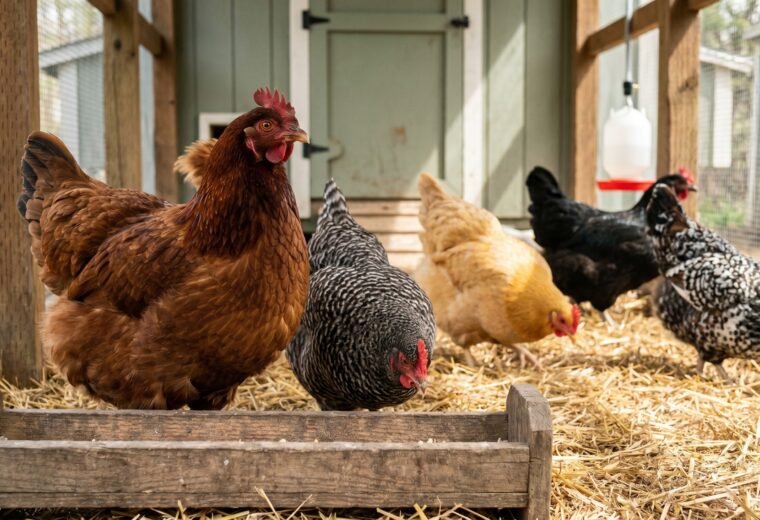
Not all breeds start from the same baseline, and pretending otherwise sets people up for frustration. Mississippi State University Extension classifies backyard chicken breeds into temperament categories based on behavioral observations. Their breakdown is worth having in a single place:
| Temperament category | Breeds | Taming difficulty |
|---|---|---|
| Good-natured / docile | Orpington, Rhode Island Red, Naked Neck | Low - typically gentle with minimal socialization |
| Friendly | Dominique, Australorp, Jersey Giant, Delaware, Java | Low to moderate - respond well to routine handling |
| Nervous / flighty | Leghorn, Ameraucana, Polish | Moderate to high - need extra patience and early starts |
Polish chickens deserve a specific note. Their crests block peripheral vision significantly, so they are frequently startled by things other breeds see coming. MSU Extension describes them as "easily surprised," and that's an understatement if you approach from their blind side. With Polish, always announce yourself with sound first, approach slowly from the front, and expect the socialization process to take longer than with an Orpington of the same age.
Scientific comparisons back this up at a deeper level. A peer-reviewed study comparing commercial and heritage strains found that Rhinelander chickens (a local German heritage breed) showed only about 10% of the approach behavior toward humans that Lohmann Brown commercial layers did, measured across the first ten weeks of life. Heritage and ornamental breeds bred for outdoor foraging and predator vigilance carry more reactive temperaments - that's an adaptation, not a flaw, but it is the starting reality.
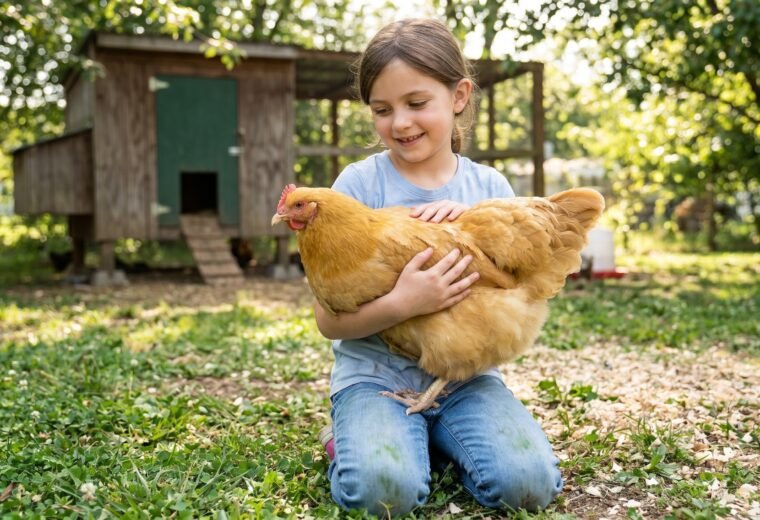
If you're choosing birds specifically for handling and family-friendliness, our rundown of friendliest chicken breeds covers the docility spectrum in more detail, including breed-specific egg production so you don't have to sacrifice one goal for the other. Families with children will also find useful breed comparisons in our article on best breeds for kids and families.
What scares chickens and how to avoid it
Most taming setbacks come from predictable triggers. Understanding them helps you protect the progress you've built.
Overhead approach. This is the single largest source of unnecessary fear in handled chickens. Always reach in from the side, at the bird's level. When picking up a bird, come from behind and slightly below, supporting the body from underneath immediately.
Sudden movement and noise. Merck Veterinary Manual notes that panic spreads bird-to-bird in a flock instantly - one startled bird sets off the rest. A clattering feed bucket, a slammed gate, or a dog rushing the fence can undo a week of calm work. This doesn't mean total silence; it means predictable, consistent sounds rather than sharp surprises.
Strangers and irregular visitors. Chickens learn to tolerate specific people who visit consistently. A stranger entering the coop behaves differently from you in ways birds detect - different cadence, different smell, different posture. Pilot research from 2025 showed that chickens' calm behavioral responses to humans were specific to familiar individuals rather than generalizing to all people. When someone new visits your flock, have them sit quietly near the run first and let birds approach rather than moving toward the birds.
Flock dynamics after handling. When you pick up a lower-ranked bird and then set her down, her flock mates sometimes take the disrupted order as an invitation to assert dominance. If you're regularly handling a specific bird for any reason, do it away from the main flock, and return her to a calm situation. For more on how social rank shapes flock behavior, our piece on chicken pecking order covers the hierarchy structure and what happens when it gets disrupted.
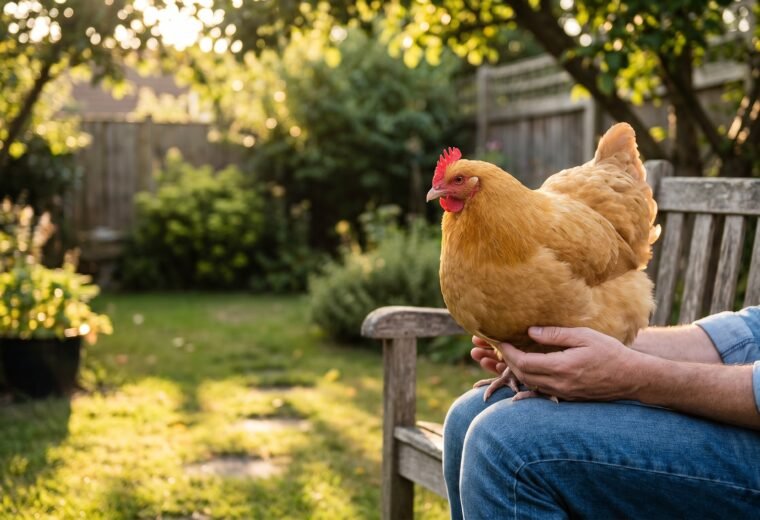
The squat response and what it means. When a hen squats flat to the ground as you approach, she is not frightened - she is displaying submission, which in flock terms is the deference a subordinate shows to a dominant individual. Alabama Extension notes this behavior is how hens show deference to dominant animals, including humans. A hen that squats reliably for you is the most tame bird in your flock, not an anxious one.
Working with adult birds that were never socialized
Older birds that missed early handling can still be gentled, but set realistic expectations. A two-year-old hen raised with minimal human contact has two years of "humans equal stress" wired in. You're not erasing that - you're adding new associations on top of it.
Start with feed-based association, not touch. Bring treats at the same time every day for two to three weeks without trying to touch the birds at all. The goal is getting them to come to you. Once they approach reliably, begin extending a treat-holding hand and waiting for them to eat from it. Contact follows naturally from there - first a brief touch on the back while they're eating, then a short hold, then longer contact.
Some individual birds simply won't tame past a certain point regardless of method. That's not a failure of technique - it's normal variation in individual temperament. A bird that tolerates you at arm's length, eats treats from a container near your feet, and doesn't bolt when you enter the run is a reasonably social bird even if she never becomes a lap chicken. Push past her comfort zone repeatedly and you'll get a more fearful bird, not a tamer one.