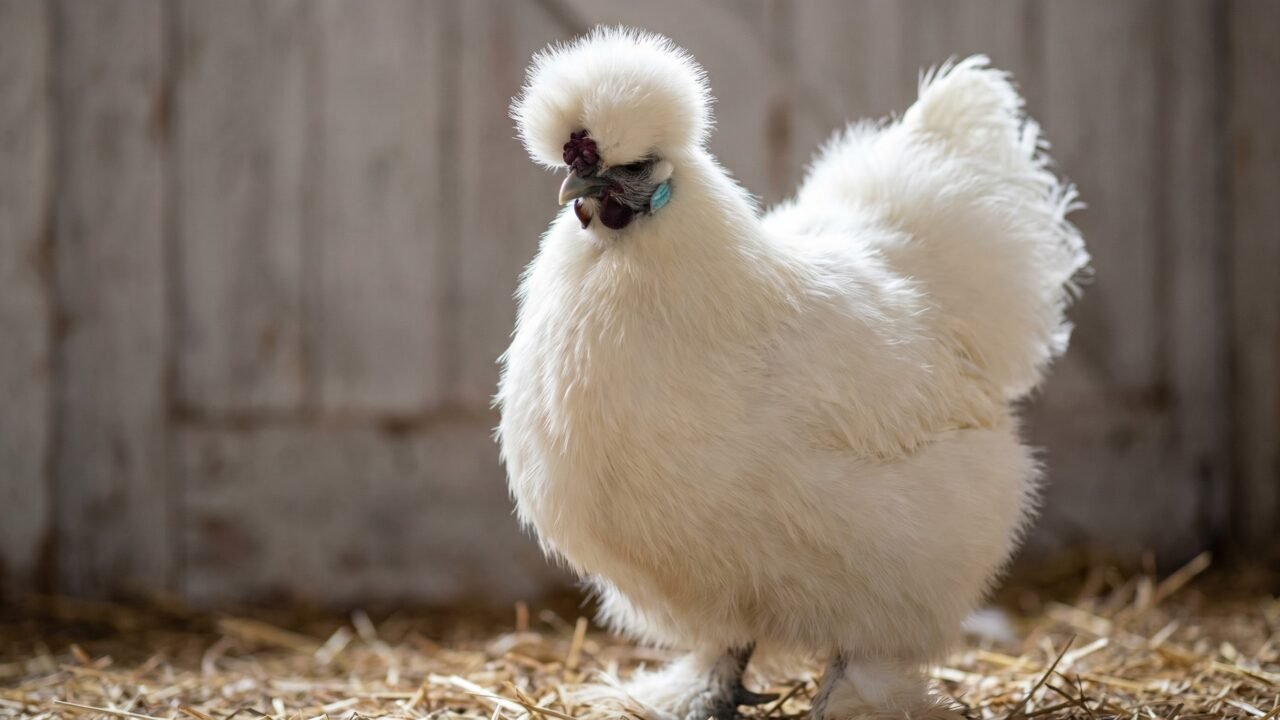
Somewhere between a lap pet and a living incubator, the Silkie sits in a category of its own. Hens lay roughly 100 small, cream-colored eggs a year under ideal conditions, but the breed's real calling card is broodiness: a Silkie hen will abandon a laying streak three, four, or even five times a season to sit on a clutch. If you want a mellow, handleable bird that doubles as a surrogate mother for hatching eggs from other breeds, nothing beats her. If consistent egg production is the goal, a different breed will serve you better.
The following profile covers everything a prospective owner should know: where the Silkie comes from, what the numbers actually mean, and the care quirks that trip up newcomers.
Origin and breed history
The Silkie traces back to ancient China, and the earliest Western record comes from Marco Polo, who wrote of encountering "furry" chickens during his 13th-century travels in Asia. The breed traveled westward through centuries of trade and reached North America by the 1800s, earning a place in the American Poultry Association's Standard of Perfection in 1874, making it one of the oldest breeds on the APA books.
What sets the Silkie apart physically goes deeper than the feathers. The black skin, bones, and grayish-dark muscle are caused by fibromelanosis, a condition driven by a duplication of the EDN3 gene on chromosome 20. Research published in PLoS One (Dharmayanthi et al., 2017) found that Chinese Silkies and Indonesian Cemani chickens share an identical genetic arrangement, pointing to a single ancient origin of this trait, estimated to predate full domestication by thousands of years. The black pigment extends into connective tissue, a trait unusual in any domesticated animal.
In the APA Standard of Perfection the Silkie falls under the All Other Standard Breeds / Feather Legged class (not the Asiatic class, which covers Brahma, Cochin, and Langshan), and in the United States it is shown only as a bantam. Other registries worldwide recognize both bantam and a slightly larger "standard" Silkie, but the bird you will meet at most hatcheries and shows fits in your two hands comfortably.
Size, weight, and what the bird actually looks like
Mature Silkie hens weigh around 32 ounces (2 lb), with cocks reaching 36 ounces, based on APA breed standards. Pullets come in at 28 ounces. For comparison, a Buff Orpington hen is roughly four times heavier. This is a genuinely small bird.
The feathers are the first thing most people notice. The Silkie's plumage lacks functioning barbicels (the tiny hooks that hold a feather's vanes together), so each feather drapes like down rather than lying flat. The result feels more like fur than feathers, and it is beautiful in a theatrical way. The downside is equally theatrical: those feathers cannot shed water, and a Silkie caught in rain will saturate to the skin within minutes. A covered run is not optional for this breed.
Beyond the plumage, the Silkie carries a cluster of distinctive traits that appear together in no other breed:
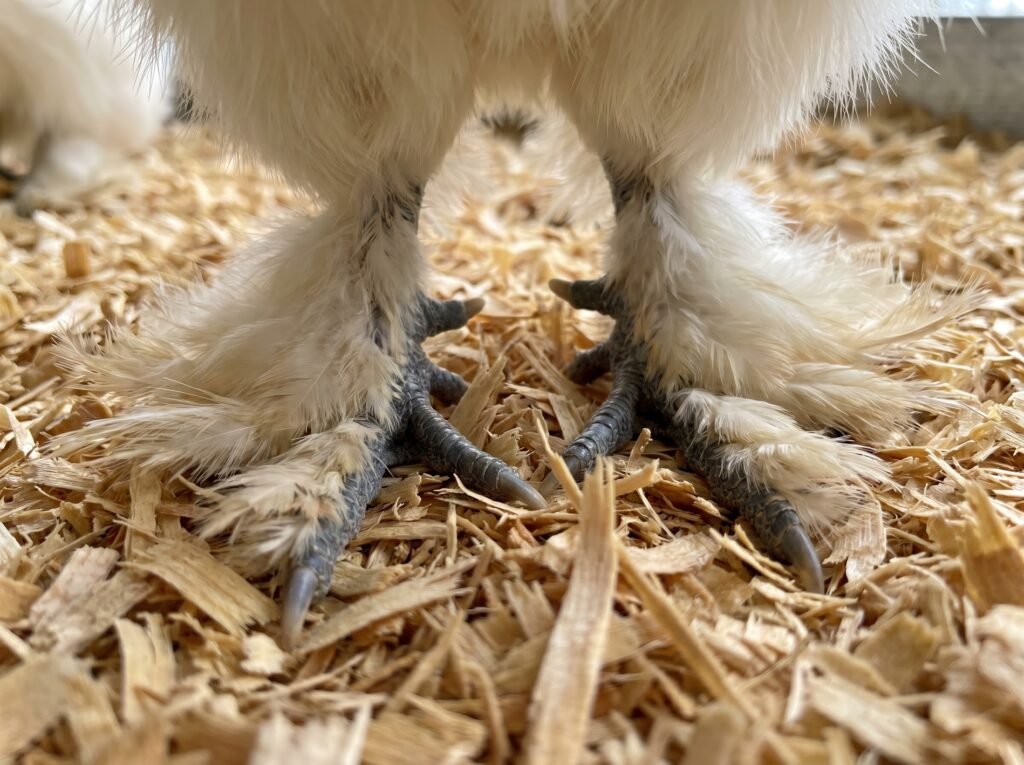
- Five toes on each foot (polydactyly), where most chickens have four
- Black or dark-bluish skin, bones, and grayish muscle
- Turquoise-blue earlobes
- A dark mulberry-colored walnut comb and small wattles
- Heavily feathered legs and outer toes
- A rounded crest of feathers on the skull that can obscure the eyes
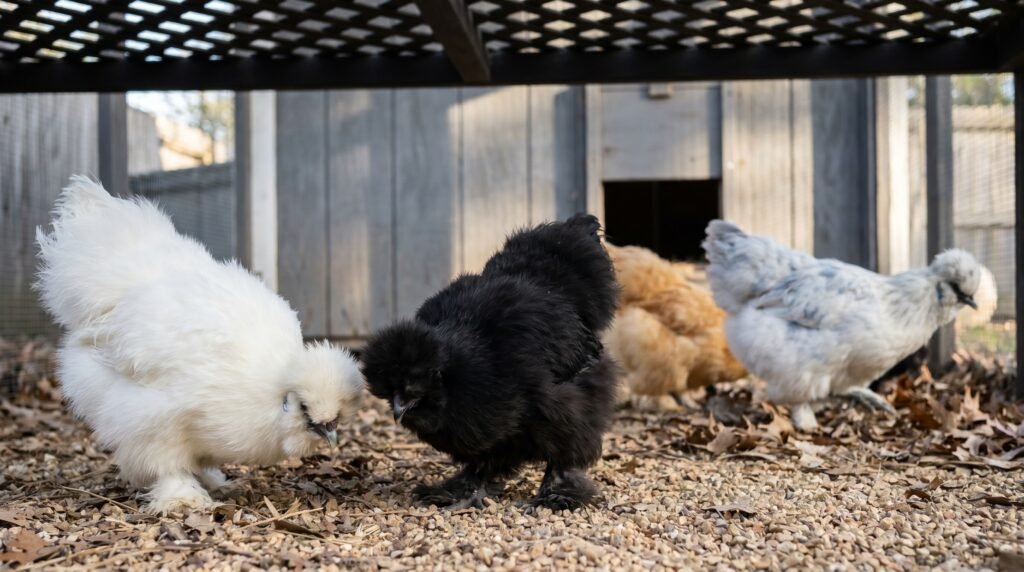
Both bearded and non-bearded varieties exist. Bearded Silkies carry an extra muff of fluffy feathers beneath the beak that covers the earlobes; non-bearded birds show the turquoise earlobes clearly. The APA recognizes seven color varieties: black, blue, buff, gray, partridge, splash, and white, each available in both bearded and non-bearded forms. In practice, breeders work with additional colors not yet on the APA standard.
The crest deserves a separate note. On a well-bred exhibition bird, it forms a full round pom-pom that can genuinely block forward vision. For a pet flock kept away from shows, a small trim around the eyes (or tying the crest back with a soft hair tie) keeps the bird from stumbling around blind. Never trim show birds; clip feathers are a disqualification.
Egg production: what around 100 eggs per year really means
Hoover's Hatchery lists Silkie hens at approximately 100 small eggs per year, and Cackle Hatchery describes production as "good" but notes that broodiness regularly interrupts it. Wikipedia's breed entry puts the ceiling at 100 eggs in an ideal year. Around 100 is a reasonable composite of what hatcheries and breed references consistently report, and real-flock output often falls below that once repeated broody cycles are counted.
To put those numbers in context, consider a small keeper with five Silkies:
| Metric | Silkie (5 hens) | Rhode Island Red (5 hens) |
|---|---|---|
| Eggs/hen/year (est.) | ~100 | 250-300 |
| Eggs/hen/week (avg.) | ~2-3 | ~5-6 |
| Flock total/year (est.) | ~500 | 1,250-1,500 |
| Egg size | Small/bantam, cream or tinted | Large, brown |
| Laying interrupted by broodiness? | Yes, multiple times/year | Rarely |
The math matters for realistic planning. Each broody cycle eats at least three weeks of laying, and a hen that goes broody five times a year can lose two to three months of production even without hatching a single chick. If you break the broodiness promptly by moving the hen to a wire-bottomed broody-breaker crate to cool her underside and interrupt the hormonal cycle, she typically resumes laying within seven to ten days. Letting her sit naturally on nothing can extend the pause to four to eight weeks.
For more detail on managing a sitting hen, our guide on what to do with a broody hen covers the decision tree from "let her hatch" to "break her now."
Eggs themselves are bantam-sized and cream to lightly tinted. They taste identical to any other fresh egg; the small volume is the only real trade-off at the table.
Temperament, handling, and flock dynamics
Hoover's Hatchery describes the Silkie as "among the most docile of poultry," and Cackle Hatchery's listing calls them "naturally people friendly" and "perfect as pets, especially for a family with small children." Those characterizations hold up across what breeders consistently observe. Silkies tend to tolerate handling calmly, rarely peck, and will often squat voluntarily for petting once they know you.
That docility is also the main risk in a mixed flock. Because Silkies are almost never assertive, they tend to land at the bottom of the pecking order when housed with larger or more aggressive breeds. Rhode Island Reds, production Leghorns, and other energetic layers will readily bully a Silkie. The safest arrangement is a flock of all Silkies, or pairing them only with other known-gentle breeds such as Cochins, Faverolles, or Buff Orpingtons. Mixing breed sizes with drastically different temperaments rarely ends well for the smaller, calmer bird.
For families with young children, the Silkie's calm nature is a real advantage. Its size is also a practical advantage: a 32-ounce hen is easy for a child to carry safely. The breed is a common entry point for 4-H poultry projects and exhibition programs for exactly this reason.
Cold and heat tolerance
The Silkie's relationship with weather is the wrong way around from what most keepers expect. The fluffy coat looks warm, but it provides less insulation than normal feathering because the barb-less structure traps less heat. More critically, when those feathers get wet, they stay wet. A soaked Silkie in cold weather is a hypothermia risk.
Practical cold-weather management means a dry coop above all else. Ventilation is still essential, because damp, ammonia-laden air causes respiratory illness, but the ventilation openings should be positioned so rain and snow cannot blow directly onto the birds. A covered run prevents the worst-case scenario of a Silkie standing in a downpour. Roost bars for Silkies work best set low, around 8-16 inches off the floor, because these birds cannot fly up to a standard-height perch. A flat 2x4 laid wide-side-up gives feathered feet the grip they need.
Heat is a different but real concern. Dense fluffy plumage traps warmth, and the crest can limit a bird's ability to locate the waterer when it is already lethargic from heat. Shade, consistent access to cool water, and good airflow are the priorities on hot days. Tying up the crest with a soft hair band during heat waves helps the bird find its drinker and reduces the risk of heat stress.
The broody superpower: why Silkies hatch eggs from other birds
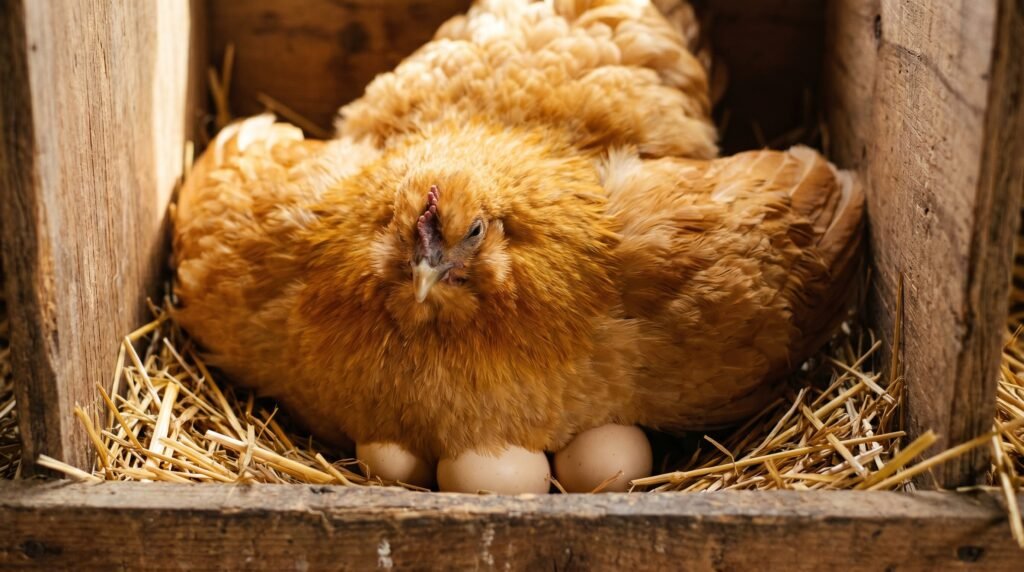
No other domestic chicken breed matches the Silkie's reliability as a surrogate mother. Cackle Hatchery describes their "persistent broodiness and conscientious mothering instincts" as making them "invaluable for hatching eggs of rare or non-brooding poultry without the need for an incubator." In practice, a broody Silkie can cover up to 10 bantam eggs, around six standard chicken eggs, or five duck eggs, depending on her body size and the ambient temperature.
This is genuinely useful in a small flock operation. Rare breeds that no longer go broody reliably, guinea fowl, quail, and even some duck species all benefit from having a Silkie foster their clutch. The Silkie is indifferent to what is underneath her. She will sit on golf balls with the same devotion she gives to fertile eggs, which is both amusing and occasionally maddening when you are trying to keep her laying.
Our companion article on bantam chicken breeds discusses how other small breeds compare as brooders and pets if you are weighing your options.
Care quirks: what first-time Silkie owners miss
A few Silkie-specific care points do not come up in general chicken guides but matter enough to address directly.
Parasite detection is harder. Lice and mites are difficult to spot against dark skin and dense, dark-feathered legs. Northern fowl mites, which live on the bird rather than retreating to the coop at night, can build large populations before a keeper notices any trouble. Check under the crest, around the vent, and along the feathered shanks at least monthly. The feathered legs also invite scaly leg mites, which burrow beneath the leg scales and raise them in a crusty crust. Early detection requires close, regular inspection. A quick visual scan from arm's length is not enough. For active infestations of any external parasite, see a poultry vet for treatment guidance.
Marek's disease susceptibility is above average. The Merck Veterinary Manual notes that "vaccination of all chickens is strongly recommended" against Marek's disease, and Penn State Extension confirms that Silkies are particularly vulnerable to clinical signs. The Marek's virus lives in feather dander and can persist in the environment for years, so a new bird introduced to a previously contaminated space can contract it without any apparent source. Ordering vaccinated chicks from the hatchery is the simplest protection for small flock keepers who cannot access vaccine in small-quantity vials.
Feathered feet need regular checking. Cackle Hatchery's care notes flag that "feathered feet can also collect mud or snow, so foot checks are helpful during messy seasons." Muddy foot feathers become heavy and matted, making the bird uncomfortable and potentially causing feather breakage. In wet periods, check every few days and remove any caked mud gently. Deep pine-shaving bedding kept dry helps; cedar shavings should never be used as they release aromatic oils harmful to poultry.
The beard collects feed and moisture. Bearded Silkies dip their chin feathers into waterers. Nipple waterers reduce beard soaking dramatically and are worth the minor setup effort for these birds.
Silkies cannot fly. This is actually a practical convenience: a two-foot fence will contain a Silkie flock. But it also means they cannot escape ground-level predators the way other breeds sometimes manage. The run must be secure at ground level, with hardware cloth buried or bent outward as an apron to stop digging. A covered run also protects the plumage from rain and prevents hawk strikes.
Who the Silkie suits
The Silkie works best for a keeper who wants a bird with personality over production. Children's farms, school and therapy programs, and 4-H projects all make excellent use of the breed's temperament. Anyone who hatches eggs from breeds that do not go broody reliably (Leghorns, Marans, Welsummers) can keep one or two Silkies specifically to cover those clutches, eliminating the need for an incubator on small batches.
What a typical Silkie keeper's day actually looks like: in the morning you open the pop door, top up the nipple waterer (essential for keeping beards dry), and do a quick visual scan of each bird's crest, feet, and vent. Every week or two you run your fingers through the foot feathers to check for caked mud or the early signs of scaly leg mites. Two or three times a season you will probably find a hen glued to a nest box with no intention of leaving - you decide whether to let her hatch something useful or move her to a broody-breaker crate for a week. The routine is not burdensome, but it is more attentive than what a flock of production breeds requires.
Minimum practical housing for a small group of four to five Silkies: a covered run (rain soaks them to the skin fast), a coop with good ventilation but no drafts at roost height, low roost bars at 8-12 inches, and dry pine-shaving bedding refreshed frequently. A simple A-frame or small shed coop keeps costs modest. The non-negotiable is the roof over the run.
| Good fit | Poor fit |
|---|---|
| Families with young children wanting a handleable bird | Keepers who need reliable year-round egg volume |
| 4-H and school/therapy programs | Cold, wet climates without covered housing |
| Mixed-species hatching without an incubator | Flocks with assertive large breeds |
| Keepers who enjoy hands-on daily interaction | Keepers who want a fully low-maintenance bird |
If you are new to chickens and weighing breeds, our overview of chicken breeds lays out the full spectrum from production layers to exhibition ornamentals so you can compare the Silkie against other options side by side.