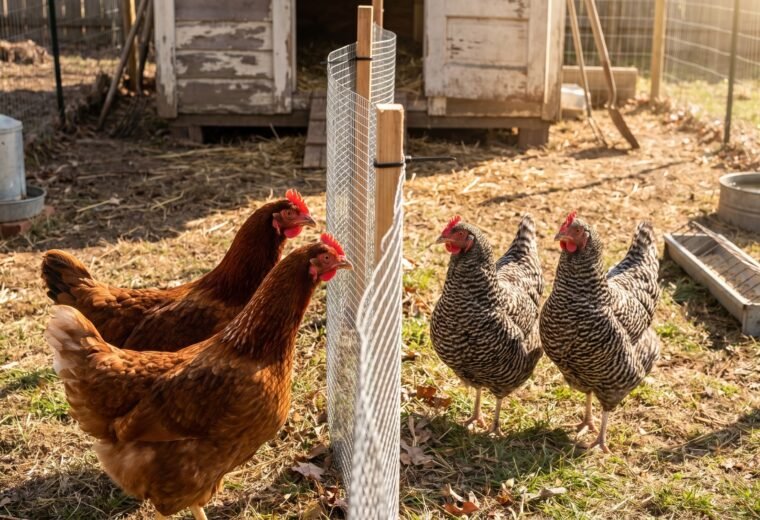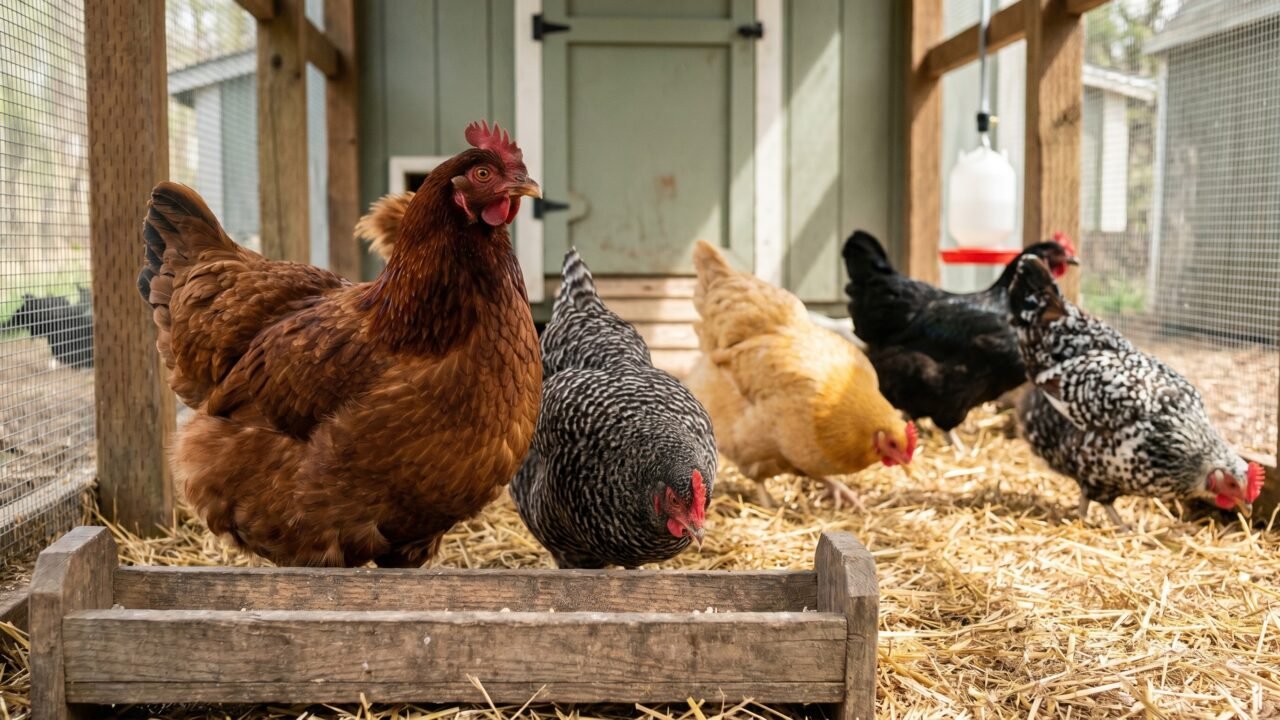
Walk up to a mixed flock at feeding time and you will see it instantly: one hen rushes in, grabs the best spot, and the others step aside. That polite-looking shuffle is the chicken pecking order at work. Every bird knows her rank, and for most of the day the hierarchy hums along without drama. The trouble starts when keepers do not recognize the difference between normal sorting-out and the escalating aggression that can injure or kill a bird in hours. Understanding how this social system works is the first step to managing it well.
What the pecking order is and why chickens need it
A chicken pecking order is the ranked dominance chain that governs who eats first, who roosts where, and who yields in a flock. Every bird holds a position relative to every other bird, and a well-settled hierarchy means far less daily conflict. Without it, chickens would fight repeatedly for every resource. Understanding the system gives a keeper the tools to manage it.
The term "pecking order" comes from Norwegian zoologist Thorleif Schjelderup-Ebbe, who formally described the dominance hierarchy in his 1922 German paper "Beitrage zur Sozialpsychologie des Haushuhns." His 1935 English-language contribution was a chapter in the Handbook of Social Psychology - often cited by extension services as the point where the concept reached wider English-speaking audiences, but the foundational observation predates that by over a decade. Every bird holds a rank relative to every other bird, in a system built from one-on-one pairings: one is dominant, one is subordinate. The Merck Veterinary Manual describes the structure clearly - "This hierarchy is made up of dyads, with one bird dominant and the other subordinate," with each pairing settled through early contests.
This structure matters because it prevents constant fighting. Once the ranking is settled, dominant hens maintain their status through posture, a hard stare, a lowered head, or a short chase - not repeated brawls. The Merck Veterinary Manual notes that "once established, the hierarchy is very stable, and rank is reminded with body gestures rather than aggression." A functioning pecking order is actually peaceful. The chaos happens during gaps: when new birds arrive, when an existing bird falls ill and loses her edge, or when a rooster is removed and the whole ranking reshuffles.
Chicks begin establishing their order remarkably early. The Alabama Cooperative Extension System documents that "the social hierarchy in chickens starts to establish itself about 1 week after hatch and is fully established around 6 weeks of age." Pullets in all-female groups tend to lock in a stable order by around 10 weeks, or as early as 8 weeks in smaller groups, according to eXtension's small-flock poultry resources. Cockerels take considerably longer, and their contests are more intense.
Roosters occupy a separate position above the hen hierarchy. A cock does not slot into the female pecking order - he presides over the entire flock. Hens still maintain their own ranking among themselves regardless of whether a rooster is present.
Normal sparring versus harmful bullying: a practical guide
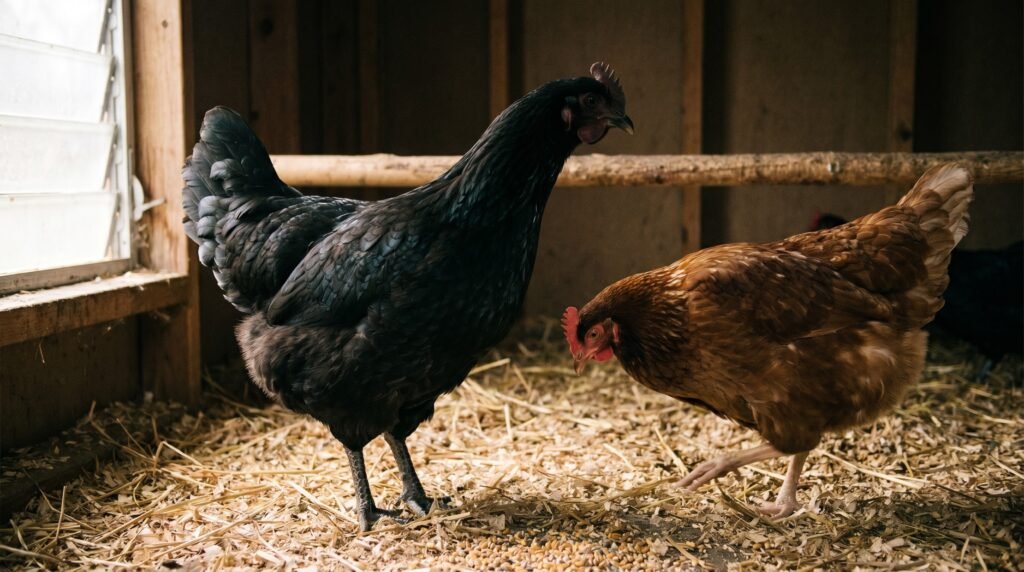
Watching two birds square off is unsettling if you are new to chickens, but most brief confrontations are normal. Knowing what to look for stops a keeper from panicking over healthy sorting-out - or missing a real crisis.
| What you observe | What it means | Action needed |
|---|---|---|
| Brief chase, peck to the head or neck, subordinate bird moves away | Normal rank reminder; subordinate conceded | None - monitor only |
| Two birds circling, eye contact, feigned ground-pecking before a short fight | Rank dispute; typical during introductions or reshuffling | Watch; separate only if blood appears |
| Aggression resolves within 24-48 hours, no open wounds | Normal reordering after a flock change | None - this is expected |
| One bird repeatedly targeted and cannot reach feed or water | Social exclusion; subordinate is being starved out | Add feeders and waterers; separate if severe |
| Feathers pulled, bare patches visible on back or head | Escalated feather pecking; potential precursor to cannibalism | Separate injured bird; apply anti-peck spray; investigate cause |
| Raw skin, bleeding wounds, other birds gathering around the spot | Active cannibalism beginning | Isolate injured bird immediately; treat wound; address root cause |
| Vent pecking during or after egg-laying | Dangerous cannibalism targeting exposed tissue | Emergency isolation; dim the nest box area; see a poultry vet if prolapse is present |
The escalation from normal pecking to cannibalism is a documented risk every flock keeper should understand. The Merck Veterinary Manual points out that "a bloody wound often attracts other birds to peck at it," meaning an untreated scratch can become a flock-wide emergency within a single afternoon. Speed matters once blood is drawn.
Feather pecking is its own problem, separate from routine rank-setting pecks. Mississippi State University Extension cautions that feather pecking "may also be a learned behavior that spreads rapidly" through a flock and is "difficult to reverse" once established. One determined feather-pecker can teach the habit to the whole group within days. Catching it early and finding the trigger is far easier than stopping a flock-wide outbreak.
Why flocks become dangerous: the root causes of bullying and cannibalism
Cannibalism and chronic bullying almost always have a correctable cause. The Merck Veterinary Manual groups the triggers into four main areas: genetics, crowding, excessive light intensity, and nutritional imbalances. In practice, most backyard flock problems trace back to one or more of these.
Space. Extension.org's small-flock housing guidelines specify a minimum of 3-4 square feet of indoor space per laying hen, with 10 square feet per hen outdoors recommended. Those are minimums, and experienced keepers consistently report less feather damage in flocks managed at 5-6 sq ft per bird indoors and 15 or more sq ft per bird in a covered run. Birds that cannot get away from an aggressor cannot submit, so fighting escalates. The coop size per chicken article walks through the math for different flock sizes and run configurations.
Light intensity. Bright light raises aggression directly. Extension guidelines state never to use a white bulb more powerful than 40 watts in the coop, and to target 1.0 to 2.0 foot-candles as the normal standard for a laying house. If feather pecking or cannibalism is already active, dimming down to 0.5 to 1.0 foot-candles is the recommended correction. More than 16 hours of light per day also increases hostility. Red and blue-tinted bulbs are measurably less stimulating than white ones for the same wattage.
Nutrition. Protein shortfalls - particularly a deficiency in the amino acid methionine - are a well-documented driver of feather pecking. eXtension's feather-pecking guidance states that "feed lacking protein and other nutrients, particularly the amino acid methionine," triggers the behavior. A standard layer feed at around 16% protein covers most flocks in lay, but birds coming out of a hard molt, or growing pullets on undersized rations, can run short. Sodium and phosphorus gaps also increase picking. Providing grit and oyster shell free-choice handles the mineral side.
Breed. Light breeds such as Leghorns, Anconas, and Hamburgs are documented to be more prone to feather pecking and cannibalism than heavier dual-purpose breeds. According to Mississippi State Extension, "light breeds are more susceptible than heavier breeds to feather pecking and cannibalism behaviors." That does not make light breeds a bad choice, but they need more enrichment and more careful management of space and light.
Boredom and barren environments. The Alabama Cooperative Extension System links blocked foraging and comfort behaviors directly to aggression: preventing those natural outlets "causes frustration leading to aggressive feather pecking, egg eating, and cannibalism." A flock with nothing to do directs its energy inward.
Enrichment and management: what actually reduces bullying
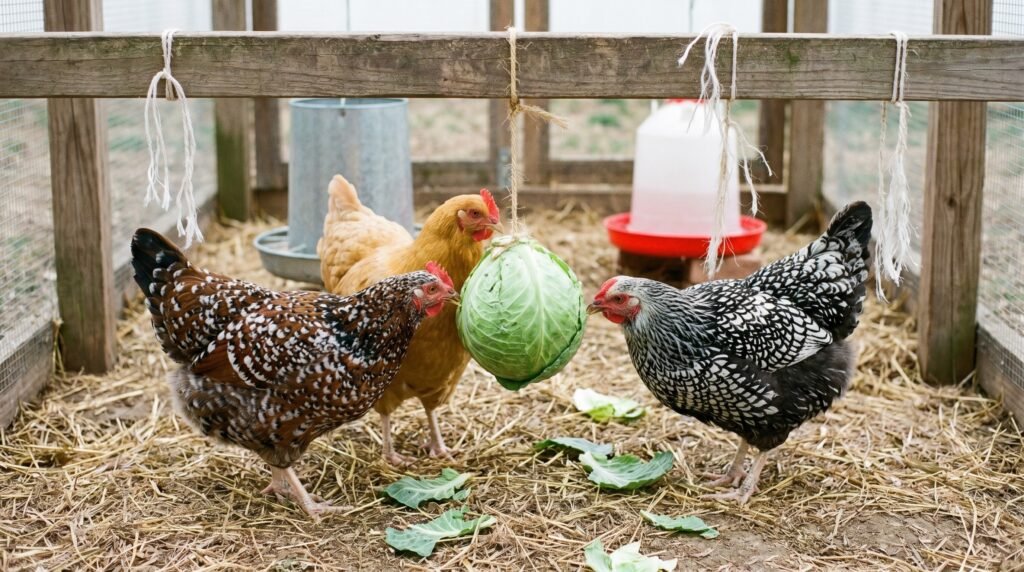
Once you have the basics of space and nutrition covered, enrichment is the most reliable tool for keeping aggression at a low simmer. The goal is giving birds something to do other than peck each other.
University of Nebraska-Lincoln Extension identifies the most effective environmental interventions: "nest boxes, perches, foraging opportunities, and other things that might redirect pecking away from flock mates." University of Maryland Extension adds a simple, proven trick - hang four to eight pieces of white string or twine in the run. Birds peck at the strings instead of each other. It sounds almost too simple, but it satisfies the exploratory pecking drive without a victim.
Other enrichment approaches that keepers and extension advisers consistently recommend:
- A head of cabbage or a leafy brassica hung at head height gives the flock a moving target to peck and chase throughout the day.
- Deep litter - 4-6 inches of wood shavings, straw, or a mix - enables scratching and foraging behavior all day long. Keepers who have compared deep-litter and shallow-bedded setups side by side typically report less feather damage in the deeper-litter coop.
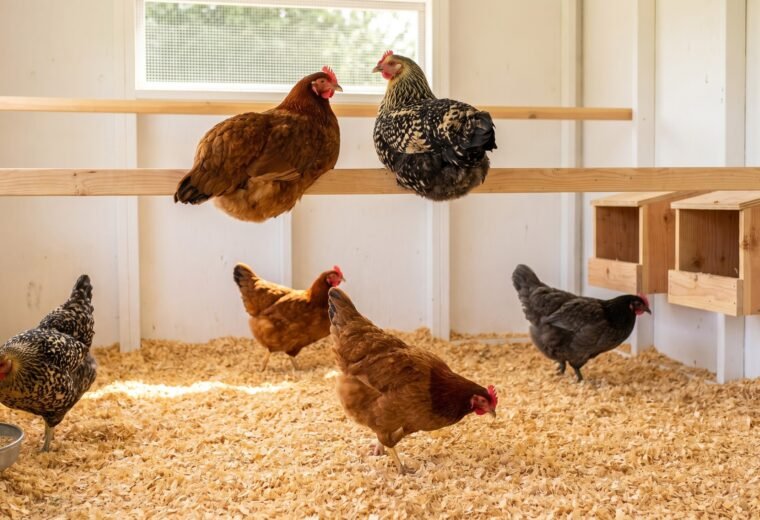
- Perches at multiple heights give lower-ranking birds an escape route that ground-level space cannot provide. A subordinate hen that can hop to a second bar is no longer cornered. Aim for at least 8-10 inches of bar per bird, at varying heights, set higher than the nest boxes so the roost remains the premium resting spot.
- Multiple feed and water stations. A single feeder dominated by the top hen means lower-ranking birds eat less, lose condition, and become more attractive targets. A common guideline is one feeder station per five to six birds, spread across the run rather than clustered in one corner.
Keeping your birds comfortable and low-stress overlaps directly with broader flock health. The chicken health article covers parasite checks, respiratory signs, and the daily observation habits that catch problems early.
Introducing new birds without a war
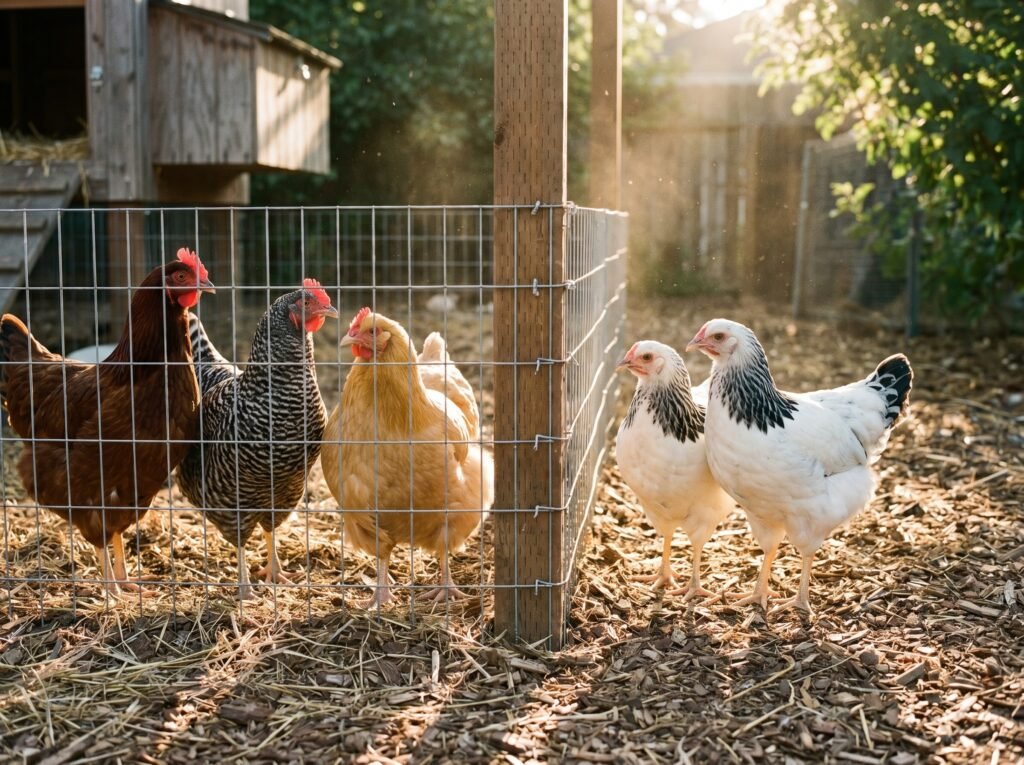
Adding birds to an established flock is the single most common trigger for a pecking crisis. The Merck Veterinary Manual states that "stress or changes in the environment, such as the addition or loss of a flock member, can cause the hierarchy to collapse." Every bird then has to re-establish dozens of individual pairings simultaneously. That is genuinely stressful, and the fighting during this period is not brief.
The approach that consistently reduces injury is a see-but-can't-touch introduction period before full integration. New birds stay in a separate enclosure inside or adjacent to the run, so both groups can observe each other through wire for seven to 14 days. By the time the partition comes down, each bird has already formed some mental model of the newcomers' status. True first-contact fights are shorter and less severe. The introducing new chickens article covers when to remove the partition, what warning signs to watch in the first 48 hours, and how to handle a bird that refuses to accept newcomers.
A few additional points that smooth the transition:
- Introduce at night. Birds placed on the roost after dark wake up together, and the initial burst of daytime energy that drives attack behavior is blunted.
- Add birds in groups rather than singles. One new bird is an easy target; three or four new birds spread the hazing across more interactions.
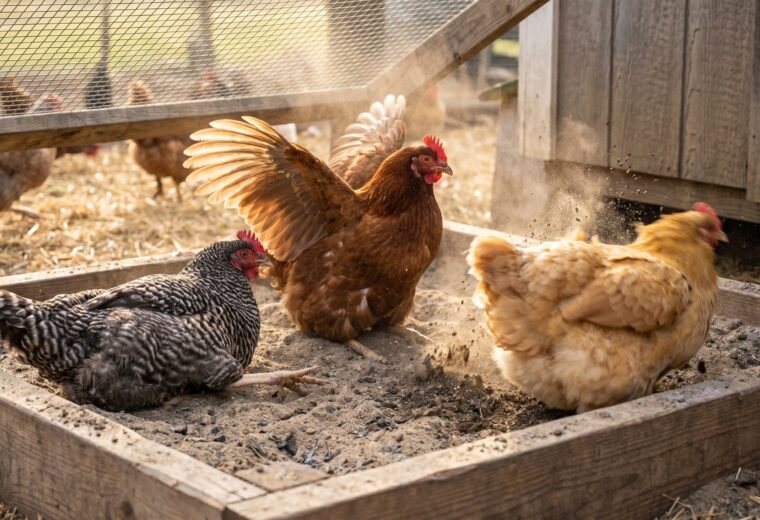
- Rearrange the furniture. Moving feeders, adding a second dust bath area, or briefly covering the run with extra windbreak panels creates enough novelty that the established birds spend mental energy re-exploring rather than re-policing rank.
- Match size. Small bantams mixed into a standard flock are at a structural disadvantage. When in doubt, keep breeds of similar size together.
When the pecking order breaks down: a step-by-step response
If feather damage, blood, or clear social exclusion is already happening, act in this order:
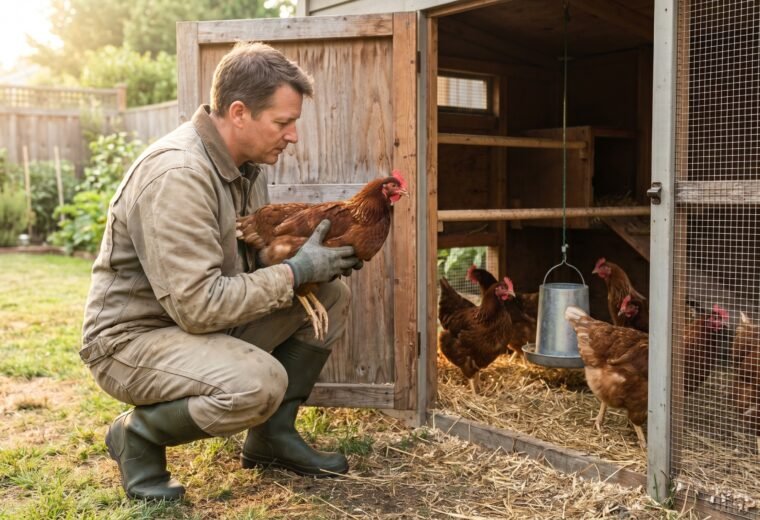
- Remove the injured bird immediately. Wounds attract more pecking. Examine the wound before anything else. A deep open wound, a wound near or at the vent, or any sign of prolapse (tissue protruding from the vent) is a veterinary emergency - call a poultry vet now rather than working through the remaining steps first. For surface wounds, clean the area and apply a blue-colored anti-peck spray; the color masks the injury visually. Do not return a visibly wounded bird to the flock until the wound is fully healed and the skin color blends with surrounding feathers.
- Identify the aggressor. Watch the flock for 15-20 minutes. Usually one or two birds are responsible for most of the damage. Remove the ringleader and keep her separate for five to seven days. Birds lose rank during absence, so the returning bird often re-enters lower in the order and the harassment pattern breaks.
- Dim the lights. Drop intensity to the 0.5-1.0 foot-candle range right away as an active correction measure. If you are using supplemental light to extend the laying day, consider whether the benefit is worth the behavioral cost during a crisis period.
- Check nutrition. Confirm the protein percentage on your feed bag matches the life stage: grower feed at 18-20% protein, layer feed at around 16%. If birds have been on restricted rations or poor-quality feed, a brief switch to a higher-protein flock raiser (18-20%) while the situation stabilizes can help.
- Add space and enrichment. Hanging strings, a foraging block, extra perch space, or moving to a larger run - any of these reduce the boredom-driven pecking that amplifies a crisis.
- If the behavior continues and is causing real injury, see a poultry vet. A practitioner can assess whether the flock has an underlying health stressor, evaluate nutrition more precisely, and advise on beak trimming if needed. Chronic cannibalism that does not respond to management changes warrants professional eyes.
The flock size factor most keepers overlook
Here is a piece of poultry biology that surprises most backyard keepers: the stability of the pecking order depends on whether individual birds can actually recognize each other. Extension.org's research summary notes that "laying hens are able to recognize around 30 individuals" and that "the social structure developed in small groups begins to break down in flocks of 30 to 60 birds." Above 60 birds, chickens become "less aggressive and more tolerant of each other" - which sounds paradoxical, but makes sense once you realize that without individual recognition, the strict hierarchy simply cannot be maintained.
For most backyard keepers running flocks of six to 30 birds, this means you are operating right in the range where individual recognition is fully active and every social disruption is felt. A flock of four hens reshuffling after one bird dies will fight harder for rank than a commercial flock of 500 that has given up tracking individuals at all. Small flocks feel every change acutely - and that is normal, not a sign that your birds are unusually aggressive.
The practical implication for small-flock management: keeper experience and extension guidance consistently align on the same pattern. Flocks of six to eight birds typically stabilize within three to five days of a new introduction when the see-but-can't-touch protocol is used. Flocks where new birds were dropped in cold tend to show active feather damage for two to three weeks, with roughly half experiencing real injury. The difference traces almost entirely to the introduction method, not the breed or coop size.