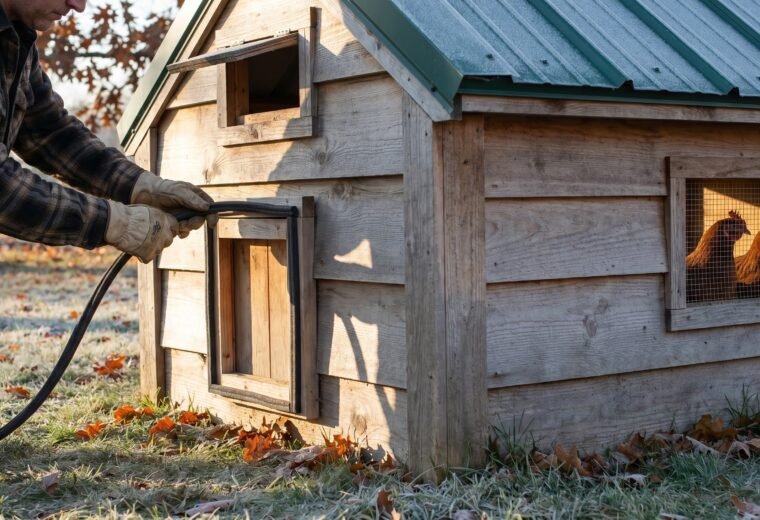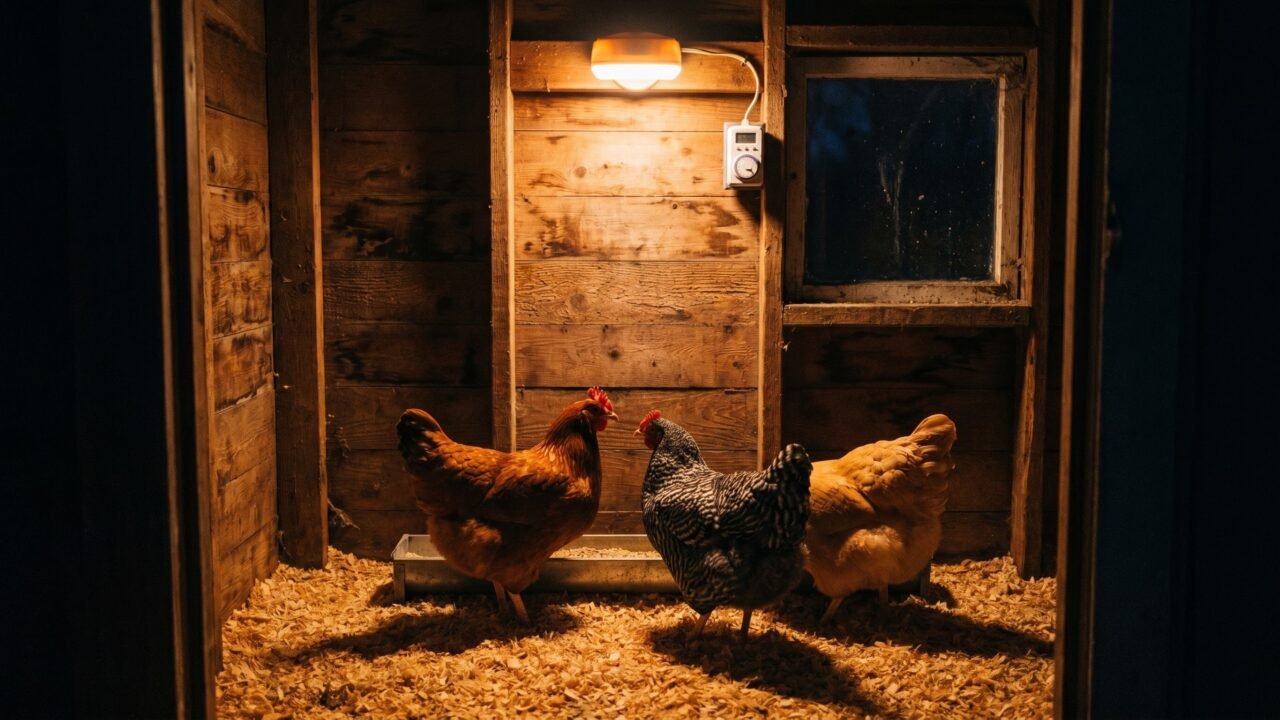
Fourteen hours. That is the threshold. Once natural daylight drops below roughly 14 hours per day - which happens across most of the US from October through February - hens start winding down their laying cycle, and many stop entirely. Supplemental light for chickens is simply the practice of making up that shortfall with a bulb and a timer. Whether it is the right call for your flock depends on what you want from your hens and how you weigh a genuine welfare tradeoff.
Here is the short version: light works, it works reliably, and the setup is simple. The live debate is about what happens to hens that never get a seasonal rest.
Why light controls the laying cycle
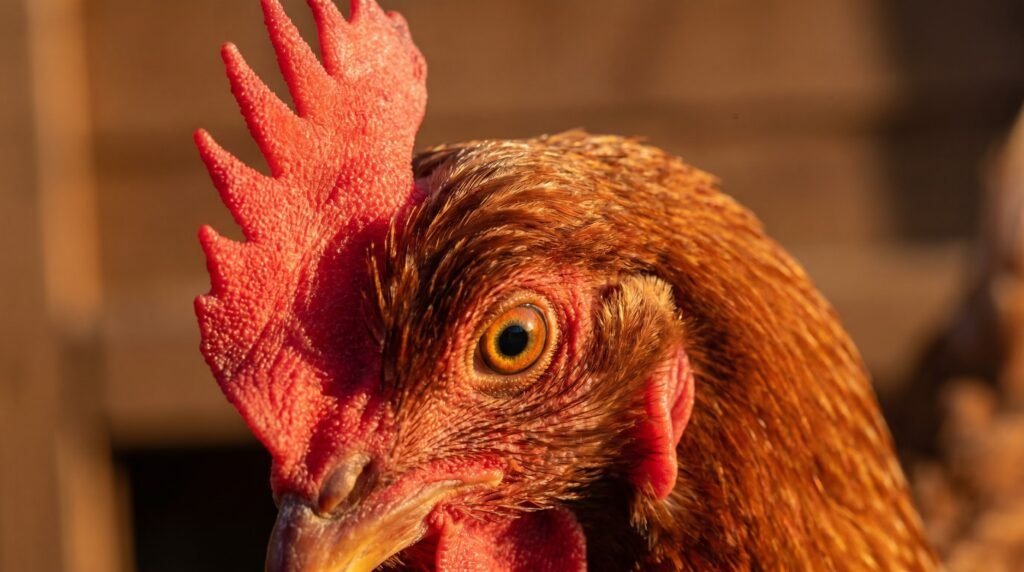
Chickens are not triggered by temperature or cold - they are triggered by day length. As daylight shortens into fall, deep-brain photoreceptors in the hypothalamus (including the paraventricular organ and lateral hypothalamic area) detect the reduced light signal directly. The pineal gland plays a complementary role: it releases melatonin during dark periods, and that rising melatonin level acts as a dark-signal that suppresses the hypothalamus and pulls back on gonadotropin-releasing hormone (GnRH). Without GnRH, the pituitary stops releasing the luteinizing hormone (LH) and follicle-stimulating hormone (FSH) that drive ovulation. No LH spike, no ovulation, no egg. The same mechanism in reverse is what supplemental light exploits: keep the perceived day long enough, and the hormonal cascade keeps running.
UF/IFAS Extension puts the minimum threshold plainly: "Hens need about 14 hours of day length to maintain egg production." Below that number, "decreasing daylength during the fall and shorter day lengths in the winter would be expected to cause a severe decline, or even cessation, in egg production unless supplemental light is provided." The ceiling is 16 hours per day - exceeding it does not increase production and wastes electricity. Penn State Extension is specific: never exceed 16 hours of light per day for laying hens.
This is also why a power outage that lasts more than a day or two can disrupt a lit flock mid-winter. A sustained disruption - even a few days of darkness - can begin to disrupt the hormonal cycle and delay or derail egg production for weeks. Consistency is not optional - it is part of how the system works.
The seasonal triggers behind winter slowdowns - including how breed and age affect the response - are laid out in the winter laying patterns overview.
The welfare debate: rest versus eggs
This is the part most lighting guides skip. Keeping hens under 14-16 hours of light year-round is not neutral from a welfare standpoint - it is a choice to suppress the natural molt-and-rest cycle indefinitely.
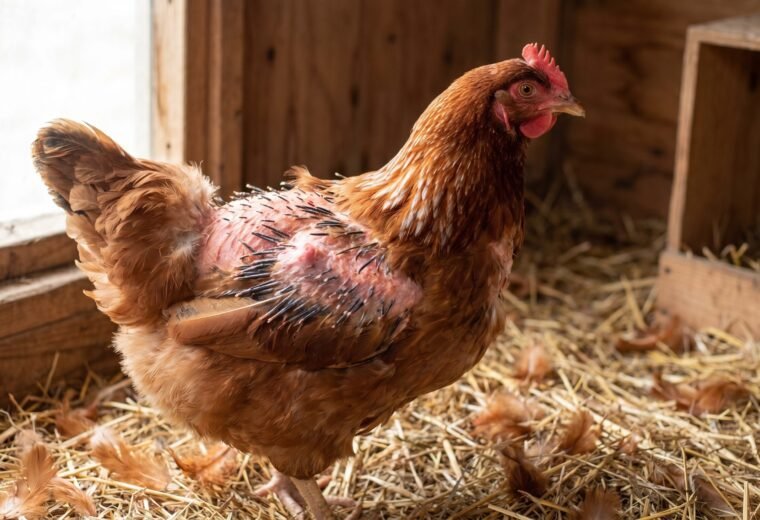
In nature, and in unlit backyard coops, hens slow or stop laying each fall, go through molt (losing and regrowing feathers), and resume production in spring. UF/IFAS Extension describes this rhythm: "Good layers will lay for about 50 to 60 weeks and then have a rest period called a molt," with production resuming the following season. That rest period allows the reproductive tract to recover, feather condition to improve, and calcium stores in the bones to partially rebuild.
The welfare concern runs in both directions, though. Forced molt by abruptly withdrawing feed and light - a practice once common in commercial production - carries its own documented problems, including elevated mortality risk and immune suppression during the starvation phase. Penn State Extension notes that commercial operations now often skip molt entirely, reflecting "welfare concerns over molting." Abrupt light withdrawal in a backyard flock, even without feed restriction, creates the same hormonal shock that Penn State flags as "potentially deadly" in extreme cases.
For backyard keepers, the practical question is simpler: do you want eggs through winter, or do you want your hens to follow their natural rhythm? Both are defensible choices. Penn State Extension notes "it does not harm birds to allow natural molting during winter as an alternative to artificial lighting." What matters is that you choose deliberately rather than defaulting to whichever requires less thought.
What to expect during molt - timing, feather regrowth, and feed adjustments - is laid out in detail at the complete molting guide.
Light setup: making it work safely
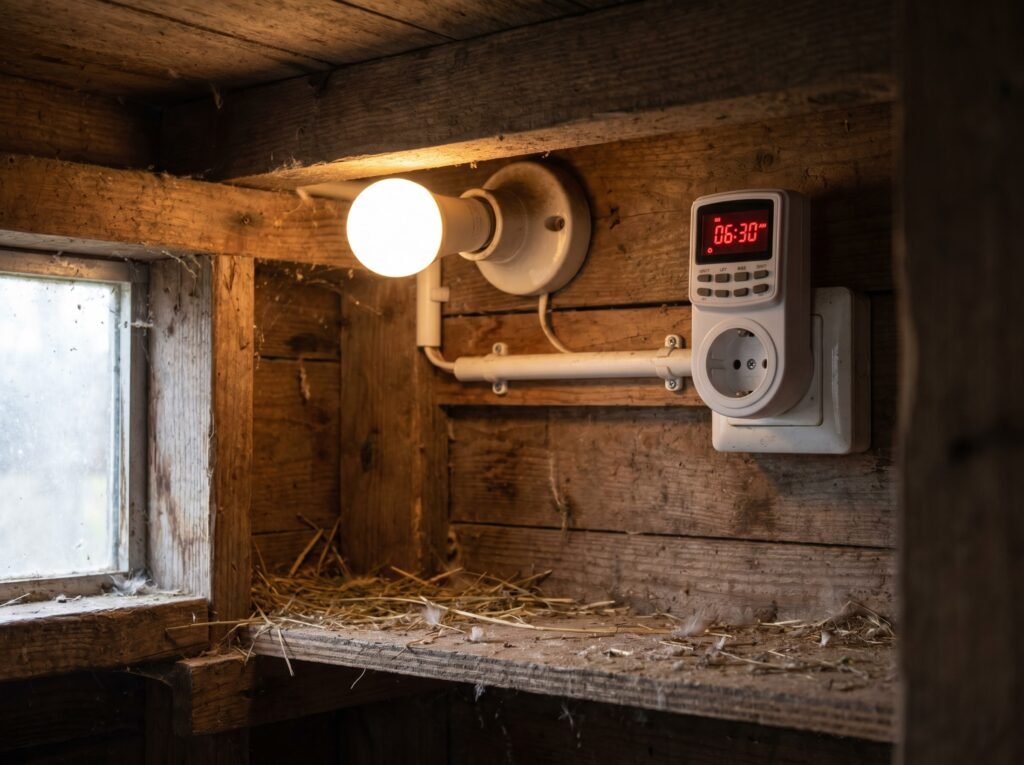
If you decide to add supplemental light, the setup is genuinely uncomplicated. A few specific decisions matter; the rest is just consistency.
How much light and what kind
Hens do not need a bright coop. The industry standard - and what extension services from Maine to Florida agree on - is that intensity should be enough to read newsprint at bird level. That works out to roughly 0.5 to 1 foot-candle (about 5 to 10 lux). Extension.org's poultry resource notes: "The supplemental light you provide does not have to be overly bright. A typical 60-watt incandescent light bulb works fine for a small laying flock."
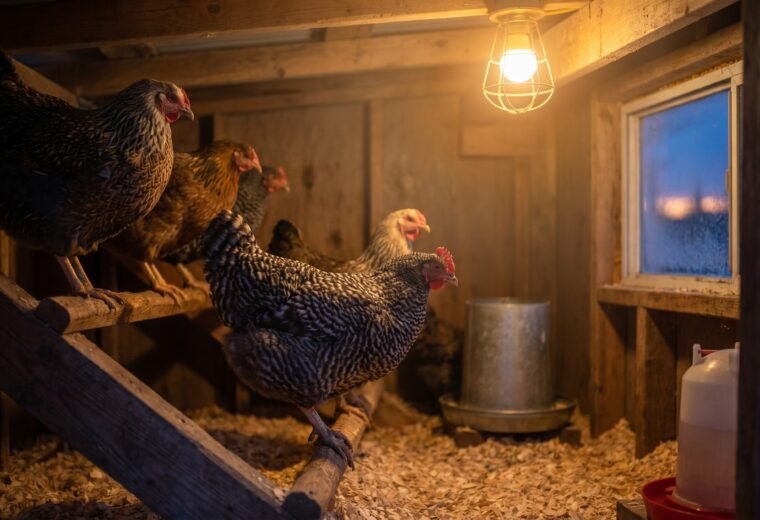
In practical terms for a 100-square-foot coop, a single 9-watt warm-spectrum LED mounted 6 to 7 feet off the floor is sufficient. Penn State Extension specifies using bulbs with a color temperature below 3500K - the orange and red end of the spectrum - because those wavelengths are more effective at photostimulating reproduction than cool blue-white light. LEDs have a clear practical advantage over incandescents: they run cool, consume far less electricity, and pose much lower fire risk.
Strong light does the opposite of what you want. Poultry extension guidance is consistent that high intensity "can result in bird stress and increased incidences of feather pecking and cannibalism." Keep it dim enough to be functional, not enough to read across the coop.
Timing: morning light is easier to manage
The standard approach is to add light in the early morning before sunrise, then let natural sunset end the day. This way you are not fighting against the hens' roosting instinct - they still go to bed when daylight fades. If you are in a latitude where December days are 9 hours long, you would set the timer to add about 5 to 7 hours of pre-dawn light to reach your 14-16 hour target.
An automatic timer is not optional. University of Maine Cooperative Extension is direct: timers are "really a necessity to ensure that the birds receive a uniform number of hours each day." Manual switching will eventually result in an inconsistent schedule, which is worse than no supplemental light at all. A forgotten day here and there disrupts the hormonal cycle.
The transition rule
Never jump from natural short days to 16 hours overnight. Penn State Extension recommends changing the photoperiod no more than one hour per week. Increase light gradually when you start the program in early fall, and if you ever wind it down, taper it gradually too. Abrupt changes throw off the reproductive cycle - Penn State's guidance states they can be "potentially deadly" in extreme cases, though that framing applies primarily to situations where laying hens unexpectedly experience sudden dark periods.
For pullets coming into their first laying season, do not start photostimulation until they are at least 17-20 weeks old - UF/IFAS Extension and Penn State Extension both identify this window as the appropriate minimum before stimulating laying in growing birds. Forcing early sexual maturity in young birds causes smaller initial eggs, reduced lifetime production, and risk of reproductive prolapse.
Safety is the non-negotiable part
The fire risk in a coop is real. Coops combine dry bedding, accumulated dust, and electrical equipment - exactly the conditions that turn a faulty connection into a catastrophe. A few rules that matter:
- Use a UL-listed timer and an LED bulb rated for enclosed fixtures. LEDs run far cooler than incandescents and nearly eliminate the ignition risk that hot bulbs create near litter.
- Run wiring through conduit, not exposed along the walls. Chickens will peck at anything - including wire insulation.
- Mount the light where birds cannot reach it. Perching directly under a hot bulb, or jumping up to peck at it, is a documented problem.
- Check the bulb monthly. Dust accumulation on a bulb reduces output significantly and, on incandescents, creates a heat concentration point.
- Use GFCI-protected outlets for any coop electrical work. Coops collect moisture, and GFCI protection is standard electrical code in wet locations.
Insulation, ventilation, and electrical prep for winter - including coop wiring safety - are addressed together in the coop winterizing guide.
The light-versus-rest decision table
Most of the relevant variables are laid out below. These are the factors that actually differ between a lit flock and an unlit one - not a marketing comparison, just the tradeoffs as extension research and practical experience describe them.
| Factor | With supplemental light (14-16 h/day) | Without supplemental light (natural cycle) |
|---|---|---|
| Winter egg production | Maintained at or near peak | Drops significantly or stops Oct-Feb |
| Annual molt | Suppressed; molt does not occur on schedule | Occurs naturally each fall; lasts 8-12 weeks |
| Feather condition mid-winter | Unchanged - no feather renewal | Fresh feather coat after molt completes |
| Egg quality post-rest | No rest period; quality stays consistent | Egg size and shell thickness typically improve after molt |
| Setup cost | Timer + LED + wiring; low ongoing electricity cost with LED | No additional cost |
| Management requirement | Daily timer reliability; monthly bulb check; consistent power | Feed adjustment during molt (higher protein); patience |
| Welfare stance | Accepted as sound when hens are well-nourished; no evidence of harm when molt allowed every 12-18 months | Follows natural reproductive rhythm; widely considered low-stress |
One practical note on the "molt suppressed" row: if you run supplemental light year-round without ever giving hens a rest period, you are eventually going to see a decline in production quality anyway - reproductive systems do not improve on a clock that never stops. Many keepers who use supplemental light through winter deliberately give hens a 6-8 week dark rest period in late summer before restarting the program.
The no-light alternative
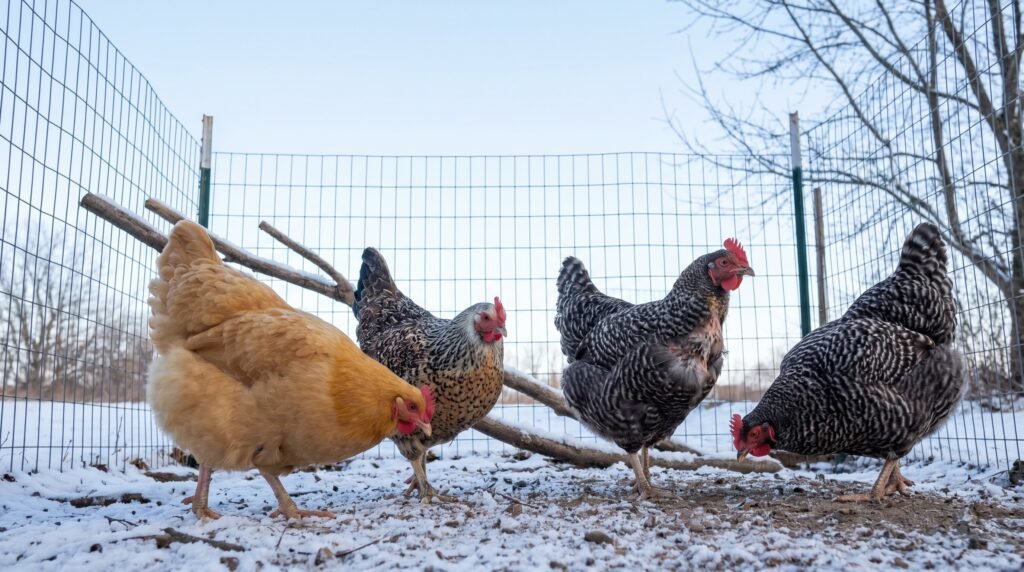
Going without supplemental light is a real choice, not a default. Hens exposed to natural day length will stop or slow laying from roughly October through January in most US latitudes, molt, and resume production as days lengthen again in late winter. UF/IFAS Extension confirms they "would be expected to resume egg production in the spring" without any intervention.
The practical upside: lower-quality layers and older hens that would produce unreliably even under lights get a proper rest and may come back with better feather coverage and improved shell quality. The obvious downside: no eggs for 8-16 weeks mid-winter, depending on the hen and the breed.
Breed matters here. High-production breeds like White Leghorns and Golden Comets (280-320 eggs per year at peak) are bred to lay hard and rest poorly - they tend to drop off quickly without light and recover fastest when light returns. Dual-purpose breeds with lower annual totals, like Speckled Sussex (200-240 eggs/year) or Buff Orpingtons (150-200 eggs/year in typical backyard settings, per UF/IFAS and Virginia Cooperative Extension flock guides), handle the natural winter pause with less disruption and often look considerably better in feather condition coming out of it.
For the nutrition and management levers that help hens produce as well as possible through the natural cycle, see encouraging winter laying without added light.
Frequently asked questions
Can I start supplemental light mid-winter if I forgot to set it up in fall?
Yes, but ramp up gradually. Start at your current natural day length and add no more than one hour per week until you reach 14-16 hours total. Adding several hours all at once stresses the reproductive system and risks triggering an off-cycle molt rather than resuming laying. Hens already in molt need to finish it before lighting will restart egg production.
Will a red heat lamp count as supplemental light?
Partially. Red wavelengths do stimulate the reproductive system - poultry science research shows red-spectrum light (630-725 nm) is more effective at photostimulation than green or blue. However, heat lamps are a documented fire risk in coops and are typically too bright (and too hot) to manage safely as a dedicated lighting solution. A dim warm-spectrum LED on a timer is the safer and more controllable option.
Do I need to add light in the coop if my birds free-range during the day?
If your hens are outside in natural light for the full daylight period and you are adding pre-dawn or post-sunset artificial light to bridge the gap to 14-16 hours, a coop light still helps - the hens need to perceive the total combined light exposure. What they get outside during the day counts toward the total, so you only need to supplement the shortfall, typically with a pre-dawn timer.
My hens stopped laying mid-winter even though I have a light on them. What went wrong?
Several things can cause this: a power outage that lasted more than a day or two, a burned-out bulb that went unnoticed (check it), a timer that shifted or failed, or hens that are molting because of a prior disruption. Age is also a factor - hens in their third year or beyond produce less reliably under any conditions. See our full breakdown of why hens stop laying for the diagnostic checklist.