A quarter pound of complete feed per bird per day, matched to their age, with fresh water always within reach. That's the core of what backyard chickens need. Everything else - oyster shell, grit, the occasional treat - builds on top of that foundation. Get the basics right and the rest is fine-tuning.
Complete feed: the only thing that covers everything
A bagged complete feed - starter, grower, or layer matched to the bird's age - is the only single product that supplies every protein, energy, vitamin, and mineral a chicken needs. Scraps, scratch, and forage alone cannot fill those gaps; the complete feed is the foundation everything else is built on.
Chickens can't meet their nutritional needs from scraps, scratch, or forage alone. A bagged complete feed is formulated to provide the right balance of protein, energy, vitamins, and minerals for each life stage. Once you add scratch grains or other extras alongside it in significant amounts, you dilute the balance. Mississippi State University Extension puts it directly: "Feeding any other ingredients, mixed with the feed or fed separately, upsets the balance of nutrients in the complete feed."
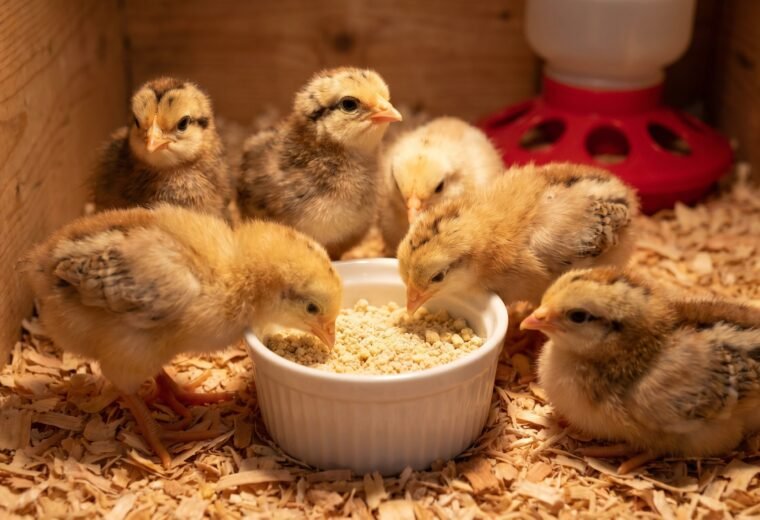
Complete feeds come as mash (loose ground feed), crumbles (coarser broken pellets), or pellets. All three are nutritionally equivalent. Pellets waste less and tend to keep feeders tidier, which is why many keepers prefer them for full-grown birds. Crumbles suit chicks better than whole pellets.
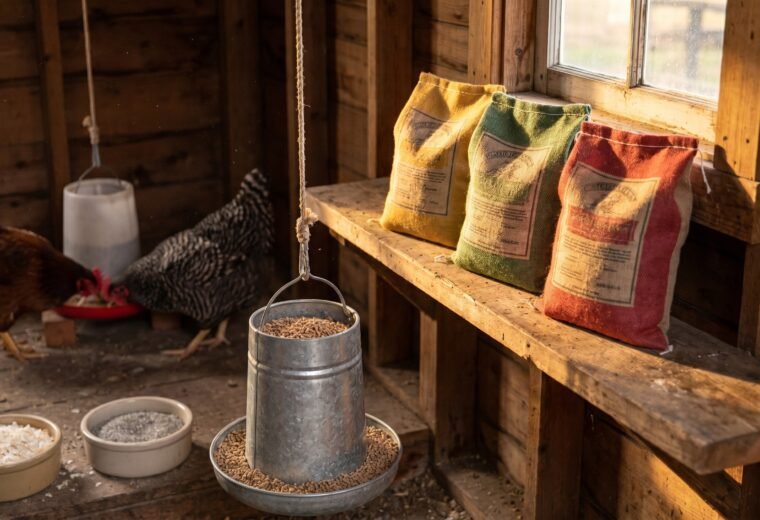
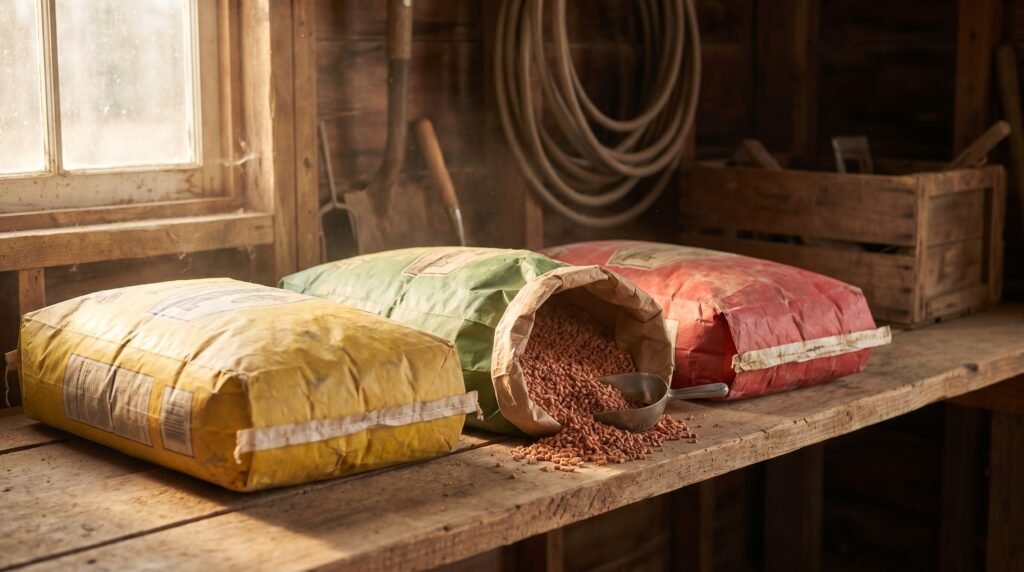
For storing feed, keep it in a sealed metal or hard-sided container in a cool, dry spot, and use it within four weeks of the milling date. Moisture and heat accelerate the breakdown of vitamins and invite mold. Toss anything that smells off, looks clumped, or shows visible mold - never feed moldy feed, because the toxins (mycotoxins such as aflatoxins) persist even after the mold is no longer visible and can seriously harm the flock.
Feed by life stage: three phases, three different formulas
The protein and calcium levels chickens need change substantially as they grow. Feeding the wrong formula to the wrong age group causes real harm - it's not just a slight inefficiency.
| Life stage | Age range | Protein target | Calcium level | Notes |
|---|---|---|---|---|
| Chick starter | Hatch to 6 weeks | 20-22% | ~0.9% | Medicated (amprolium) or non-medicated; medicated only for unvaccinated chicks |
| Pullet grower / developer | 6-20 weeks | 14-16% | ~0.8-1.2% | Lower protein than starter; keeps growth steady without pushing early laying |
| Layer feed | 18-20 weeks or first egg | 16% (14-18% range) | 2.5-3.5% | Never feed layer ration to chicks or growers |
The calcium warning is worth repeating: layer feed contains roughly 2.5-3.5% calcium, which laying hens need to build strong eggshells. Growing birds need only about 1.2%. Feed layer ration to a chick or pullet and the calcium overload can damage their kidneys. Conversely, lay hens on a grower diet and you'll see thin-shelled eggs and a hen depleting calcium from her own bones.
Switch to layer feed at around 18-20 weeks of age, or when you spot the first egg - whichever comes first. (eXtension places the grower phase at 6-20 weeks; most breeds begin laying at 18-20 weeks, so the transition timing varies by breed.) If you keep a mixed-age flock, the safest option is to feed the younger birds' grower ration to everyone and offer oyster shell free-choice in a separate dish so laying hens can self-regulate their calcium intake.
More detail on choosing and comparing brands is in our complete guide to chicken feed types.
How much feed per bird, per day
A standard laying hen eats roughly a quarter pound (about 110-115 grams) of complete feed per day. That's close to a half cup in volume. Heavier dual-purpose breeds eat toward the upper end of the range; smaller Mediterranean breeds like Leghorns eat less. Cold weather pushes consumption up slightly as birds burn more energy maintaining body temperature.
For a flock of 12 hens, expect to go through about three pounds of feed a day, or roughly 21 pounds a week. At that scale, a 50-pound bag lasts just under three weeks. Running the math before you stock up helps avoid feed sitting around long enough to lose potency or go stale.
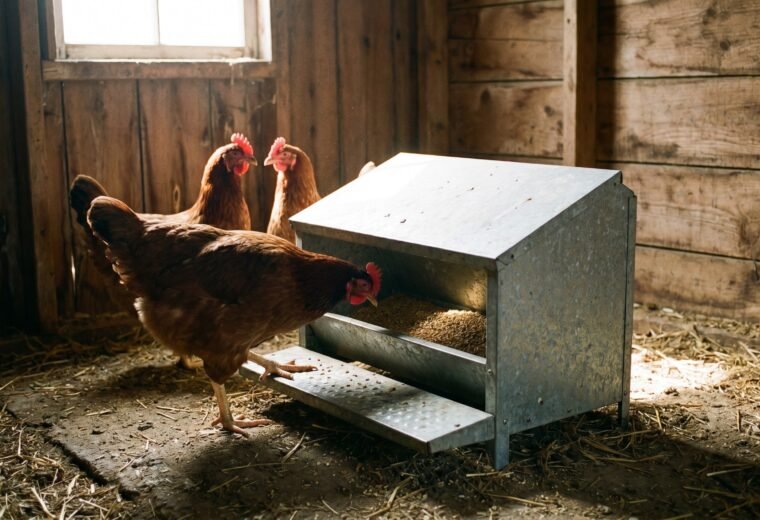
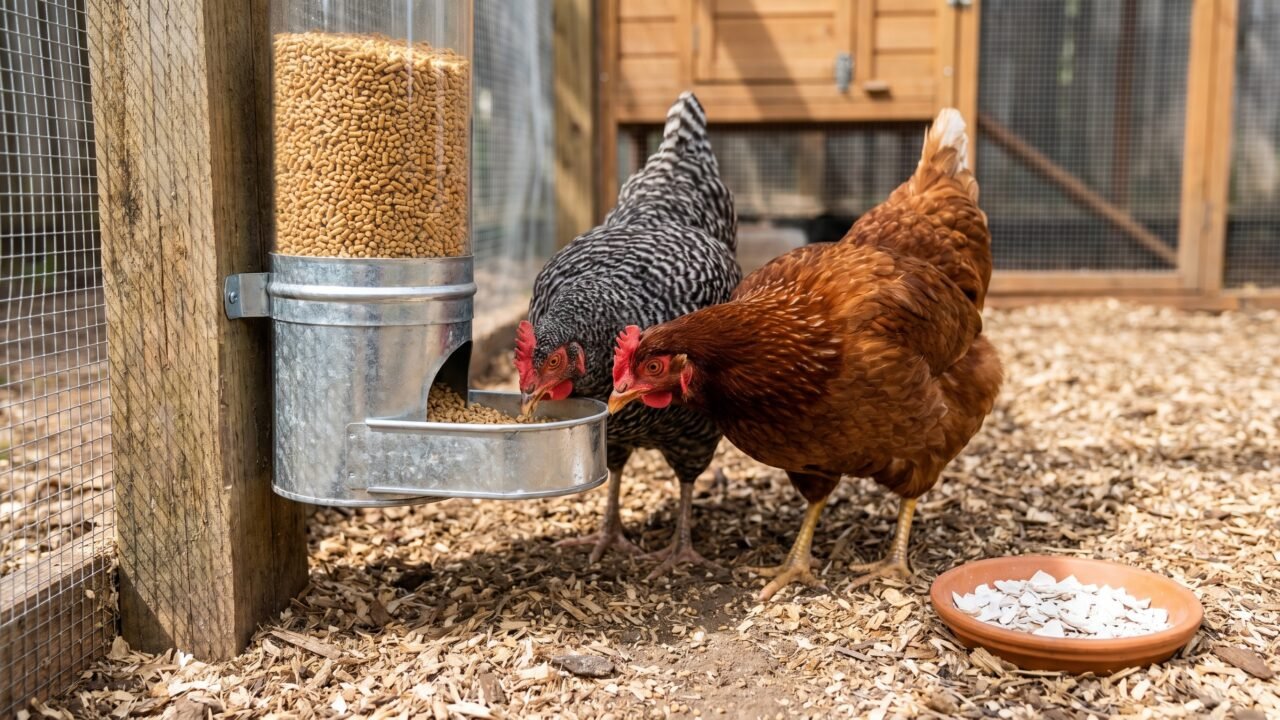
Most keepers use trough or tube feeders set to ad-lib (always-available) feeding rather than metered portions. Chickens naturally regulate their intake to meet energy needs, so free-choice feeding works well for laying flocks. Keep the feeder off the ground to reduce scratching and contamination, and check it daily.
A good feeder setup matters more than most new keepers realize. Our overview of best chicken feeders covers trough vs. tube styles, rodent-resistant designs, and the right feeder space per bird.
Water: the nutrient most people underestimate
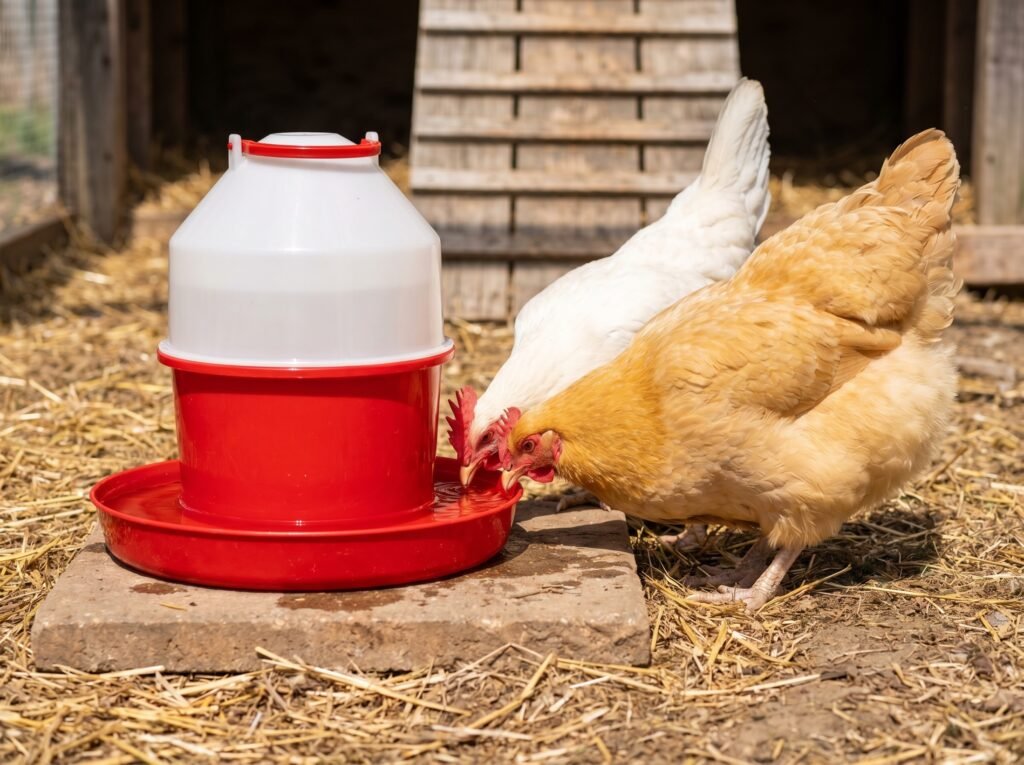
A laying hen needs water to form every egg she lays - water makes up about three-quarters of each egg's weight (roughly 74-76% by composition, per USDA FoodData Central data). That single fact explains why access to clean water matters more than almost any feeding decision you make. eXtension's poultry nutrition resources are clear on the hierarchy: "Water is a critical but often overlooked nutrient. Animals can survive longer without food than they can without water."
The practical rule of thumb is that chickens drink about twice as much water by weight as they eat in feed. A hen consuming a quarter pound of feed a day will drink close to half a pound (roughly a quarter liter) of water. In hot weather, that figure can double or quadruple. A hen that runs out of water for even a few hours on a hot day may go off lay for days afterward.
About 25% of a laying hen's daily water intake happens in the last two hours of daylight, when eggshell mineralization is most active. A waterer that runs dry by evening costs more egg production than most keepers realize.
Practical checkpoints:
- Rinse waterers daily; scrub weekly (algae and biofilm harbor bacteria).
- In winter, use a heated base or a submersible heater to keep water liquid. Chickens will not eat snow as a substitute.
- Place waterers in shade in summer; warm water is less appealing and chickens will drink less.
- Separate waterers from feeders - chickens dunk feed in water, which accelerates spoilage and mold growth inside the waterer.
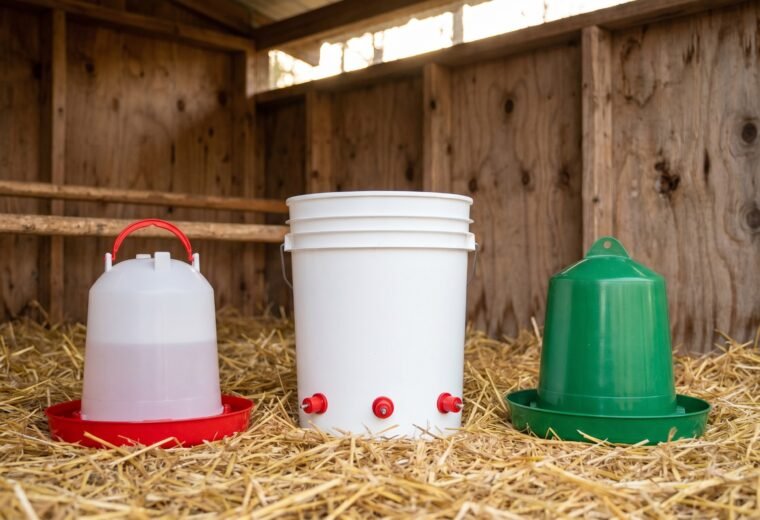
We cover waterer styles and winter heating options in depth in the best chicken waterers guide, including heated models for climates that freeze.
Supplements: grit, oyster shell, and what's actually optional
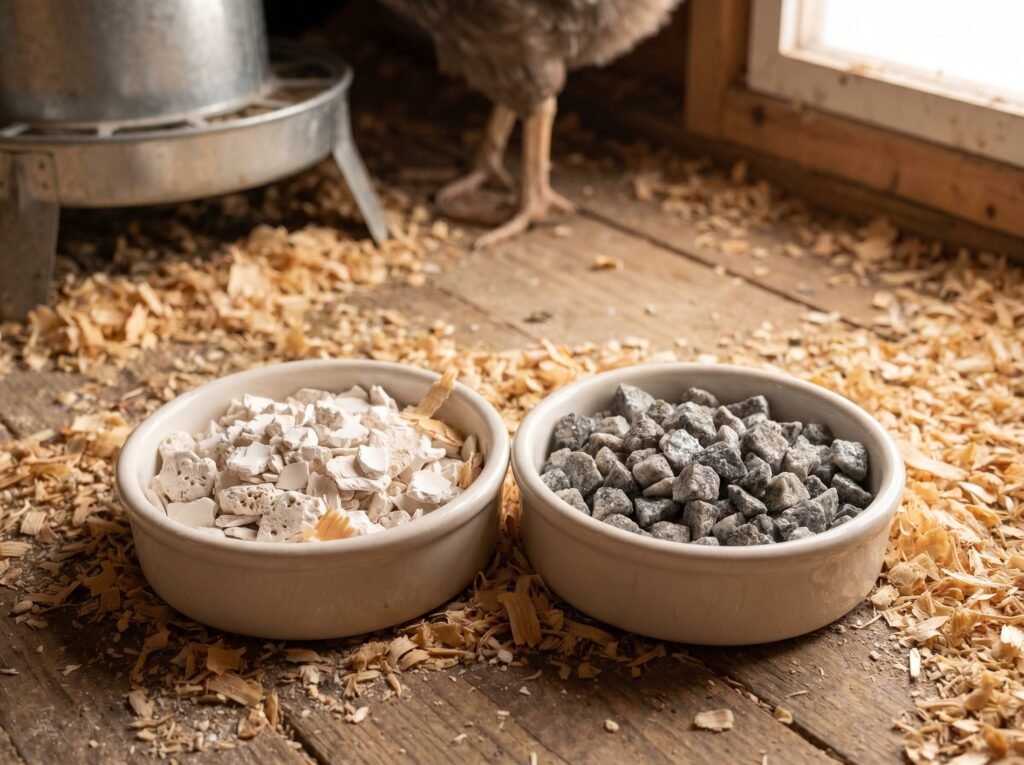
Two supplements come up in almost every feeding discussion: grit and oyster shell. They serve entirely different purposes and are not interchangeable.
Grit is insoluble crushed granite (or similar hard stone). It lodges in the gizzard and helps grind whole grains, seeds, and fibrous plant material. Chickens on a complete pelleted or crumbled feed - where everything is already ground - don't strictly need supplemental grit. But any bird that free-ranges, eats scratch grain, or gets fibrous treats (grass, vegetable scraps) should have access to it. Chick-size grit for birds under eight weeks, hen-size for adults. Granite grit is the right material; oyster shell is too soft to do the grinding job.
Oyster shell is soluble calcium carbonate. It dissolves in the digestive tract and goes into eggshell formation. Layer feed already contains calcium, but some hens - especially heavy layers or older birds - need more than the feed alone provides. Offer it free-choice in a separate small dish or cup attached to the coop wall. Hens know when they need it and will eat accordingly. Birds that aren't laying (chicks, roosters, molting hens) will mostly ignore it, so free-choice availability is the right approach for mixed flocks.
Everything else marketed as a supplement is largely optional for flocks on a quality complete feed. Probiotics, apple cider vinegar, and similar products are a live debate in poultry circles with limited controlled research behind them. None are harmful at typical doses, but none replace the fundamentals of a good complete diet and clean water.
Treats, scratch, and the 10% ceiling
Chickens love scratch grain, mealworms, fruit, and kitchen scraps. That enthusiasm is exactly why treats need a ceiling. Extension guidance consistently points to no more than 10% of daily intake from treats and scratch - and several sources recommend keeping it closer to 5%. For a hen eating a quarter pound of feed, 10% means about two tablespoons of extras per day. That's less than it sounds.
The problem is simple: scratch grain and many common treats are energy-dense but nutrient-poor. When a hen fills up on corn or watermelon, she eats less complete feed and starts missing out on the protein, calcium, and vitamins the complete feed was delivering. The result is lower egg production, thinner shells, and over time, condition loss.
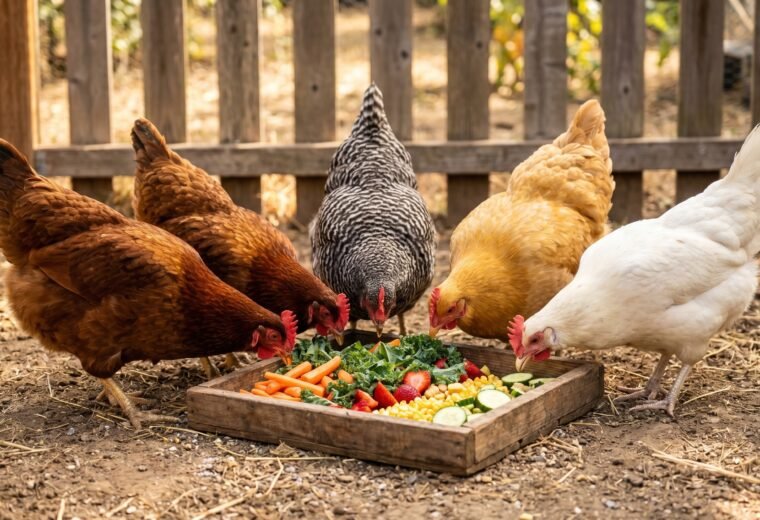
Treats that work well (in moderation): cooked plain rice, plain oats, cut-up leafy greens, plain cooked pasta, mealworms (protein-rich, good during molt), cucumber, and berries. Healthy scraps from the kitchen are fine if they're fresh and plain.
For a much deeper look at what to offer and what to skip, the treats and what not to feed guide covers the full list with portion context.
What not to feed chickens
Most of the foods below cause problems ranging from off-tasting eggs (not an emergency) to death within hours (very much an emergency). The list below covers the ones that matter most.
| Food | Why it's a problem | Severity |
|---|---|---|
| Avocado (fruit, skin, pit, leaves) | Contains persin, which causes cardiac tissue damage; birds show lethargy, labored breathing, edema, and can die | High - potentially fatal |
| Raw or dried beans | Contain phytohaemagglutinin (a lectin) documented as acutely toxic to chickens and other poultry in peer-reviewed research (Pusztai 1993, Grant et al. 1983); cooking destroys the toxin | High - acute toxicity |
| Chocolate | Methylxanthines (theobromine and caffeine) cause tremors, seizures, and cardiac events in birds | High - potentially fatal |
| Moldy feed or moldy scraps | Mycotoxins (aflatoxin, fusariotoxin) persist after visible mold dies; linked to serious illness and death in poultry | High - cumulative and acute risk |
| Heavily salted food | Salt overload causes neurological signs; research links doses above roughly 1,500 mg/kg to fatalities in birds | Moderate-high |
| Onion and garlic (large amounts) | Thiosulfate compounds can cause hemolytic anemia; small incidental amounts are generally tolerated | Moderate with repeated exposure |
| Green potato skins / nightshade plant parts | Solanine is toxic to poultry; ripe cooked potato flesh is fine, green parts and raw uncooked potato are not | Moderate |
| Lawn clippings (after pesticide application) | Residual herbicides and pesticides; avoid for at least the period the product label specifies | Variable by product |
| Fish meal / strong fish scraps | Not toxic, but in quantity causes noticeably fishy-flavored eggs | Quality concern only |
A note on the avocado entry: the Merck Veterinary Manual's toxicology section confirms that persin causes cardiac damage and that all parts of the plant carry the compound. Birds show lethargy, labored breathing, edema, and death (Merck Vet Manual). Caged and companion bird species appear more sensitive than chickens and turkeys, but chickens are not immune. The risk is real enough to keep avocado entirely out of the run and kitchen scrap bucket.
If a bird shows sudden illness after eating something unusual - labored breathing, unsteady movement, sudden collapse - contact a poultry vet. This article is for healthy flock management, not diagnosis or treatment.
Putting it all together: a quick-check reference
Here's the daily routine reduced to its essentials, scaled to a flock of 12 standard laying hens:
- Feed: ~3 lbs of layer complete feed (roughly a quarter pound per hen), available free-choice in a covered feeder.
- Water: at least 1.5-2 gallons of clean water, refreshed daily, waterers rinsed. (Baseline: roughly half a pound of water per hen per day per eXtension's 2:1 ratio = about 0.7 gallons; the 1.5-2 gallon figure builds in a buffer for hot-weather demand and waterer dead-space.)
- Oyster shell: kept available in a separate dish at all times; hens self-regulate.
- Grit: available if birds free-range or eat anything whole (scratch, greens, etc.).
- Treats: two tablespoons or less per hen per day, from the safe list above.
Nothing on that list is complicated once the habits are set. The flock gives clear feedback: strong shells, steady egg production, and birds with a healthy weight and bright eye tell you the feeding program is working. Dull feathers, thin shells, or a sudden production drop are often the first sign something in the diet has slipped.