Chickens need three different feeds across their life: starter, grower, and layer - each matched to age and production stage. Getting chicken feed right is the single biggest lever you have over your flock's health and egg output. The wrong ration at the wrong life stage - too little protein for fast-growing chicks, or too much calcium for a bird that isn't laying yet - quietly causes problems you might not trace back to the bag for weeks. The good news: commercial feeds have done most of the calculation for you, and understanding a handful of numbers makes the whole system click into place.
This guide covers every feeding stage from hatch to peak lay, including feed types, the supplements that actually matter, water management, feeder choices, and the foods that can land a bird in serious trouble. Guides on fermented feed and organic options are linked throughout where they fit.
What feed do chickens need at each stage of life?
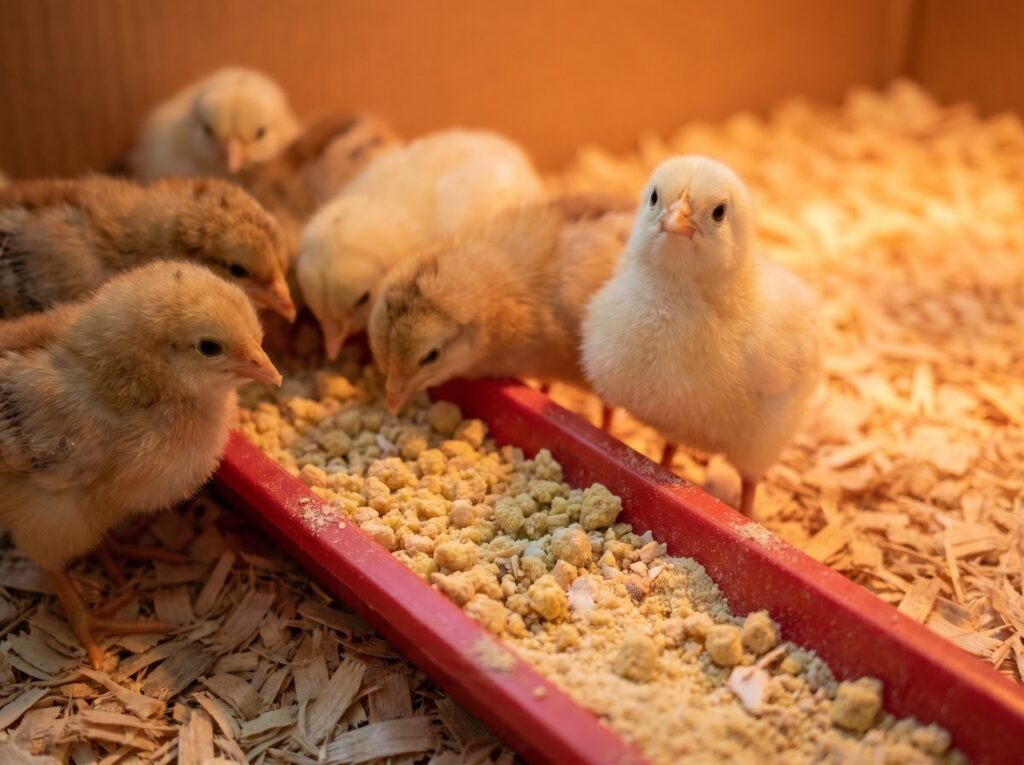
Chickens need three sequential rations: high-protein starter (hatch to about 6-8 weeks), lower-protein grower (6-18 weeks), and calcium-rich layer feed from first egg onward. Poultry nutritionists at Auburn University and Penn State Extension agree on the core framework: the protein percentage drops as birds mature, and the calcium percentage shoots up right at the start of lay. Every decision about switching feeds flows from those two facts.
Chick starter (hatch to about 6-8 weeks)
Chick starter delivers 18-22% crude protein, depending on whether you are raising egg-breed pullets or broilers. For pullets that will eventually lay, Auburn University's extension tables show 20% as the standard target for weeks one through six. Broiler starter runs a bit higher - 22-23% - because meat-bird breeds put on muscle at a much faster rate. Do not use broiler starter for your future laying hens; the extra protein and energy density push growth faster than a laying bird's skeleton is designed to handle.
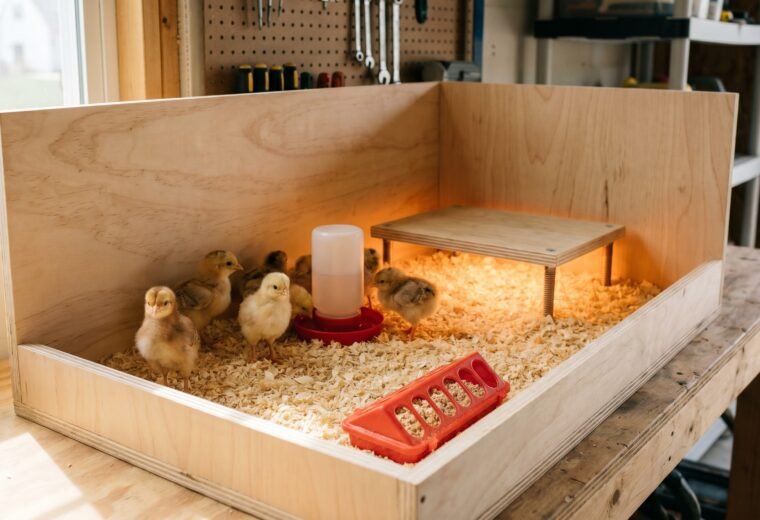
You have one more decision at the chick stage: medicated or unmedicated starter. Medicated feeds contain a coccidiostat (usually amprolium) that helps chicks build resistance to coccidia, an intestinal parasite that can wipe out a brooder in days. If your chicks arrived already vaccinated for Marek's or coccidiosis from the hatchery, check the vaccination paperwork before using a medicated feed - ask your feed supplier if you are unsure. Brooder temperature, bedding, and the right week to move birds outside are covered in detail under raising chicks week by week.
Starter comes milled as crumbles, which are easier for small beaks than pellets. Keep feed available at all times during this stage - chicks eat frequently and grow fast. Auburn's extension data puts consumption at roughly 200 pounds of starter per 100 birds over the first six weeks.
Grower or developer feed (roughly 6-18 weeks)
Once chicks are fully feathered and through the brooder stage - usually around six to eight weeks - they move to a grower (sometimes called developer or pullet grower) ration. Penn State Extension recommends 15-16% protein for this window; the University of Georgia Extension tables put it at 16-18% for pullets through week 18. In practice, most commercial grower bags land in the 15-17% range.
The key thing grower feed does NOT have is the high calcium level of layer feed. That matters a lot. Laying mash contains 3.5-4.5% calcium - the right amount for a hen building eggshells every day, but dangerously high for a bird whose kidneys are still developing. Feeding layer ration to chicks or growing pullets "may cause growth problems, kidney damage, or death," Auburn's Cooperative Extension warns. Keep growers on grower feed all the way to first egg.
Grower comes as crumbles or pellets. Pellets hold up better in feeders and produce less waste, so many keepers switch from crumbles to pellets around eight to ten weeks.
Layer feed (around 18 weeks or at first egg)
Layer rations are formulated with 15-18% crude protein and 3.5-4.5% calcium - the nutrition a hen needs to produce roughly one egg per 24-26 hours at peak. Penn State Extension recommends making the switch "at 18 weeks of age" or when you find the first egg, whichever comes first. If a few birds in your flock are older but none have started laying, 18 weeks is a safe trigger point.
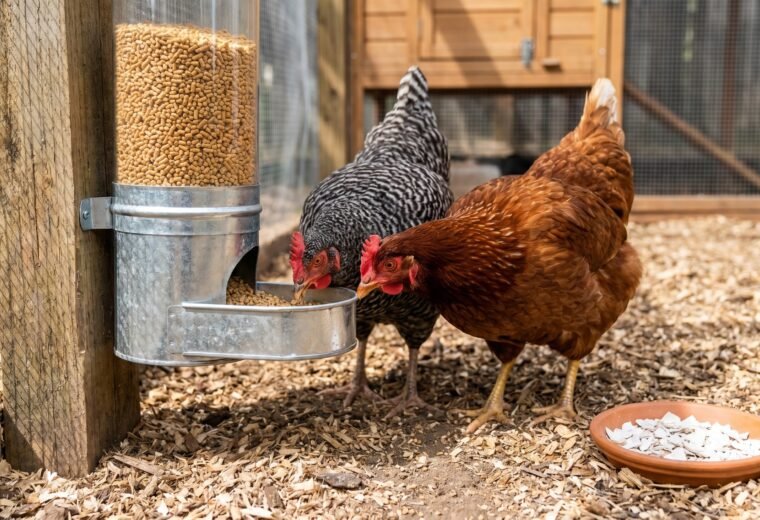
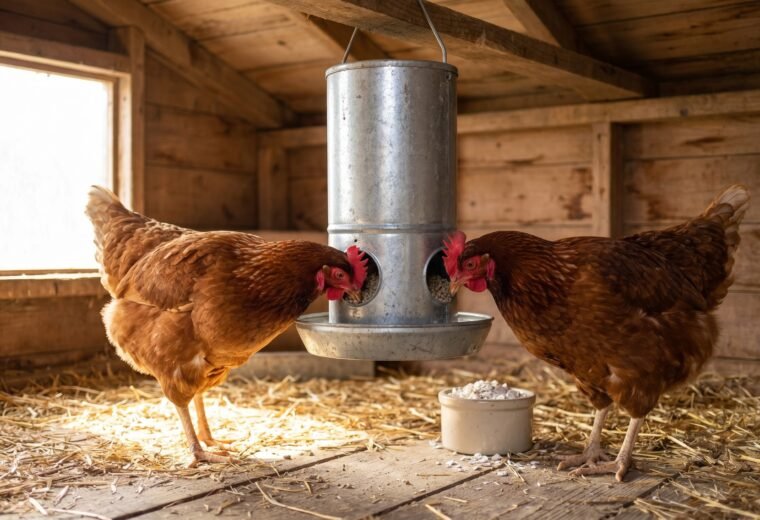
The layer ration handles calcium, but many keepers supplement with free-choice oyster shell alongside it, and that is a reasonable habit. Oyster shell is roughly 95% calcium carbonate; an eggshell is about 96% calcium carbonate. A hen deposits around two grams of calcium into each shell, mostly overnight, drawing partly from her bones and partly from whatever calcium she consumed that day. Hens self-regulate well - they eat more oyster shell when they need it and ignore it when they don't. Put it in a separate small dish or feeder compartment, not mixed into the feed. And offer it only to birds that are actively laying, not to chicks or growers.
Pellet vs. crumble vs. mash, organic options, and how to read a feed tag are all unpacked in the layer feed guide.
How do the four main ration types compare?
The table below puts starter, broiler starter, grower, and layer rations side by side so you can quickly match a feed tag to your birds' current stage. Check crude protein and calcium first - those two numbers tell you almost everything about whether a bag is right for your flock at a given age.
| Stage | Age range | Crude protein | Calcium in feed | Typical form | Critical note |
|---|---|---|---|---|---|
| Chick starter (pullet) | Hatch - 6-8 wk | 18-20% | 0.85-1.00% | Crumbles | Medicated vs. unmedicated: check hatchery vaccine records |
| Chick starter (broiler) | Hatch - 4-6 wk | 22-23% | 0.90-1.00% | Crumbles | Do not feed to pullets; promotes excess early growth |
| Grower / developer | 6-8 wk - 18 wk | 14-17% | 0.75-1.00% | Crumbles or pellets | Never skip this stage by jumping to layer too early |
| Layer | 18 wk + / first egg | 15-18% | 3.5-4.5% | Pellets or crumbles | Add oyster shell free-choice in a separate dish |
One reading tip: the feed tag's "guaranteed analysis" lists crude protein as a minimum and calcium as a range. A layer tag that says "calcium min 3.00%, max 4.50%" is normal; the actual formulation sits in the middle of that window.
Do chickens need grit?
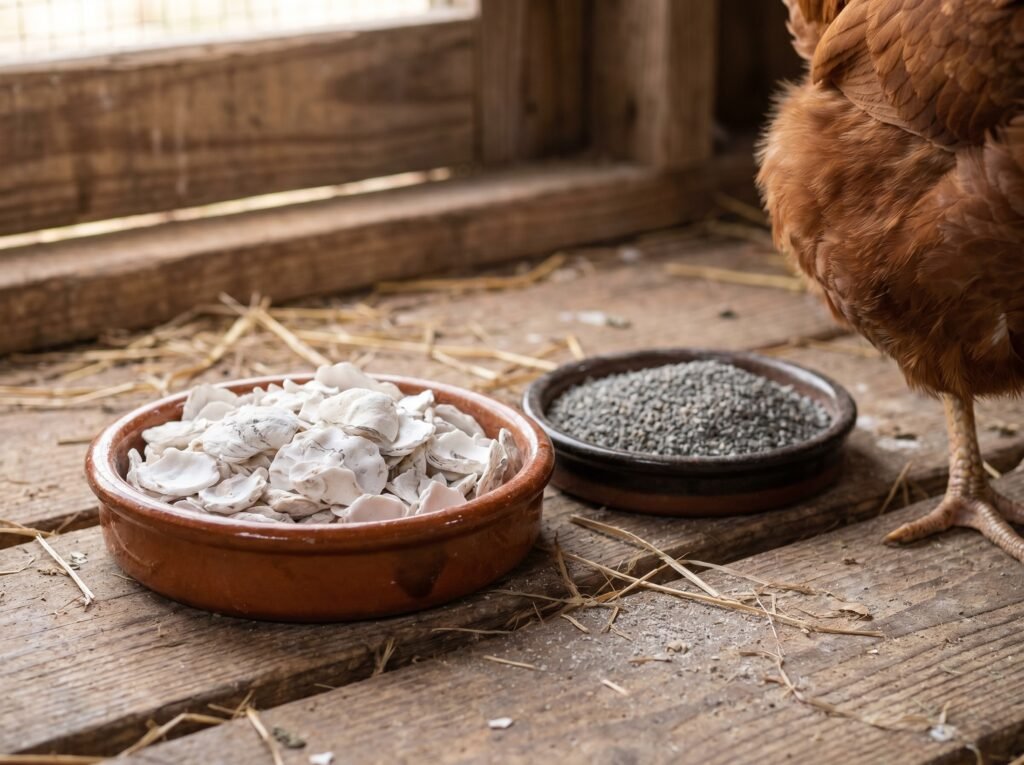
Only if they eat anything other than commercial ground feed. Chickens have no teeth - the gizzard grinds food using small hard particles. Pellets and crumbles are already milled fine enough that grit is not strictly necessary for birds on commercial feed alone. But the moment they eat anything whole - scratch grains, grass, mealworms, kitchen scraps - grit becomes essential for digestion.
Free-range birds pick up natural grit from the ground. Confined birds need it supplied. Use commercial poultry grit, sized for the age group (chick grit for birds under eight weeks, hen grit for adults). Put it out free-choice in a separate hopper from the oyster shell - the two look similar but serve completely different purposes. Oyster shell is soft and calcium-soluble; it dissolves quickly in the gizzard and does not work as grinding grit. Granite grit is hard and insoluble, which is exactly what the gizzard needs.
Alabama's Cooperative Extension recommends making grit available continuously for any flock that has access to whole grains or pasture.
Do chickens need supplements and scratch grains?
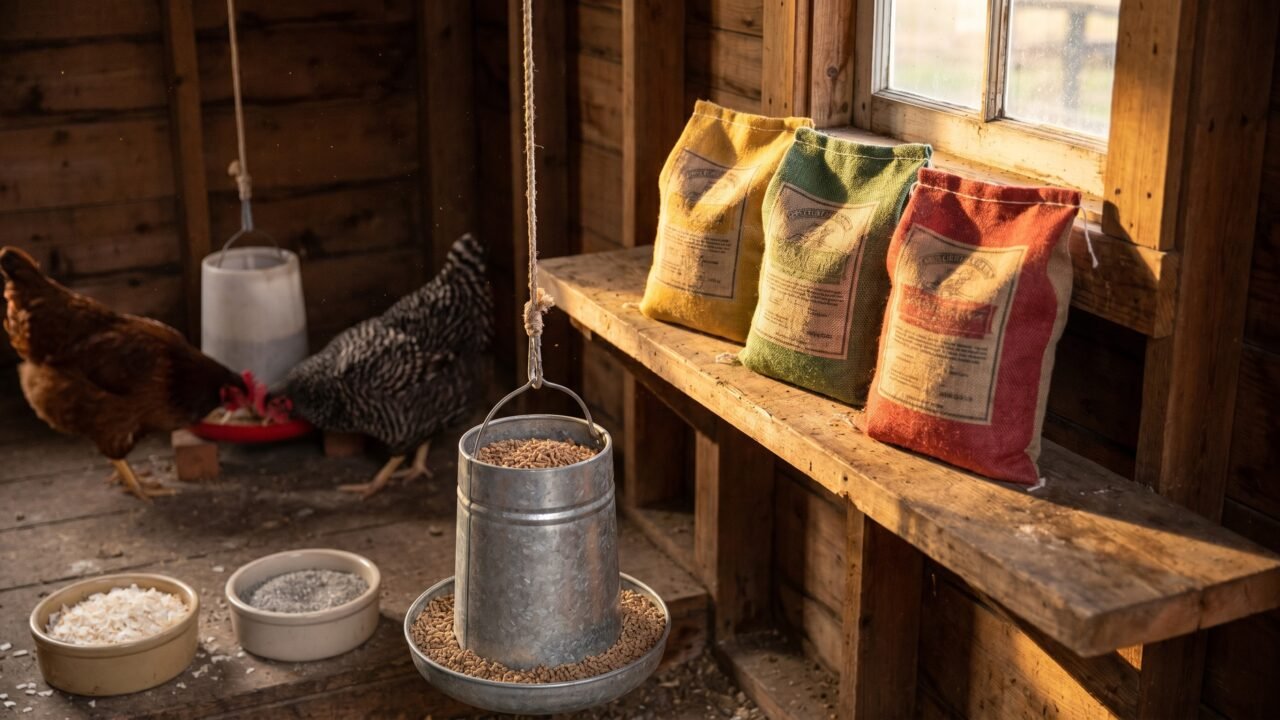
Most flocks on quality commercial feed do not need extra supplements. Manufactured rations are formulated as nutritionally complete diets; adding vitamins or minerals on top shifts the balance the manufacturer already calculated. Scratch grains are a separate category - a treat, not a supplement - and are fine in small afternoon amounts, but they are low in protein and should never make up more than a small fraction of the diet.
Walk into any feed store and you will find aisles of probiotics, diatomaceous earth, oregano oil blends, and vitamin-electrolyte powders. Save your money unless a bird is recovering from illness or a vet recommends something specific. Scratch grains are a different story - not a supplement, but a snack. Corn scratch in winter is a popular treat because the extra starch generates body heat as it ferments in the gut overnight. It's fine as a small afternoon addition. But scratch is low in protein and completely lacks the vitamins, minerals, and amino acids a laying hen needs. The eXtension poultry network recommends feeding scratch and table scraps only in amounts the flock can clean up in about 20 minutes, and only after birds have had access to their complete ration first.
A useful working rule, consistent with the eXtension 20-minute guideline, is keeping treats to roughly 10% or less of total daily intake. Three laying hens eating about three-quarters of a pound of layer pellets per day should get no more than an ounce or so of scratch at most - ideally tossed into the run in the late afternoon.
Specific safe foods and which kitchen scraps are worth offering get a full treatment in the what to feed chickens article. Keepers curious about fermented feed - which some swear by for improved gut health and reduced waste - will find the methodology and a realistic look at the tradeoffs in the fermented chicken feed piece.
What foods are toxic or dangerous to chickens?
Avocado (all parts), raw or dry beans, moldy food, green potato peels, onions in large quantities, chocolate, caffeine, apple seeds, stone-fruit pits, and heavily salted foods are the main hazards. Chickens are opportunistic eaters and will try almost anything you throw their way - that enthusiasm is mostly harmless, but these specific foods are genuinely dangerous, and keepers who don't know the list tend to find out the hard way.
- Avocado (all parts): The flesh, skin, and pit all contain persin, a compound that causes breathing difficulty, weakness, and heart failure in birds. University of Florida IFAS Extension lists it as one of the highest-risk foods for poultry. No safe dose is established; skip avocado entirely.
- Raw or dried beans: Uncooked beans contain phytohemagglutinin (PHA), a lectin that is toxic to chickens even in small amounts. Cooked beans are safe. Never toss raw bean scraps into the coop.
- Moldy or rotten food: Mold produces mycotoxins - compounds that cause liver damage, immune suppression, and respiratory problems. Some molds produce aflatoxins that are carcinogenic over time. If you wouldn't eat it, don't feed it. The same rule applies to moldy feed in the bin: discard any feed that smells musty or shows clumping or discoloration.
- Green potato peels and green parts of tomatoes/eggplant: These members of the nightshade family contain solanine, which affects the nervous system and cardiovascular function.
- Onions in large quantities: Sulfur compounds can damage red blood cells and cause hemolytic anemia.
- Chocolate and caffeine: Both affect the heart and nervous system; even small exposures can be fatal in small birds.
- Apple seeds and stone-fruit pits: Contain compounds that release cyanide when crushed.
- Heavily salted foods: High sodium causes rapid dehydration and kidney damage. A pinch is not a crisis, but salty snack foods and cured meats are off the table.
If you suspect a bird has eaten something toxic and is showing distress - labored breathing, weakness, neurological signs - contact a poultry vet rather than trying to treat at home.
How much water do chickens need each day?
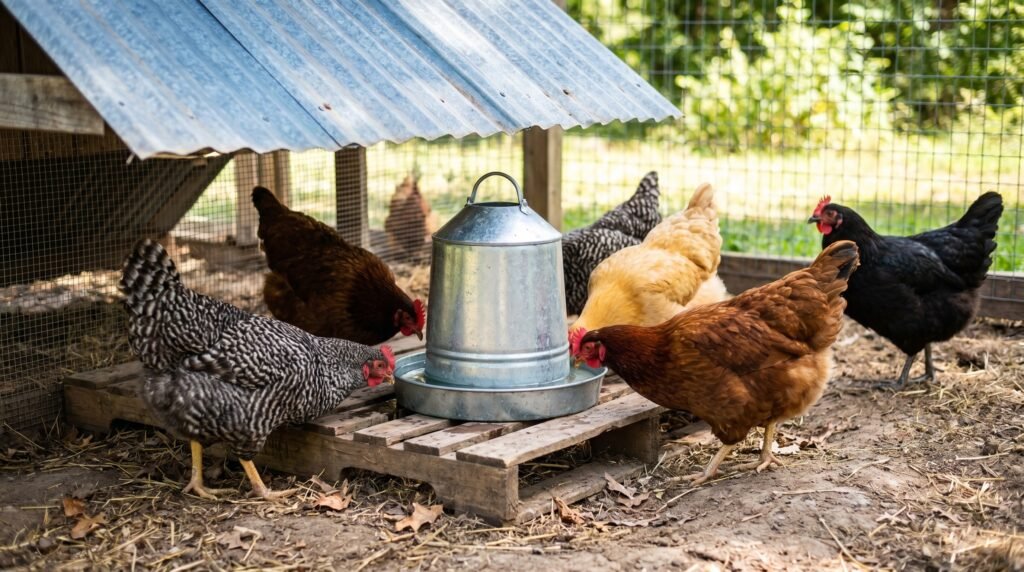
Chickens drink roughly twice as much water by weight as they eat in feed - about half a pound of water per quarter-pound of feed consumed. A flock of 3 laying hens eating about three-quarters of a pound of feed per day needs roughly one and a half pounds of water daily under normal conditions; scale that up for larger flocks and the numbers get serious fast. In summer heat, the daily requirement can double or quadruple. Water is not an afterthought: it is involved in every metabolic process a chicken runs - temperature regulation, digestion, nutrient transport, waste removal, and eggshell formation - a ratio the eXtension poultry network documents explicitly.
Going without water for more than 12 hours causes a measurable drop or complete stoppage of egg production, a consequence Penn State Extension flags directly. In practice, that means waterers need to be checked and filled at least twice a day in summer, and daily in mild weather. A single afternoon without water during a heat wave can drop egg production for a week.
A few management details that matter:
- Keep waterers in the shade. Algae grows fast in warm water and makes birds reluctant to drink.
- Scrub waterers weekly with a mild bleach solution (one tablespoon per gallon), rinse thoroughly, and refill.
- In winter, use a heated base or heated waterer to prevent freezing. A flock that can't break ice goes without water for hours before you notice, which hits production hard.
- Position waterers away from feeders by at least a few feet to prevent soggy feed and wet litter under the drinker.
Capacity, durability, and cleaning practicality across all major waterer styles - including heated options for cold climates - are compared in the best chicken waterers roundup.
What type of feeder works best for a backyard flock?
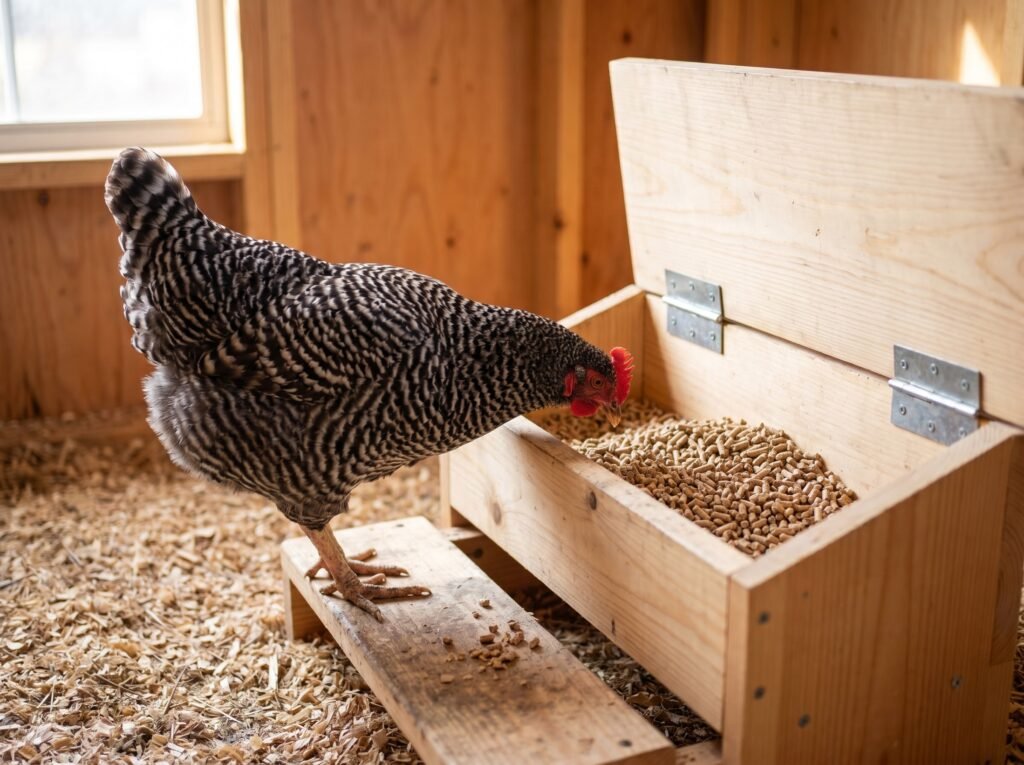
The right feeder depends on flock size and pest pressure, but Penn State Extension's spacing rule applies universally: at least three linear inches of feeder space per bird, lip at the birds' back height, trough filled no more than one-third to one-half full. Those two details cut waste significantly - birds scoop less onto the ground at the correct lip height, and a half-full trough gives them less to bill-and-scatter. The feeder is where a lot of feed budget quietly disappears through spillage, rain contamination, and rodents.
The main feeder types each have real tradeoffs:
- Tube or hanging feeders: Inexpensive, hold several days of feed, easy to fill from above. Downside: open to wild birds and weather if outside.
- Treadle feeders: The bird's weight opens the lid; wild birds and most rodents can't trigger the mechanism. Higher upfront cost but can pay back in saved feed and reduced pest pressure. Some birds take a week or two to learn the treadle - persistence pays off.
- Automatic or timer feeders: Release a measured portion on a schedule. Useful for keepers who are away during the day. Require more upfront setup to get portion size right.
Run multiple feeders if your flock is larger than about 10-12 birds, or if you have birds at the bottom of the pecking order that get pushed off a single station. A submissive hen that can't eat freely will lose condition and drop production faster than most keepers expect. Tube, treadle, and automatic options across different flock sizes each get a thorough pros-and-cons breakdown in the best chicken feeders comparison.
How should you store chicken feed to keep it fresh?
Store feed in a sealed, waterproof container off concrete, in a cool dry area, and use it within one month in summer or two months in winter - those are the Alabama Cooperative Extension guidelines. Three laying hens eat roughly 0.75 pounds of feed per day, so a 50-pound bag lasts about nine weeks - fine in winter but over the one-month summer limit, which is a good reason to buy smaller bags in hot weather. The real risks are mold, rodents, and nutritional degradation from heat and humidity - all of which erase the value you already paid for.
Heat and humidity accelerate mold and vitamin breakdown, especially fat-soluble vitamins A, D, E, and K. Use a non-metal container where possible - metal conducts temperature swings that promote condensation inside the bin. Keep the container off concrete, which wicks moisture; a wooden pallet or rubber mat works. Check the bag date when you buy: a bag sitting in a hot feed store warehouse for six weeks is already compromised.
Rodents are attracted to feed before you usually notice the signs. A tight-lidded galvanized trash can or purpose-built feed bin is far more effective than a bag clipped shut. If you are storing bulk feed, check for droppings, gnaw marks, or tunneled bags every week.
How much does it cost to feed ten laying hens per year?
A ten-hen flock on conventional layer pellets costs roughly $400-510 per year in feed, or $600-800 on certified organic, based on typical mid-2026 US prices. Feed prices are volatile - check your local feed store for current rates. Here is how those numbers break down.
A laying hen eats roughly 0.25 pounds (about 100-115 grams) of layer feed per day. Ten hens need about 2.5 pounds daily, or 17-18 pounds per week. A 50-pound bag of quality layer pellets lasts about 20 days. At roughly $22-28 per bag (as of mid-2026, US Midwest and Northeast; prices vary by region and retailer), that works out to around 18-19 bags per year per ten hens. These are feed-only figures; they don't include bedding, healthcare, or equipment.
Scratch grain (at about $0.30-0.40 per pound) and oyster shell (about $0.80-1.00 for a two-pound portion per month for ten hens) add relatively little to the total. The biggest variable in real-world cost is how much of your birds' diet is offset by pasture access - a genuine free-range flock on good pasture can reduce pellet consumption by 15-20% in the growing season, though the actual reduction varies by forage quality, stocking density, and season.
Startup and ongoing expenses across every category get a full breakdown in how much does it cost to raise chickens.