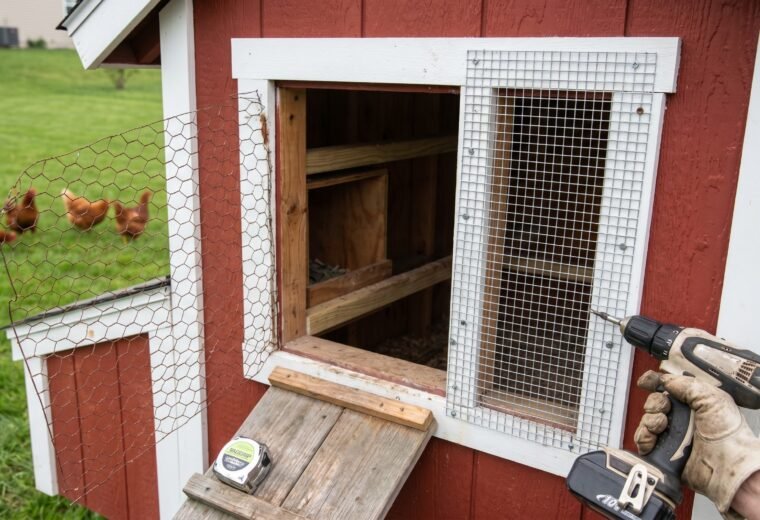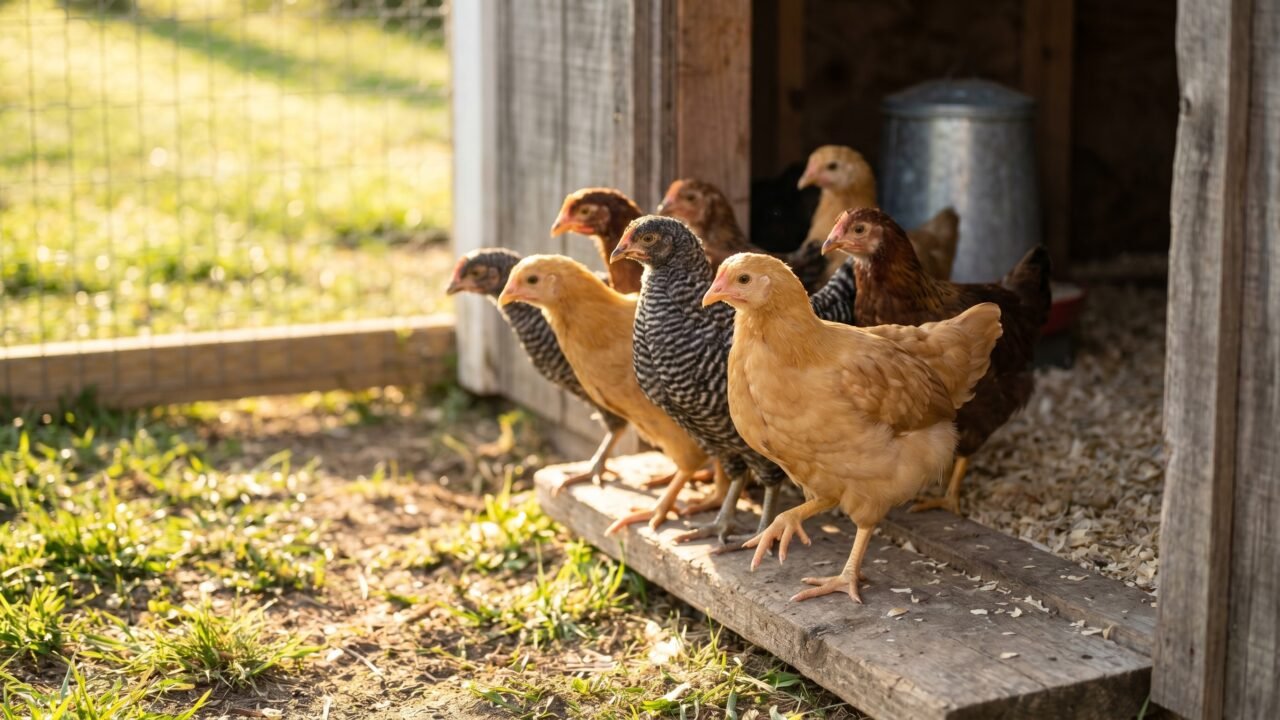
When are chicks ready to go outside?
Most backyard chicks are ready to move outside permanently somewhere between six and eight weeks of age. That said, the calendar is only part of the answer. Two things matter more: whether the birds are fully feathered, and whether the outdoor overnight temperature is warm enough that they can keep themselves comfortable without a heat source. Get those two right and the transition is smooth. Misjudge either one and chicks chill fast, pile on each other, and can die.
Below is everything you need to time the move correctly, harden the birds off safely, prep the coop, and work through the tricky part of blending young pullets with an adult flock.
The feather and temperature test - the only two benchmarks that actually matter
Chicks cannot regulate their own body heat until they are fully feathered. Down is insulating, but it loses heat rapidly in a breeze and offers no real water resistance. True feathers (wing primaries, tail, breast, and back all covered) give a bird the same weatherproofing an adult has. For most standard breeds, full feathering arrives somewhere around six to eight weeks, though breeds with slower feather development - Silkies, Cochins, and similar heavily-feathered types - can take a week or two longer.
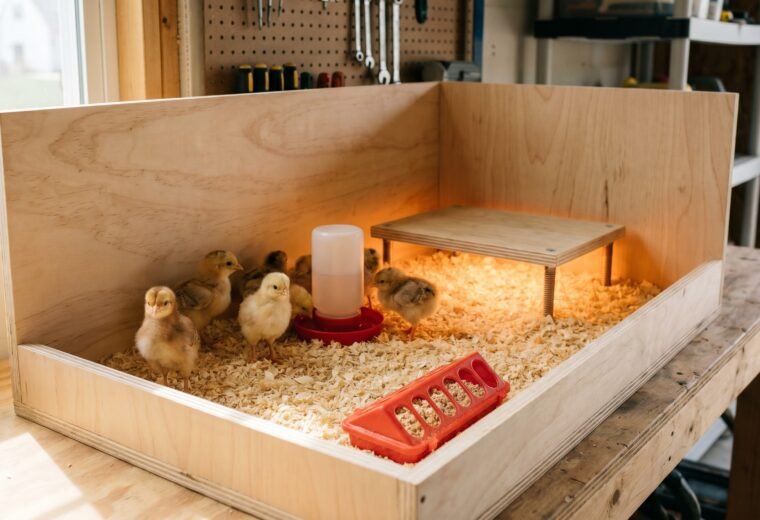
While the birds are growing those feathers, the brooder does the temperature work for them. A sensible reduction schedule runs like this:
| Week | Target brooder temp (at chick level) | What healthy chicks look like |
|---|---|---|
| 1 | 90-95°F | Active, spread out, peeping quietly |
| 2 | 85-90°F | Exploring edges of brooder |
| 3 | 80-85°F | Feathers visible on wings |
| 4 | 75-80°F | Tail and back filling in |
| 5 | 70-75°F | Most of body feathered; some down on head |
| 6+ | 65-70°F (ambient) | Fully feathered; supplemental heat often not needed |
These numbers come from standard extension-service guidance, which specifies starting at 90-95°F at chick level and dropping roughly 5°F per week. By week five or six, birds can generally maintain their own temperature at around 65-70°F ambient (University of New Hampshire Extension confirms this threshold). That ambient figure is also the practical benchmark for outdoor nights: if overnight lows are consistently at or above 65°F, a fully feathered six-week-old is fine outside without heat. If spring nights still dip into the 40s or 50s, wait until either the birds are older or the nights warm up, and plan to provide supplemental heat in the coop through those cool spells.
One exception worth knowing: in winter, eXtension advises continuing heat for the first six weeks regardless of feathering, mainly to keep waterers from freezing. The birds may not need the warmth directly, but the equipment does.
How to read your chicks instead of just your thermometer
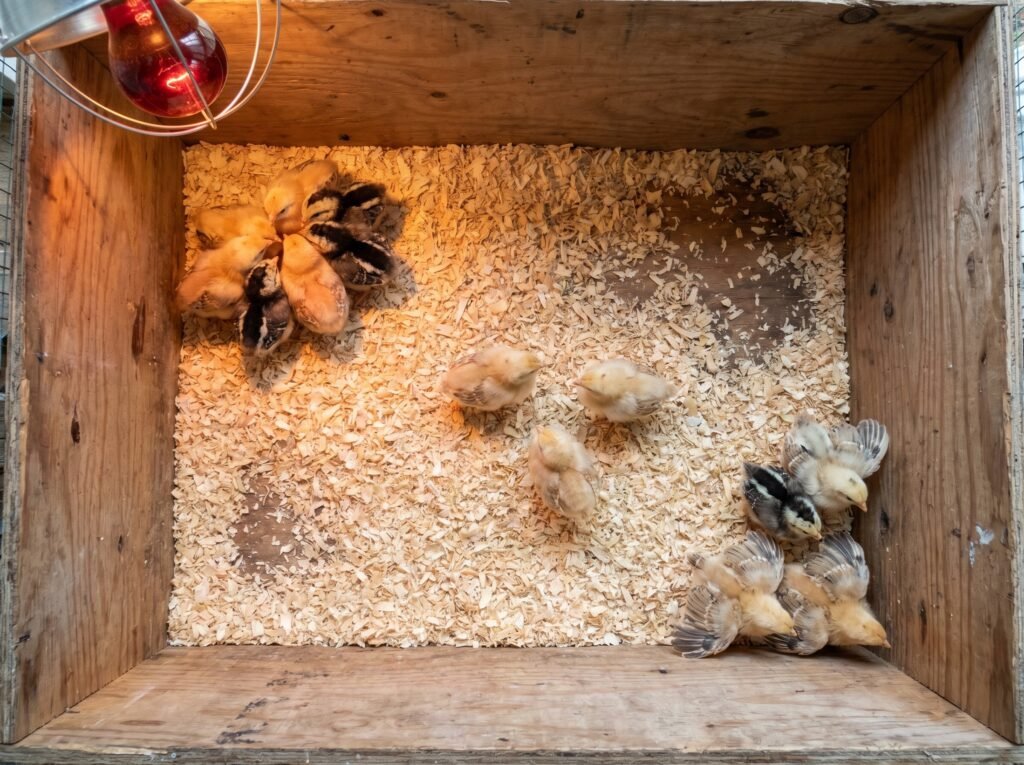
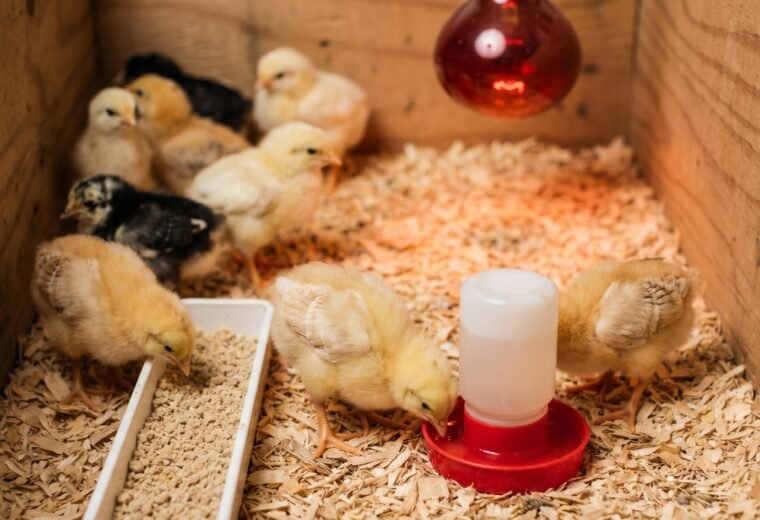
A thermometer tells you what the air is doing; the birds tell you what they feel. This behavior check is more reliable than any fixed schedule, especially on a warm spring day when a chick raised in a garage brooder may be ready earlier than the calendar suggests.
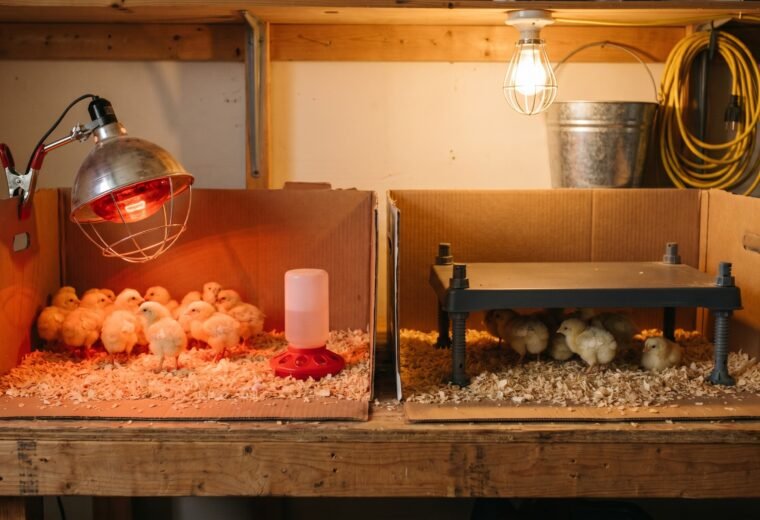
- Huddling tightly under the heat source: too cold - lower the heat or raise the brooder temperature.
- Panting, wings spread, pushing to the far edges: too hot - raise the lamp or reduce the heat.
- Clustered to one side only: there is a draft somewhere - find and block it.
- Spread out evenly, active, peeping softly: the temperature is right.
Apply the same logic outdoors during the hardening-off period. If chicks pile in a corner of the run on a breezy 68°F afternoon, they are telling you the wind chill is too much. Give them a sheltered corner or bring them in for another day or two.
Hardening off: the week or two that makes the difference
Moving chicks directly from a 70°F brooder to a coop on a 55°F night is a shock their systems did not ask for. A short hardening-off period (four to ten days of gradual outdoor exposure) closes that gap and reduces the respiratory stress that follows a sudden temperature swing.
A practical sequence that works well for a batch of 12 to 15 pullets:
- Days 1-3: Move the brooder to an unheated space (a garage or barn aisle) if it has been indoors. The birds experience ambient temperature swings without wind or predator stress.
- Days 4-6: On mornings above 60°F, let the chicks into the run for two to three hours. Return them to the brooder before the afternoon cools. Watch for huddling.
- Days 7-9: Extend outdoor time to most of the day. Lock them in the coop at dusk, but keep a heat plate or lamp available if overnight temps drop below 55°F.
- Day 10+: If overnight temps are consistently above 55-60°F and the birds are fully feathered, remove supplemental heat. They sleep in the coop from now on.
The pace is adjustable. A warm spell in May compresses it to five or six days. A cold front in early April stretches it to two weeks. Watch the birds, not the plan.
Our observations in the coop: with a spring batch of Rhode Island Red and Barred Rock pullets moved out in mid-April in the mid-Atlantic, chicks that skipped hardening off and went straight outside during a cold snap often spent two or three days pressed into a corner rather than exploring, and they ate noticeably less during that period. The birds that went through even a brief transition settled into the coop within 24 hours and were ranging confidently by day two.
Coop readiness checklist before the birds arrive
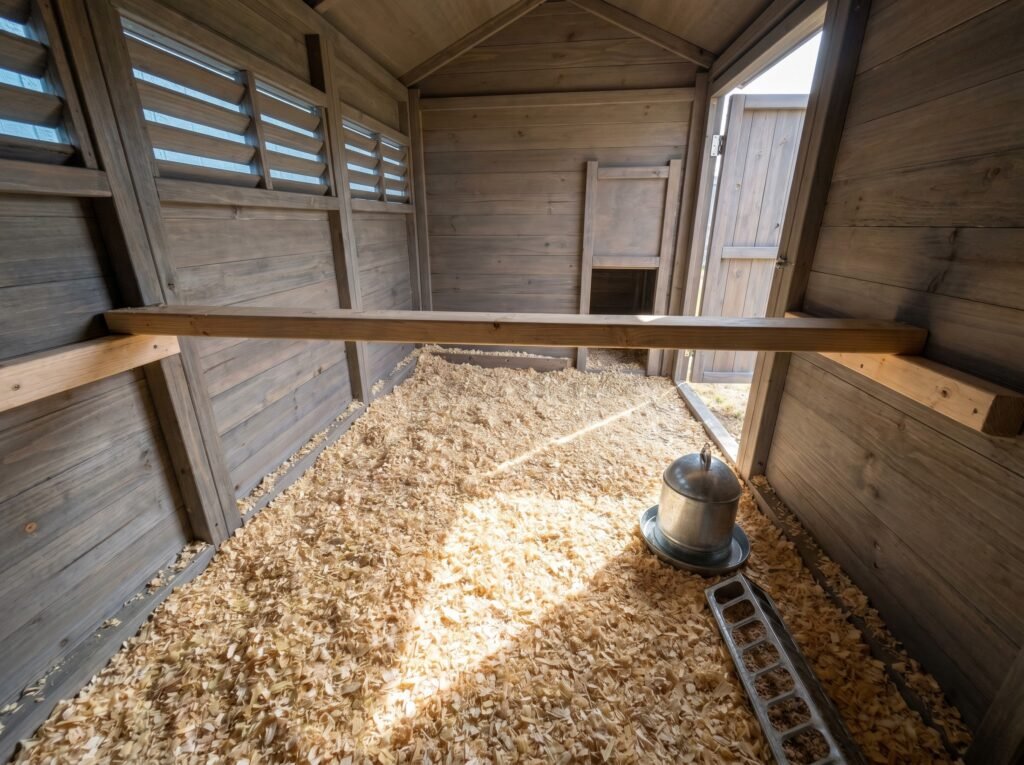
Young pullets moving into a new space are vulnerable on several fronts. Predators, drafts, and disease all hit them harder than they hit adult birds. A walk-through before move day catches problems while they are still easy to fix.
| Item | Standard | Notes |
|---|---|---|
| Floor space | 3-4 sq ft per bird indoors (laying hens); give young birds a bit more to prevent piling | Overcrowding is the leading trigger for feather pecking at this age |
| Run space | 10 sq ft per bird | Cramped runs drive aggression and cannibalism |
| Roost bars | 8-10 in of bar per bird; 18-24 in off the floor; higher than nest boxes | Young pullets often sleep on the floor for the first week - that is normal |
| Nest boxes | One 12x12-in box per 3-4 hens | Not needed until around 18 weeks; block them early to prevent pullets sleeping and fouling them |
| Ventilation | Openings that allow fresh air exchange without direct drafts on the birds | Moisture and ammonia buildup is far more damaging than cold; a draft-free coop with good airflow is the goal |
| Hardware cloth and predator gaps | No gaps larger than 1/2 in on walls, doors, and hardware cloth; 1/4-in mesh if weasels are local | Small chicks fit through gaps that adult birds cannot |
| Bedding | 3-4 in of pine shavings or straw | Dry litter is essential; wet litter at this age raises disease risk sharply |
| Feeders and waterers | Chick-height; accessible to all birds simultaneously | Dominant birds blocking access causes uneven growth and stress pecking |
Ventilation deserves a separate note. The coop's primary job is to remove moisture, ammonia, and carbon dioxide - not to hold heat. Extension-service guidance on backyard poultry housing describes ventilation's main function as maintaining adequate oxygen while removing carbon dioxide, moisture, dust, and odors. A coop that is sealed up tight to stay warm fills with ammonia quickly, and chicks' respiratory tracts are more sensitive than adults'. Open vents above the roost line, on the opposite wall from prevailing wind, and let the air move even in cool weather.
If you plan to use a heat lamp during the hardening-off period or any cold nights after the move, secure it with wire or chain - never by its cord - on a porcelain socket, and position it so it cannot fall onto bedding. A radiant heat plate eliminates this risk entirely and is worth considering if you need to bridge a cold stretch after the birds move in.
Feed transition when chicks move out
Chicks eating starter feed (around 20% protein for pullets, per Mississippi State University Extension) should stay on it through eight weeks. After that, switch to a grower or developer diet - lower protein, around 15-16% - which they continue until first egg at roughly 18-20 weeks. Layer feed (16% protein, 3.5-4% calcium) comes only at point of lay; giving it earlier puts unnecessary calcium stress on kidneys that are not ready for it.
If your young pullets will share outdoor space with adult hens already eating layer feed, offer plain oyster shell free-choice rather than switching the whole flock to a grower. Most adults will take what they need from the shell, and the pullets avoid the excess calcium. More on the feed transition - including what to look for when deciding whether to move to grower earlier or later - is in the chick starter feed guide.
Integrating with an adult flock - the part most beginners underestimate
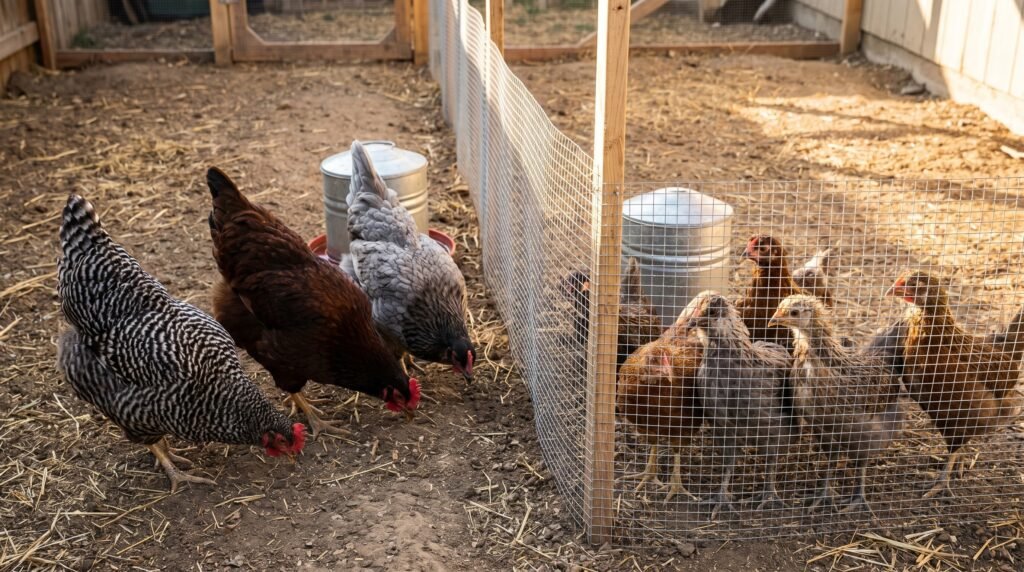
Chickens have a stable social hierarchy, and introducing strangers into it is genuinely disruptive. Extension-service research on chicken behavior is clear on this: birds that normally form a social hierarchy "usually attack a new bird of the same species or breed that is introduced into the pen." That is how the pecking order enforces itself. Your job is to manage the process so the young birds are not seriously injured while the hierarchy reshuffles.
Two principles do most of the work:
Size matching matters. Young pullets moving in with full-size hens face a real physical disadvantage. A six-week-old Rhode Island Red pullet weighs roughly a pound or less; a laying hen of the same breed weighs three to four pounds. That mismatch means a peck that annoys an adult can wound a chick. Mississippi State University Extension is direct: never co-mingle birds of different sizes unless they were raised together throughout their lives. Waiting until pullets are at least two-thirds the body size of the adults before combining them (typically 12-16 weeks depending on breed) reduces serious injury sharply.
The see-but-don't-touch method. Dividing the run with wire for one to two weeks so the birds can observe each other without physical contact gives the adult flock time to process the newcomers as flock members. When you drop the divider, the hierarchy still needs to sort itself out, but without the full shock of first contact. Watch for blood. Any bird with a bleeding wound must come out immediately, because the sight of blood escalates pecking fast.
A practical integration sequence for adding a group of eight pullets to a flock of four adults:
- Quarantine period (minimum two weeks): Keep the newcomers completely separate. Biosecurity guidance from poultry.extension.org specifies at least two weeks of quarantine to watch for disease signs before any contact with the established flock. New birds may look healthy but still carry pathogens. Two weeks is the sourced minimum; many experienced keepers extend this to four weeks if the adults are older or the source flock was unknown.
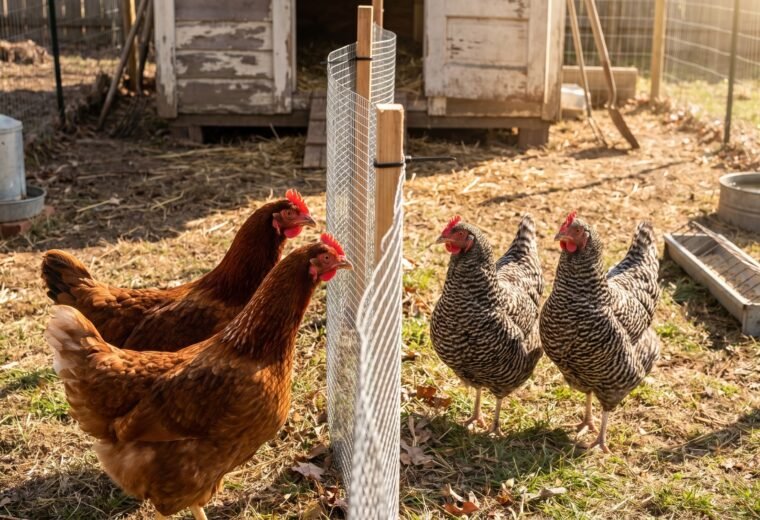
- Side-by-side separation (one to two weeks): Move the pullets into a section of the run divided by hardware cloth. Feed and water both groups normally. Let them get used to each other's presence and sounds.
- Supervised mixing: Start with daytime mixing when you can watch. Distract the flock with a head of cabbage or scattered scratch - something to focus attention away from the newcomers.
- Nighttime integration: Move the pullets into the coop after dark. Chickens are docile in the dark, and waking up together in the morning is calmer than a daytime introduction. Expect some chasing the next morning. Normal pecking that establishes rank is fine; bloodshed is not.
Slow-feathering breeds, crested birds like Polish, and birds with feathered feet like Cochins face extra scrutiny from flock-mates because they look different. Feather pecking research confirms that raising feather-legged, crested, or bearded fowl with plain-feathered birds triggers curiosity-driven pecking. If your adults are plain-feathered and the newcomers are fancy, give the integration process more time and monitor closely.
For keepers dealing with persistent chasing or a dominant hen that will not stand down, introducing new chickens to an existing flock walks through additional strategies for de-escalating the hierarchy reshuffle.
The one mistake that causes the most problems
Rushing the move because the brooder is crowded. Young chicks grow fast - what felt like plenty of space at week two is tight at week four - and the instinct is to hustle them outside. But a chick that is not feathered and goes out on a 45°F night will pile with the others and risk chilling and respiratory illness. The brooder is not the problem; overcrowding in the brooder is. Expand the brooder space, add a second water point, and wait for feathers.
A close second: skipping hardening off and hitting a cold snap. Even a fully feathered eight-week-old that has spent six weeks in a 70°F house is not ready for a sudden 40°F night. The bird's thermoregulation works, but the abrupt change stresses the immune system. That week of gradual transition is the insurance policy, not a nice-to-have.
If you want to back up to the full arc, raising baby chicks week by week traces each stage from day one through the brooder-to-coop move, and raising chicks gives the broader overview from hatching through the first months outdoors.