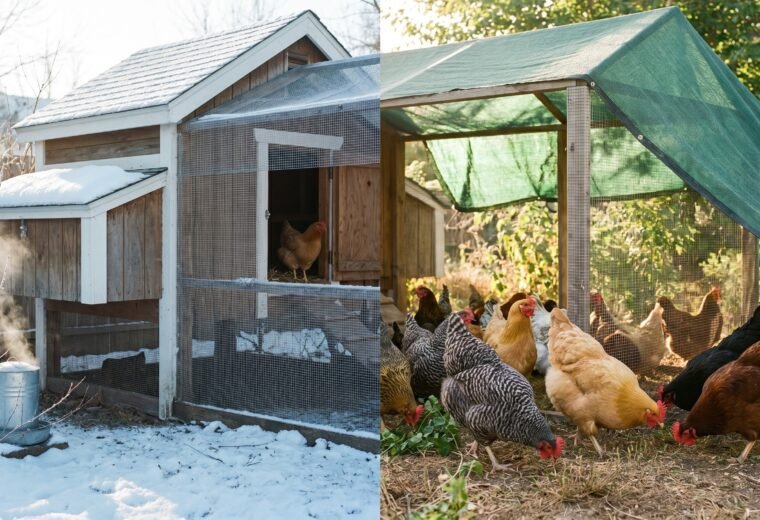
Cold weather is not the real danger for a backyard flock. Moisture is. A dry, well-ventilated coop protects chickens through serious winters far better than a sealed, heated box that traps ammonia and condensation. Get those two things right, airflow and dryness, and most everything else on this list falls neatly into place. This checklist walks through every system worth checking before the first hard freeze, in the order we find most logical to tackle them.
How much ventilation does a chicken coop need in winter?
Keep upper vents open year-round, even in hard cold. Moisture from droppings, breath, and drinkers is the primary danger to a winter flock - not temperature. Roof-level openings let humid, ammonia-laden air escape without sending a cold draft across the roost. If you see condensation on walls each morning, airflow is insufficient.
Open vents in the dead of winter sounds counterintuitive, but sealing a coop tight is one of the fastest ways to harm a flock. A closed, unventilated space allows that humid air to accumulate until it hits cold surfaces and condenses. According to Cornell Cooperative Extension, that combination of high moisture and low temperature raises the risk of ammonia buildup, bumblefoot, and frostbite all at once.
The fix is simple in principle: keep vents open at the roofline, above the birds' heads, so stale humid air escapes without a cold draft blowing across the roost. If you can see condensation on the walls or ceiling on a cold morning, ventilation is not enough and needs to increase. South-facing vents or windows that can be cracked slightly on calmer days are a practical choice in cold climates. Burlap tacked over an opening reduces direct wind without blocking all airflow. A good check: stand at roost height at night and feel for moving air on your face. If you feel a draft there, the birds do too.
Lower openings (ground-level pop doors, windows below roost height) are the ones to close against wind and drafts. Upper vents stay open year-round. Sizing and positioning those vents by coop square footage is a different calculation - the full method is in the coop ventilation guide.
How do you block drafts without sealing off airflow?
Seal gaps at roost height and below - door frames, board joints, electrical entries - while leaving upper vents open. A draft is moving air striking birds directly at roost level; ventilation is air exchange high in the space. Getting one wrong while maintaining the other is the whole skill in winter coop management.
Drafts and ventilation are two different things. A draft is a stream of moving air striking the birds directly, especially at roost level. Ventilation is the exchange of air higher up in the space. Blocking one while maintaining the other is the whole skill.
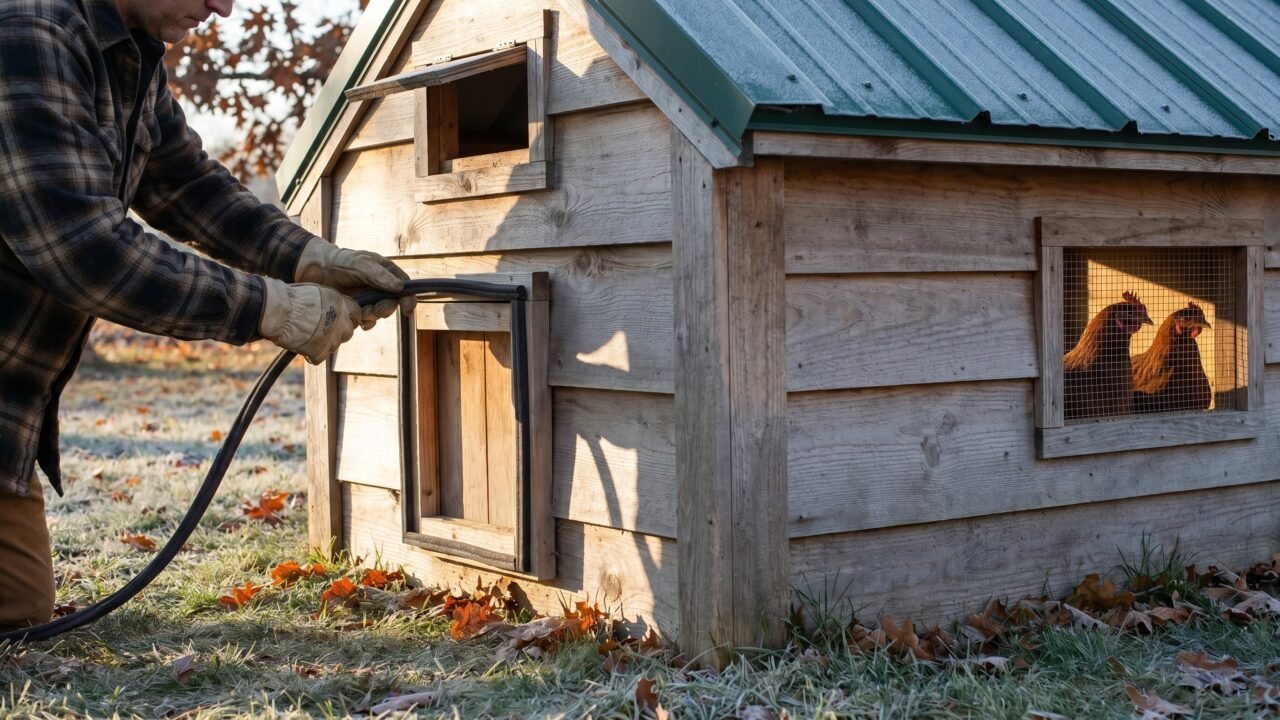
Walk the perimeter of your coop on a windy day and press your hand against every board joint, door frame, and window edge. Even a small gap at roost height can chill birds enough to spike feed costs and drop production. Common places to find leaks: around the pop door frame, at corners where siding meets the floor, and around any electrical entries. A tube of exterior caulk and a few scraps of weatherstripping handle most of them.
Adding temporary insulation (rigid foam board against interior walls, or a deep straw bale stacked along the windward outside wall) helps in climates that see sustained sub-zero temperatures. Neither is strictly necessary for cold-hardy breeds like Wyandottes, Plymouth Rocks, or Orpingtons, which handle cold well in a dry, draft-free space.
Does deep litter actually help keep a coop warm in winter?
Yes, with caveats. Starting with 4-6 inches of pine shavings or straw and stirring layers every few days allows microbial decomposition to generate modest floor-level heat. The bigger benefit is dry, managed bedding that reduces ammonia and moisture - the two conditions that harm birds far more than cold air alone.
Deep litter is less a product and more a process. You start with 4 to 6 inches of pine shavings or straw (UMN Extension recommends this depth), then add fresh bedding on top as the surface soils rather than removing everything each week. Stirring the layers every few days moves droppings down where microbes can break them down. The decomposition generates a modest amount of heat at the floor level, which is a useful bonus in very cold weather.
Two things will kill the system fast. The first is wet litter. Drinkers that drip, or rain that blows in through gaps, introduce enough moisture to shut down decomposition and start composting in the wrong direction, producing ammonia instead of warmth. The second is skipping the stir. Packed, compacted litter stops working. Plan on one complete cleanout in spring and possibly one mid-winter top-up of fresh material if the smell rises above what a quick stir fixes. Ohio State University Extension is explicit that deep bedding can increase humidity on its own, so watch your condensation check even with good litter management.
Getting the carbon-to-nitrogen ratio right is what separates bedding that composts quietly from bedding that smells by January - ratios, layering sequence, and troubleshooting are all in the deep litter method guide.
What kind of roost bar protects chickens from frostbite in winter?
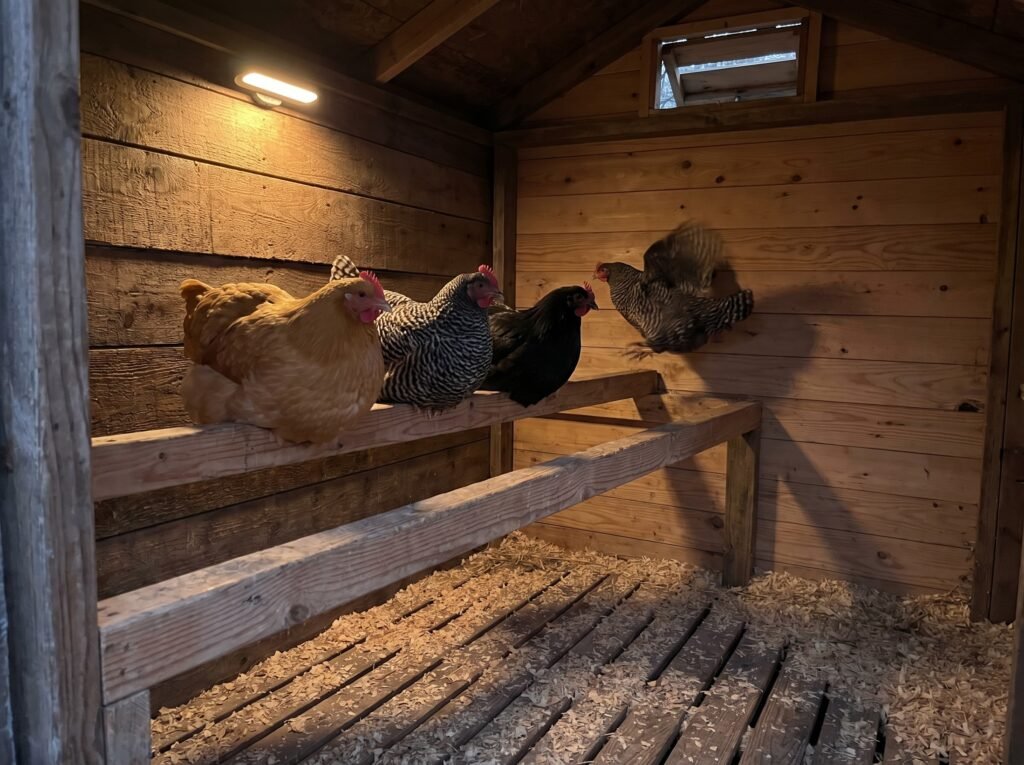
A flat 2x4 installed wide-side-up, mounted at least 12 inches off the floor, with 9 inches of bar space per bird. The flat surface lets hens sit completely flat-footed and drape breast feathers over their toes. Round or narrow bars force toes to grip, pulling them out of the feather cover and into the cold.
A flat 2x4 installed with the 4-inch face up is the standard winter roost for good reason. University of Maryland Extension is specific on this: a flat surface lets a bird sit completely flat-footed, draping her breast feathers over her toes to insulate them against the cold bar. Round or narrow perches force the feet to grip, which pulls the toes out from under the feathers and leaves them exposed. Cornell Cooperative Extension confirms the same point: round and narrow perches result in feet wrapping around the bar, which prevents feather insulation.
Skip metal or plastic bar materials entirely. Both conduct cold directly to the feet. Untreated pine or fir 2x4s are inexpensive and work well.
Space per bird at the bar: 9 inches is the figure UMN Extension gives for standard-size chickens. The bars should be mounted at least 12 inches off the floor and higher than the nest boxes, since chickens always choose the highest sleeping spot available, and if nest boxes are higher, you'll be cleaning eggs out of soiled nests through the whole season. Bar height also affects frostbite risk: toes on a bird roosting too close to a cold floor lose warmth faster.
More detail on bar dimensions, spacing, and materials is in our roost and bar guide.
How do you keep chicken water from freezing in winter?
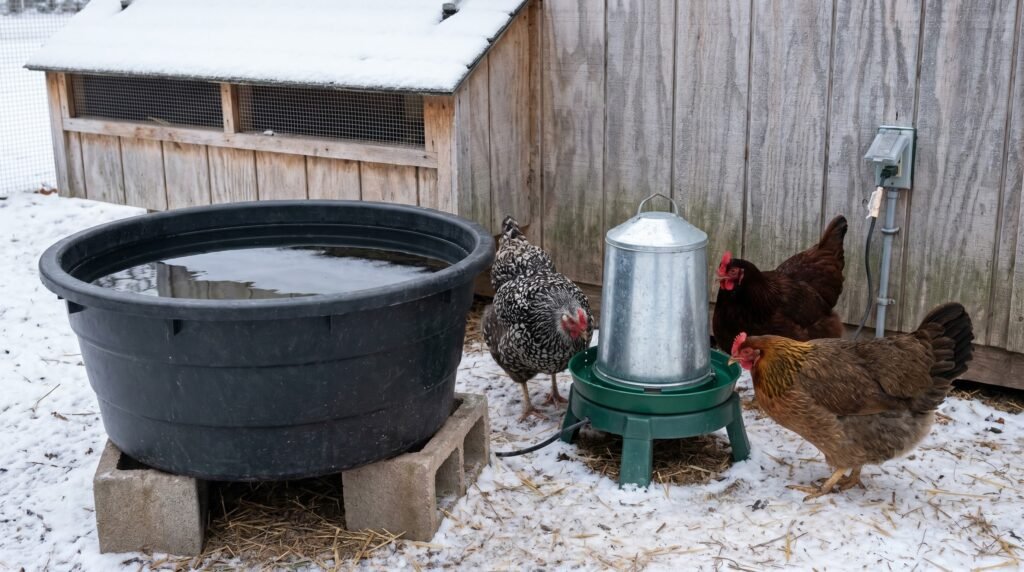
The most reliable approach is a heated waterer or a heated metal fount base if you have coop electricity. Without power, black rubber tubs in a south-facing run absorb enough solar heat to delay freezing, though they need breaking two or three times daily in sustained freezes. A two-waterer rotation is the low-tech fallback for any setup.
UMN Extension makes this plain: without water, chickens will stop eating. A frozen waterer by 7 a.m. means a flock that refuses feed all morning, which then cuts into their ability to generate body heat, exactly when they need it most.
Several practical approaches work depending on your setup and budget.
| Method | Best for | Limitation |
|---|---|---|
| Heated base for metal fount | Coops with electricity | Check wiring regularly; fire risk if faulty |
| Heated plastic fount (self-contained) | Coops with power, small flocks | Plastic can crack at sustained low temps |
| Black rubber tub in a south-facing run | Moderate-cold climates, no power | Needs breaking 2-3x daily; not for sub-zero weather |
| Two-waterer rotation | Any setup without power | Requires twice-daily manual swap |
The rubber-tub trick is worth knowing: University of Maryland Extension recommends placing black rubber tubs in sunlight because they absorb heat, will not crack in the cold, and are easy to pop ice out of when it forms. For a flock where electricity is available, a dedicated heated waterer is the lowest-hassle option, though it pays to have a backup fount ready in case the heater fails. Our roundup of the best options is in the heated waterers guide.
Are heat lamps safe to use in a chicken coop in winter?
Rarely necessary and genuinely risky. Most healthy adult flocks in a dry, draft-free coop do not need supplemental heat. When heat is required - chicks, sick birds, or sustained temperatures well below freezing - a flat-panel wall-mounted heater carries far less fire risk than a hanging heat lamp. If you use a lamp, a safety chain is non-negotiable.
Most healthy adult chickens do not need supplemental heat if the coop is dry and draft-free. University of Maine Extension and UMN Extension both say as much, pointing to cold-hardy breeds that acclimate naturally. Chicks and very young birds are a different case, but for an established flock the bigger risk from heat lamps is usually fire, not cold.
Cornell Small Farms documented what goes wrong: a brooder lamp fell into dry bedding and killed most of the chicks in the pen. University of Maine Extension's bulletin on small-flock lighting states it directly: many barns and livestock have been lost to fire due to heat lamps. The construction on cheaper fixtures is the problem: short cords, unreliable hang points, no protective cage around the bulb.
If your climate genuinely calls for supplemental heat (UMN Extension suggests below 35°F as a threshold, particularly for younger or sick birds), a flat-panel coop heater mounted to the wall is a less volatile choice than a hanging lamp. Whatever you use: always secure with a safety chain, never hang by the cord, keep all wiring away from litter and drinkers, and have a licensed electrician wire any permanent electrical work in the coop.
A parallel question: supplemental lighting for winter egg production is separate from heating. Penn State Extension recommends 16 hours of light per day for laying hens, using a warm-color bulb below 3500K (hens need only about half a foot-candle of brightness to trigger laying, so a single low-wattage LED on a timer is sufficient). That's covered fully in our winter laying guide.
What causes frostbite in chickens and how do you prevent it?
High humidity combined with cold is the primary cause - not cold alone. A coop that stays dry through proper ventilation and litter management prevents most frostbite. Large-comb breeds like Leghorns and Minorcas are most vulnerable. Petroleum jelly on combs and wattles before a hard freeze adds a physical barrier; weekly bird checks catch early damage before it advances.
Frostbite in chickens shows up first on the comb, wattles, and toes, the extremities with the least insulating feather cover. UMN Extension identifies high moisture combined with cold as the main cause, which is why a humid, poorly ventilated coop produces more frostbite cases than a colder but drier one. Large-comb breeds like Leghorns and Minorcas are more vulnerable than small-comb or rose-comb breeds.
Petroleum jelly applied to combs and wattles before a hard freeze provides a physical barrier. It does not treat existing frostbite damage, but it reduces how fast moisture on the skin chills in the cold. Checking birds weekly through winter makes early damage visible before it progresses to the gray or blackened tissue of a serious injury. If you see that level of damage, a poultry vet is the right next call.
Does winter increase predator pressure on a backyard flock?
Yes. Snow-covered ground pushes hungry foxes, weasels, and coyotes closer to structures. Frost heave can open new gaps under aprons that were secure in autumn. Shorter days mean birds are confined longer, and earlier dusk narrows the window between birds going in and a keeper closing up. Winter is the season to re-audit every gap and latch.
Winter shifts predator behavior in ways that catch keepers off guard. Snow on the ground pushes hungry foxes, weasels, and coyotes closer to human structures. Frozen ground can work in your favor (harder to dig under your apron) or against you (some predators find new entry points under structures as the soil heaves and gaps open). Shorter days mean birds are in the coop longer, and a coop that seemed secure at dusk in September may be breached by 5 p.m. in December.
A pre-winter predator audit worth running:
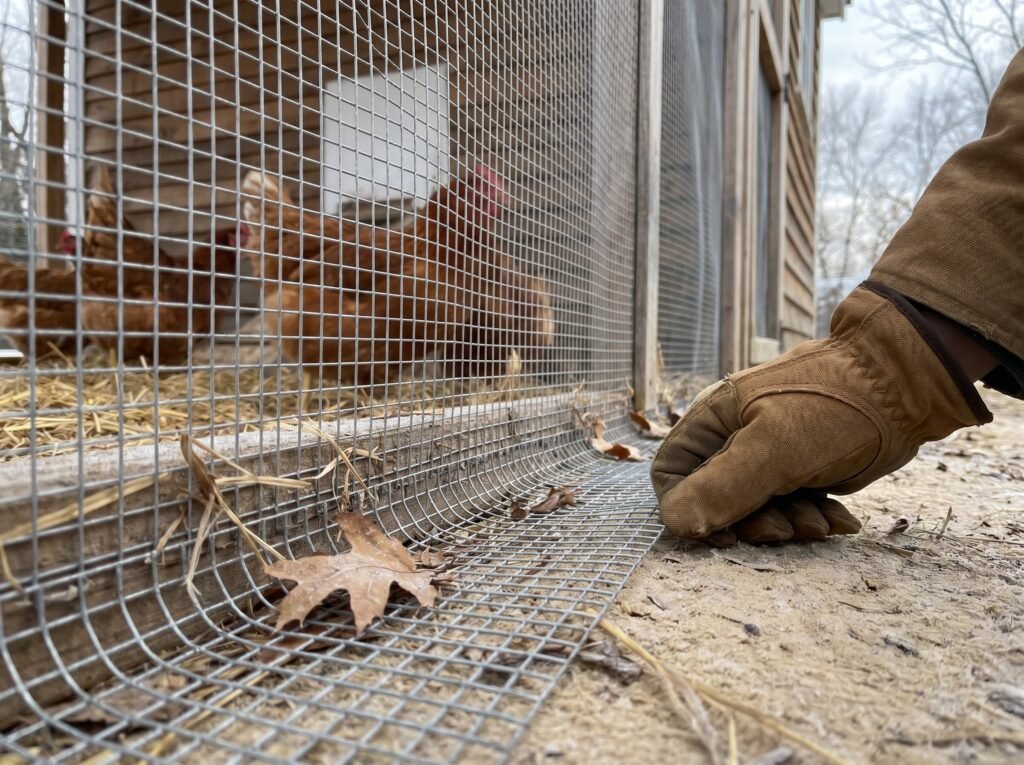
- Check every gap wider than half an inch. Weasels squeeze through surprisingly small openings. Hardware cloth (half-inch or smaller mesh) covers gaps that chicken wire leaves open. Quarter-inch mesh is the choice if weasels are a documented problem in your area.
- Inspect the buried apron or trench. Frost heave can lift hardware cloth that was pinned tight in fall. Walk the perimeter and press the mesh down; re-pin anywhere it has lifted away from the soil.
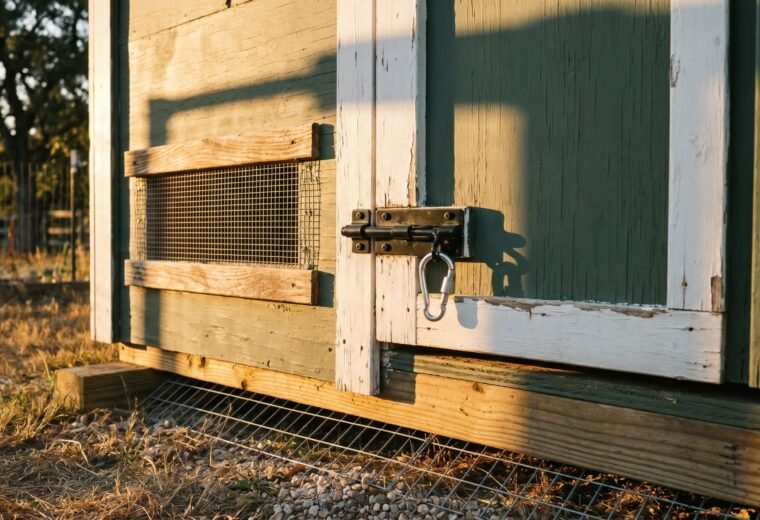
- Check every latch. Raccoons remember how a hook-and-eye latch works after a few nights of practice. A spring-loaded carabiner or a two-step barrel bolt is harder to defeat.
- Close birds in at dusk. Automatic coop doors set to close at sunset reduce the window of opportunity for any predator. Verify that the door's timing still matches sunset after daylight saving time ends (the offset is larger than it looks).
- Look up as well as around. Hawks are federally protected, so deterrence rather than harm is the only legal option. A covered run matters most during the short, low-sun winter days when hawks hunt in different light conditions.
Our full breakdown of predator identification, hardware cloth sizing, and apron installation is in the predator-proofing guide.
How should you adjust feed and nutrition for chickens in cold weather?
Expect consumption to rise up to 25 percent as birds burn more calories maintaining body temperature. Keep feeders full and check them more often. Do not swap layer feed for scratch grain - that drops protein and calcium when hens need them most. A small evening scratch ration adds digestive warmth overnight; free-choice grit covers what snow-covered ground no longer provides.
A flock eating through winter cold burns more calories to maintain body temperature. UMN Extension puts the increase at up to 25 percent more feed during cold weather, so checking feeders more often and keeping them full is a practical priority. Protein should stay at standard layer-feed levels (around 16 percent crude protein); dropping to a low-protein scratch-grain mix in winter is a common mistake that reduces both warmth generation and egg quality.
Scratch grain is a useful tool used correctly: feeding a small amount in the evening gives birds a burst of digestive heat as they roost overnight. UMN Extension recommends no more than a handful per 10 birds to keep it supplemental rather than displacing balanced feed. More than that and you dilute the protein and calcium the hens need.
Grit is also easy to overlook when birds are spending less time outdoors. Snow-covered ground removes their natural access to small stones, so offering granite grit free-choice through winter matters for any bird that is not on a fully milled feed.
What does a complete winterizing checklist for a chicken coop include?
Nine task areas cover every system that needs attention before and during the cold season: ventilation gaps, draft sealing, litter depth, roost setup, water, supplemental heat, frostbite prevention, predator security, and feed. The table below maps each area to a specific action and timing so nothing gets missed during a busy autumn.
| Task | What to check or do | When |
|---|---|---|
| Ventilation | Upper vents open; no condensation on walls; feel for drafts at roost height | Before first freeze; recheck after each storm |
| Draft sealing | Caulk gaps at joints, frames, and electrical entries; weatherstrip pop door | Before first freeze |
| Deep litter | 4-6 in of shavings or straw; stir every few days; watch litter smell and moisture | Establish before cold sets in; full cleanout in spring |
| Roosts | Flat 2x4 wide-side-up; 9 in per bird; higher than nest boxes; no metal/plastic | Before first cold night |
| Water | Heated fount or rubber-tub rotation; backup waterer on hand | Before temps drop to freezing |
| Supplemental heat | Assess only if below 35°F or sick/young birds present; safety chain mandatory | As needed; panel heater preferred over hanging lamp |
| Frostbite prevention | Petroleum jelly on combs/wattles; keep litter dry; weekly bird checks | Before hard freezes; ongoing through winter |
| Predator audit | Gaps under half-inch; apron pinned; two-step latches; auto door timing | Before first freeze; recheck after ground heave |
| Feed | Increase fount/feeder checks; small scratch evening portion; free-choice grit | Ongoing through winter |
Everything that goes into broad seasonal management (molting, daylight changes, health checks across the calendar) lives in our seasonal chicken care overview. For cold-hardy breed selection that makes every item on this list easier, see the full comparison at keep chickens warm in winter.