Ten square feet per bird is the starting point for an outdoor chicken run - that's the figure Virginia Tech Extension and Extension.org both land on for laying hens. Build to the minimum and you'll have functional space; build larger and you'll have noticeably calmer, healthier birds and ground that stays cleaner far longer. What those numbers don't tell you is how to keep a run from turning into a mudhole, which fencing materials will actually stop a determined raccoon, or whether you need a roof at all. That's what this guide covers, from the first measurement tape pull to the day you let the flock in.
A quick note before diving in: the research on backyard poultry space allowances is thinner than you'd expect - "there is very little peer-reviewed research looking at the space allowances for backyard poultry" (Extension.org) - so every number here is a well-grounded guideline, not a law of physics.
How to size a chicken run: the numbers that actually matter
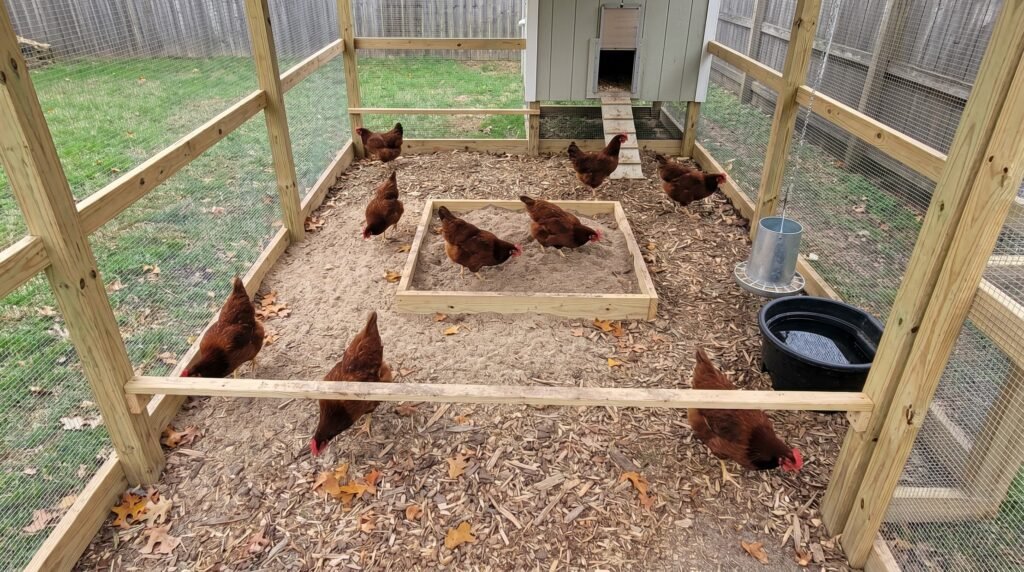
The 10-sq-ft-per-bird figure applies to standard-sized laying hens in a run they use daily as their main outdoor area. A common starting point for bantams is 6-8 sq ft each, though no peer-reviewed standard exists for smaller breeds - treat it as a rough rule of thumb rather than a fixed number. If your hens also free-range during part of the day, you can shade the run smaller - but crowding still causes pecking, feather damage, and fouled ground faster than you'd like.
Work through this before you set a single post:
- Count your birds now, then your birds in two years. Flocks expand. A run sized for eight hens feels tight with twelve.
- Factor in how much time they'll spend in it. A run used only a few hours a day carries less load than one that's the flock's entire world.
- Think about the ground. More square footage per bird means the soil degrades more slowly, stays drier, and needs less intervention.
The table below shows run dimensions for common flock sizes. The "comfortable" column is where we'd aim if starting from scratch:
| Flock size | Minimum run (10 sq ft/bird) | Comfortable run (15 sq ft/bird) | Ground stays decent at... |
|---|---|---|---|
| 4 hens | 40 sq ft (5×8 ft) | 60 sq ft (6×10 ft) | 15+ sq ft/bird |
| 8 hens | 80 sq ft (8×10 ft) | 120 sq ft (10×12 ft) | 15+ sq ft/bird |
| 12 hens | 120 sq ft (10×12 ft) | 180 sq ft (12×15 ft) | 15+ sq ft/bird |
| 20 hens | 200 sq ft (10×20 ft) | 300 sq ft (15×20 ft) | 15+ sq ft/bird |
This table is intentionally paired with the embedded Run Size Calculator below. Plug in your flock size and how much outdoor time they get each day, and the calculator adjusts the recommendation accordingly.
One more sizing reality: a standard chicken run will be stripped bare of any plant material within days to weeks. Extension.org notes the run "will quickly be denuded of any plant material and could become muddy during wet weather." Size your run generously, locate it on well-drained ground, and plan the ground surface before the birds move in.
Keepers who prefer no fixed run often switch to free-ranging, which trades the space constraint for higher predator exposure and neighbor-relations complexity.
Choosing fencing: what stops predators and what doesn't
The single biggest mistake in run construction is using chicken wire as the primary barrier. Chicken wire was designed to keep chickens in, not predators out. Raccoons can tear through it, rats can bite through it, and weasels slip through the hexagonal gaps without much effort - a conclusion multiple extension programs have reached independently.
Hardware cloth is the answer. Welded-wire hardware cloth with 1/2-inch or 1/4-inch openings holds against almost everything. For the walls of the run, 1/2-inch hardware cloth stops raccoons from reaching in and pulling birds to the fence. For the bottom apron and any areas where weasels or rats are a known issue, step down to 1/4 inch.
| Mesh guidance | Source |
|---|---|
| "Tightly woven mesh hardware cloth that is one-fourth to one-half inch for the best protection" | USU Extension |
| Maximum one-inch-by-one-inch opening; anything larger allows weasel access | Cornell Cooperative Extension |
Gauge, cost, and predator-specific scenarios are compared in the hardware cloth vs. chicken wire breakdown.
Run fencing: material decision table
| Material | Mesh opening | Stops raccoons | Stops weasels | Stops rats | Relative cost | Best use |
|---|---|---|---|---|---|---|
| Hardware cloth, 1/4 in | 1/4 in | Yes | Yes | Yes | Highest | Bottom aprons, weasel-heavy areas |
| Hardware cloth, 1/2 in | 1/2 in | Yes (no reach-through) | Partial | Yes | High | Run walls, standard builds |
| Welded wire, 1x2 in | 1x2 in | Partial (paws reach through) | No | No | Medium | Upper sections with hardware cloth base |
| Chicken wire | 1 in hex | No | No | No | Lowest | Not recommended as primary barrier |
CSU Extension notes that 1-by-2-inch welded wire is preferable to the cheaper 2-by-3-inch option because the larger openings lead to meaningfully more bird losses. If budget is tight, prioritize 1/2-inch hardware cloth for the lower 36 inches of the run walls (where raccoons and dogs make contact) and use welded wire above that.
Predator-proofing: the details that decide whether your run holds
Most run breaches happen at the bottom or the top. Diggers work under the fence; climbers and fliers come over. Address both.
Stopping diggers
Foxes, dogs, skunks, and raccoons all dig. The two approaches that work are a buried skirt and a ground apron:
- Buried skirt: UConn Extension recommends burying fencing "at least 12 to 18 inches with a 6 to 8 inch 'L' or 'J' to the outside, backfilled with rocks and soil." Virginia Tech Extension lands on 12 inches straight down as its standard recommendation.
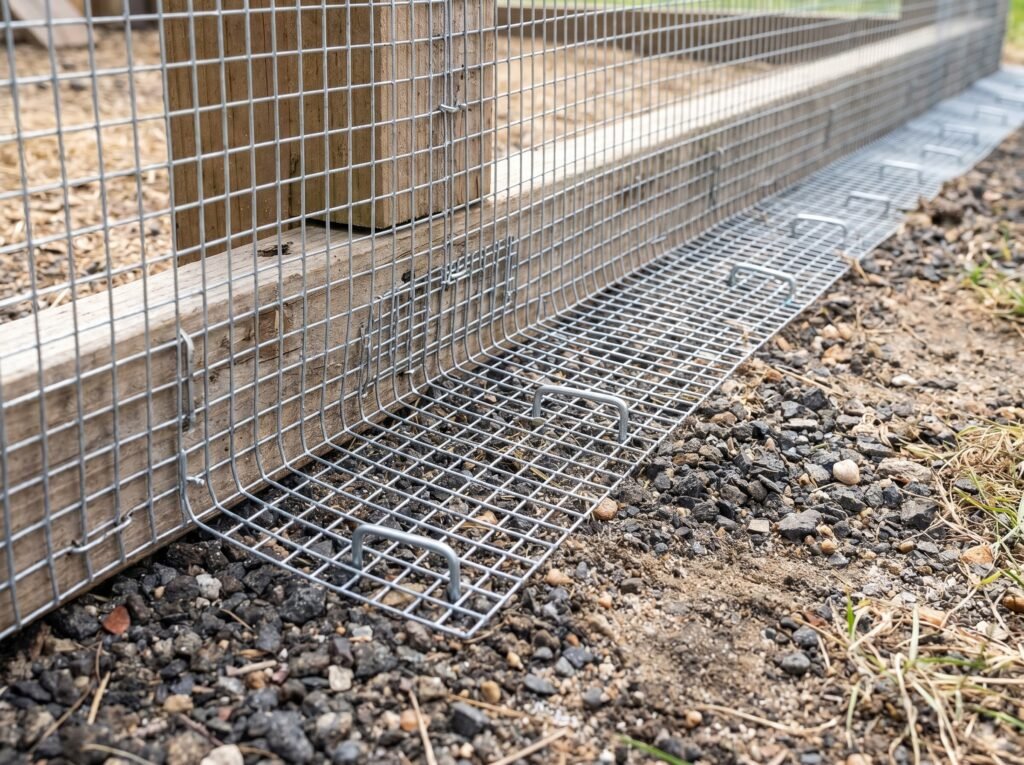
- Surface apron (L-footer): Lay a 12-inch-wide strip of hardware cloth flat on the ground, angled outward from the base of the run wall, and stake it down or cover it with soil. A predator digging at the wall hits the apron immediately - they rarely figure out to back up and dig further from the fence. USU Extension cites this as one of the effective options alongside burying.
Extension.org's predator management guide puts the burial depth at "at least 30.5 centimeters (12 inches) into the ground to deter diggers."
Stopping climbers and fliers
Raccoons climb well. So do minks, opossums, and domestic cats. A fully covered run solves all of it. CSU Extension recommends covering the run "with welded-wire fencing, chicken wire, or game-bird netting, or install a random array of crisscrossing wires overhead" as a deterrent for hawks and owls.
If a particular hawk or owl becomes a regular visitor, Extension.org's predator guide notes: "the easiest way to protect your flock is to use a covered run. Orange netting is best because hawks and owls see orange well." Hawks in the US are federally protected - you cannot harm or kill them. Overhead coverage is your only reliable tool.
Fence height matters for other jumpers. CSU Extension warns that "bobcats and coyotes can easily clear 4-foot-high fences," so 6 feet is a safer height in areas with either predator, with an outward-angled overhang adding extra resistance.
Hardware locks on all gates deserve attention here too. Raccoons have nimble paws and quickly learn to work simple latches. Two-step closures or carabiner-style locks are worth the small cost. The behavior profiles of the most common threats - useful context when deciding which protection layers your area needs - are mapped out in the predator overview.
Covered vs. open run: how to decide
An open-top run is cheaper and faster to build. A covered run costs more and takes longer but delivers meaningfully better protection and gives you control over weather exposure. Neither is always right.
| Factor | Open-top run | Covered run |
|---|---|---|
| Hawk/owl protection | None (overhead deterrents help but are not reliable) | Full, when cover is solid or tight netting |
| Climbing predator risk | Higher - fence height is the only defense | Low with a solid or mesh roof |
| Rain and snow | Ground gets wet; mud accumulates | Ground stays drier; litter lasts longer |
| Ventilation / shade | Natural airflow | Requires design attention in hot climates |
| Construction cost | Lower | Higher (roofing materials, added structure) |
| Works well when... | Hawks are rare; you lock birds in at dusk; low-rainfall climate | Hawks or climbing predators are active; wet climate; full-time outdoor access |
Virginia Tech Extension states directly that "keeping poultry totally confined with fencing and in covered runs is your best protection from predators." Keepers in wet climates consistently report that a covered run is the single biggest quality-of-life upgrade they made - dry ground means less disease pressure, happier birds, and far less boot-scraping. Construction options for both setups are laid out in the covered vs. open run comparison.
Managing the ground: mud is the real enemy
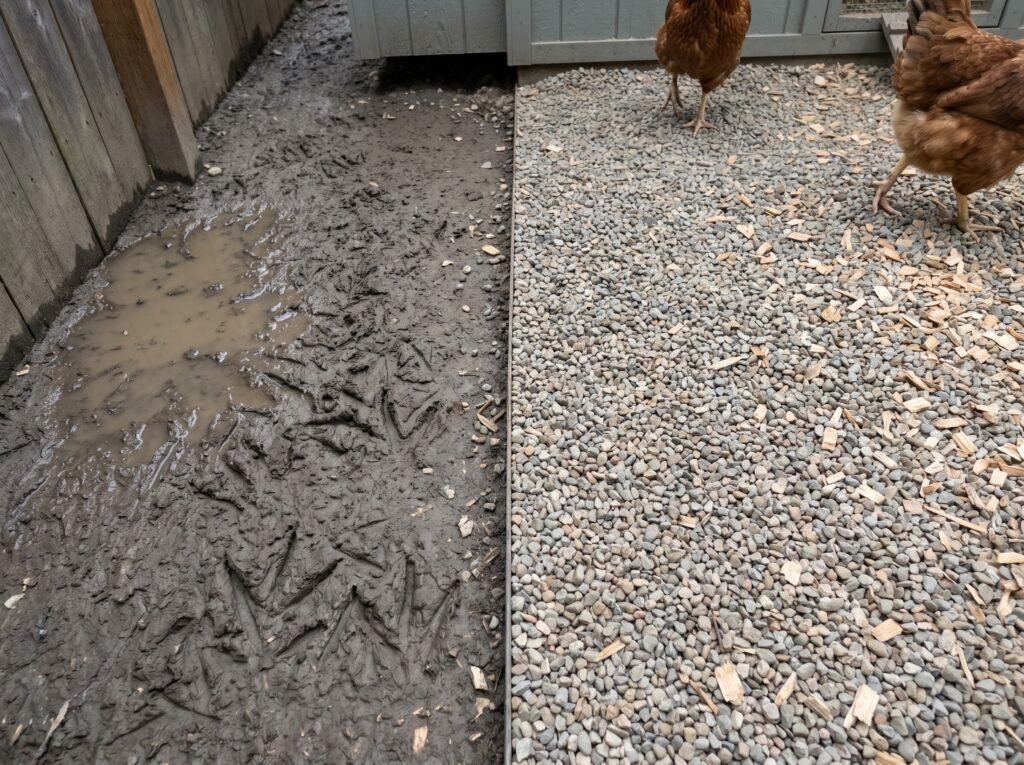
Chickens and mud are a miserable combination. Muddy runs breed pathogens, cause foot problems, and smell far worse than they need to. The run "could become muddy during wet weather" once plant cover is gone (Extension.org), and it goes fast.
A few approaches work, and the right one depends on your soil and rainfall:
Deep drainage build-out
UConn Extension describes a layered system that handles serious drainage problems: excavate 12-18 inches with a slight slope away from the coop, lay plastic sheeting if drainage is poor and add a drain pipe, then build up 4-6 inches of sand, a 1/4-inch wire mesh layer, 4-6 inches of coarse gravel, another mesh layer, and top with 4-6 inches of pea gravel. It's labor-intensive to install but virtually maintenance-free for years.
Simpler surface options
- Coarse sand: Drains well, easy to rake, chickens love dust-bathing in it. Avoid fine play sand - it compacts and holds moisture.
- Wood chips or wood shavings: Absorbs moisture quickly. Kiln-dried pine chips are preferred because green or damp wood can carry molds harmful to birds. Needs replenishment.
- Pea gravel: Excellent drainage, easy to hose down. Too coarse for young chicks.
- Deep litter (in a covered run): Layering carbon-rich material and allowing it to break down works in covered runs where rain doesn't keep the litter waterlogged.
Slope always matters. Even a 2% grade away from the coop door keeps standing water from pooling where birds congregate. Build slope in before you add any surface material.
Cost per square foot and cold-climate performance for each surface are covered in the chicken run flooring breakdown.
Enrichment: what the run should actually do for your flock
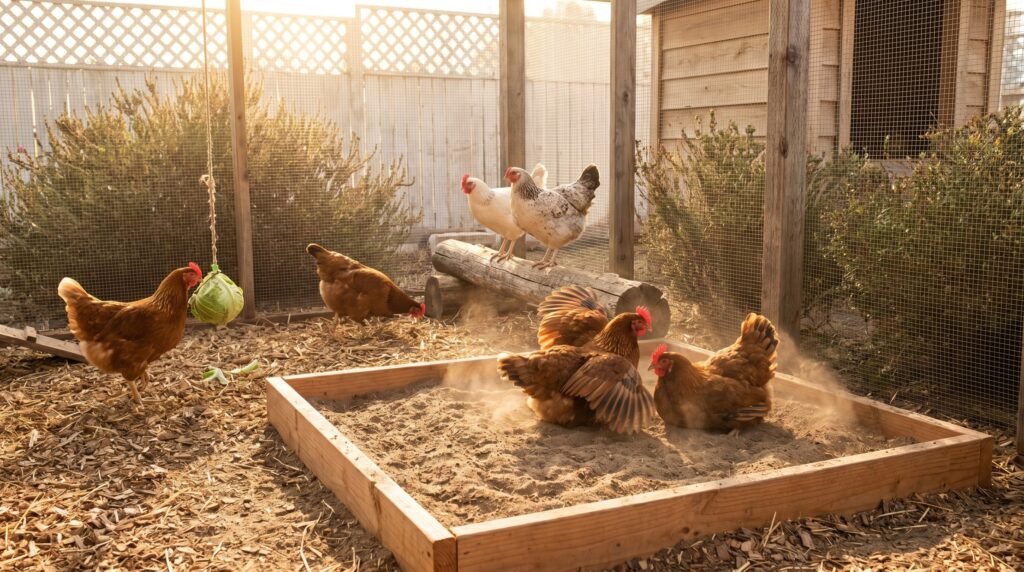
A bare dirt box checks the space box but misses the point. Chickens are active, curious animals with genuine behavioral needs - foraging, scratching, perching, dust-bathing, and social interaction. Virginia Tech Extension defines enrichment as "items or resources that allow birds to perform important behaviors," and adds a critical implementation note: "if an item is attractive to the birds, they need to be able to actually use it" - which means space is a prerequisite, not an afterthought.
What actually works in a run:
- Perches at varying heights. A low 2x4 set 12-18 inches off the ground gives lower-ranking birds a retreat and satisfies the roosting drive during daylight. Different heights prevent one bird from monopolizing the best spot.
- Forage scatter or a treat log. Tossing scratch grain into the run or drilling a log with treats packed in gives birds something to work for. Foraging enrichment is widely considered effective at reducing feather-pecking pressure in crowded runs - a serious welfare concern when space is limited.
- Dust bath station. If the run ground doesn't offer loose dry soil naturally, provide a container (a rubber stock tub, a wooden frame) filled with fine dirt, sand, or wood ash. Virginia Tech notes dust bathing is socially facilitated - once one bird starts, others join - so size the station generously for your flock.
- Visual barriers. Low panels, a straw bale, or a pallet leaned against one wall give submissive birds a sight break from dominant hens. Reducing line-of-sight reduces bullying.
- Hanging items. A head of cabbage or a corn cob on a string keeps a bored flock occupied for a surprising amount of time.
Enrichment matters most in runs sized closer to the minimum. At 15+ sq ft per bird with varied terrain, birds self-direct most of their social energy productively. At 10 sq ft in a featureless rectangle, you'll see more pecking and more feather damage. Seasonal enrichment and run furniture ideas are collected in a separate roundup.
Connecting the run to the coop: the details that matter
The run and coop work as a system. The transition point between them deserves as much thought as either structure individually. A few things worth getting right:
- Pop door placement. Position the coop pop door so birds enter the run away from a fence corner. Corners concentrate pecking-order stress; a central entry gives submissive birds more exit routes.
- Run grade relative to coop. The run floor should sit level with or slightly below the coop floor. Water pooling against the coop sill rots wood and lets moisture wick into bedding.
- Shade within the run. In hot climates, a shaded corner or covered section of the run is essential. A covered run roof over part of the space - with open sky above the rest - works well.
- Feeders and waterers. Keep at least one feeder and one waterer in the run, separate from coop equipment. Hens spend most daylight hours outside, and birds at the bottom of the pecking order often can't access indoor feeders freely.
Coop design decisions - ventilation, roost placement, nest box count - all affect how birds use the run; the chicken coop guide covers each one.
Putting it together: a run-build decision checklist
Before you buy materials or break ground, run through these nine questions. Getting clear answers saves rebuilding later:
- How many birds now, and what's your realistic maximum in three years?
- Will the run be their entire outdoor space, or a supplement to free-ranging?
- What's your local predator pressure - diggers, climbers, aerial, or all three?
- What's the drainage situation on the site? (Probe it after rain.)
- Are hawks a regular presence? If yes, a covered run is close to mandatory.
- What climate are you in? Wet climates need covered roofs or deep drainage. Hot climates need shade.
- What's your gate and latch plan? Raccoon-proof latches cost almost nothing extra.
- Do you want a permanent run or something movable? (A chicken tractor is the movable alternative.)
- What's your mud plan? Every run eventually needs one.