Chickens start struggling with heat earlier than most keepers expect. Penn State Extension puts the onset at 80°F, with effects becoming clearly visible around 85°F, and above 100°F "survival is a concern." The gap between "a little warm" and "genuinely dangerous" is smaller than a standard thermometer suggests - especially when humidity pushes heat stress down to 78°F, as NC State Extension has documented. A coop sitting in afternoon sun with poor ventilation can run noticeably hotter indoors than the ambient air outside.
The toolkit for getting through a summer heat wave is not complicated: shade, cold water, airflow, and a few feed-timing adjustments. Getting those basics right early in the day - before temperatures peak - is what separates flocks that sail through July from flocks that lose birds.
Reading heat stress before it turns into an emergency
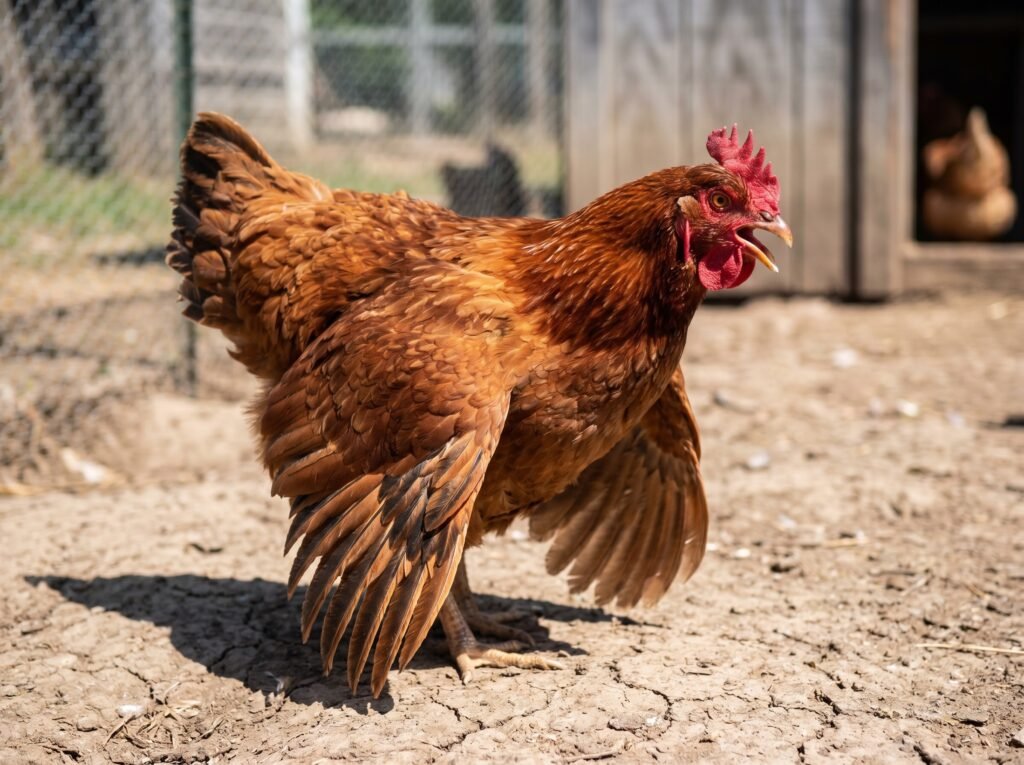
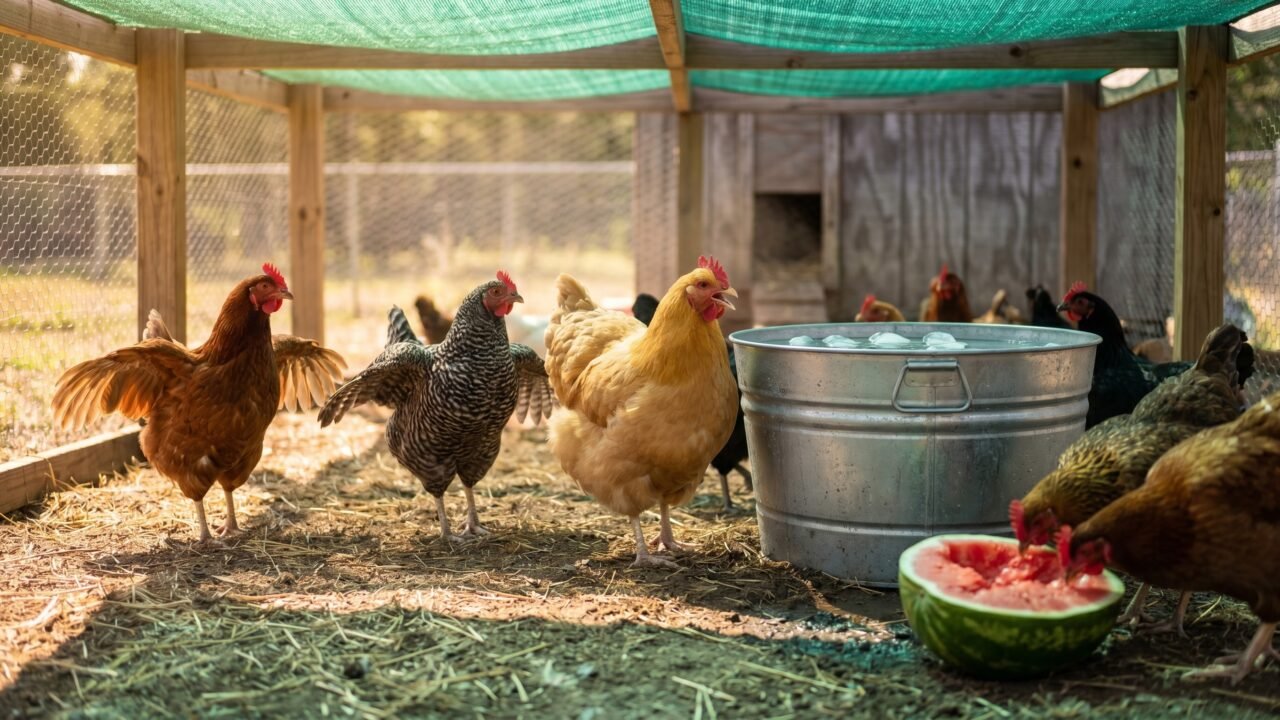
Chickens are prey animals. They hide weakness until they cannot. By the time a hen is on the ground, you have missed earlier signs that were there for hours. NC State Cooperative Extension identifies the behavioral signals to watch for: open-mouth panting, less time walking and standing, consuming less feed while drinking more water, and wings spread out and lifted away from the body. That last sign - wings held open to expose the bare skin underneath - is a passive cooling attempt, not illness by itself, but it tells you the bird is working to dump heat and struggling.
Wing-spreading is often one of the earliest visible signals - it typically shows up on more heat-sensitive individuals before the rest of the flock starts looking visibly wilted. If even one hen is holding her wings out by midday, that is a prompt to add ice to the waterers and check shade coverage for the whole run.
The Penn State Extension temperature table shows how effects escalate:
| Temperature range | What you'll see |
|---|---|
| 80-85°F | Slight feed reduction; egg size may shrink slightly; shell quality beginning to soften |
| 85-90°F | Greater feed reduction; egg quality and shell strength visibly deteriorate |
| 90-95°F | Feed intake declining steadily; heat exhaustion risk rises for laying hens specifically |
| 95-100°F | Heat exhaustion likely; high water consumption; watch for collapse |
| Over 100°F | Survival is the concern; regular monitoring required; have a cool space ready |
Severe signs - pale or blue comb, lethargic bird that won't drink, hen that is limp or unresponsive - call for immediate action. University of Arizona Extension advises submerging the bird's body (not her head) in a bucket of cool, not icy, water, then moving her to an air-conditioned or well-shaded space until she recovers completely. If she does not improve promptly, contact a poultry vet. Heat prostration can cause internal damage that is not visible from the outside.
Ventilation first: why airflow beats everything else on a hot day
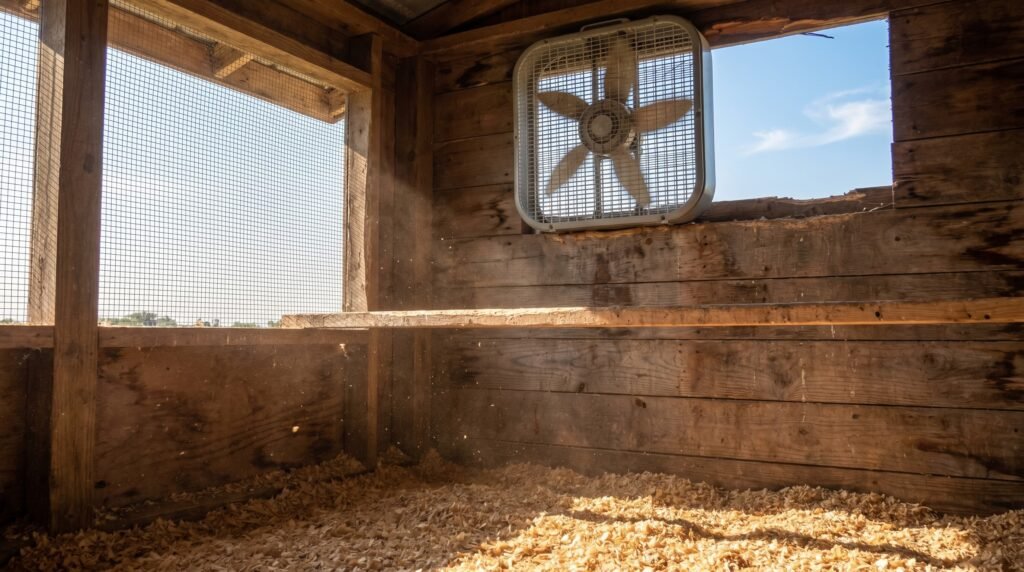
The University of Minnesota Extension is direct about priority: "Increasing ventilation to remove heat from the birds should be your first priority." That framing matters. A fan running in a coop with poor cross-ventilation still does more work than shade alone, because moving air allows panting to work more efficiently. Chickens can only cool themselves through evaporative loss at the respiratory tract - and still, humid air limits that mechanism severely.
Practical ventilation principles that hold across coop sizes:
- Cross-ventilation - openings on opposing walls - works far better than a single vent. Hot air needs somewhere to go as cooler air enters. If your coop has one window, adding a second on the opposite wall is worth the effort.
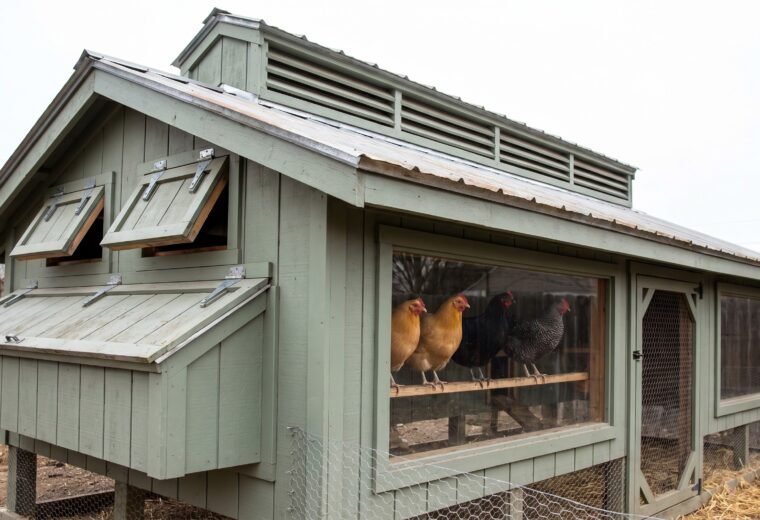
- High vents exhaust the hottest air. Hot air pools near the ceiling, so a ridge vent or a high rear vent provides a natural exhaust path without directing cold drafts across roosting birds at night.
- A box fan exhausting outward through a high vent lowers interior temperature more effectively than one blowing inward. The principle is simple: an exhaust fan actively pulls hot air out of the building, while an inward-blowing fan just pushes heat around without creating a reliable exit path.
- Shade the coop roof and south-facing walls. Radiant heat through a metal or dark roof is a major source of interior heat that ventilation alone cannot fully offset. Shade cloth, a simple roof overhang, or tree canopy make a measurable difference.
The full geometry of vent sizing, opening placement by flock count, and fan pairing is in the chicken coop ventilation guide.
Water: the most important supply on a hot day
During heat stress, water intake can rise to two to four times normal consumption. For a standard laying hen drinking roughly one to two cups on a typical day, that means potentially four to eight cups per bird during a heat wave. For a flock of 14 hens, that adds up to seven to fourteen gallons on the worst days. Running short of water during a heat wave is one of the fastest paths from stressed flock to dead flock.
At 100°F, the water-to-feed ratio climbs to a full gallon of water per pound of feed consumed, according to hatchery water-consumption data. That is a useful benchmark for provisioning: if your 14 hens are eating around three and a half pounds of feed per day, they may need three and a half gallons just to meet the feed-to-water ratio under severe heat - before accounting for waste and spillage.
The management rules that hold in summer:
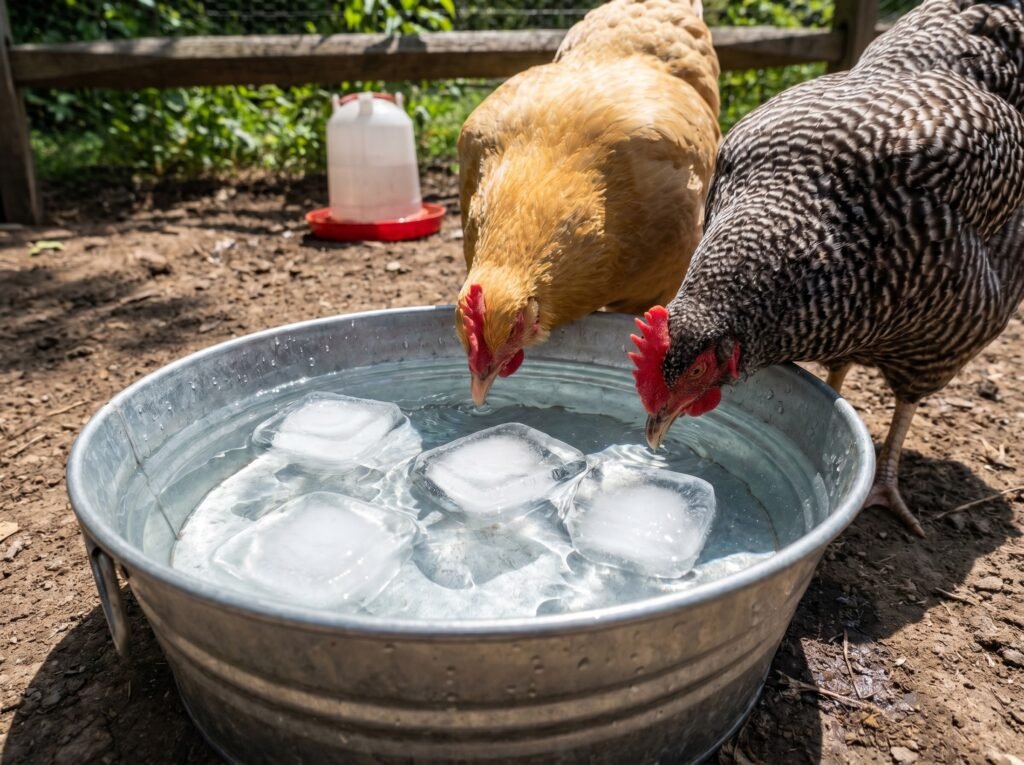
- Add ice to waterers in the morning and again at midday. Water sitting in a shaded metal drinker stays cool longer than an open dish in the sun, but even shaded water warms over hours. University of Arizona Extension recommends ice cubes, ice blocks, or frozen water bottles to keep water cold through peak heat. Birds drink more from cooler water, which is exactly what you need them doing.
- Change open dishes daily. Penn State Extension specifically advises flushing waterers routinely to keep water fresh, and Arizona Extension notes that stale warm water can spread coccidiosis. What is a clean-every-few-days task in March becomes a daily job in July.
- Multiple stations reduce competition. A subordinate hen pushed away from the only waterer by a dominant bird is going into heat stress faster than the rest. One waterer per six to eight birds is a reasonable summer minimum, with the positioning favoring the cooler, shadier part of the run rather than the center.
- Trough-style, nipple-system, and automatic-fill waterers each have different summer trade-offs for daily cleaning and capacity; see best chicken waterers for a side-by-side breakdown.
Electrolytes: when plain water is not enough
Panting expels carbon dioxide continuously, which shifts blood chemistry toward alkalosis and flushes out electrolytes - sodium, potassium, bicarbonate - in the process. After two or more days of temperatures above 90°F, a flock's electrolyte reserves are often meaningfully depleted even if the birds look functional. A peer-reviewed study published in PMC documented exactly this: blood sodium drops and blood potassium rises under severe heat stress, and "hyperventilation results in excessive CO2 loss, inducing respiratory alkalosis." That alkalosis is what causes eggshells to thin - carbonate, a shell-building component, is being chemically diverted by the pH shift.
Practical electrolyte use:
- During heat waves lasting more than two days, add a commercial poultry electrolyte mix to one waterer at the label rate. Offer plain water alongside it so birds can choose. Most guidance suggests not running electrolyte supplementation continuously for more than about ten days.
- Sodium bicarbonate (baking soda) has a specific role for laying hens. Penn State Extension specifically notes it as a targeted supplement during heat stress, because it directly addresses the alkalosis that disrupts calcium carbonate availability for shells. Follow current extension guidance or consult your extension office for dosing appropriate to your situation before adding it to waterers.
- If you want a supplemental mix beyond commercial products, follow your extension service's current recommendation for a commercial poultry electrolyte product rather than relying on unverified folk recipes. A bird already in heat prostration needs immediate veterinary attention, not a home remedy.
Shade and frozen treats
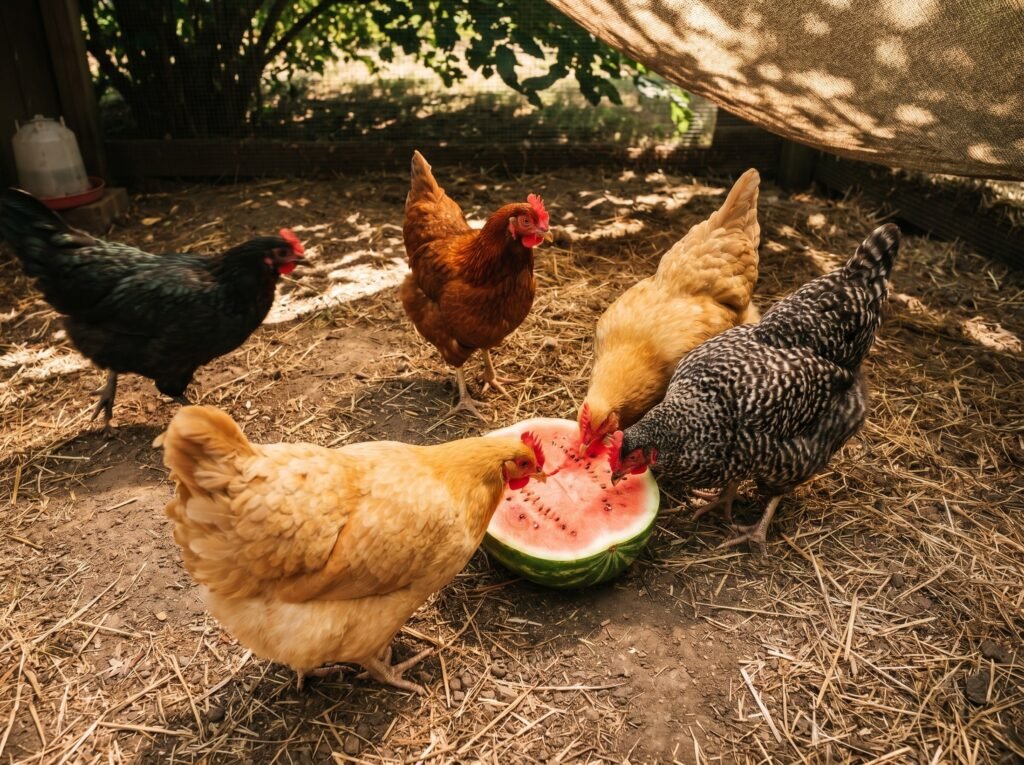
Shade is the simplest and most effective intervention in a free-range or large-run setup, because birds will self-regulate when given the option. The constraint is having enough shaded area that every bird can stand in it simultaneously - a single small tree under which hens must crowd barely helps the dominant birds in the center.
Shade cloth over the run roof cuts both direct sun and radiant heat absorption into the ground litter. Cool soil stays several degrees cooler than baked dirt, and hens will press themselves flat against it. For coops without tree cover, a temporary tarp or shade cloth rigged over the south and west sides of the run during summer is low-cost and genuinely effective.
Frozen treats work in a simple way: cold food temporarily lowers gut temperature, and birds take in water through the food at a time when they may not be actively seeking the drinker. University of Arizona Extension specifically recommends frozen watermelon and vegetables frozen into a block as effective options for keeping hens cool. A few that hold up well:
- Halved watermelons placed in the shade (high in water content, so also a meaningful hydration contribution)
- A muffin-tin frozen block: fill cups with water, chopped leafy greens, berries, or peas, freeze overnight, pop out at mid-morning
- Cucumber slices frozen flat
- A large ice block with corn, peas, or herbs frozen inside - birds peck at it, which extends the cooling effect as the ice melts
Keep treats within the standard 90/10 guideline (roughly 10% of daily intake). On hot days when feed consumption is already suppressed, a heavy treat ration can crowd out protein and calcium at exactly the time shells are already thinning from alkalosis. High-water-content options like watermelon and cucumber add hydration without significant metabolic heat from digestion.
Feed timing is the other lever worth pulling during extreme heat. Digesting a full crop generates metabolic heat internally. Restricting feed during the peak heat window - roughly noon through 4 p.m. on days forecast above 90°F - and offering the bulk of the ration in the early morning and again after sunset reduces internal heat load when ambient temperatures are already pushing limits. Hens still meet their nutritional needs; they just do the metabolically intensive work during the cooler parts of the day.
Why eggshells thin in summer - and what to do about it
Thin or soft-shelled eggs are among the first measurable indicators that heat stress is affecting the flock, often appearing before visible behavioral signs. Research published in PMC found that at severe heat stress levels (a temperature-humidity index of 85, roughly 91°F at moderate humidity), feed intake dropped 30% and egg production declined 11%. Eggshell thickness and breaking strength fell significantly alongside those numbers.
The shell problem has a specific mechanism. Panting continuously expels CO2. Lower blood CO2 means less carbonic acid, which raises blood pH toward alkalosis. Calcium carbonate, the primary shell material, is partly dependent on adequate blood carbonate for its synthesis. So a hen panting through a hot afternoon is chemically undermining her own shell-making capacity - independent of whether she is eating enough calcium.
Sodium bicarbonate supplementation addresses this directly by helping buffer blood pH. Increasing shade, airflow, and cool water all reduce the panting load itself, which is the upstream fix. Once temperatures normalize, most hens recover production within a few weeks, though older birds may not fully bounce back in the same season.
Molt timing, seasonal light changes, and how production typically shifts through the year are all covered in the seasonal chicken care overview - useful background once the summer heat management is sorted.
Choosing heat-adapted breeds
For keepers in consistently warm climates, breed selection at the start removes a significant portion of summer heat management. Three physical traits correlate with heat tolerance: small, lean body mass (less metabolic heat generated per hour), large combs and wattles (more vascular surface to radiate body heat), and tight, smooth feathering over dense or fluffy plumage.
Mississippi State University Extension states it plainly: "most American breeds do better in colder climates, while Mediterranean breeds do better in hot climates," and "birds with large combs do better in hotter regions." The geographic origin reflects actual evolutionary pressure - birds from Sicily, Tuscany, and coastal Spain were shaped by centuries of hot summers.
| Breed | Origin | Comb | Body type | Eggs/year (approx.) | Heat tolerance notes |
|---|---|---|---|---|---|
| White Leghorn | Tuscany, Italy | Large single | Small, lean | 280-320 | The standard benchmark for heat-hardy egg production; active forager; large flopped comb on hens radiates heat efficiently |
| Ancona | Ancona, Italy | Single | Small, active | 150-200 | Lean Mediterranean build similar to Leghorn; mottled plumage reflects some solar radiation; non-broody |
| Blue Andalusian | Andalusia, Spain | Large single | Lean, moderate | 150-180 | Active free-ranger; clean legs; large comb supports heat dissipation; lays white eggs |
| Minorca | Minorca, Spain | Very large single | Lean, larger frame | 120-180 | Largest comb and wattles in the Mediterranean class; lean muscle structure despite size; good layer for the heat |
| Fayoumi | Egypt | Single | Very small, scrawny | ~150 | Desert-origin breed; excellent heat tolerance; active and flighty; not suited to cold winters |
| Naked Neck (Turken) | Transylvania | Single | Medium | 120-180 | Featherless neck exposes skin for heat dissipation; needs shade to prevent sunburn on bare neck |
Breeds to think twice about in hot climates: Buff Orpingtons, Cochins, Brahmas, and Wyandottes. Mississippi State Extension specifically notes Wyandottes "do not do well in the heat" and Brahmas "are not ideal for warmer climates." Their dense, insulating plumage is a liability in summer. They can survive with consistent management attention, but they need more shade, more water stations, and more intervention than a Mediterranean bird during the same conditions.
Note on egg production figures in the table above: the ranges listed for Ancona, Blue Andalusian, Minorca, Fayoumi, and Naked Neck are typical estimates drawn from breed standards; individual lines vary and none of these figures appear in the cited extension sources. Consult APA breed standards or breed-society publications for detailed production data on specific lines.
Climate-zone breakdowns for backyard keepers - including comb type, body weight, and how each breed performs in sustained summer heat - are laid out in the heat-tolerant chicken breeds guide, which goes beyond the Mediterranean class to cover dual-purpose options.