Raising chickens and ducks together can work well in a backyard setting, and plenty of keepers run a mixed flock without serious problems. But the pairing comes with real management differences that trip up beginners almost every time: water mess, incompatible feed, and a genuine disease-risk gap between the two species. Get those right and cohabitation is very manageable. Ignore them and you will deal with wet litter, leg problems in your ducklings, and birds that aren't thriving.
This guide covers the practical side of a mixed flock - where the two species genuinely live well together, where they don't, and the exact adjustments that make the difference.
How well do chickens and ducks actually get along?
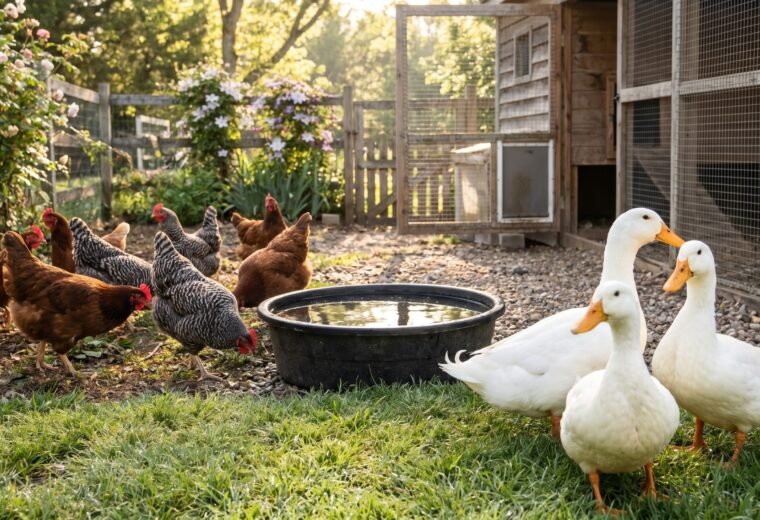
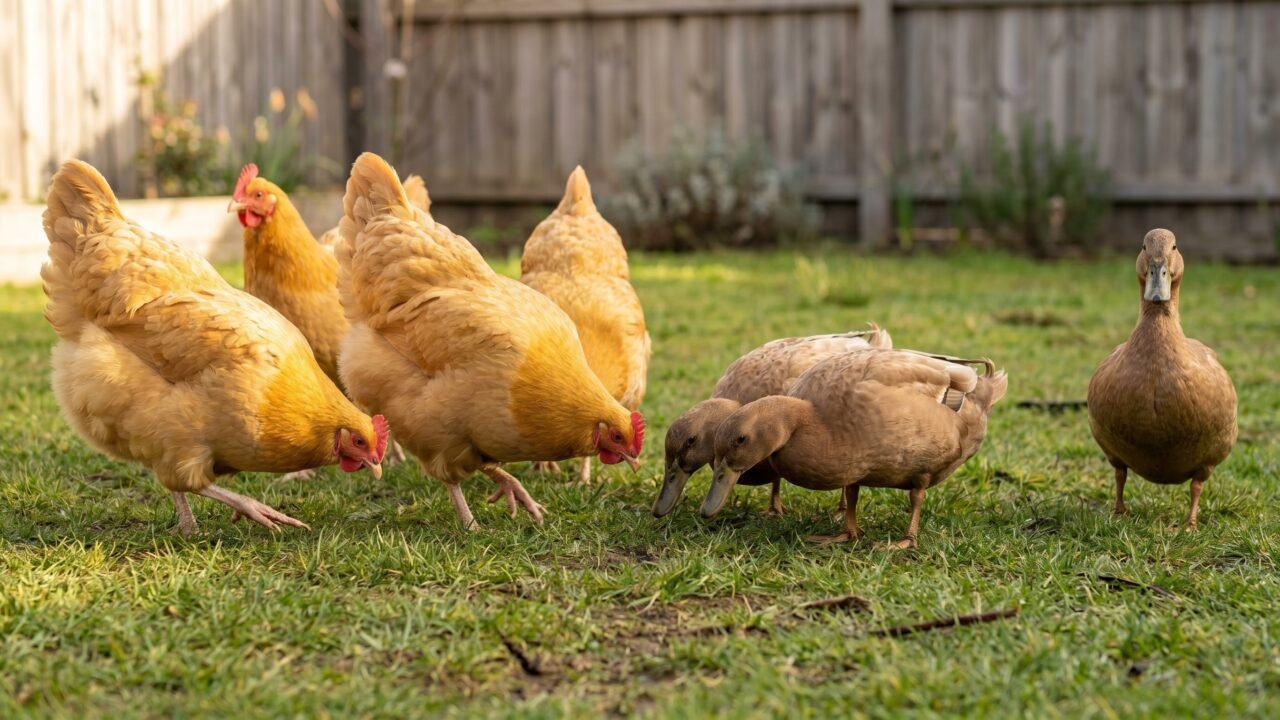
Temperament compatibility is good most of the time. Chickens and ducks occupy different behavioral niches - chickens roost and sort hierarchy through posture and pecking; ducks sleep on the floor and forage differently. A mixed group typically settles into a workable coexistence once the pecking order is established, usually within one to two weeks.
In practice, a mixed group of five or seven birds - say, two or three chickens and two to four ducks - usually settles into a loose coexistence once everyone figures out the hierarchy.
The one compatibility problem worth taking seriously is the drake (male duck). Drakes have anatomy and mating drives that are physically incompatible with hens. A drake that attempts to mount a hen can cause internal injury - this is not a rare edge case, it's a documented management hazard. If you want to keep ducks and chickens together, plan on keeping only female ducks (hens), or maintain a drake-to-duck ratio of at least one drake to four or five ducks and watch closely for cross-species harassment. Any drake that persistently chases chickens needs to be separated.
Female ducks tend to be docile and are rarely the aggressors. During the pecking-order establishment phase when you first combine the groups, expect some chasing and mild skirmishing, same as you'd see when introducing new chickens to an existing flock. Give both species enough space and sight-break barriers, and things settle within a week or two.
The feed problem: niacin, medicated starter, and layer calcium
Feed is where most mixed-flock setups go wrong. Chickens and ducks have meaningfully different nutritional requirements, and several common chicken feeds are either inadequate or outright harmful to ducks.
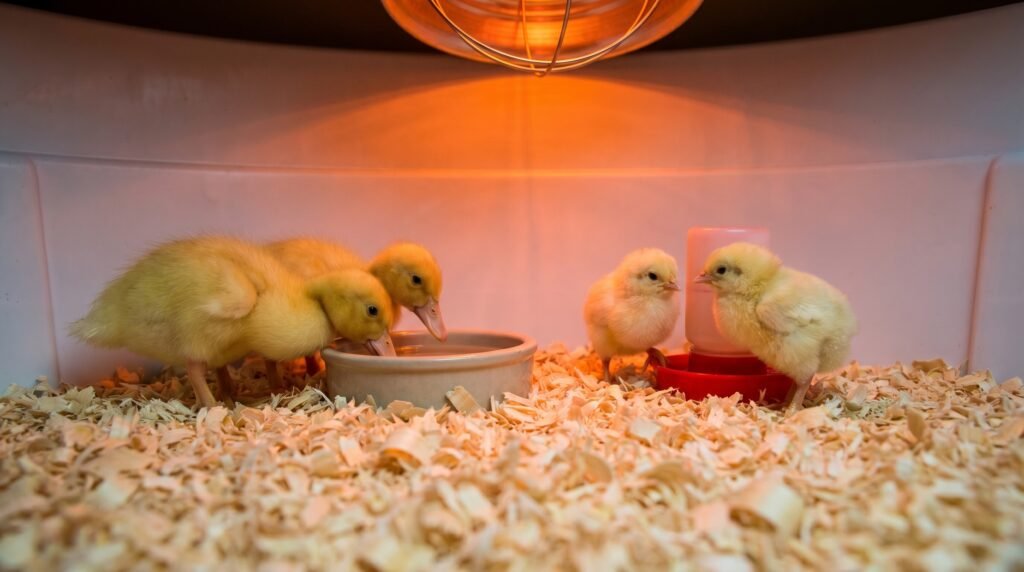
Niacin. Ducks need roughly five times the niacin of adult laying hens. The Merck Veterinary Manual puts the requirement for Pekin ducks at 55 mg/kg of feed across all life stages, while adult laying hens need approximately 11 mg/kg (NRC); the higher figure of ~27 mg/kg applies to growing chicks, not adult hens. A duckling raised on plain chick starter - which is formulated to the lower chicken requirement - will develop niacin deficiency. The symptoms are hard to miss: severe bowing of the legs and swollen hock joints. Once structural damage sets in, it doesn't reverse. Broiler-type starter (as opposed to layer or chick starter) has a niacin profile closer to what ducks need; alternatively, niacin supplement added to the drinking water bridges the gap when chick starter is all that's available.
Medicated starter. Standard medicated chick starter contains a coccidiostat dosed to match chicken feed consumption rates. Ducks eat more than chickens of comparable size, so they ingest a proportionally higher dose. Extension poultry specialists flag this directly: medicated chicken feed can be toxic to waterfowl because the medication is calibrated for chicken intake, not duck intake. Use unmedicated starter for any flock that includes ducks.
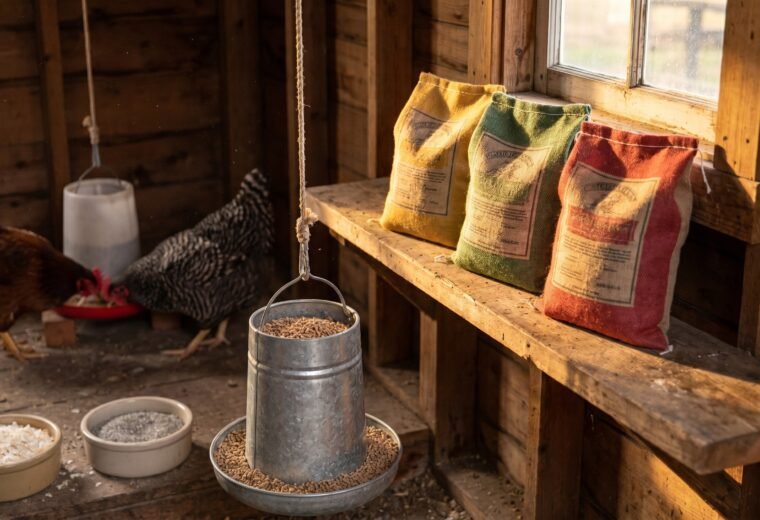
Layer feed and calcium. The calcium level in layer pellets (typically 3.5-4.5%) is sized for a hen producing an egg every 24-26 hours. That same calcium concentration fed to non-laying birds - growing pullets, growing ducks, or male ducks at any age - can cause irreversible kidney damage. The Merck Veterinary Manual is direct on this: "Nonlaying, growing birds should not be fed high-calcium layer diets, which can lead to irreversible renal damage." If your flock is mixed-age or includes drakes or growing ducks, switch to an all-flock or flock-raiser formula (typically 16-18% protein, ~1% calcium) and offer oyster shell free-choice on the side so your laying hens can self-regulate their calcium intake.
The table below maps out the feed decision by flock composition - this is where the rubber meets the road for anyone running a mixed group.
Feed decision guide for a mixed chicken-and-duck flock
| Flock composition | Best base feed | Niacin supplement? | Oyster shell? |
|---|---|---|---|
| Laying hens only, no ducks | Layer pellets (16% protein, ~3.5-4.5% calcium) | No | Optional (already in feed) |
| Laying hens + laying ducks | All-flock or flock-raiser (16-18% protein, ~1% calcium) | If using chick/layer starter: yes, in water | Yes, free-choice for hens and ducks |
| Laying hens + male ducks | All-flock or flock-raiser | Monitor; supplement if needed | Yes, free-choice |
| Growing ducklings + chicks (brooder) | Unmedicated broiler/meat bird starter (~20% protein), or unmedicated chick starter + niacin supplement in water | Yes, until on all-flock grower | No |
| Adult mixed flock, eggs not the focus | All-flock or flock-raiser | Not needed at maintenance | Yes, free-choice for any laying birds |
The chicken feed guide walks through each life-stage formula if you want the full breakdown of chicken-specific feed choices and protein stages.
Water: the biggest day-to-day challenge
Water management is genuinely the hardest part of running chickens and ducks in the same space. Ducks are messy with water by design. They scoop, splash, dunk their heads, and churn through it constantly. The Merck Veterinary Manual notes that waterfowl require up to five or six times as much water per unit of feed as chickens do - chickens need roughly 1.5 to 3.5 parts water per part feed, while ducks can hit five to six parts. That volume shows up in their droppings, which are very watery compared to chicken droppings, and in how wet the ground and litter stay around their waterers.
The moisture problem is not cosmetic. Ammonia from wet litter becomes a health hazard at surprisingly low concentrations - 20 ppm begins damaging the respiratory tract in chickens and reduces their ability to fight off bacteria and viruses. Ducks generate wet conditions that push a shared space toward those levels faster than a chicken-only coop would.
Practical solutions that work:
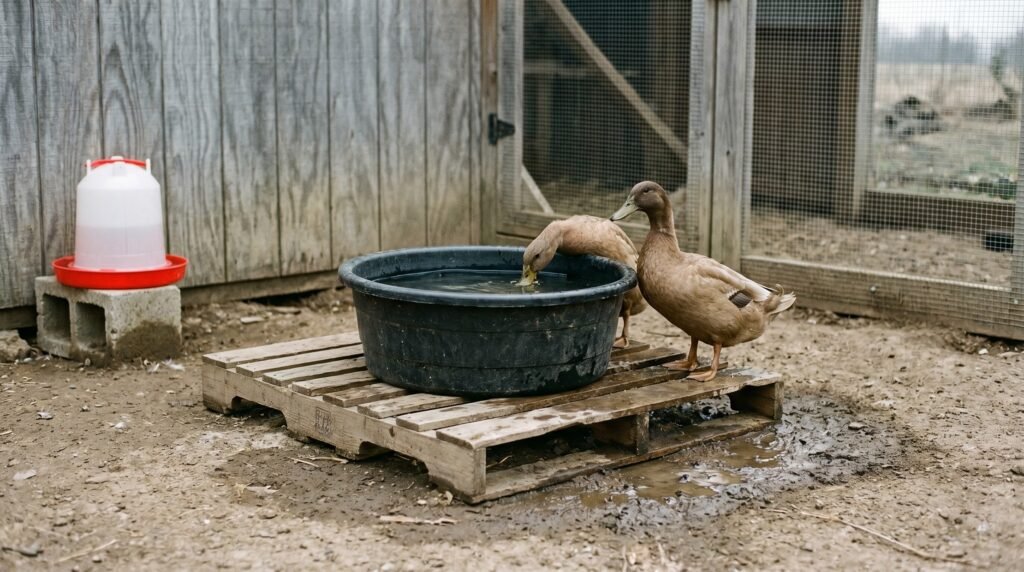
- Position duck waterers outside the coop, in the run, so splash and spill don't saturate indoor bedding.
- Use nipple drinkers or deep-bill waterers designed to limit splash for the indoor drinker; ducks can use nipples but prefer deep-bill access so they can clear their nostrils.
- Stock deep litter at least three to four inches of pine shavings or wood shavings. Turn or stir daily where ducks congregate, remove caked sections every day, and expect a full litter change more frequently than in a chicken-only setup - sometimes weekly depending on duck numbers and shelter size.
- Ducks do not need a pond or swimming water to be healthy. What they must have is water deep enough to dunk their heads and clear their nostrils and eyes. A five-gallon bucket or a deep rubber trough works fine; a kiddie pool adds mess without adding welfare benefit for a small flock.
Housing: space, roosts, and keeping things dry
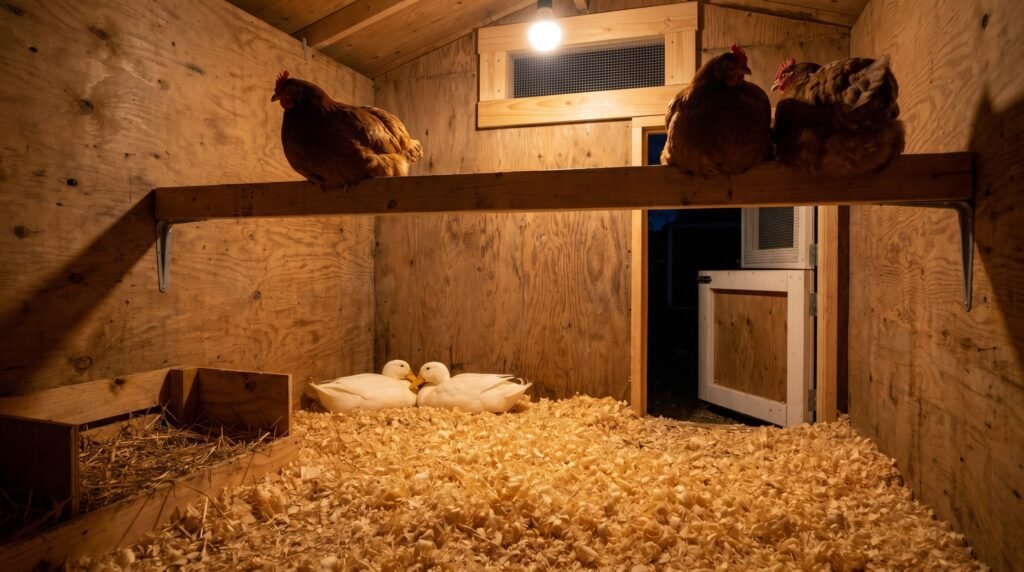
Chickens and ducks can sleep in the same shelter, but the building has to be sized for both species' needs - and those needs differ in one important way.
For indoor floor space, extension guidelines call for at least 3-4 sq ft per chicken and at least 4-5 sq ft per duck. Running a mixed group of nine birds - four chickens and five ducks - means a coop with a bare minimum of around 37-41 sq ft of usable floor space, before accounting for feeders, waterers, and corner furniture. Tight quarters amplify both the moisture problem and social friction.
Roost bars matter for chickens, not for ducks. Chickens prefer to be 18-24 inches off the floor at night, on a flat 2x4 oriented wide-side-up. Allow 8-10 linear inches of bar per chicken. Ducks sleep on the floor and do not use roost bars at all. In a shared coop, this arrangement works fine - chickens occupy the roosts, ducks settle in the litter below. Just make sure the roosts are positioned so ducks resting underneath aren't directly beneath chicken droppings all night (a simple shelf or partial board solves this).
Nest boxes remain a chicken feature. Ducks lay their eggs on the floor, often in a corner or a low-slung nesting area with a bit of straw. Providing a few low nest areas or baskets at ground level encourages ducks to lay in predictable spots rather than scattering eggs around the run.
Ventilation becomes more critical in a mixed flock because of the extra moisture load from ducks. A well-ventilated coop handles mixed-species moisture much better than a closed one - more air exchange keeps ammonia and humidity from building. Aim for at least one square foot of vent opening per bird, positioned high to allow moisture to escape without creating drafts at roost or floor level. More ventilation is almost never the wrong answer. Coop ventilation fundamentals and predator-proofing basics are covered in the beginner's guide to raising chickens.
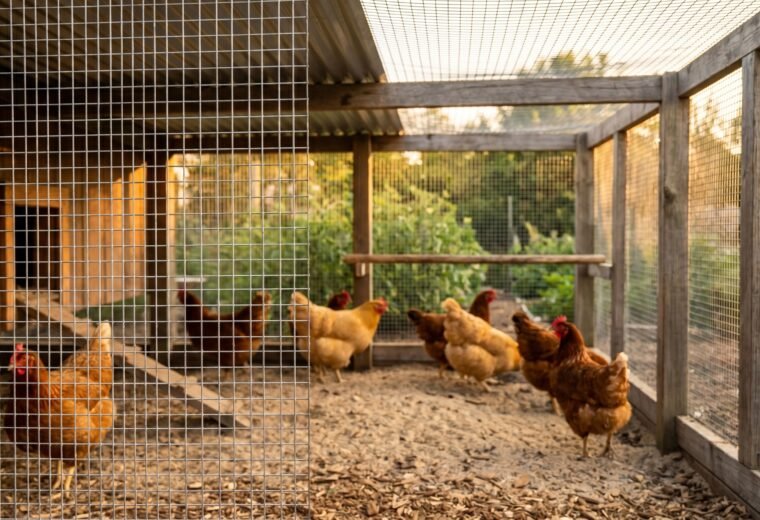
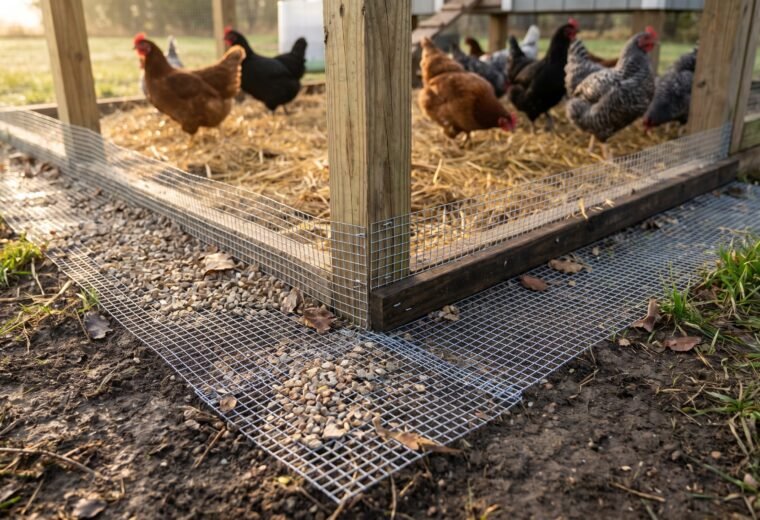
For the run, bury hardware cloth (1/2-inch mesh) at least 12 inches into the ground or extend it as an apron to stop digging predators - a requirement the Merck Veterinary Manual specifies for predator exclusion. Both species are vulnerable to the same predators: foxes, raccoons, mink, and overhead raptors. One secure run handles both.
Disease risks: the honest picture
This is where keeping ducks and chickens together requires the most careful thinking.
Ducks can carry highly pathogenic avian influenza (H5N1 and related strains) without showing illness. Peer-reviewed modeling published in 2025 found that "waterfowl, such as ducks or geese, can be asymptomatic and act as silent carriers of H5N1, making detection harder and increasing the risk of further transmission." In chicken-only flocks, disease tends to become visible within about seven days of introduction, allowing faster response. In mixed flocks with ducks present, detection can take ten or more days at the median - and in worst-case scenarios, 40 days or longer - because the ducks aren't showing symptoms.
The same research found that a mixed flock of 30 chickens and 10 ducks produced the highest average number of bird deaths across modeled scenarios, higher than either pure-duck or pure-chicken flocks. The takeaway for backyard keepers isn't necessarily that mixing is impossible, but that the combination increases your exposure window if the disease enters the flock from wild birds.
Practical biosecurity steps that reduce risk:
- Prevent contact between your flock and wild waterfowl - wild ducks and geese are the primary reservoir. Cover runs, avoid open ponds accessible to wild birds, and keep feed secured so it doesn't attract wild birds.
- Report sudden unexplained deaths or severe, rapid illness to your state veterinarian. USDA APHIS maintains a reporting line at 1-866-536-7593.
- Do not share equipment (waterers, feeders, shovels) between your flock and any outside birds.
- Quarantine any new ducks or chickens for two to four weeks before introducing them to an established flock.
Beyond avian influenza, ducks and chickens share some common parasites but differ in medication tolerance. Very few treatments approved for chickens are cleared for use in waterfowl, and a vet comfortable with one species may not be comfortable with the other. Consult a poultry vet before administering any medication to a mixed flock - do not assume that what is safe for one species is safe for the other. If you keep a mixed flock, find a poultry-knowledgeable vet before you need one in an emergency.
When to keep them separate
Despite the workability of a mixed setup, a few situations call for separate housing from the start:
- Brooding ducklings with chicks. Ducklings grow faster, splash water everywhere, and need different feed. Even well-intentioned mixed brooding leads to chronically wet bedding and chilled chicks. Brood them separately until fully feathered (around seven to nine weeks) and on the same all-flock grower feed, then do a supervised introduction.
- An active drake and no companion hens to buffer his attention. A drake with one or two duck hens and a crowd of chickens will focus his mating behavior more broadly. This leads to injured chickens. The ratio matters.
- Any bird showing illness. Isolate immediately and get a vet involved. Do not assume a sick duck has something chickens can't catch, or vice versa.
- High-risk periods for avian influenza in your region. During active HPAI outbreaks in your area, USDA APHIS guidance calls for keeping birds confined and minimizing exposure to wild birds. A mixed indoor flock during these periods is workable, but extra vigilance on biosecurity is warranted.
If separation isn't possible, at minimum give each species its own feeding station and its own water source to reduce competition and cross-contamination. Ducks will try to hoard the water. Chickens will eat the duck feed if it's accessible. Separate stations, even a few feet apart in the same run, make management substantially easier.
Quick-reference: chickens vs ducks at a glance
| Feature | Chickens | Ducks | Mixed-flock adjustment |
|---|---|---|---|
| Indoor space | 3-4 sq ft per bird | 4-5 sq ft per bird | Use the higher figure for planning total floor area |
| Outdoor run | ~10 sq ft per bird | Larger is better; no set minimum | Lean toward 12-15 sq ft per bird in a mixed run |
| Roost bars | Yes; 8-10 in per bird, 2x4 wide-side-up | Not used; sleep on floor | Install roosts for chickens; leave floor clear for ducks |
| Niacin in feed | ~11 mg/kg (laying hens); ~27 mg/kg (growing chicks) | 55 mg/kg | Use all-flock or add niacin to water for ducks |
| Medicated starter | Optional; widely used | Do not use | Always feed unmedicated starter to a mixed group |
| Water consumption | 1.5-3.5x feed volume | Up to 5-6x feed volume | Expect much more water mess; position waterers in run |
| Litter turnover | Weekly stirring; major cleanout 1-2x/yr | Daily turning/removal; weekly change | Follow duck schedule; deeper litter helps |
| Laying location | Nest boxes at 12-18 in height | Floor nests; lay in morning | Provide both elevated boxes and ground-level nest areas |
| H5N1 risk profile | Symptomatic; faster detection | Often asymptomatic carrier | Stricter biosecurity; limit wild-bird contact |