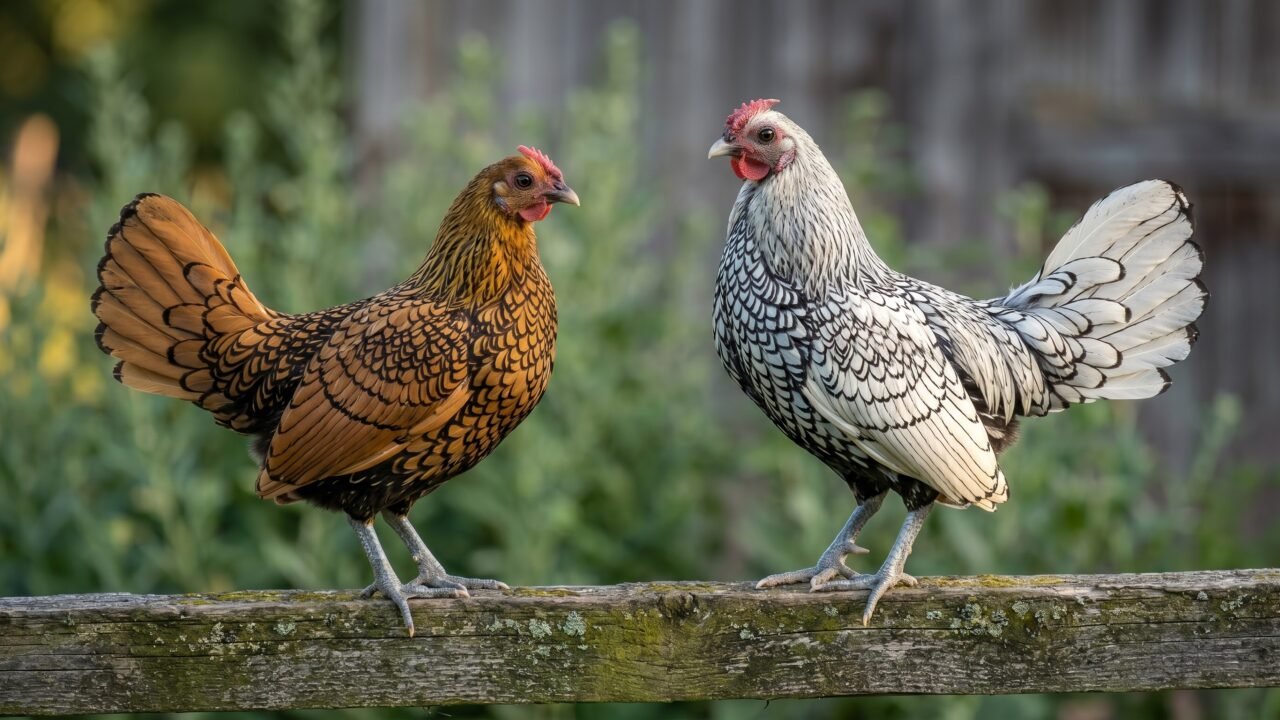
Thirty birds of a dozen breeds might fill a typical mixed flock, but you could drop a pair of Sebrights among them and watch every visitor stop mid-sentence. At just 22 oz for a rooster and 20 oz for a hen, the Sebright bantam is one of the smallest chickens you can keep - and one of the most visually striking. Each feather across the entire body is edged in a clean line of jet black, a pattern called lacing, and both the gold and silver varieties carry it with the same precision. If you are looking for a practical egg machine, this is the wrong breed. If you want a show-quality ornamental that fits in a compact space and rewards patient handling, the Sebright deserves a serious look.
This profile covers origin, plumage, size, egg output, the famous hen-feathered roosters, temperament, climate limits, and everything that goes into day-to-day care - including the health vulnerability that catches new Sebright keepers off guard.
Origin and history
The Sebright is named for Sir John Saunders Sebright (1767-1846), the 7th Baronet of Besford, who spent roughly two decades crossing breeds to produce exactly the bird he had in mind. According to Wikipedia's documented breed history, the gold variety likely came from a buff Nankin bantam hen, a gold-spangled Hamburg-type hen, and a hen-feathered Pit Game cock; the silver followed using a white Rosecomb cock. The breed was introduced around 1810, and that same year Sebright founded The Sebright Bantam Club - the first single-breed poultry association for chickens in recorded history. Both the gold and silver varieties were admitted to the American Poultry Association's Standard of Perfection in 1874, making them among the earliest breeds in that document.
The Livestock Conservancy currently lists the Sebright on its Watch category, meaning population numbers remain low enough to warrant active monitoring by conservationists and breeders. That status makes purchasing from reputable breeders - rather than grabbing whatever appears cheapest - genuinely matter for the breed's future.
Appearance: lacing, pigeon-breast, and the hen-feathered rooster
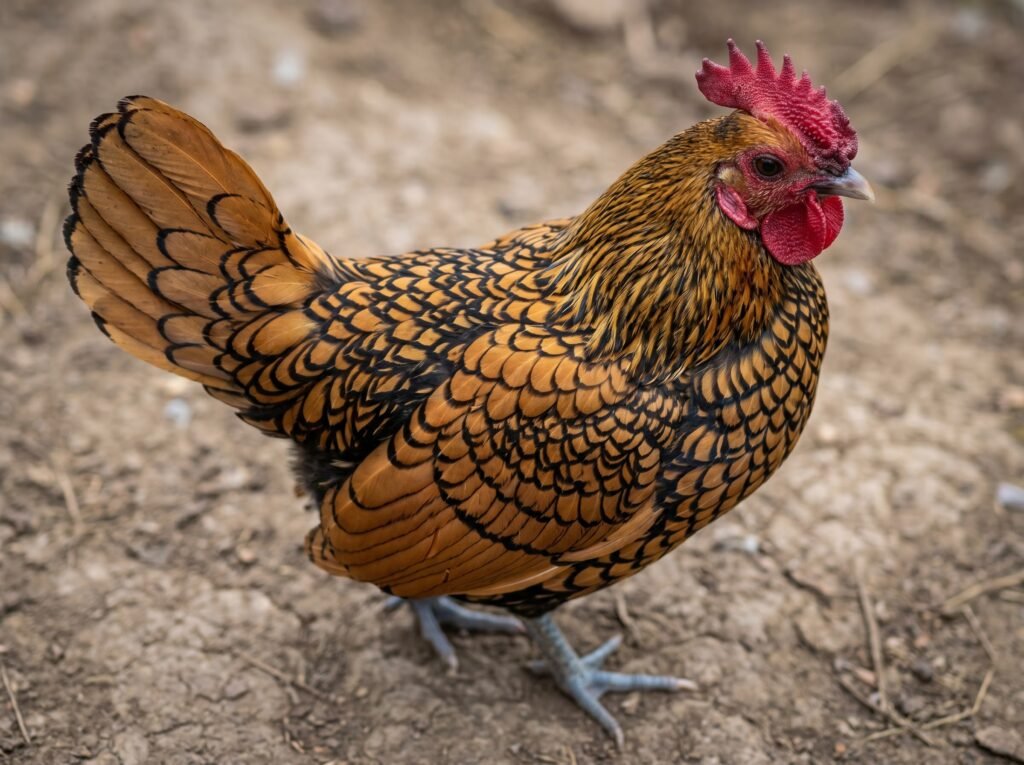
Three things set Sebrights apart visually from nearly every other chicken breed.
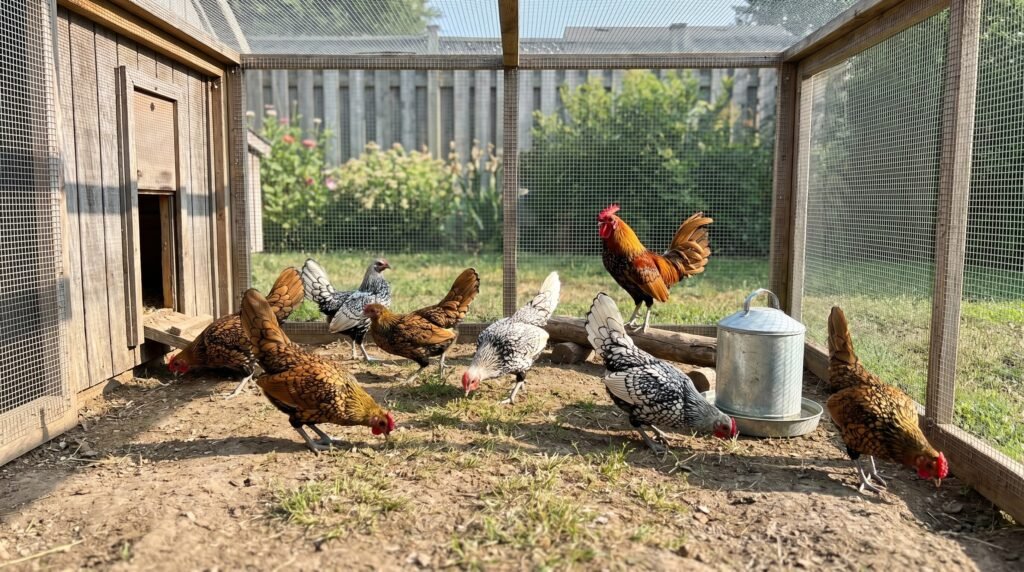
First, the lacing. Every single feather on the body - neck, breast, back, wings, tail - is the same base color edged with a sharply defined black border. On gold birds, the base is a warm golden bay. On silver birds, it is a clean silver-white. The result is a scalloped pattern that looks almost printed. Crucially, both sexes carry identical coloring, which is unusual; in most chicken breeds, males and females look quite different.
Second, the body shape. Sebrights are compact with a short back and a notably prominent, forward-jutting breast. The overall silhouette reads more pigeon than chicken, upright and bold despite the tiny frame.
Third, and most biologically interesting, the roosters carry no sex feathers. Standard roosters grow long, pointed hackle feathers at the neck, flowing saddle feathers over the back, and curved sickle feathers arching from the tail. Sebright males have none of these. Their plumage is identical in shape to the hen's - a trait breeders and geneticists call hen-feathering or henny-feathering. Research published in the Journal of Clinical Investigation (PMID 6715868) traced this to a dominant mutation affecting an aromatase gene, which causes the skin tissue of both sexes to convert an unusually high proportion of male sex hormones into estrogen. The result is that even heterozygous males show full feminine feathering, because half-maximal enzyme activity is enough to produce the effect. It is sex-limited (only males display the phenotype) but inherited as a dominant trait. The rose comb, clean unfeathered slate-blue legs, and dark beak complete the picture.
Size and what that means in practice
The Sebright is a true bantam: there is no large fowl version. Roosters average 22 oz (roughly 620 g) and hens 20 oz (around 510-570 g, depending on the source). For context, a standard-size Rhode Island Red hen tips the scale at roughly 6.5 lb - about five times heavier.
That tiny footprint has real housing implications. Bantams like the Sebright need only about 1 sq ft of indoor coop space per bird, compared to the 3-4 sq ft recommended for standard breeds. A well-built coop housing 16 Sebrights would fit comfortably in the footprint most keepers would use for four or five standards. The run still needs room - plan for at least 4-5 sq ft per bird outdoors - and the fencing needs to account for flight. Sebrights can and do fly, so a covered run or clipped wings are practical considerations.
Their size also makes them more vulnerable to predators and to cold. Small body mass means less thermal mass. A wet, drafty coop that a Brahma shrugs off can stress a Sebright significantly.
Egg production and broodiness
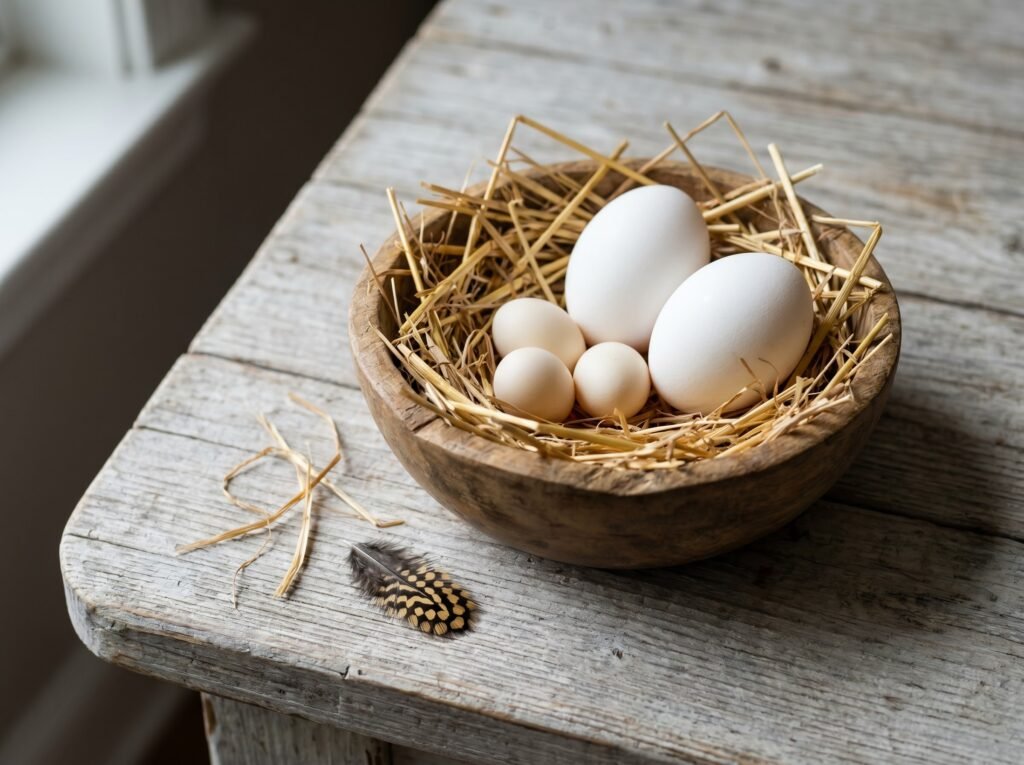
Sebrights lay approximately 60-80 small cream or lightly tinted eggs per year (Wikipedia; confirmed by the Livestock Conservancy). Work out the math: at 70 eggs per year from a typical hen, that is roughly one egg every five days - about 1.4 eggs per hen per week. A flock of 15 Sebrights might therefore produce around 18-21 eggs per week at peak, which covers occasional baking but not a household's daily egg needs.
The eggs are bantam-sized - noticeably smaller than a standard large egg. Two Sebright eggs are roughly equivalent to one standard large egg in volume, a useful conversion for cooking.
Hens are not broody. The Livestock Conservancy notes that Sebright hens "do not have good maternal instinct," and fertility can vary between strains. Keepers who want to hatch Sebright eggs typically rely on a surrogate broody hen (a Silkie or Cochin work well) or an incubator. If hatching is a goal, sourcing from a strain with documented fertility is worth asking about before purchasing.
For egg-production comparisons across breeds, the chicken breeds guide lists output ranges side by side so you can match a breed to your actual egg needs.
Temperament: active, curious, and conditionally friendly
Sebrights are not lap chickens. They are alert, quick-moving, and prefer to be busy - foraging, perching high, investigating anything new in the run. The Livestock Conservancy describes them as "active, spunky, and easily tamed" when handled from a young age, and that qualifier matters. Birds handled regularly as chicks can become genuinely friendly and tolerant of people. Birds that grow up with minimal human contact tend to stay flighty and difficult to catch.
They are rarely aggressive, but they are vocal when agitated and not as content with confinement as heavier, more phlegmatic breeds. Given a well-enriched run with places to perch at different heights, they settle better than in a bare enclosure. They generally coexist fine in mixed flocks, though their small size puts them at a disadvantage in a pecking order that includes large, assertive breeds. Pairing them with other small bantams or notably gentle breeds reduces that friction.
The bantam breeds overview covers temperament and housing comparisons for the full range of bantam options if you are weighing Sebrights against other small breeds.
Cold and heat tolerance: the honest picture
The rose comb is a genuine advantage in cold weather. Extension poultry specialists at poultry.extension.org document that low-profile combs - including rose, pea, and strawberry types - suffer far less frostbite than large single combs, because they expose less tissue above the skull. The Sebright's tight rose comb sits flat against the skull, giving it the same structural protection as pea- and strawberry-combed breeds. Frostbitten combs are much less of a concern here than in, say, a Leghorn or Ancona.
However, that comb advantage does not make Sebrights cold-hardy overall. The Livestock Conservancy is direct on this: they "do not handle cold and damp well, and do better overall in warm climates." Small body mass, relatively lean muscle, and fine feathering combine to make wet-cold conditions a real risk. A Sebright in a dry, well-ventilated, draft-free coop can get through a mild winter reasonably well. In a cold, damp climate with temperatures regularly dropping below freezing, extra management - deep bedding, minimizing drafts, possibly a safely installed heat source - becomes necessary. Supplemental heat carries its own fire risks, and most healthy adult chickens in well-built coops do not need it; but Sebrights in hard winters are closer to the edge than cold-hardy standards like Australorps or Dominiques.
Heat tolerance is moderate. Their small size means they generate less metabolic heat, which can help in summer compared to larger, heavier breeds. Even so, Sebrights can overheat quickly when shade or airflow is inadequate, and their small body has less thermal buffer than a big hen. On days above 90 degrees F, add a small amount of electrolyte powder to the drinking water (poultry-specific formulas are sold at most feed stores), place a shallow dish of frozen peas or watermelon chunks in a shaded corner of the run, and ensure at least two ventilation openings in the coop so air flows through rather than just sitting. The frozen treat also gives the birds something to investigate, which reduces heat-stressed panting behavior.
Care and health: the Marek's disease factor
Day-to-day care follows standard bantam practice. Feed a quality layer ration (approximately 16% protein with 3.5-4.5% calcium) once hens come into lay, keep grit and oyster shell free-choice, and provide clean water at all times. The coop needs about 1 sq ft of floor space per bird with at least 6 inches of roosting bar per bird (8-10 inches is more comfortable at this size). A nest box roughly 10x10 inches suits bantam hens well; one box per three to four hens is enough given that Sebrights rarely go broody.
Chicks can be delicate in the brooder. Start brooder temperature at 95°F in week one and drop approximately 5°F per week. Sebrights take longer to fully feather than some heavier breeds, so be conservative about moving them outdoors - wait until they are fully feathered and nighttime temperatures are reliably above 50°F.
The single most important health step for Sebrights is Marek's disease vaccination. The Livestock Conservancy explicitly flags their susceptibility to this herpesvirus, which causes nerve damage, paralysis, and tumors. Vaccination at hatch is the standard approach; reputable hatcheries typically offer it as an option, and keepers sourcing chicks from breeders should confirm vaccination status. Vaccinated birds can still be exposed and shed the virus, but vaccination dramatically reduces clinical disease. Any new bird entering an established flock should be quarantined for two to four weeks regardless of vaccination history.
Mites are a perennial concern for all small-bodied birds. Check routinely under wing feathers and around the vent. Northern fowl mites live on the bird; red mites hide in coop crevices and feed at night. If you find either, treat the bird and the coop separately, and repeat treatment in seven to ten days to break the egg cycle. For any bird showing lameness, swelling, labored breathing, or significant weight loss, a poultry vet is the right call - not a home remedy.
Who the Sebright suits - and who it does not
This breed excels in a narrow set of situations. It fits well for 4-H and show poultry enthusiasts who want a breed with genuine exhibition history and a distinctive appearance that judges have recognized since 1874. It suits keepers with limited space who want variety in a small flock - 16 Sebrights take up the housing footprint of three or four standard hens. And it rewards patient, hands-on owners willing to handle chicks early and consistently.
Where it struggles: households that need meaningful egg output, anyone in a very cold or persistently damp climate without covered, insulated housing, and beginners who want a forgiving, hardy first bird. The Marek's susceptibility, the delicate chicks, and the flighty temperament without early handling add up to a breed that punishes neglect more than a Rhode Island Red or an Australorp would.
Among rare and heritage breeds, the Sebright occupies a particular niche - genuinely ornamental, historically significant, and rewarding for keepers who go in with clear expectations.
Sebright bantam at a glance
| Trait | Sebright bantam | Typical beginner bantam |
|---|---|---|
| Adult weight (hen / rooster) | 20 oz / 22 oz | 24-32 oz / 26-36 oz |
| Eggs per year | 60-80 (small, cream) | 100-200+ (varies) |
| Egg color | Cream to lightly tinted white | Varies by breed |
| Broodiness | Rarely to never | Varies (Silkie: often) |
| Rooster sex feathers | None (hen-feathered) | Hackle, saddle, sickles present |
| Comb type | Rose (low frostbite risk) | Single or pea (varies) |
| Cold tolerance | Fair - poor in damp cold | Moderate to good |
| Temperament | Active, flighty; friendly if handled young | Generally docile |
| Marek's susceptibility | Higher than average - vaccinate | Moderate |
| Primary use | Exhibition / ornamental | Eggs / mixed purpose |
| Livestock Conservancy status | Watch | N/A (most are common) |
| APA recognition (year) | 1874 | Varies |
The Sebright has survived more than two centuries because it is genuinely beautiful and genuinely unusual. No other APA-recognized breed combines true bantam size, matched male-female coloring, and the hen-feathered rooster in one package. For keepers who appreciate that combination and plan their setup around it, it is an excellent choice. For everyone else, it is at least worth adding to the shortlist - if only to rule it out properly.