Seventeen minutes is a useful working estimate of the gap between the last hen stepping onto the roost and full dark on a calm summer evening - the window when a fox, raccoon, or opossum will test your coop. An automatic door closes that gap every night without you standing there in the yard. The HenAcre team considers a quality automatic opener one of the three best upgrades a backyard keeper can make, alongside solid predator-proofing and a well-ventilated coop.
This guide covers every variable that matters: how each trigger type actually behaves in the field, what safety sensors do and don't prevent, which power option fits your setup, how to size the door opening, and which models we'd reach for in specific situations.
Light sensor vs. timer vs. app: which trigger fits your flock?
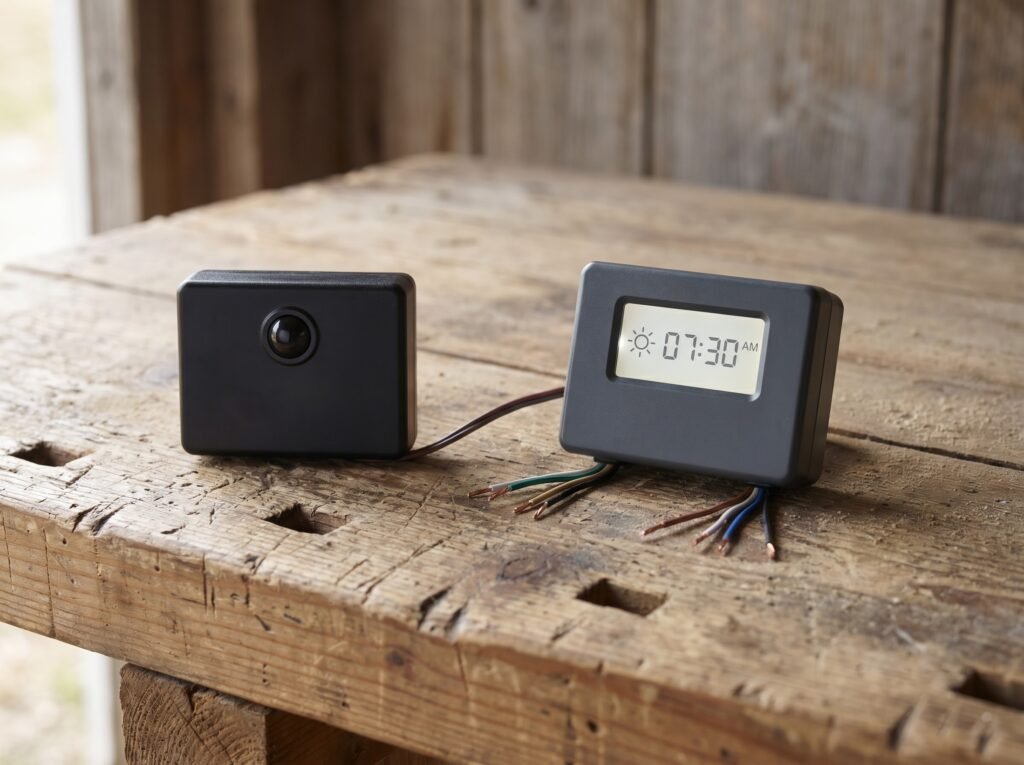
For most backyard flocks, a dual-mode unit combining a light sensor with a timer backstop is the best default choice. The light sensor tracks natural sunrise and sunset automatically across the year, while the timer prevents false closes during storms or overcast days. App control is worth adding only if your coop is remote or you travel frequently.
Every automatic door needs a trigger - the signal that tells the motor to open or close. The three main types behave very differently, and choosing wrong is the most common first-time mistake.
Light sensor
A photoresistor reads ambient brightness and opens the door when light crosses a set threshold at dawn, then closes it again near dusk. The big advantage is that the trigger automatically tracks the changing sunrise and sunset across the entire year - no seasonal readjustment needed. It also mirrors how chickens actually think: they file in and settle before full dark, so a correctly calibrated sensor closes right behind the last bird.
The honest limitation is variability. On a heavy overcast or during a thunderstorm, a light-sensor door can try to close at noon. Most quality units let you dial in a sensitivity range and add a close-delay of 15-60 minutes, which absorbs most false triggers. The Chickcozy door, for example, offers a 0-100 sensitivity scale and a configurable delay precisely because this is a real-world issue. Still, a few false-close events per year are normal with light-only control.
Timer
A timer opens and closes at fixed clock times you program. Storms don't fool it. The predictability helps new keepers establish a routine and makes it easy to confirm that every bird is inside before the door closes. The drawback: sunrise and sunset shift significantly across the seasons. At mid-latitudes (roughly 35-40°N, covering most of the continental US), the swing between June and December is about 2-3 hours; at northern US latitudes above 45°N it reaches 3-4 hours. A timer set accurately in June can be off by that full margin by December unless you update it. For flocks anywhere north of the Sun Belt, a timer-only setup means revisiting the schedule four to six times a year.
Dual mode (light + timer)
Most mid-range and premium units combine both. The ChickenGuard All-in-One, for instance, lets you set an open and close time OR run dawn-to-dusk sensing, whichever fires first. In practice, keepers in our wider community run the light sensor as the primary trigger and use the timer as a hard-close backstop - so the door shuts no later than, say, 9 p.m. even on an overcast night that confused the sensor. This is the setup we'd recommend for most people.
App / WiFi control
App-connected doors add real-time status monitoring, remote open/close from your phone, and push or email alerts. The Omlet Smart Autodoor connects to home WiFi (it needs a 2.4 GHz network within 65 feet of the coop) and pairs with a smartphone app; it can also trigger via light sensor or timer when you're not touching it. The Coop Tender system goes further, logging ambient light, door status, temperature, and battery charge, and it can fire an SMS when its optional motion module detects movement near a closed door at night.
App control is genuinely useful if your coop is far from the house, if you travel frequently, or if you want confirmation that the door closed on a specific night. It is less useful - and harder to maintain - if your coop sits in a WiFi dead zone. Note that all WiFi-enabled units we've looked at require a 2.4 GHz band; a 5 GHz-only router will not pair.
Safety sensors: what they catch and what they miss
All three common sensor types - infrared beam, torque-based auto-stop, and touch strip - reliably halt the door against a bird or object already in the doorway. Their shared limitation is that they cannot detect a hen still in the run, not yet in the doorway. Training your flock to enter before closing time prevents that failure mode more reliably than any sensor.
Every automatic door we'd recommend includes some form of obstruction detection, but the technology varies and none of it is foolproof.
Infrared (IR) sensors project a beam across the door opening. If a bird or any object breaks the beam while the door is closing, the motor stops and the door holds open or reverses. The VEVOR line uses this approach and specifies: "if it detects any obstacles when closing the door, the automatic chicken door opener will immediately stop closing." That is the ideal behavior.
Pressure or torque sensors take a different approach: they measure motor resistance. When the door meets unexpected force - a hen's back, a pile of shavings, a frozen track - the motor stops and often reverses. ChickenGuard's auto-stop function works on this principle. The weakness is that a small bird or a chick may not generate enough resistance to trigger a torque sensor reliably.
Touch sensors (Chickcozy's approach) use a contact strip on the door panel itself. Physical contact stops the door. The response is immediate but requires actual contact, so a very slow close against a small bantam is the trickiest case.
The single highest-frequency beginner failure we see with automatic doors is not sensor malfunction - it is a bird not yet inside when the door closes. Sensors stop the door against an obstruction already in the path. They cannot see a hen who is still in the run. The fix is practical: train birds to the new schedule over five to seven days by manually operating the door at consistent times, so they learn to come in before it closes. Count birds before dark for the first few weeks.
Door sizing: matching the opening to your birds
Size for your largest bird: bantams are comfortable at 8x10 inches, standard light breeds at 10x12 inches, and large heavy breeds such as Orpingtons or Brahmas at 10x14 inches minimum. Most stock doors ship with openings that suit light standards and bantams well; heavy-breed keepers should confirm the manufacturer offers a larger panel before ordering.
Pop holes that are too small slow down traffic, create a bottleneck when birds are rushing in at dusk, and can injure large-combed breeds that brush the frame. Too large and you lose insulation and structural integrity.
General guidance from extension poultry resources and manufacturer sizing charts points to these working ranges:
| Bird type | Minimum opening (W × H) | Comfortable opening (W × H) |
|---|---|---|
| Bantams (Silkies, Dutch, Seramas) | 8 in × 10 in | 10 in × 12 in |
| Standard light breeds (Leghorn, Ancona) | 10 in × 12 in | 10 in × 14 in |
| Standard heavy breeds (Orpington, Brahma) | 10 in × 14 in | 12 in × 16 in |
| Mixed flock (standards + bantams) | 10 in × 12 in | 10 in × 14 in |
Size for your largest bird. A flock of 20 standard layers running through a single 10×14 pop hole at dusk is fine; the same flock trying to squeeze through an 8×10 opening creates crowding and potential injury. If your existing coop has a fixed pop hole that's smaller than you'd like, that's an argument for a door kit that fits the current opening rather than cutting a new one.
Notable out-of-box dimensions: the VEVOR unit ships with an 8.26×10.23-inch aluminum door panel; the Omlet Smart Autodoor opens to 7.75×11.75 inches; the Chickcozy opening is 8.15×10.4 inches. These all fall in the comfortable bantam and light-standard range. For heavy breeds like Buff Orpingtons, check whether the manufacturer offers a larger door panel before purchasing - several brands do.
Power options: battery, solar, and wired
If your coop has a nearby outlet, wired DC power is the most reliable long-term choice. If not, 4xAA batteries cover most flocks for four to six months; add a solar kit if you want to avoid seasonal battery swaps. In hard winters, switch to lithium AA cells or AC power - alkaline cells lose significant capacity below 20 degrees F.
The right power choice depends on how close your coop is to an outlet and how much direct sun the roof or nearby fence gets.
Battery (4×AA)
Every mainstream unit runs on four AA alkaline batteries as the baseline. This is the easiest starting point and eliminates all wiring. Battery life varies by temperature and how many open/close cycles per day the motor runs. The Omlet Smart Autodoor claims six months on four AAs in normal conditions; ChickenGuard's figures are comparable. Cold weather shortens that noticeably - alkaline chemistry loses capacity as temperatures drop, sometimes significantly below 20°F. Lithium AA batteries hold capacity better in cold and are worth the extra cost if your coop sits in a climate with hard winters. We keep a spare set taped inside the controller housing so a change takes 90 seconds.
Solar
A small solar panel (typically 1.5-15 watts depending on the system) trickle-charges a battery pack and keeps the door running indefinitely in most climates. ChickenGuard, Chickcozy, and Coop Tender all sell solar add-on modules. Solar is excellent for coops with no nearby outlet but needs a genuinely sunny south- or west-facing mounting point. Shade from trees or the coop roof itself kills the panel's output. In winter at northern latitudes, reduced daylight and panel angle may mean the battery discharges faster than it recharges - AA backup or switching to mains power for December and January is practical insurance.
Mains (wired DC)
Plugging into a nearby outlet via a 9V DC adapter (ChickenGuard) or a low-voltage transformer (Coop Tender, which draws only 1 watt on AC) removes battery anxiety entirely. The Coop Tender unit even offers a battery backup that provides five-plus days of operation during power outages. If you're already running a light timer or heated waterer to the coop, wiring the door is no extra effort and the most reliable long-term option. The main friction is the cable run itself - use a weatherproof outdoor extension and keep it off the ground to avoid damage from predators or lawn equipment.
Vertical vs. horizontal sliding: a tradeoff worth understanding
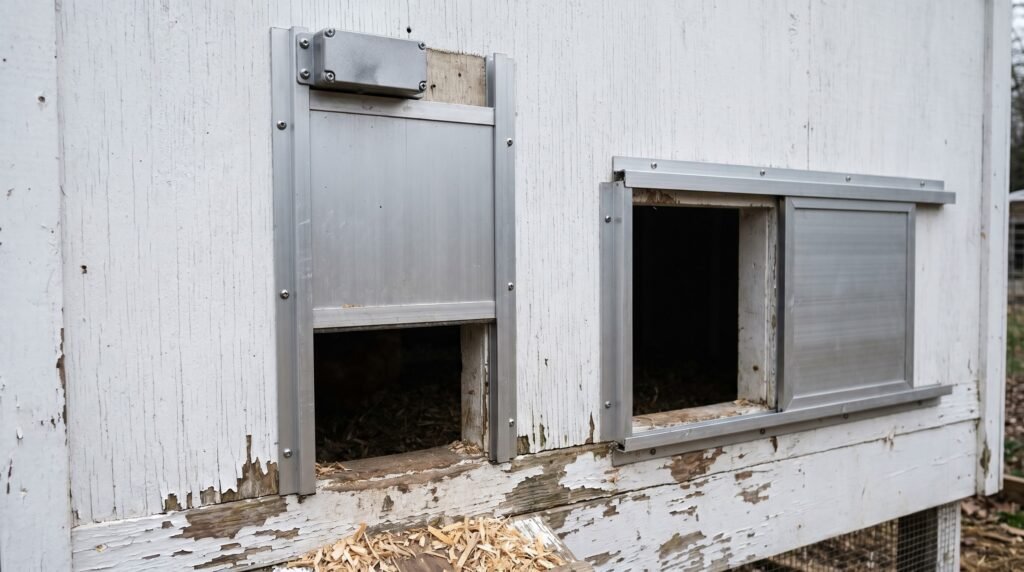
Vertical guillotine doors fit almost any existing rectangular pop hole and are the right default for most backyard coops. Horizontal sliding doors, like the Omlet Smart Autodoor, cannot be pried upward by a predator - a meaningful advantage in locations with documented raccoon pressure - but require side-clearance that some coop walls can't accommodate without modification.
Almost all automatic doors use one of two mechanical designs, and each has a real security implication.
Vertical sliding doors (the guillotine style used by ChickenGuard, VEVOR, Chickcozy, and many others) raise and lower on side-channel tracks. They are simple, proven, and easy to retrofit into an existing rectangular pop hole. The vulnerability is that a determined predator - particularly a raccoon, which has been documented opening simple latch mechanisms - can sometimes push or pry the panel upward. A door with a positive locking pin or a gear-driven motor that holds position when off is substantially more resistant than a simple gravity-drop design.
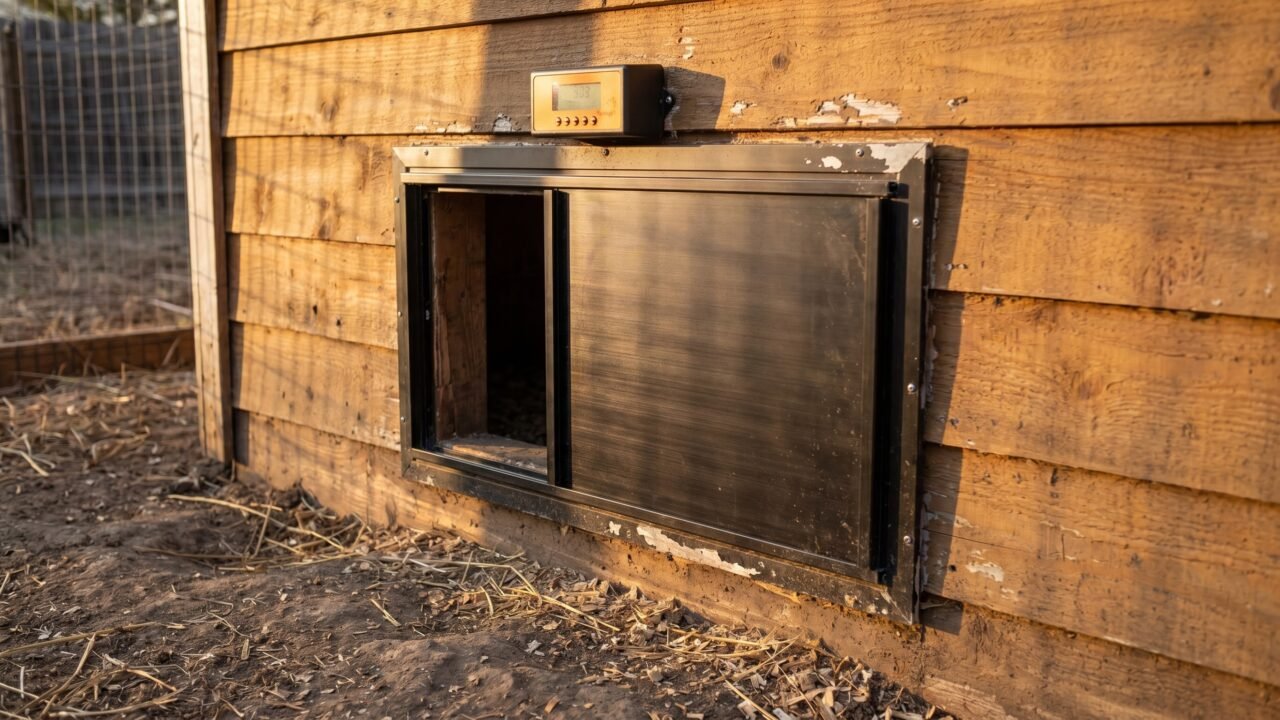
Horizontal sliding doors (Omlet's approach) move side to side. Because the panel travels horizontally, there is no vertical gap along the bottom edge for a predator to exploit - the door physically cannot be pried upward regardless of how persistent the animal is. The Omlet Smart Autodoor also uses a coil-spring mechanism rather than a weight-dependent cable, which means it holds closed with force rather than gravity (Omlet manufacturer guide). The tradeoff is that the horizontal panel requires clear side-clearance that a vertical design doesn't need, so it may not fit all coop configurations without modification.
For most backyard flocks, a quality vertical-sliding door with a gear motor (not a simple cable-and-pulley) and a positive stop is adequate predator protection - especially when the coop itself has solid hardware-cloth construction on walls and floor. If your location has documented raccoon or fox pressure, the horizontal Omlet design is worth the premium. The door is only one part of a secure coop - walls, latches, and perimeter hardware all contribute, as detailed in the broader predator-proofing section.
Top picks by use case
Rather than a single ranked list, these pairings match door to situation. Prices shift with retailers and sales, so treat the categories as guidance rather than fixed figures.
| Use case | Our pick | Why it fits |
|---|---|---|
| First automatic door, budget-conscious | VEVOR (timer + light sensor, remote) | Four trigger modes, IR safety sensor, LCD display, wide temp range (-15°F to 140°F), IP44. Proven motor, widely available parts. |
| High predator pressure (raccoon/fox active) | Omlet Smart Autodoor | Horizontal slide can't be pried up; IPX6 waterproof; WiFi alert if door fails to close. Steeper cost but the geometry matters. |
| Off-grid coop, no outlet within 50 ft | ChickenGuard All-in-One Solar kit | Three power inputs (batteries, solar, 9V DC); 3-year warranty; winter mode for extra torque in cold. Light sensor + timer dual mode. |
| Remote monitoring, frequent travel | Coop Tender + WiFi module | Full web app: real-time door status, temperature, battery, ambient light. SMS/email alerts. Optional motion detection module. Operating temperature range per manufacturer spec page (verify before ordering for extreme-cold climates). |
| Small or bantam flock (under 10 birds) | Chickcozy standard | Vertical sliding (guillotine) design, built-in touch sensor, 8.15×10.4 in opening suits bantams cleanly. Straightforward installation per manufacturer instructions. |
| Large heavy breeds (Brahmas, Jersey Giants) | ChickenGuard Extreme + large door panel | Extreme motor is rated for substantially higher lift than the standard All-in-One (verify current capacity on the manufacturer spec page); compatible with larger custom door panels; strong enough for a 12×16-in aluminum door. |
Installation: what the manuals skip
Most units install in two to four hours with a drill, level, and pencil. The three steps that matter most and that manuals consistently understate: mount perfectly level (even slight tilt causes panel binding), allow 20-22 inches of clear wall height above the pop hole for full door travel, and set the door bottom at floor level to close the gap against weasel-sized predators.
Most units take two to four hours to install with basic tools (drill, level, pencil). Here is what actually matters:
Level is everything. A controller mounted even slightly off-level causes the door panel to bind in its tracks. Use a bubble level at mounting, not just by eye.
Clear the frame before you measure. The controller mounts above the door opening, and you need enough vertical clearance for the full door travel plus the controller housing. A standard 10-in door needs roughly 20-22 inches of clear wall above the opening bottom. Measure twice before drilling.
Bottom track height. Mount the door bottom at floor level or no more than 1-2 inches above it. A gap underneath is a draft point and an entry path for small predators like weasels - animals that can compress through a surprising 1-inch space.
Power cable routing. If running wired power, drill your entry hole from inside the coop so the opening angles downward toward the outside. This keeps rain from tracking along the cable into the wall. Seal with weatherproof caulk.
Training the birds. For the first week, open and close manually at your intended schedule so birds build the habit. Stand outside and watch the last few birds enter before you let the automated schedule run unsupervised. A hen who develops the habit of roosting in the run instead of the coop will be outside when the door closes, sensor or not.
Keeping the door running: the failures that catch people off guard
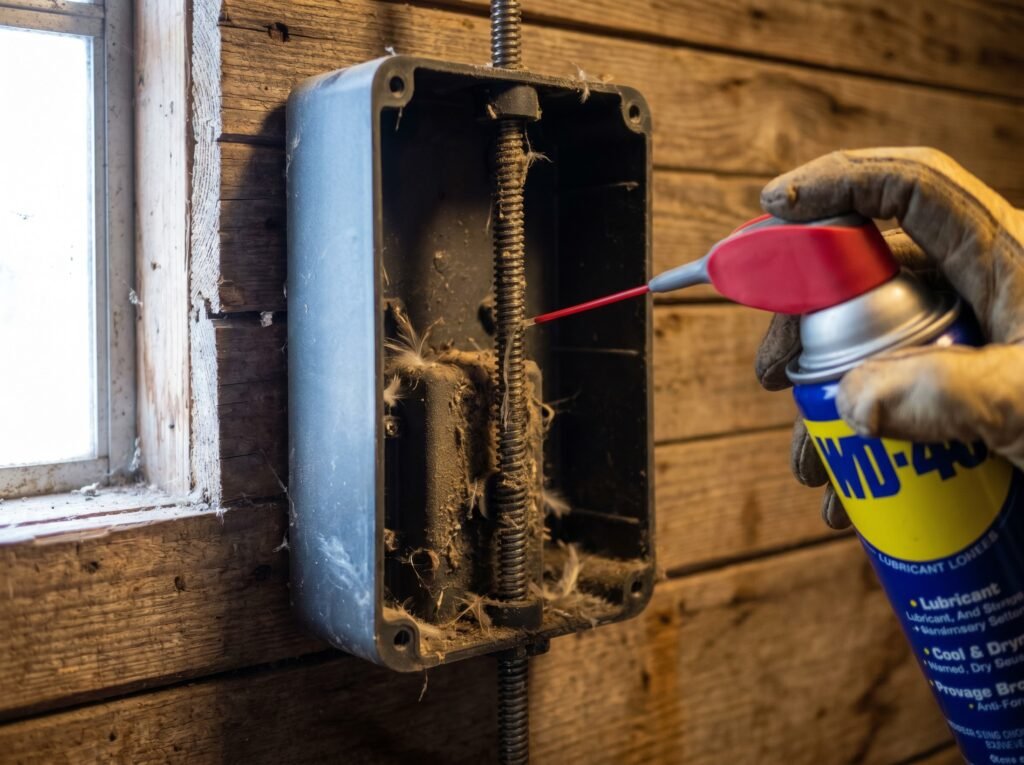
Debris packing the worm drive is the most common cause of mechanical failure - an annual clean and re-lube prevents most of them. Dead batteries in cold weather and ice in the tracks are the next two in frequency. A short maintenance check in autumn covers all three before the hardest season begins.
An automatic door is a mechanical device in a dusty, damp, feather-filled environment. These are the real-world problems in order of frequency:
Debris on the worm drive. Fine feather dust, shavings particles, and dried droppings pack into the threaded drive rod over months and slow the motor until it stalls. The fix is straightforward: remove the door, spray the drive rod with WD-40 (it cleans rather than lubricates long-term), cycle the mechanism several times, then apply a thin coat of lithium grease. Doing this once a year - more often in a tightly packed coop - prevents most mechanical failures.
Dead batteries in cold weather. Below about 20°F, standard AA alkaline cells lose a significant fraction of their capacity. The door may operate fine at noon when the battery warms up and then fail to open at 4 a.m. Lithium AA batteries maintain output far better at low temperatures. Switching to AC power through the coldest months eliminates the issue entirely.
Ice in the tracks. Water gets into vertical door channels, freezes overnight, and the morning trigger can't overcome the friction. A track cover or a small overhang above the pop hole helps. On stubborn freeze nights, a quick pour of warm water from a kettle frees a frozen track faster than waiting for the motor to struggle through it.
Light sensor false triggers. A dirty sensor lens reads lower light levels than reality. Clean the lens every few months with a damp cloth. If the door is still triggering early, reduce sensitivity or add a longer close-delay in the settings.
WiFi pairing failures. Every WiFi-capable door we've tested communicates only on 2.4 GHz networks. A dual-band router broadcasting both 2.4 GHz and 5 GHz under the same network name can cause pairing failures because the phone and the door end up on different bands. If pairing fails, temporarily disable the 5 GHz band on your router during setup, or give the 2.4 GHz band a separate SSID.
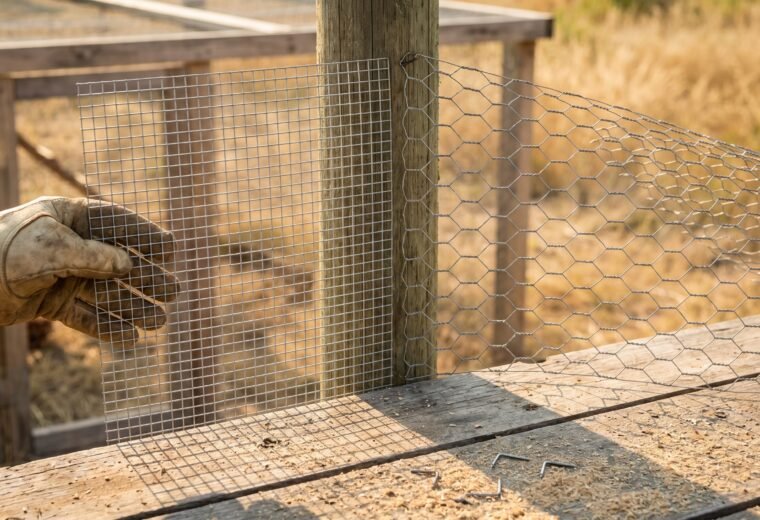
Beyond the door itself, the coop structure around it is what determines whether predators stay out. Hardware cloth (not chicken wire) on walls and runs, a buried or apron-style perimeter, and a door with a positive mechanical lock - these work together.