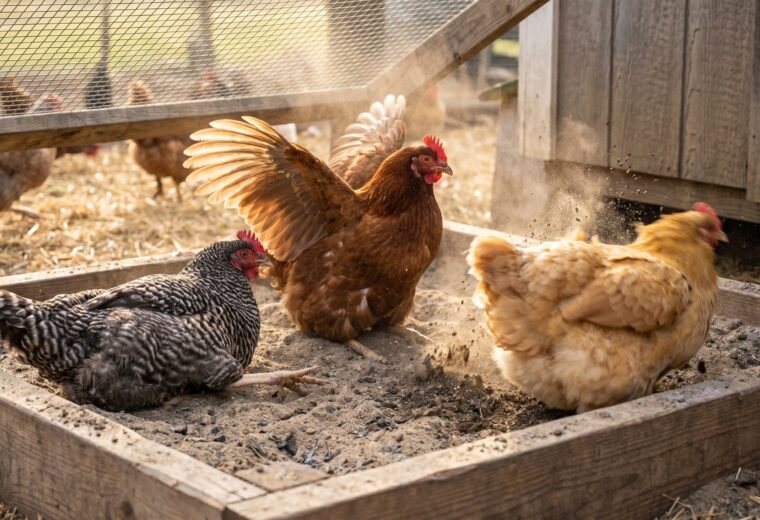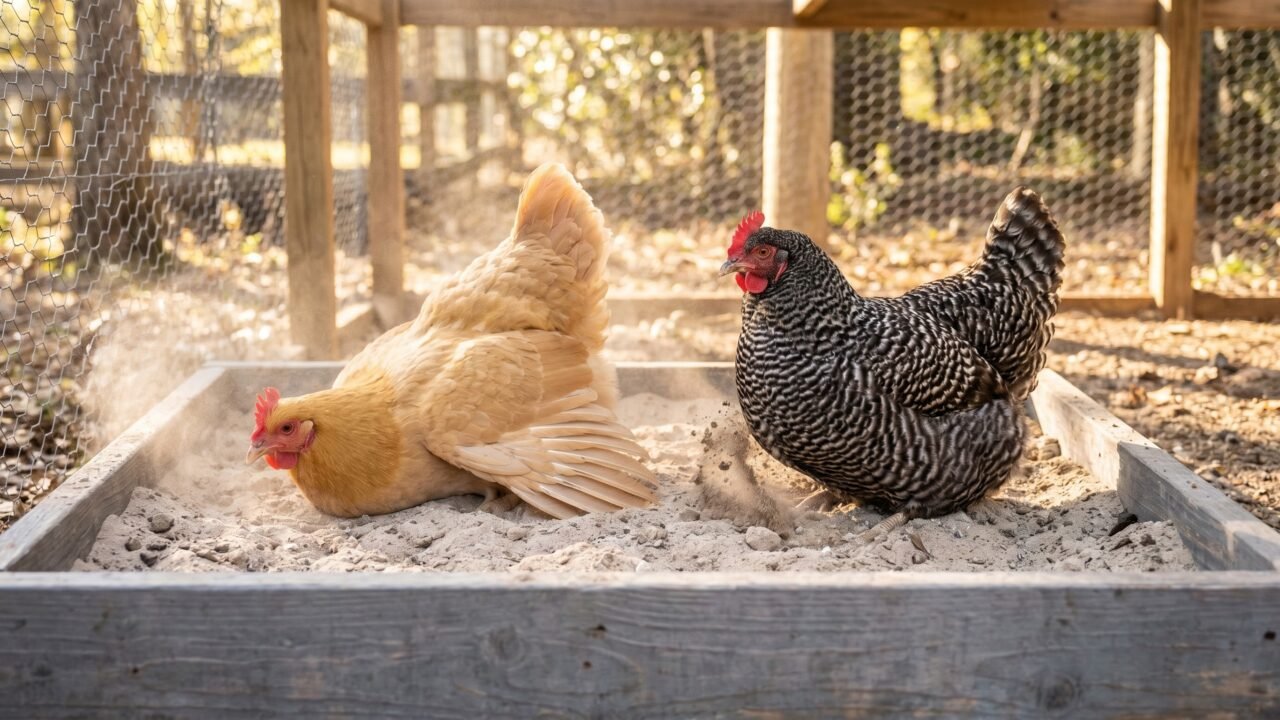
Every few days, healthy chickens throw themselves on the ground, flap dirt into their feathers, and shake themselves off like a dog after a swim. This is not odd behavior. Dust bathing is how chickens clean themselves, manage the natural oils on their feathers, and help keep external parasites in check. Deny them a proper spot and they will dig their own, usually in your garden bed or the corner of the run you least want excavated. Give them one purpose-built area and they will use it religiously.
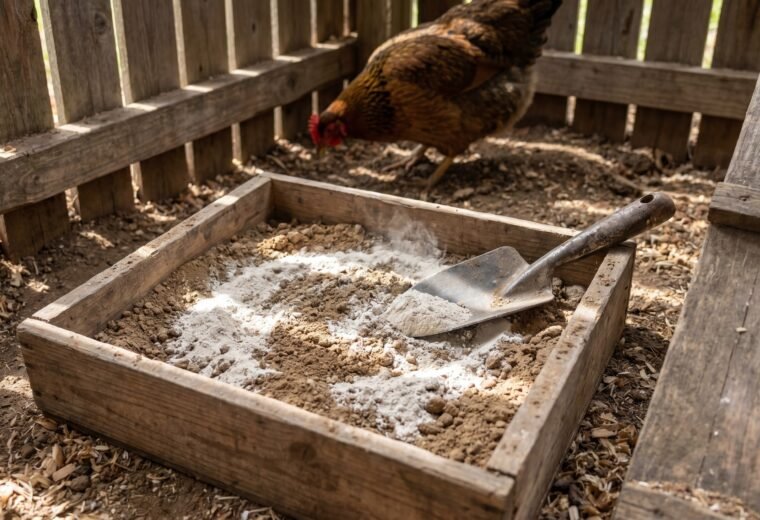
The basic recipe is three parts dry fine soil, two parts coarse sand, and one part wood ash. That mixture stays loose enough for birds to work it into their feathers and drains well enough that rain does not turn it into mud. Wood ash adds alkalinity that is hostile to mites and lice, and the fine grit helps strip away stale preen oil. You can add a small amount of food-grade diatomaceous earth if you choose, though its real-world efficacy is more limited than its reputation suggests, and it carries a respiratory caution worth knowing.
Why chickens need to dust bathe
Chickens produce preen oil from a gland near their tail, and they spread it across their feathers to maintain waterproofing and insulation. Over time that oil goes stale and needs to be removed. Dust works like a dry shampoo, binding to lipid residue and shaking free with the feathers when the bird stands up and ruffles. When hens are kept from a substrate to dust in, lipid buildup and feather structure degradation occur, and the effect is visible: feathers look greasy and flat instead of sleek.
Beyond feather maintenance, dust bathing appears to reduce the density of surface-dwelling parasites. Poultry Extension notes that food-grade DE in dust baths is a nontoxic option that works by abrading and dehydrating the waxy outer layer of mites, though it has no effect on mite eggs. That means even a well-maintained dust bath is support, not a standalone solution, for a flock already infested. (Our article on chicken mites covers full treatment protocols, including timing and when prescription-strength ectoparasiticides may be needed.)
The behavioral need is not trivial. Poultry Extension research shows that hens have shown a willingness to work to gain access to material for dust bathing, and when chickens do not have access, they will nonetheless go through the motions of dust bathing, essentially scratching at thin air. Virginia Cooperative Extension (APSC-245) observes that dust bathing is socially facilitated: one bird dropping down to bathe will trigger others to join. That social aspect means your dust bath area needs to fit more than one bird at a time.
What to put in a chicken dust bath
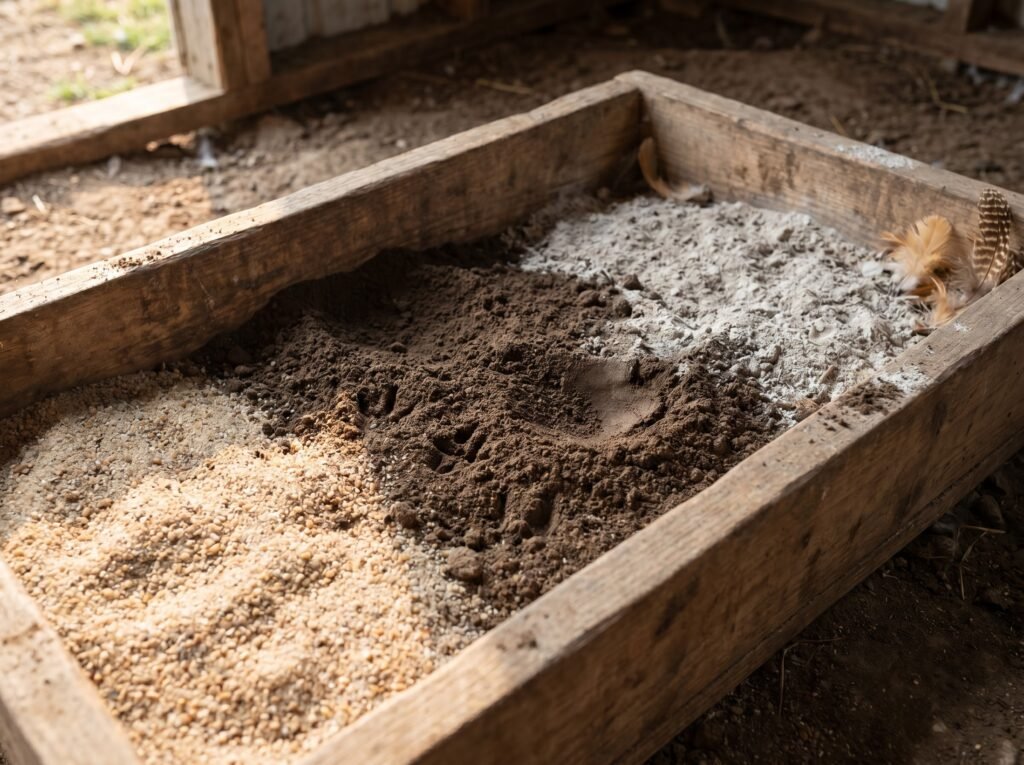
Good substrate stays loose and dry. Compacted or wet material will not work into feather shafts effectively, and wet substrate left sitting encourages bacteria and mold. Here is how each component earns its place:
| Ingredient | Proportion | What it does | Notes |
|---|---|---|---|
| Dry fine-textured soil or loam | 3 parts | Base material; birds pack it into feathers and shake it free | Avoid heavy clay; it clumps when damp |
| Coarse builder's sand | 2 parts | Improves drainage; mild abrasive action to strip preen oil | Research shows 5 cm / ~2 in depth performs best (PMC, 2025) |
| Wood ash (from untreated, unpainted wood) | 1 part | Alkaline pH; thought to be hostile to mite and lice exoskeletons | Never use ash from treated lumber or charcoal with additives |
| Food-grade diatomaceous earth | Optional - light dusting | Abrades mite cuticles; provides some ectoparasite control | Does not affect mite eggs; wear a dust mask when applying |
Soil and sand together handle the bulk of the cleaning work. A peer-reviewed study on aviary housing (PMC, 2025) found that sand at roughly 5 cm depth produced the best side-rubbing and feather-ruffling behavior, which are the movements that do most of the cleaning. Shallower substrate limited bathing quality; deeper did not improve it. Aim for about 2 to 3 inches of total material depth as a minimum, though 4 inches gives birds room to dig their own hollow, which is their preference.
Wood ash is inexpensive if you have a fireplace or fire pit, and small quantities go a long way. Limit it to roughly one part in six of the total mix so the area does not become predominantly ash. Peat moss is another serviceable alternative to loam for the base layer, particularly where well-drained garden soil is hard to source, as it stays loose and workable when kept dry.
A note on diatomaceous earth in dust baths
DE gets recommended frequently for chicken dust baths, and its inclusion is reasonable in small amounts. The mechanism is real: food-grade DE is abrasive and will remove the oily or waxy cuticle layer on the outside of a mite, causing it to desiccate and die. But a 2012 Journal of Applied Poultry Research study that ranked six treatments for northern fowl mite control placed DE near the bottom, requiring consecutive weekly applications for any effect lasting less than two weeks. Sulfur and neem ranked significantly higher. DE also has no effect on mite eggs, so rebound populations are common.
The respiratory caution matters too. The National Pesticide Information Center (Oregon State University) notes that long-term inhalation of the crystalline silica fraction found in some DE products is associated with silicosis and chronic bronchitis. Food-grade products contain mostly amorphous silica, which the same source links only to mild, reversible lung inflammation, but the label guidance is consistent: always follow label instructions and take steps to minimize exposure. Wear a dust mask when pouring DE into the bath, and do not let birds in while the fine cloud is still settling. For the birds, brief exposure during normal dustbathing is low risk; the caution applies to concentrated inhalation during mixing and application. The companion piece on diatomaceous earth for chickens walks through the full evidence, including what the peer-reviewed mite-control studies actually found.
Sizing and placement
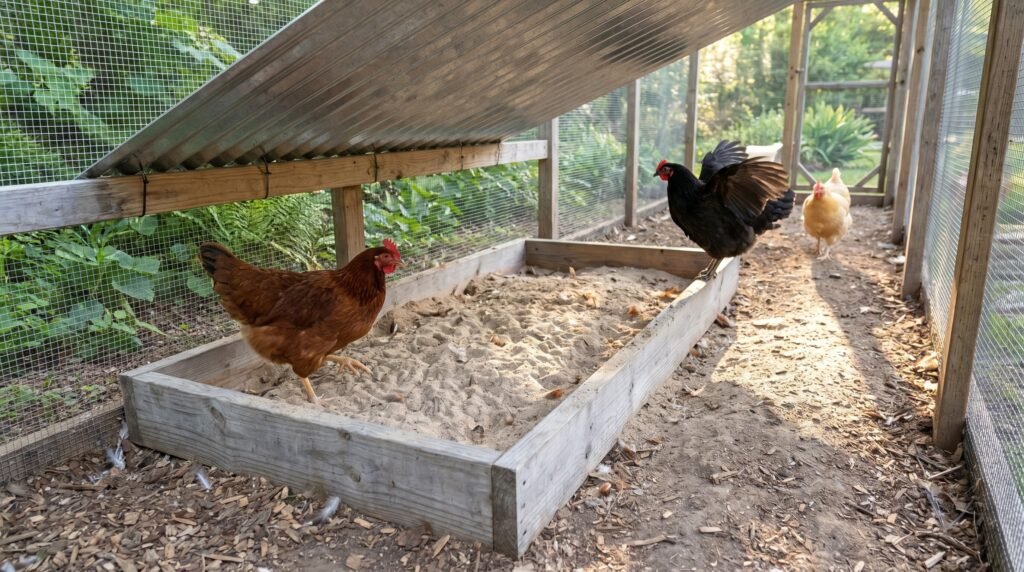
A flock of 15 standard hens needs at least two dust bath areas as a working rule. Each should fit two to three birds comfortably, which works out to roughly 3 to 4 square feet per station. A pair of stations totaling 6 to 8 square feet gives lower-ranking birds a chance to bathe without being shouldered aside, which matters because subordinate hens may skip the activity entirely if they cannot access the bath without conflict.
Virginia Cooperative Extension is clear that there needs to be enough space for all birds that want to perform the behavior to be able to perform the behavior. For smaller flocks - say, four or five birds - one well-sized station of 4 square feet with sides about 8 inches high is sufficient. The sides matter: they keep dry substrate from being kicked out and give the birds a sense of enclosure, which they prefer when lying on their sides.
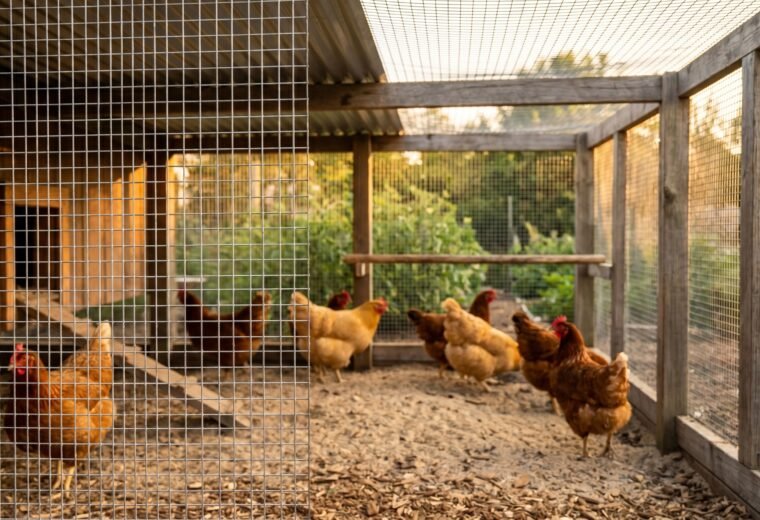
Placement rules come down to one word: dry. A wet dust bath is useless, and substrate that repeatedly gets wet and dries out packs into a hard crust. Position the area under a roof overhang, a lean-to, or a covered section of the run. The spot should still get good air circulation and some direct sun - birds choose sunny midday hours to bathe most often, so a perpetually shaded location will see less use. If the run itself is not covered, a simple piece of corrugated roofing angled over the bath is enough.
Keep dust baths away from waterers and feeders. Chickens kick substrate outward and will spread dry soil into water and feed if the bath is too close. A few feet of separation is all it takes. You can read more about run layout and keeping high-traffic areas separated in our chicken run planning guide.
Keeping the dust bath in good shape
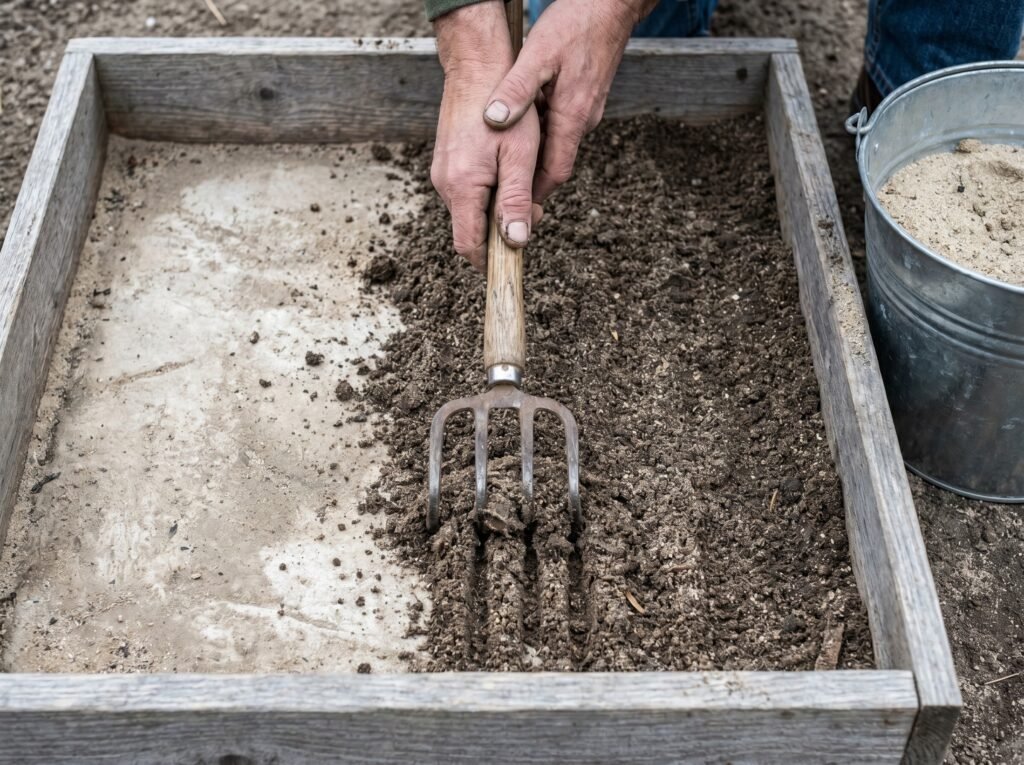
A well-used dust bath needs three things: dryness, looseness, and regular top-ups.
Check the substrate once a week. If it has compacted into a hard layer, rake or fork it over to restore the crumbly texture birds need to work it into their feathers. If it is wet or smells of ammonia, remove the top layer, let the area dry out completely, and refill with fresh material. Substrate that stays damp breeds bacteria and can cause skin irritation, which defeats the purpose of the bath entirely.
Top off the mix every few weeks because birds throw a surprising amount of material out during active sessions. Keep a bin of the dry soil and sand mixture nearby so refills take two minutes rather than a full rebuild. Add a fresh palmful of wood ash at each top-up. If you include DE, a light sprinkle every two to three weeks is plenty; more is not better and increases the inhalation risk during your own maintenance work.
Rake out any droppings that land in the bath. Chickens will defecate in and around it, and fecal matter changes the chemistry of the substrate and increases pathogen load. It only takes a moment with a small garden rake, and it keeps the bath functioning as hygiene tool rather than contamination source.
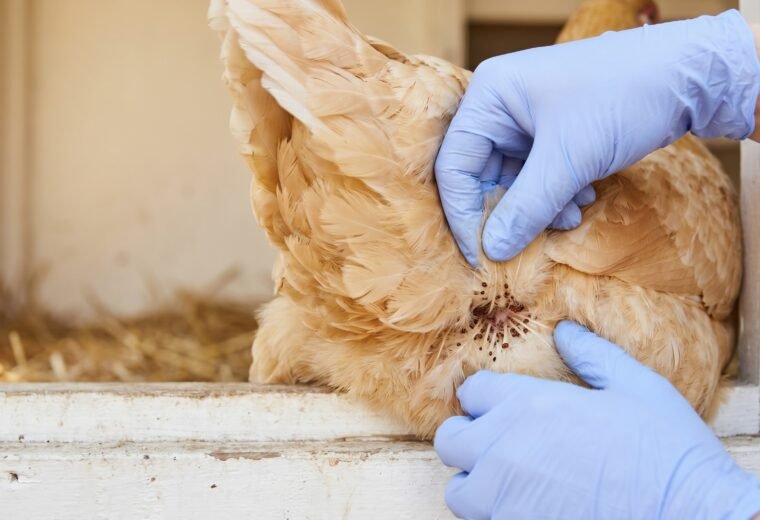
Finally, check your birds monthly for mites and lice regardless of whether they have a dust bath. Part the feathers at the vent, under the wings, and at the base of the tail. A dust bath helps, but it is not a guarantee of a parasite-free flock. Northern fowl mites can build populations faster than a dust bath alone will knock them down. If you find an active infestation, the bath stays in place but you will need additional treatment, as detailed in our guide on dust bath for chickens and the companion piece on chicken mites.
Common beginner mistakes
The single most common failure is placing the dust bath somewhere it gets wet regularly and then wondering why the birds ignore it. A soggy pile of compacted soil is not a dust bath. If your birds are scratching at dry corners of the coop or the base of a fence post instead of using the bath you built, check whether the bath is actually dry and loose when they want to use it around midday.
A close second: making the station too small for a social species. Chickens bathe in clusters. A bin sized for one bird may get used occasionally by a bold hen, but most of the flock will skip it. Size up, or add a second station, and use count will rise noticeably.
A third mistake is using the wrong sand. Fine play sand or beach sand packs densely and does not drain as well as coarse builder's sand or all-purpose sand. Either type works for the birds' bathing motion, but coarse grain keeps the mix from turning into a wet slab after rain blows in.