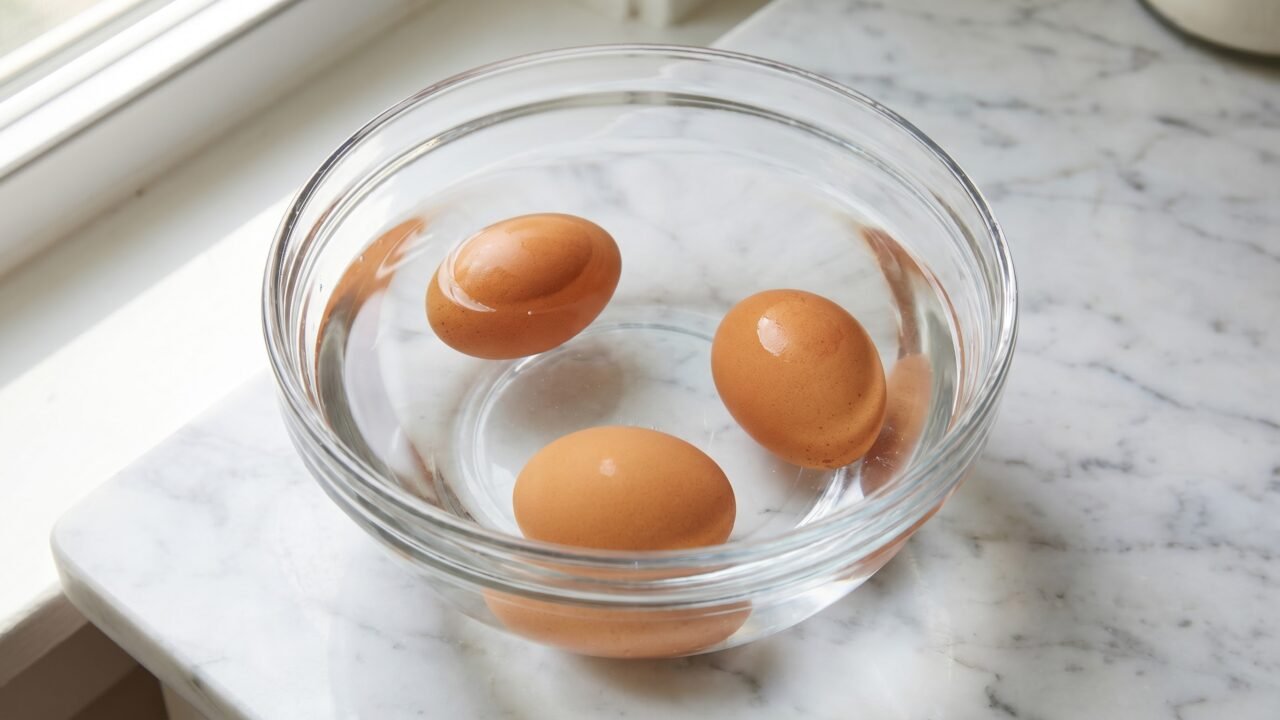
Drop an egg gently into a bowl of cold water and you can learn something real about it in about three seconds. A fully fresh egg lies on its side at the bottom. A week-old egg tilts up slightly at the large end. An egg that bobs at the surface has been aging for a while. That last one is the one people panic about, but USDA guidance is clear: a buoyant egg is old, not automatically spoiled. The smell test after you crack it open is what actually tells you whether to cook it or pitch it.
Below is how each test works, what the numbers behind it mean, and how to read the signs once the egg is in the pan.
Why the float test works: the air cell explained
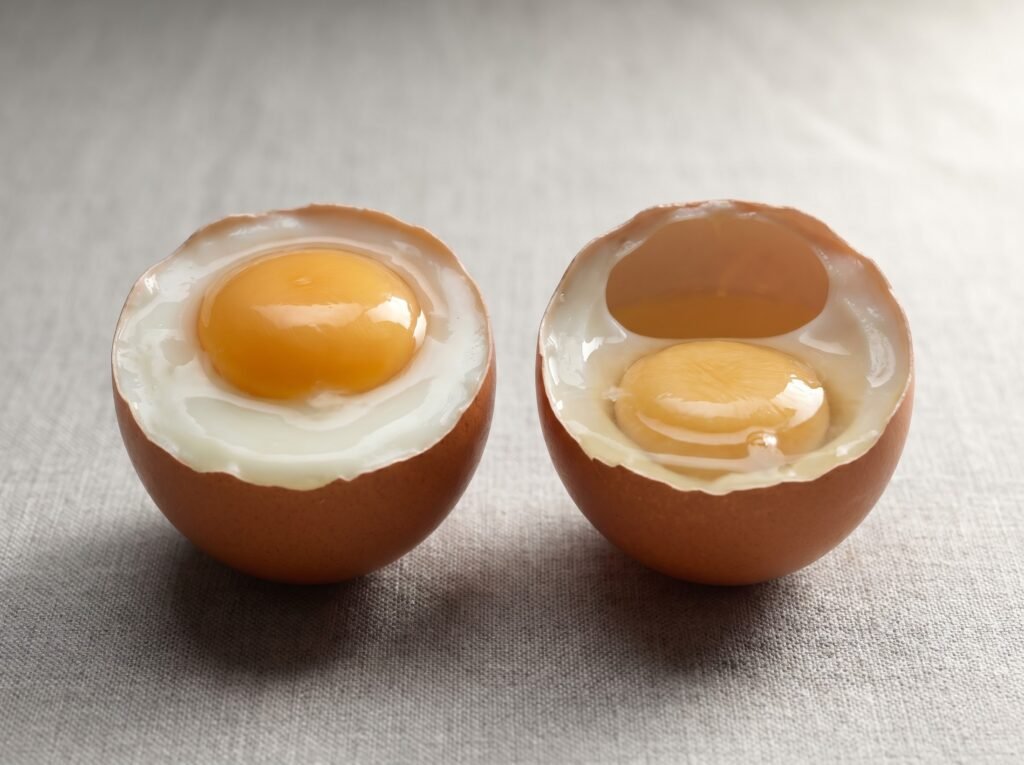
A freshly laid egg sits warm, dense, and nearly full of liquid. Within minutes of hitting the nest box, the egg begins to cool. As it cools, the liquid contents shrink faster than the rigid shell does. That contraction pulls outside air through the shell's 7,000 to 17,000 microscopic pores (Purina Mills), creating a small air pocket at the large end of the egg - the air cell (Virginia Tech Extension).
From that moment on, every day the egg sits, a little moisture and dissolved carbon dioxide seep out through those same pores, and a little more outside air moves in. The air cell slowly grows. A Grade AA egg - USDA's freshest commercial category - has an air cell no deeper than 1/8 inch. A Grade A egg runs up to 3/16 inch. Once the air cell pushes past that, the egg is technically Grade B or below (USDA AMS shell egg grading standards).
The float test reads that air cell indirectly. Plain water has a density of roughly 1.0 g/mL; a very fresh egg is denser, so it sinks. As air replaces moisture, the egg's average density drops. When the air cell is large enough, the egg becomes buoyant enough to float. The University of Nebraska Extension, citing USDA/FSIS, puts it plainly: "An egg can float in water when its air cell has enlarged sufficiently to keep it buoyant. This means the egg is old, but it may be perfectly safe to use."
One nuance matters here: the float test does not detect bacterial contamination. A perfectly fresh egg from a dirty nest box can harbor Salmonella and still sink; a week-old floater might smell fine and cook up cleanly. Age and safety are two different things, which is why the next step always matters.
Reading the positions: a freshness reference
| Position in water | Air cell size | Approximate age | What to do |
|---|---|---|---|
| Sinks flat, lies on side | Very small (under 1/8 in) | Very fresh, under 1 week | Use freely - optimal for poaching, soft-cooking |
| Sinks but large end tilts up | Moderate | 1-2 weeks old | Perfectly fine for any use; whites may be slightly thinner |
| Stands on end, bottom barely touching | Larger | 2-3 weeks old | Still good; crack into a bowl first and check before cooking |
| Floats near or at surface | Large enough for buoyancy | 3+ weeks or longer | Crack into a bowl; sniff; discard if there is any off-odor or discoloration |
Use plain cold tap water for the test - no salt. Adding salt raises the water's density and will make eggs appear to float regardless of age, giving you a false read.
The crack-and-look test: what a fresh egg actually looks like on a plate
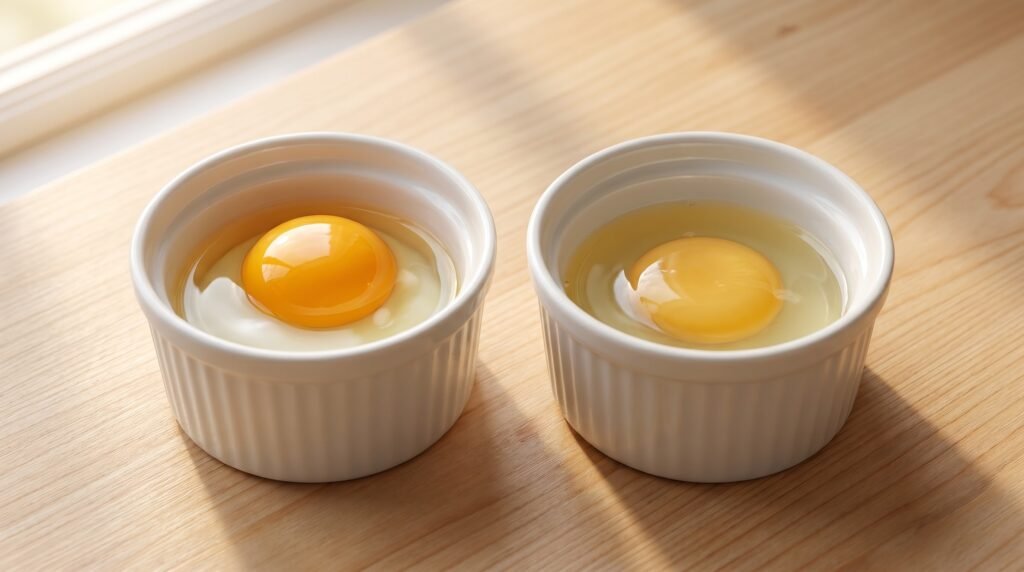
Crack the egg into a clean bowl on a light background. A fresh egg gives you three clear signs.
First, the white. A very fresh white looks slightly cloudy or milky. That cloudiness comes from dissolved carbon dioxide that has not yet escaped through the shell. As the egg ages and CO2 bleeds off through the pores, the white clears (American Egg Board). A clear white is not dangerous - it is just older. What is dangerous is a white that has gone green, pink, or iridescent, which suggests bacterial growth and means the egg goes straight into the bin (Cackle Hatchery).
Second, the yolk. A fresh yolk sits high, round, and firm, holding its shape in the center of the white. As the egg ages, the yolk membrane weakens. An older yolk sits flat and may break when the shell cracks open. Flat does not equal unsafe, but it tells you the egg has been around a while.
Third, the chalazae. Those two twisted, cordlike strands of protein that anchor the yolk in the center of the egg - the more visible and pronounced they are, the fresher the egg (American Egg Board). If they have disappeared entirely, the egg is older, though not necessarily bad.
The most reliable spoilage signal is smell. A fresh egg has no odor at all when you crack it. A genuinely bad egg produces a sulfurous, rotten smell that is unmistakable - either from the raw contents or from the shell itself (USDA/FSIS via Nebraska Extension). If it smells off in any way, discard it without tasting. Hard-cooked eggs can mask the smell until you eat them, so the smell test is most reliable on raw eggs before cooking.
What "bad" actually means, and the USDA framing
USDA guidance does not treat a floating egg as spoiled. The agency's position, consistent across FSIS publications and confirmed through Nebraska Extension: crack it into a bowl, examine it for off-odor or unusual appearance, and then decide. A spoiled egg will announce itself through smell when the shell breaks open, whether raw or cooked.
Signs that mean discard without further debate:
- Any sulfurous, sour, or "off" odor when cracked raw
- White that is green, pink, or has an iridescent sheen
- Yolk that is discolored, mottled, or very darkened
- Shell that feels slimy (bacterial overgrowth) or shows powdery spots (mold)
- Visible cracks with staining or dried residue around them
Signs that look alarming but are normal:
- Cloudy white - means very fresh, due to dissolved CO2
- Small red or brown blood spots on the yolk - a minor rupture during formation; safe to eat (American Egg Board)
- White stringy strands attached to the yolk - chalazae, perfectly normal
- Pale or deep orange yolk color - reflects the hen's diet, not quality or safety
- Clear, watery white on an older but odor-free egg - thin albumen from age, not spoilage
Carton dates and how long eggs actually keep
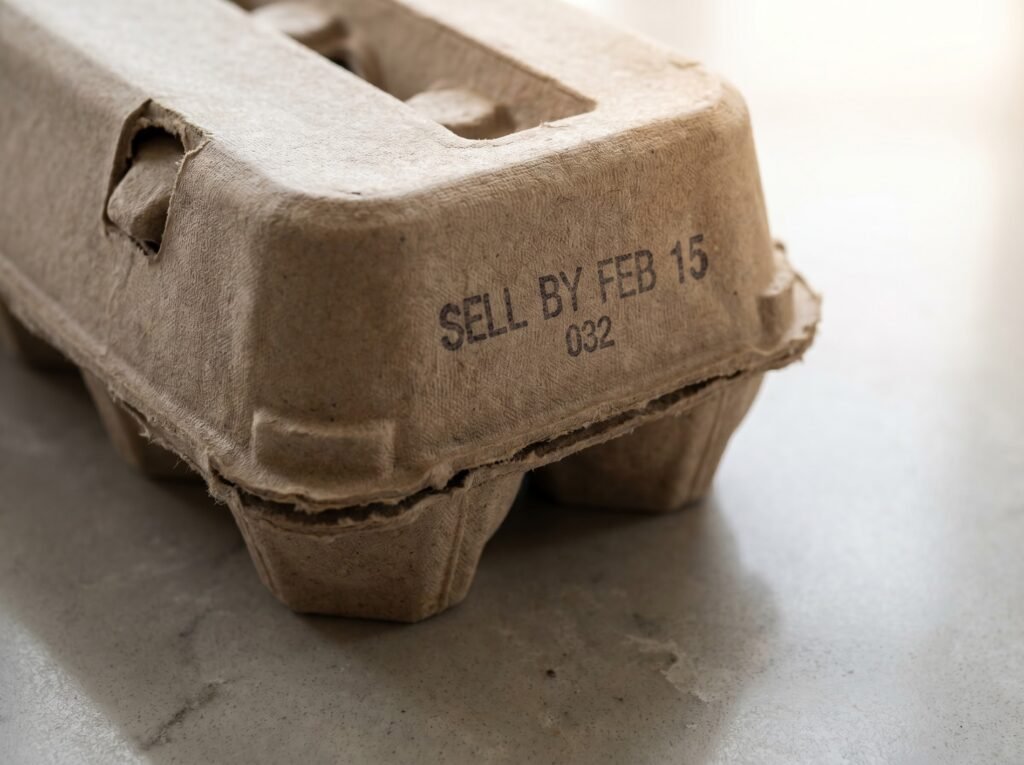
Commercial egg cartons carry a three-digit Julian Date code stamped on one end - that is the pack date, where 001 is January 1 and 365 is December 31. Some cartons also show a Sell-By or Expiration date, but federal law does not require either of those; only the pack date is regulated (UNL Food, citing USDA). When refrigerated in their original carton in the coldest part of the fridge - not the door - shell eggs remain safe and of good quality for four to five weeks beyond the pack date (American Egg Board).
Backyard and farmstead eggs follow a different track depending on whether they have been washed. Washing removes the natural cuticle, or bloom - the thin waxy coating a hen deposits on each egg as it passes through the oviduct. That bloom seals the shell pores and slows moisture loss and bacterial entry. Once it is gone, the egg needs refrigeration, full stop (Michigan State Extension). Unwashed backyard eggs with the bloom intact can sit at room temperature for up to three weeks. If you refrigerate an unwashed egg and then bring it back to room temperature, condensation forms on the shell, which can carry surface bacteria inward through the pores - so once it goes cold, keep it cold (Michigan State Extension).
For everything about the washing decision and whether to refrigerate your flock's eggs, our guide on washing fresh eggs walks through the options in detail. And the full egg collecting and storage guide covers nest box hygiene, collection timing, and storage containers.
Frequently asked questions
Can you eat an egg that floats?
Possibly, yes. USDA guidance is that a floating egg has a large air cell and is old, but "it may be perfectly safe to use." Crack it into a bowl, sniff it, and look for off-color or unusual appearance. If it smells normal and looks clean, cook it through. If there is any sulfurous or sour smell, discard it.
Does the float test work for fertilized eggs from my flock?
For eating purposes, yes - the physics are identical. For incubation decisions, no. Candling gives far more useful information about viability than the float test does, and submerging a developing egg risks contamination. Stick to candling when you are trying to assess hatching eggs.
My fresh backyard egg white is very cloudy - is something wrong?
A milky or opaque white means the egg was laid recently. The cloudiness is dissolved carbon dioxide that has not yet had time to escape through the shell's pores. It disperses fully within a few days at room temperature, or more slowly under refrigeration. Cloudy equals fresh here.
How long do hard-cooked eggs stay safe?
Hard-cooked eggs should be refrigerated within two hours of cooking and used within one week (USDA FSIS). Cooking changes the egg's chemistry and removes any remaining protective barrier, leaving the interior more vulnerable to bacteria, so they spoil faster than raw refrigerated eggs.
Why do my hens' eggs sometimes have two yolks?
Double yolks happen when a hen releases two yolks in quick succession before the shell forms around them. It is more common in pullets just starting to lay and in high-production breeds. The egg is perfectly safe to eat. If you want to know more about egg oddities from your flock, our piece on double-yolk eggs covers the mechanics.