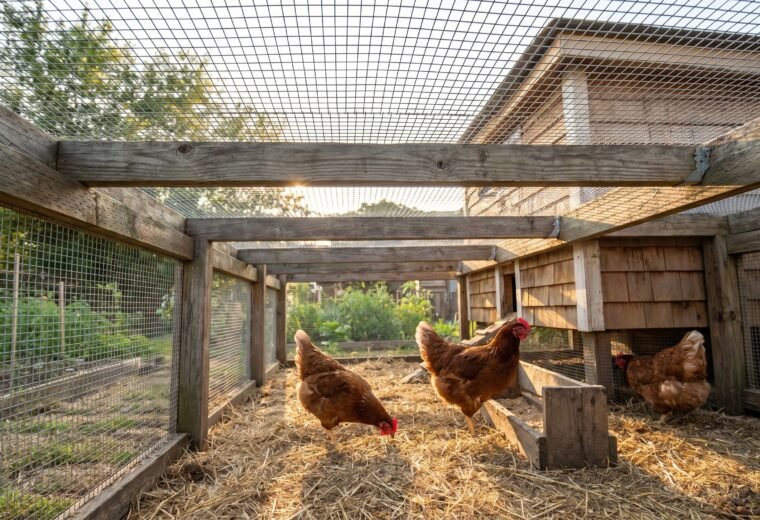
A run fails differently than a coop. Where coop losses usually come down to a latch or a gap in the wall, run losses happen because the wire is wrong, the top is open, or a digger found the three inches of soil between fence base and solid ground. Fixing a run means thinking in three directions - up, through, and down - and most attacks exploit whichever of those directions was left unaddressed. What follows covers each one with the actual specifications that hold.
If you want a broader picture of which animals visit your region and the signs each one leaves, our guide to chicken predators is the starting point for identifying what you are defending against.
The wire that actually stops predators (and the wire that does not)
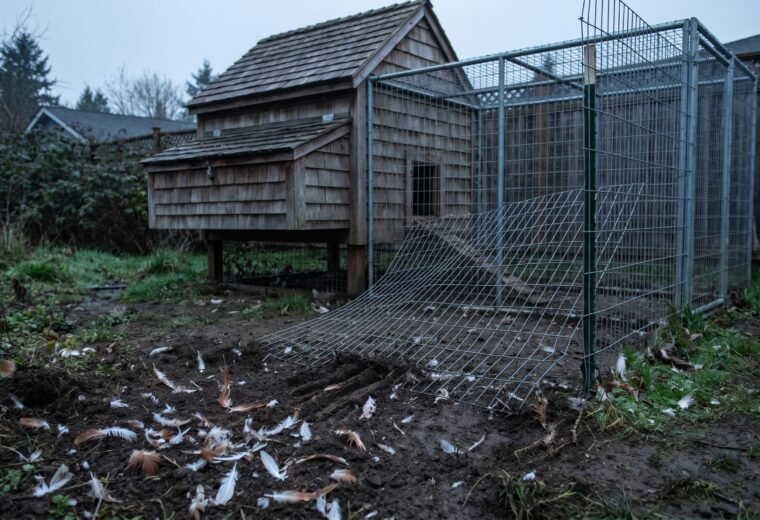
Standard chicken wire, hexagonal and lightweight, is a containment tool for chickens. It is not a predator barrier. Raccoon paws reach through two-inch openings. Dogs and foxes tear lightweight twisted wire apart. Poultry Extension's consortium of land-grant universities documents the size problem clearly: least weasels can squeeze through holes as small as 1/4-inch in diameter, which means they typically get right through chicken wire.
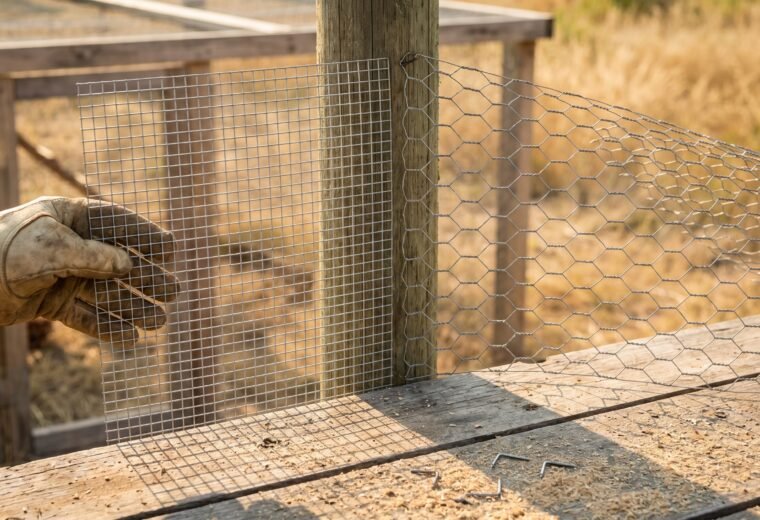
The material that holds is 1/2-inch galvanized hardware cloth with welded intersections. The 1/2-inch opening excludes raccoon paws, weasels, snakes, and rats. Welded joints do not unravel when cut or when pressure is applied at a corner. For the wall panels themselves, Colorado State University Extension notes that while 2-by-3-inch welded wire is less expensive, keepers lose fewer birds when they use 1-by-2-inch mesh or smaller. If your run is already built with larger-opening welded wire, line the lower four feet with hardware cloth as a retrofit - that is where paws and snouts probe most aggressively.
On gauge: 19-gauge wire (roughly 1 mm wire diameter) is the standard for most backyard runs, and it handles the load well when attached every four to six inches along a solid frame. If your area has bear activity or you keep a large flock with proportionally more predator interest, 16-gauge cloth is heavier and harder to compress - worth the added cost. The detailed breakdown of mesh materials and costs is in our article on hardware cloth vs. chicken wire.
One installation detail that matters more than most people expect: how the wire is attached to the frame. Staples alone pull out when a dog or coyote leans into the panel. Back every edge with a wood lath strip screwed over the cloth, or use screws with flat metal washers driven directly through the mesh. That combination cannot be pried off from outside without tools.
Dig defense: the buried apron and the surface alternative
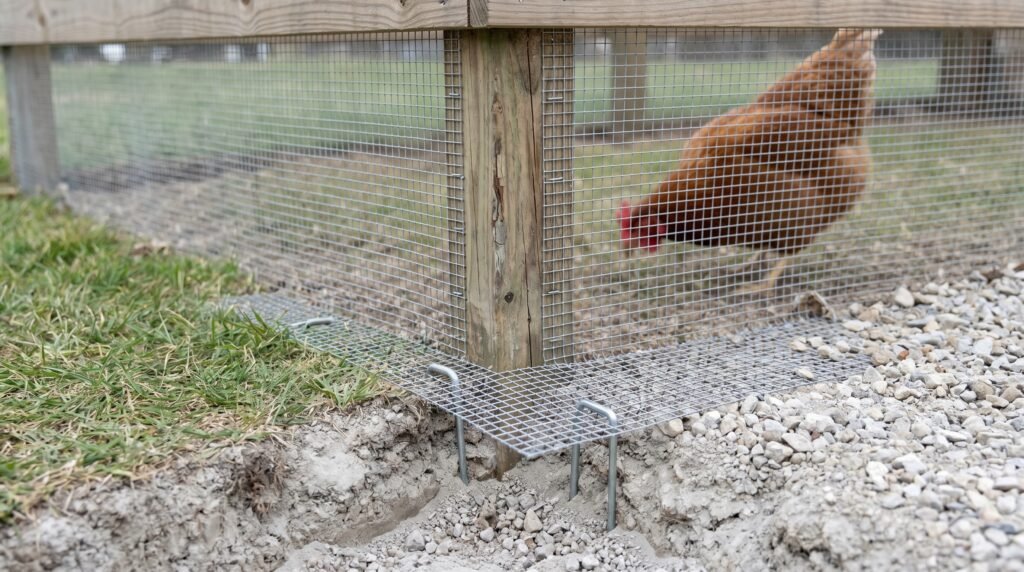
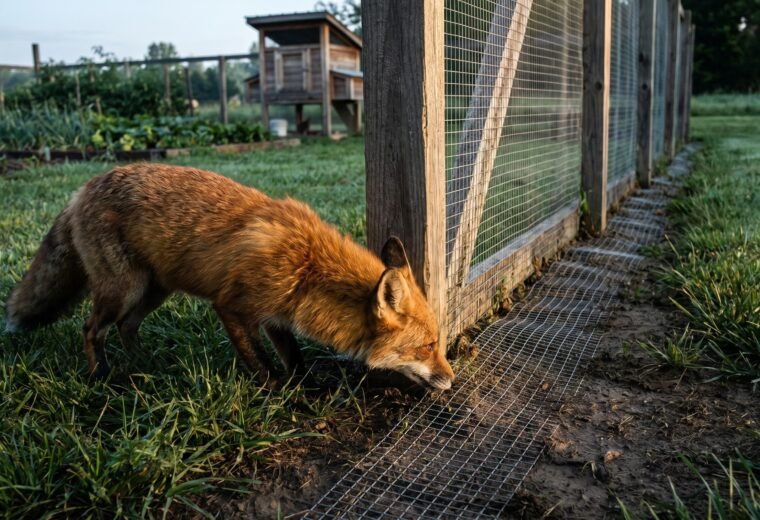
Foxes, coyotes, and dogs dig at the base of a fence, not two feet away from it. That behavior is what makes both dig-defense methods work: block the animal at exactly the spot where it tries to enter, and it almost always stops.
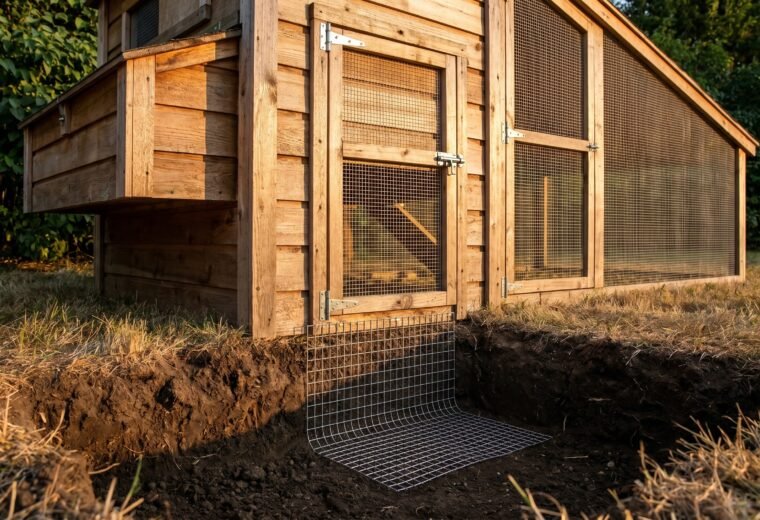
Poultry Extension recommends burying hardware cloth at least 12 inches into the ground to deter diggers. The small-scale poultry housing guidance from the same consortium adds a detail that matters: bury the wire along the fence border at least 12 inches deep, then toe it outward about 6 inches at the bottom. University of Maryland Extension puts the same principle in slightly different numbers - the fencing should go into the ground at least a foot deep and then make a 90-degree turn outward for at least another 8 to 10 inches. The outward bend is the mechanical key. A predator that starts digging at the wall immediately hits wire, then encounters more wire spreading away from the wall. It cannot dig over or around the barrier without moving far enough from the fence that the behavior changes. Most stop.
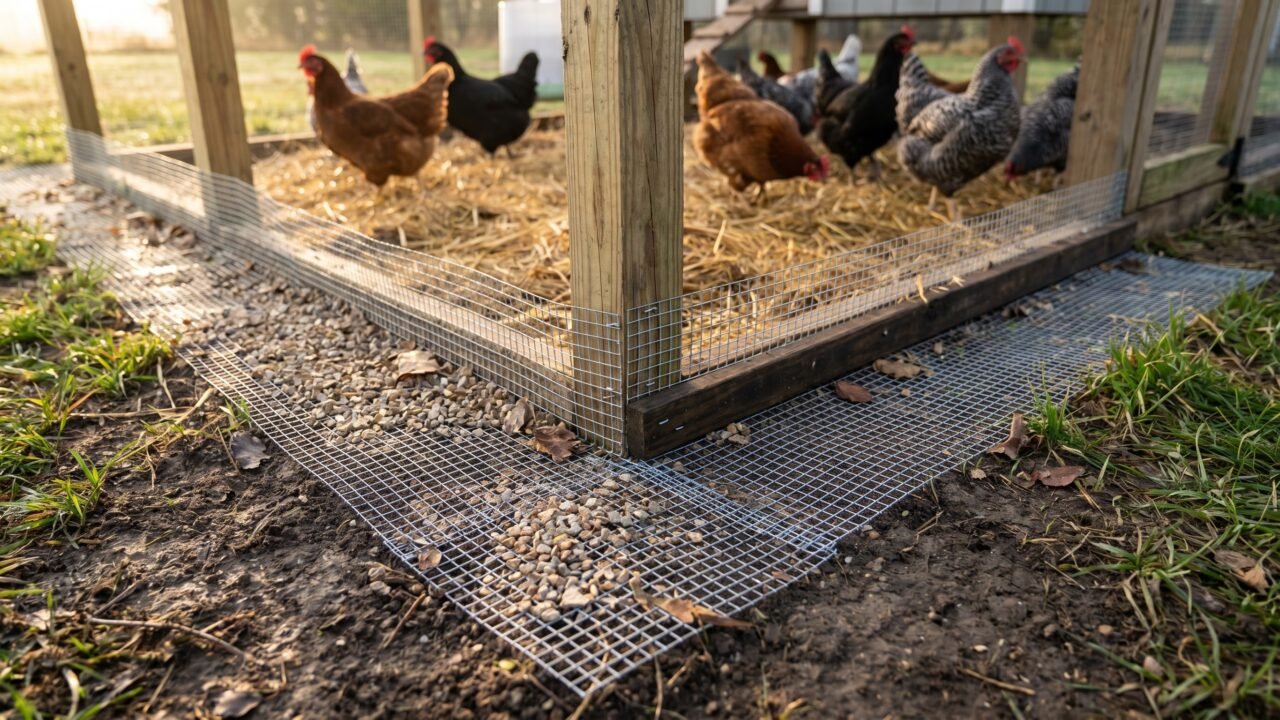
For existing runs where digging a trench is not realistic, a surface apron does the same job. Lay hardware cloth flat on the ground starting from the fence base and extend it outward 12 to 18 inches. Cover it with a few inches of soil, gravel, or stepping stones. Anchor the cloth with landscape staples every 10 to 12 inches so it cannot be folded back. The predator digs at the fence base, hits wire immediately, and encounters the same dead end it would hit with the buried version.
The table below shows the three main dig-defense configurations so you can match the right one to your build situation.
| Method | Installation | Best for | Honest tradeoff |
|---|---|---|---|
| Buried L-apron | Trench 12 inches deep; bend bottom edge outward 6-10 inches; backfill | New builds; permanent runs on soil; high-pressure predator areas | Labor-intensive; harder to retrofit in an established run with plants or paths nearby |
| Surface horizontal apron | Lay cloth flat 12-18 inches out from fence base; cover with 2-3 inches of soil or gravel; landscape-staple every 12 inches | Existing runs; portable pens; rocky ground where trenching is impractical | Can shift from frost heave or root growth over time; inspect and re-staple each spring |
| Solid-base run floor | Hardware cloth deck or concrete pad covering the entire run floor | Small urban runs with very high predator pressure; runs attached to a raised coop | Chickens need adequate bedding depth; drainage management required; higher build cost |
University of New Hampshire Extension confirms the straightforward logic: burying mesh at least one foot deep around the sides of the enclosure will keep predators from digging. Pick the version that fits your site. Both the buried L and the surface apron close the same vulnerability.
For the fox-specific angle - including how they combine digging with fence climbing - our article on foxes and chickens covers their behavior in more detail.
Overhead cover: closing the dimension most run builders skip
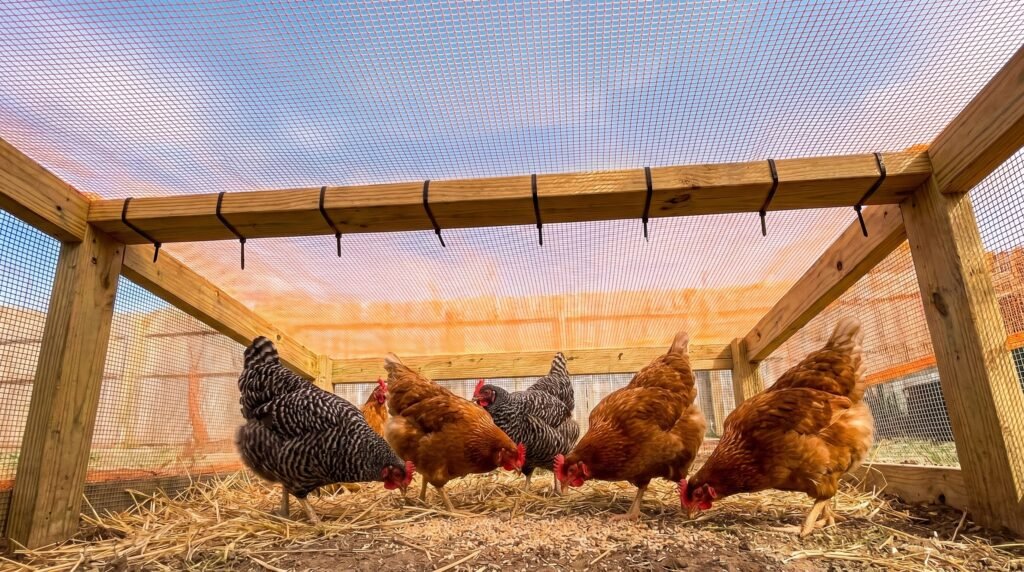
A run without a top is a feeding station for red-tailed hawks, Cooper's hawks, and great horned owls. Hawks hunt in daylight; owls work low-light hours from dusk through dawn. Both target smaller birds and juveniles, and neither needs a structural weakness to exploit - an uncovered run is simply open access. Colorado State University Extension confirms that 4-foot fences are easily cleared by both bobcats and coyotes, making them inadequate as the only barrier. University of Maryland Extension puts the coyote-specific ceiling at 5 feet - which means an open top is not only an aerial vulnerability, but also the gap that lets a coyote in even over a fence most keepers would consider tall.
The covering does not have to be expensive. Colorado State recommends welded-wire fencing, standard chicken wire, or game-bird netting - or simply installing a random array of crisscrossing wires overhead to discourage hawks and owls from making a direct attack approach. For smaller runs under about 200 square feet, welded wire or 1/2-inch hardware cloth on a frame gives the most durable result and doubles as load-bearing support in snow country. For larger runs, UV-stabilized polyethylene bird netting or game-bird netting is lighter, much faster to install, and adequate in most areas.
Poultry Extension adds a specific color note for the netting choice: orange netting is best because hawks and owls see orange well, making the barrier more visible to them. The same source adds a critical installation requirement - hawks can get through any loose or weak spots in the covering, so it must be pulled taut and secured at every edge. A drooping section in the middle of a large run is effectively an invitation.
A few practical things worth knowing about overhead cover:
- Attach netting or wire to the run frame with zip ties every 12 to 18 inches along the top rail, not just at corners. A gap at the midpoint of a long span is where hawks learn to enter.
- In regions with heavy snow loads, netting alone will sag and eventually tear under accumulated weight. Either clear snow promptly after storms or install a pitched wire frame that sheds it.
- Stringing 50-pound monofilament fishing line in a grid pattern 4 to 6 inches apart across the run opening works as an inexpensive deterrent. It interrupts the clean glide path a raptor needs for a strike. It will not stop a walking predator that climbs the fence, but it handles the aerial problem at very low cost.
- Hawks are federally protected under the Migratory Bird Treaty Act. Trapping, shooting, or otherwise harming them is not a legal option. Deterrence and covered runs are the entire toolkit.
A covered run also matters if you keep bantams or young pullets. A 4-pound standard-breed hen is below the carrying capacity of most hawks in most areas, but a 20-ounce bantam or a 12-week-old pullet is a realistic target. If your flock includes small birds, a covered run is not optional.
Electric netting: the movable perimeter that stops diggers and climbers together
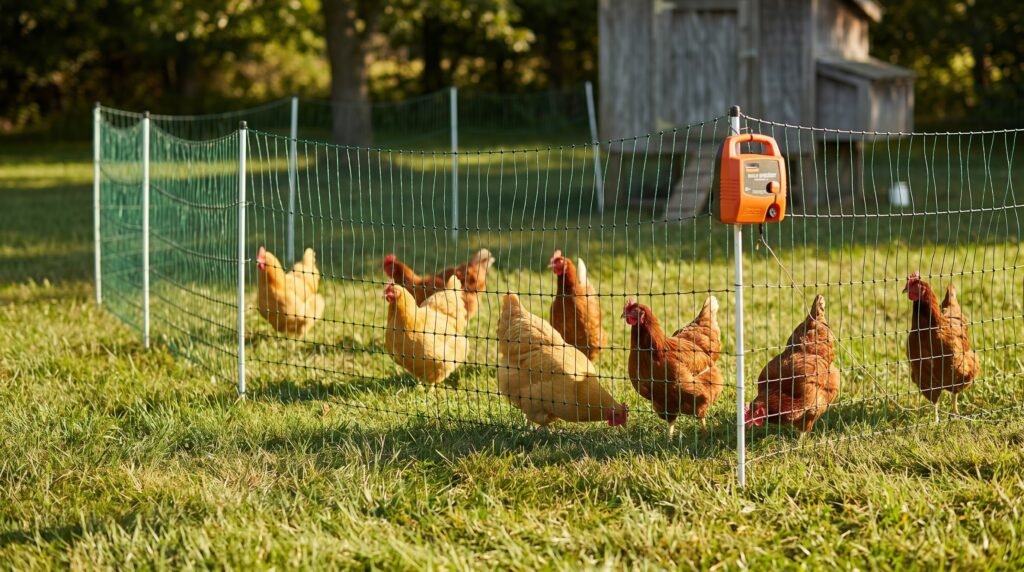
Electric poultry netting is a fundamentally different tool than a fixed run - it is a temporary, relocatable perimeter fence that delivers a deterrent shock to any ground predator that contacts it. University of New Hampshire Extension rates electric poultry fencing as an even better option to protect against ground predators than standard wire mesh. University of Maryland Extension notes that it may work well for containing the flock and offering protection against ground predators, provided an adequate charge is maintained throughout the entire fence line. That phrase - adequate charge - is the whole maintenance story with electric netting.
Standard electric poultry netting comes in heights from 42 to 48 inches, which stops most ground predators when properly energized. The netting is not a standalone predator barrier without the energizer. An un-energized net is just netting with small openings that a determined fox will push through. The energizer is what makes the system work, and joule output is the specification that matters most. For up to three 164-foot rolls of netting, a pulse-style 0.6-joule energizer is the commonly cited minimum. Runs with heavy vegetation contact require more - plant growth pulls energy out of the fence, which drops the voltage on the wire itself.
A few realities about electric netting that extension guidance and field use both confirm:
- Poultry Extension's guidance on electric fence current is worth applying directly: the amount of electricity should be enough to stun but not kill an animal. A stunned predator is deterred; a dead one is replaced by the next animal that finds the territory vacant.
- Keep vegetation trimmed to six inches or lower along the entire fence line. Heavy weed contact is the main reason an energized fence loses effectiveness gradually without any obvious fault.
- Electric netting does not replace a secure coop. It reduces daytime and dusk-hour predator pressure on a free-range or pasture rotation area. Birds still need to be secured inside a solid structure at night.
- Check the charge with a fence tester weekly during heavy growing season and after any storm that might have knocked vegetation onto the line.
The Poultry Extension small-scale housing guidance specifies the placement geometry for an electric perimeter paired with a fixed run: 4 inches off the ground and about 1 foot out from the main fence. That offset means a predator gets a shock before it even reaches the fixed fence, which prevents the nosing, scratching, and pulling that wears down a static fence over time.
The weak points that cause most run failures
The strongest hardware cloth in the world does not close a gap at the gate frame. Run failures concentrate in predictable locations - not because the overall build was poor, but because certain spots get assembled quickly, flex with seasonal wood movement, or simply look fine at a glance while hiding an opening underneath.
Walk your run once from the outside and once from the inside with a flashlight before any lock-in at night. The spots to focus on, roughly in order of how often they cause losses:
- The gate frame. Gates are the most-used part of the run and the most likely to develop a gap as hinges loosen or the ground shifts. The bottom corner where the gate swings open is where gaps develop first. A gap two inches tall at the bottom of a gate is enough for a weasel and enough for a raccoon to begin prying.
- Where the run meets the coop wall. The junction between a wire run panel and a wood coop wall is a seam that often gets a single line of staples. Predators probe this joint because it looks different from the rest of the run surface. Run hardware cloth an inch or two up onto the coop wall and screw it there through a batten.
- Corner posts. A corner post carries two run panels meeting at 90 degrees. If the panels are only stapled to the post face and not wrapped around it, the junction has two vertical gaps - one on each side of the corner. Wrap the cloth around the post or use a corner cap.
- The top edge of the wall panel. If the run has overhead cover, the wire top must connect to the wall panels without a gap at the rail. A predator that cannot enter through the wall or the top will work the seam between them.
- Ground-level along the fence base (inside the run). Predators dig from outside, but once wire is compromised at the base, the gap opens into the run floor area. Inspect the inner face of the fence base for wire that has lifted, rusted through at the soil line, or been pushed in by a digging attempt.
- Any ventilation or access panel added after the original build. Retrofitted panels - cleanout doors, feeder access hatches, egg collection ports cut through a run wall - are high-risk if they were added with lighter hardware than the original construction.
The deeper issue is that most of these weak points are not visible failures at the time of construction - they develop over one or two seasons as wood moves, fasteners loosen, and animals probe the same spots repeatedly. A quarterly walk-around inspection, ideally at dusk when the run is locked and predators are active, catches problems before they become losses.
Putting it together: a run security assessment
The table below is a working checklist for auditing any run - whether you are evaluating an existing setup or planning a new one. Items marked as high priority are responsible for the majority of run losses based on the pattern of weak points above. Low-priority items still matter but rarely cause a sudden loss.
| Item to check | Standard to meet | Priority |
|---|---|---|
| Wire mesh type on run walls | 1/2-inch hardware cloth or 1x2-inch welded wire; no hexagonal chicken wire | High |
| Wire attachment to frame | Staples plus wood batten or screw-washer every 4-6 inches; no loose edges | High |
| Dig defense at fence base | Buried L-apron (12 in. deep, 6-10 in. outward bend) OR surface apron (12-18 in. out, anchored) | High |
| Overhead cover | Wire, netting, or monofilament grid; pulled taut and secured at all edges | High |
| Gate frame gap at base | Less than 1/2 inch clearance at all edges when closed | High |
| Run-to-coop wall junction | Wire lapped onto coop wall and screwed through a batten | High |
| Corner post coverage | Wire wrapped around post or corner cap installed; no gap at either panel edge | Medium |
| Top-edge seam (wall meets roof) | Wall panels and overhead cover joined with no gap at the rail | Medium |
| Electric netting (if used) | Energizer at minimum 0.6 joules; vegetation trimmed; tested weekly | Medium |
| Wire at soil line (inner face) | No rust-through, lifting, or inward bowing at ground level | Medium |
| Retrofitted panels and hatches | Same hardware cloth standard as original construction; no lighter mesh | Medium |
| Run height | Minimum 6 feet for jumpers (coyotes, bobcats); add overhead cover if shorter | Low |
A run that passes every high-priority item on this list will hold against the vast majority of predator attempts. The medium-priority items close the gaps that a persistent animal eventually finds over weeks of probing. Together they describe a run that does not depend on a single layer of defense holding perfectly - which is the only standard worth building to.