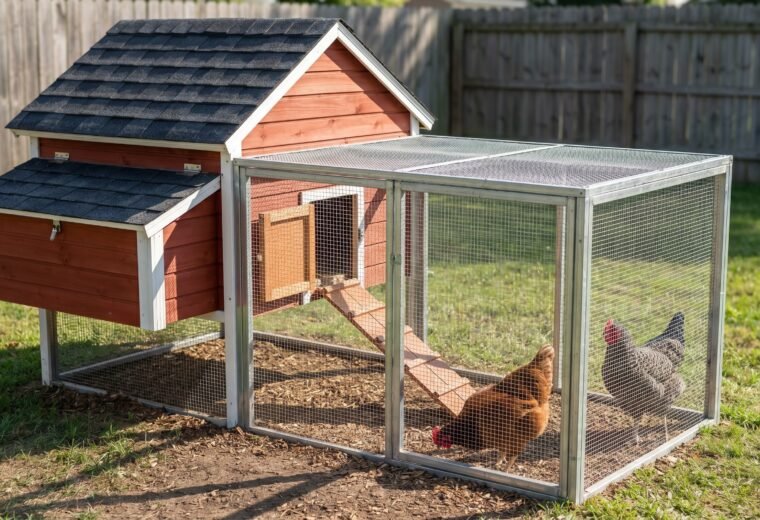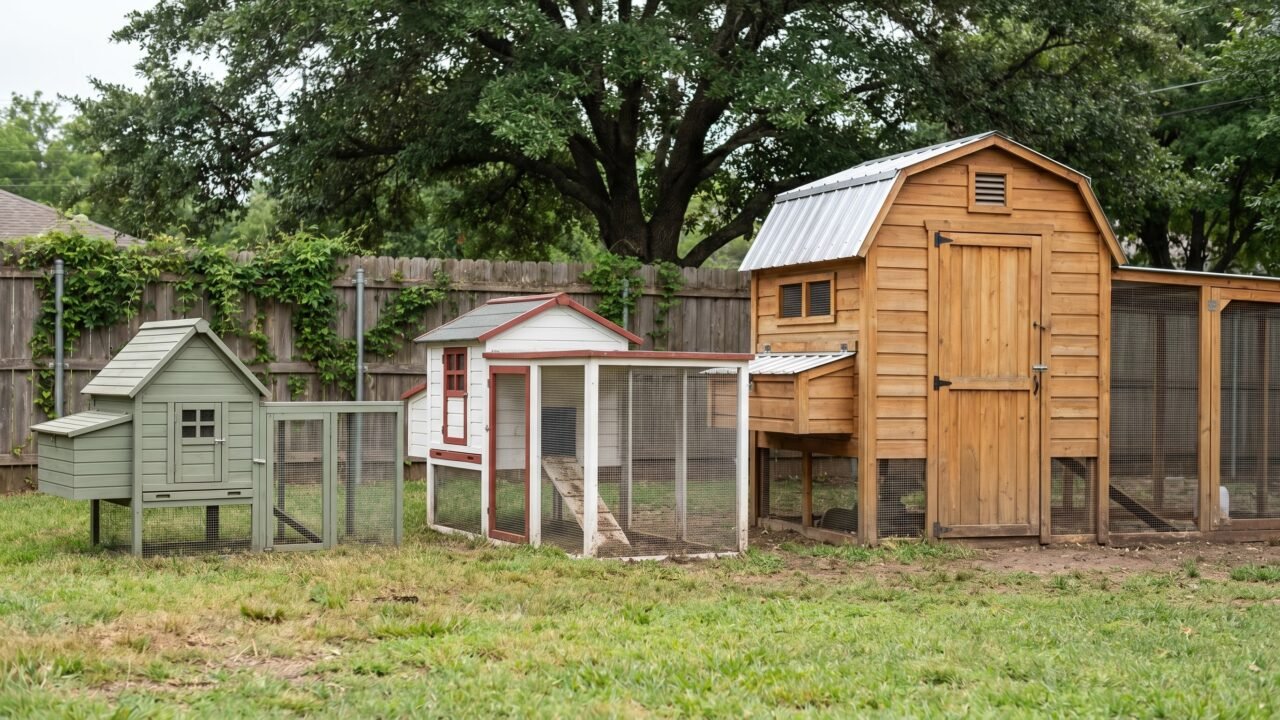
Three hens need at least 9 square feet of coop floor space. Most prefab coops labeled "fits 4-6 birds" give them about 12 square feet total - run included. That gap is the single biggest problem in the chicken coop market, and it is the first thing to measure before spending a dollar.
This guide covers which coops match which flock sizes, how wood and plastic actually compare over a few seasons, how to score ventilation and predator resistance before you buy, and the specific places where marketing language diverges from what university poultry extension services recommend. Internal links go deeper on each topic; this article keeps its focus on how to choose.
The math every coop label skips
University of Florida IFAS Extension sets the baseline plainly: 3 square feet of indoor floor per bird minimum, with a run of 8-10 square feet per bird on top of that. Extension.org's Small and Backyard Poultry resource uses essentially the same numbers - 3-4 square feet indoors, 10 square feet outdoors per laying hen. Penn State rounds down slightly, at 1.5 square feet per bird for confined layers, but that figure assumes very frequent litter cleaning and is better suited to a dense commercial setup than a backyard coop where birds spend rainy days inside.
For a backyard flock, the HenAcre working minimum is 4 square feet of enclosed coop per standard-size bird, with 8-10 in the attached run. Bantams need about half the floor space, so a 10-square-foot coop that feels tight for four Plymouth Rocks is workable for eight bantam Cochins. Coop size per chicken steps through the math for mixed flocks and odd flock sizes where the simple formula breaks down.
Where does prefab marketing go wrong? Manufacturers often calculate capacity by dividing total square footage - coop body plus run plus whatever covered area they can measure - by a very low number like 2 square feet per bird. A coop labeled "10 birds" may have a 20-square-foot footprint total. Apply the 4-square-foot indoor standard and that structure comfortably houses five standard birds, not ten. The table below translates advertised sizes to realistic headcounts.
| Flock size (standard birds) | Minimum enclosed coop (sq ft) | Minimum run (sq ft) | What prefab labels often claim | HenAcre call |
|---|---|---|---|---|
| 2-4 birds | 12-16 | 24-40 | Labeled "6-8 birds" | Good fit at 4; crowded at 6 |
| 5-8 birds | 20-32 | 48-80 | Labeled "10-12 birds" | Good at 8 if run is full size |
| 10-14 birds | 40-56 | 96-140 | Often requires a walk-in build or DIY | Most prefabs fall short here |
| 15+ birds | 60+ sq ft coop body | 150+ sq ft run | N/A - build or buy large barn-style | Budget for a custom or kit build |
Bantam keepers can use the column to the left of their actual count. A flock of eight Sebrights fits comfortably in a structure sized for four standard birds.
Picks for 2-4 birds
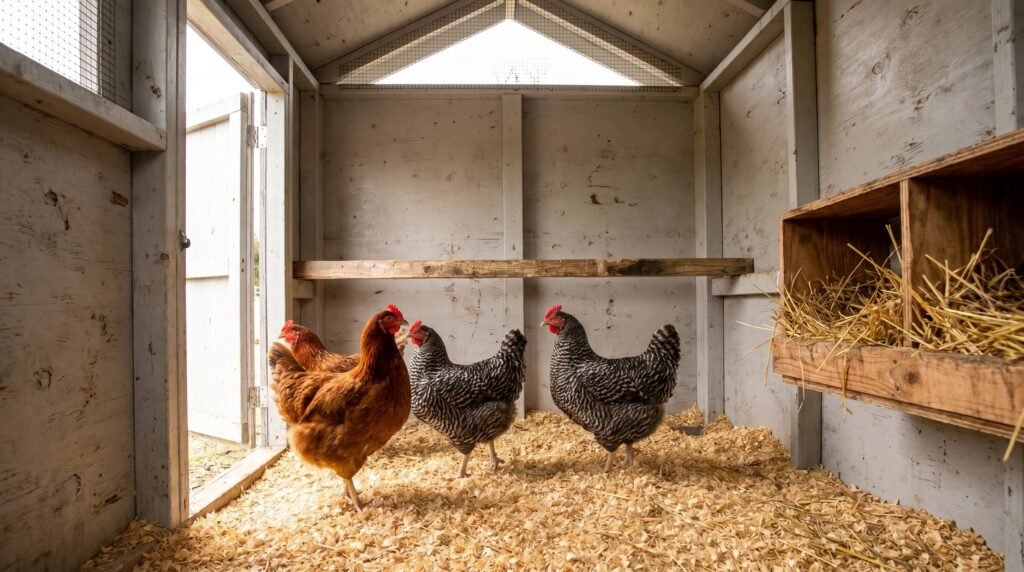
A small flock of three hens - the starter number many new keepers land on - does not need much floor space, but it does need properly placed ventilation and a secure latch. Most failures at this flock size come from buying the cheapest flat-pack and discovering that "assembly required" means warped panels, gaps at joins, and ventilation slots sized purely for looks.
What to look for at this scale:
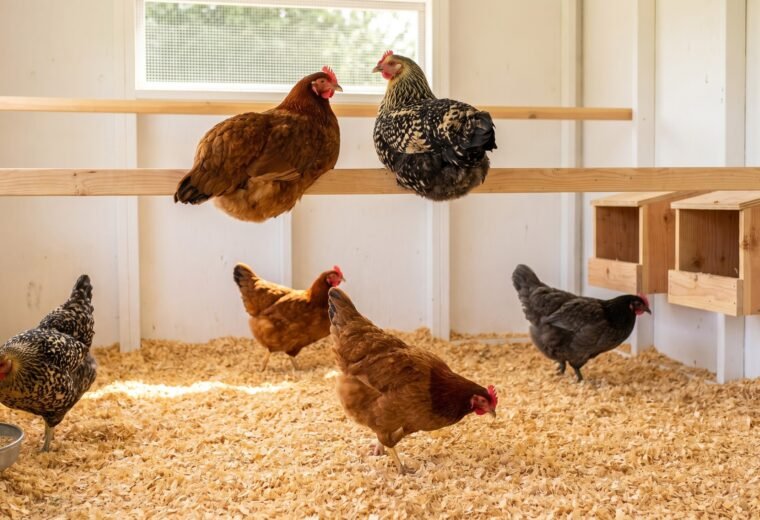
- Enclosed floor space of at least 12 sq ft - a 3x4 ft footprint is the practical minimum for three birds
- At least one nest box per three hens, sized 12x12 inches; UF IFAS recommends 12x12x12 inches packed halfway with shavings
- Roost bar above the nest boxes, at least 8-10 inches of bar per bird (University of Maryland Extension cites 6-10 inches; aim for the upper half so birds are not crowded on the perch)
- Hardware-cloth predator panels, not decorative chicken wire; more on that below
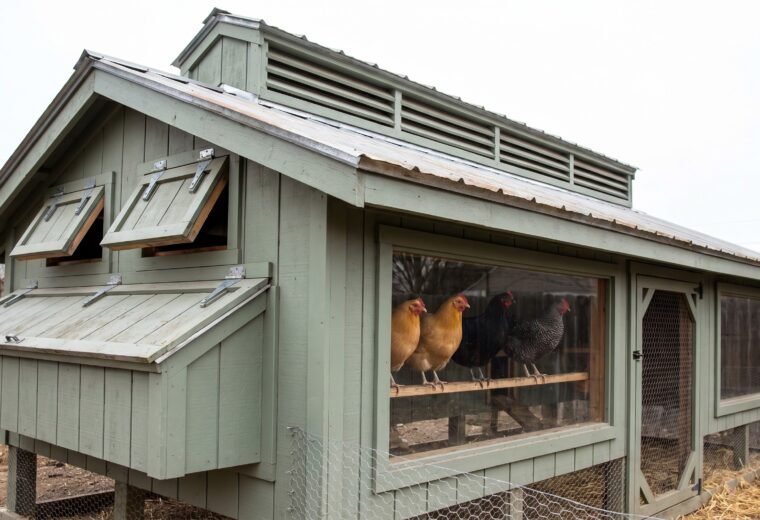
- Two or more vent panels near the roofline - screened openings you can leave partly open even in winter
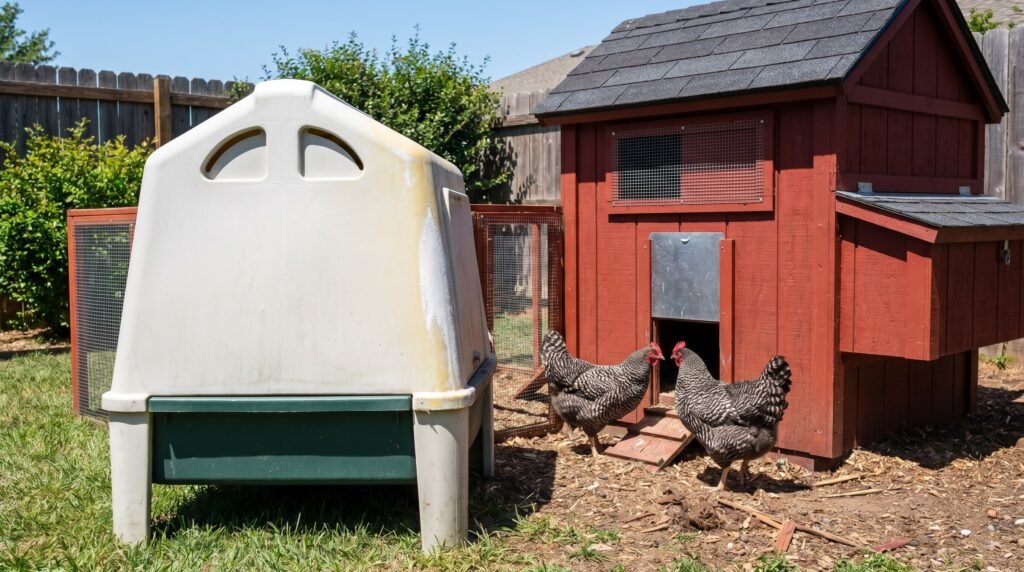
Plastic coops with removable trays show up frequently in this size range. They clean faster than wood, resist red mite (which hides in wood seams) better, and do not rot. The tradeoff: plastic holds cold in winter and can make a coop feel like a freezer during extended cold snaps. Extension.org's insulation guide notes that metal and plastic retain cold and can contribute to frostbite, while wood by-product panels insulate better. If you are in a northern climate and use a plastic coop, extra bedding depth matters more than it would in a wood structure.
A solidly built wood coop in this size range, properly painted and sealed, will outlast most plastic units by several seasons and is easier to insulate to an R-value above 10 if the climate demands it.
Picks for 6-8 birds
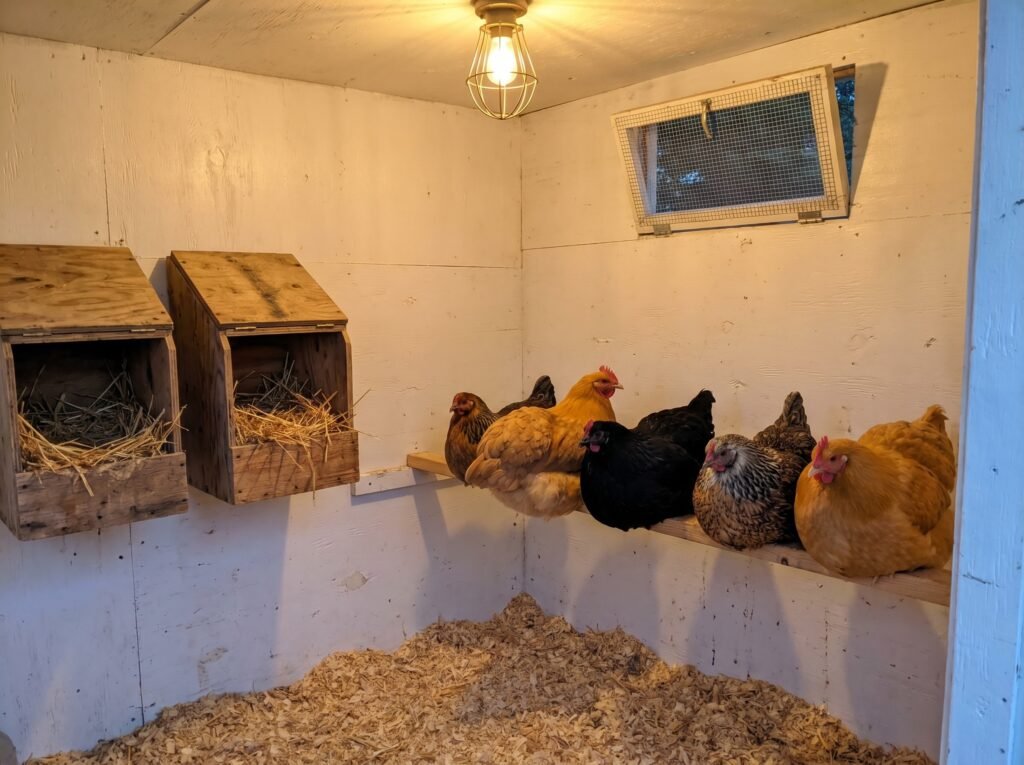
A flock of seven or eight standard hens is where most backyard keepers land after the first year - you start with four, add a few, and suddenly the starter coop is obviously too small. This size range rewards stepping up to a full walk-in or a large A-frame rather than stacking another small-footprint unit.
At eight birds you need a minimum of 32 square feet of enclosed coop space and at least 64-80 square feet of run. A coop with a full-length run attached - something in the 4x8 or 5x8 foot coop body range - covers this without building custom. The chicken coops with attached runs roundup breaks down how door placement and run orientation affect day-to-day access.
Key considerations at this size:
- At least two nest boxes - one box per three or four hens (the standard across Penn State, UF IFAS, and UMD Extension guidance); eight hens need at minimum two boxes, preferably three to prevent box-sharing fights during peak laying time
- Roost bar length of at least 5.5 to 7 feet total to give eight birds their 8-10 inches each
- Ventilation area near the roofline on at least two walls - the general planning rule of thumb is roughly 1 square foot of vent per bird, though actual needs vary by coop geometry and climate
- Pop door with a latch that requires two steps to open - raccoons operate simple slide latches without trouble
Wood wins on insulation at this size. A 4x8 foot wooden coop body with a 2x4 framework, painted exterior, and a vent ridge will handle most North American winters without supplemental heat if the birds inside are cold-hardy breeds. The UMN Extension cold weather guide is clear that ventilation, not heating, is the priority: moisture from chicken respiration and manure is the real winter threat, and proper air exchange prevents the ammonia and humidity buildup that damages respiratory health. The same guide notes supplemental heat becomes worth considering only when coop temperatures drop below 35 degrees Fahrenheit.
Heat lamps carry documented fire risk. Heating equipment is the leading cause of fires in animal housing according to NFPA data, and a heat lamp falling into shavings is the classic mechanism. A well-ventilated wood coop with cold-hardy breeds rarely needs one. If you do use supplemental heat in extreme cold, a flat panel radiant heater mounted well above bedding is far safer than a hanging lamp.
One related gap northern-climate keepers often notice first: egg production drops in short days even when the coop is warm and the birds are healthy. Penn State Extension notes that laying flocks need 14-16 hours of light per day for maximum year-round production. A simple timer-controlled LED bulb handles this; Penn State Extension gives 25-40 watts per 100 square feet of pen area as a starting point for bulb sizing.
Picks for 10+ birds
Above ten birds, most prefab coops on the market honestly cannot keep up. The square footage just is not there. A flock of 9 standard hens needs at least 36 square feet of coop floor and 72-90 square feet of run - that means a 6x6 or 6x8 foot coop body as a starting point, and adding even a few more birds pushes well beyond what most prefabs offer. At that scale you are shopping for what is effectively a small barn or a kit shed conversion, not a chicken-shaped box.
Two realistic paths work here:
- A purpose-built walk-in coop - 8x10 or 8x12 feet, with human-height access for cleaning, multiple vent panels along the upper walls, and a separate enclosed pop-door section for the birds to sleep. These are available as timber frame kits or can be built from plans. Building your own lets you dial in vent placement, roost height, and lumber grade from the start rather than retrofitting later.
- A converted shed or small outbuilding - already insulated, often with windows, and sized correctly from day one. Conversion means cutting a pop door at bird height, adding roost bars (wide-side-up 2x4s at 24-30 inches off the floor, with 8-10 inches of bar per bird), installing nest boxes at around 24 inches off the floor and away from the roost (Penn State Extension specifies 24 inches as the target height), and adding vent panels high on each wall.
The roost detail matters at any size but gets expensive to retrofit in a large coop. Flat 2x4s installed with the 4-inch face up give hens a wide platform to stand on and cover their feet with feathers on cold nights - a recommendation endorsed by University of Maryland Extension and Michigan State University Extension, both of which specify wide-side-up 2x4 boards. Penn State Extension specifies 2-inch-by-2-inch boards for laying flocks (the HenAcre team disagrees with that narrower spec based on the UMD and MSU guidance, which show flat 2x4s reduce footpad stress in backyard settings). Penn State Extension specifies roost boards at 24 inches off the floor; keepers should aim for that height. The UMD Extension coop construction resource covers roost-space-per-bird requirements (6-10 inches per bird) - independently verify their document at extension.umd.edu/resource/coop-construction-general-requirements for any perch-height ceiling guidance before relying on it. All of these constraints are easy to meet in a purpose-built walk-in.
At 15 or 20 birds, the large chicken coop page addresses the structural jump from a backyard unit to something that functions more like a small farm poultry house - roof load, drainage, and access door sizing all shift.
Ventilation and predator scoring: a field checklist
Manufacturers sell coops on aesthetics and listed capacity. Neither tells you whether the ventilation will keep birds healthy through August or whether the latch will stop a raccoon. Before buying - or building - run both of these quick checks.
Ventilation score
Score each item as shown below, then total (maximum 8 points):
- Vents placed high on at least two opposite walls (cross-ventilation possible): 0 or 3 points
- Vents covered with hardware cloth (not plastic louvers that close completely): 0 or 2 points
- Vent area equivalent to roughly 1 square foot per bird, or adjustable: 0 or 2 points
- No sealed peak or ceiling that traps hot air above the roost: 0 or 1 point
Score 7-8: good ventilation. Score 4-6: workable with modifications (add vent panels). Score below 4: avoid in hot climates; modify before winter in cold ones.
Poor ventilation shows up as ammonia smell at bird-nose height, wet litter, and respiratory disease - all avoidable. The chicken coop ventilation article works through how vent height and cross-wall placement change the airflow math in warm and cold months.
Predator resistance score
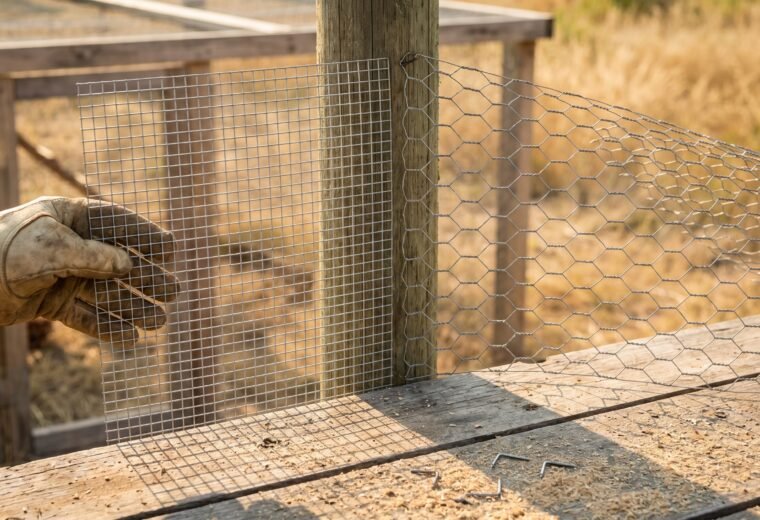
- Hardware cloth (welded wire, not chicken wire) covering all openings: 0 or 3 points
- Mesh openings 1x2 inches or smaller on all panels (Colorado State Extension: 1x2 inch mesh loses fewer birds than 2x3-inch): 0 or 2 points
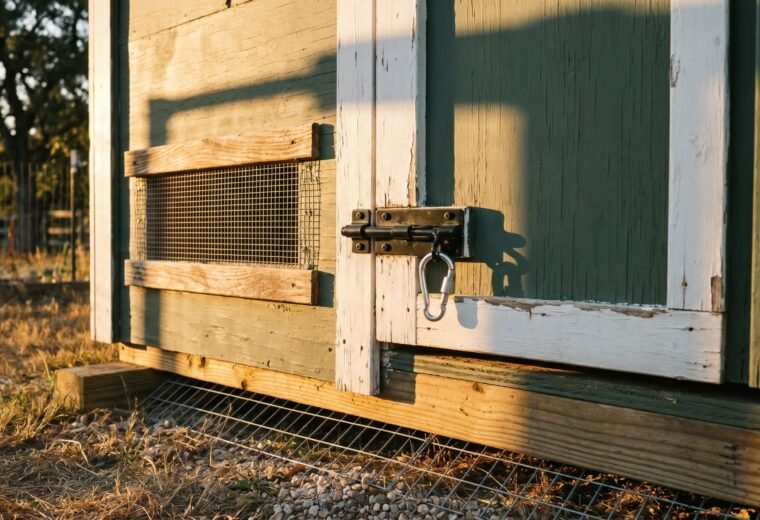
- Door latches that require two motions (a carabiner through a slide latch, a padlock, or a twist-plus-lift): 0 or 2 points
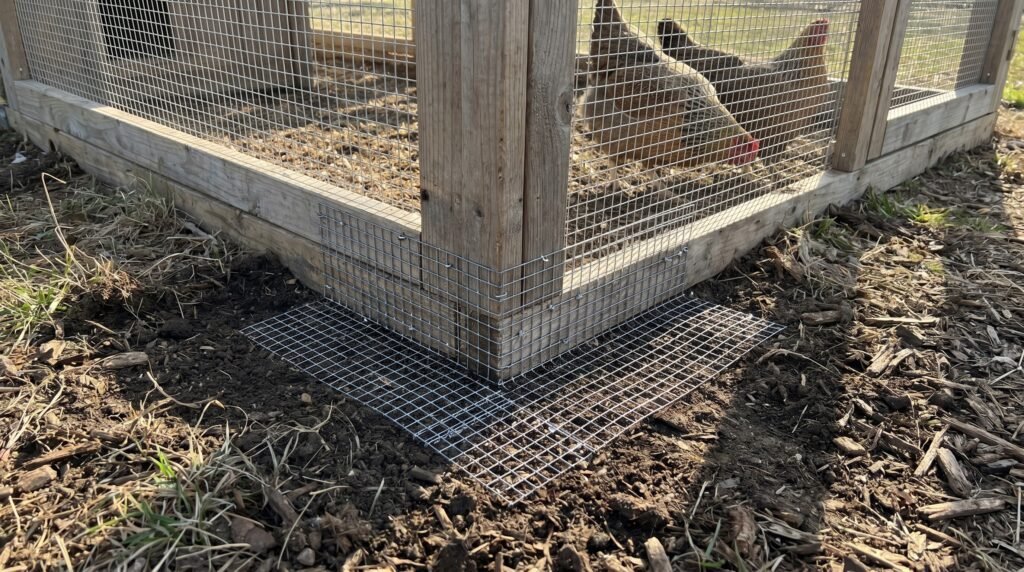
- Skirt or buried apron - hardware cloth extending 12-18 inches outward at the base (UF IFAS recommends L-shape burial 12-18 inches deep to stop diggers): 0 or 2 points
- Overhead run coverage (CSU Extension recommends welded wire or game-bird netting to discourage hawks): 0 or 1 point
Score 8-10: genuinely predator-resistant. Score 5-7: improvement needed (priority: fix latches and bury apron first). Score below 5: add hardware cloth and a skirt before birds move in.
Chicken wire is worth flagging specifically. It keeps chickens in, but extension.org's predator management guide notes that least weasels fit through 1/4-inch gaps and "can get through chicken wire." Raccoons pull it apart. For any predator that matters - fox, raccoon, weasel, mink - hardware cloth with 1/2-inch openings on coop panels and 1x2-inch mesh on the run is the standard that actually holds. The hardware cloth vs. chicken wire piece runs through gauge, mesh opening, and cost per linear foot so you can price out a retrofit before buying.
Wood vs. plastic: the honest tradeoff table
| Factor | Wood | Plastic / resin |
|---|---|---|
| Insulation (cold winters) | Better - holds warmth; easier to insulate to R-10+ | Poor - retains cold; extension guidance flags frostbite risk |
| Cleaning ease | Medium - paint or seal gaps; power-wash annually | High - smooth surfaces, removable trays, hose-clean in minutes |
| Red mite hiding places | Higher - gaps and joints ideal | Lower - fewer seams to treat |
| Durability (unsealed) | Rots in 5-8 years without maintenance | UV degrades over 8-12 years; no rot |
| Modification / expansion | Easy - screw in vent panels, pop doors, runs | Difficult - proprietary connectors limit changes |
| Cost at equal space | Lower DIY; similar for prefab | Similar to wood prefab; often less for small units |
| Best for climate | Cold and mixed climates | Mild, humid climates (easier cleaning matters most) |
Neither material is universally better. In a wet, mild climate where mite pressure and cleaning frequency are the main concerns, a plastic coop with a solid run is a reasonable choice for a small flock. In a zone 4-6 climate with real winters, a sealed and painted wood coop - even a basic one built from plywood over a 2x4 frame - gives birds more thermal mass and is easier to retrofit with insulation.
Site selection and drainage affect wood and plastic equally; the chicken coop overview goes into those ground-level decisions before you pick a build type.
What marketing routinely overstates
A few patterns appear consistently across prefab coop listings:
Capacity numbers. As discussed above, manufacturers commonly divide total footprint (coop plus covered run area) by 2 square feet per bird. By that math, a 20-square-foot total unit becomes a "10-bird coop." Apply the 3-4 sq ft indoor standard and it holds four. Always measure the enclosed body only, not the run.
"Easy assembly" claims. Flat-pack wood coops frequently arrive with pre-drilled holes that do not align, thin plywood that splits at fastener points, and latches that feel secure but can be worked open by a persistent raccoon in under a minute. Paying more for a kit with mortise-and-tenon joinery and stainless hardware is almost always worth it.
Weatherproofing. "Weatherproof" on a prefab label usually means the wood was dipped or sprayed - not that the joints and roofline are properly sealed. A pattern reported frequently in owner reviews and forums: roofline joins on budget prefab units show water intrusion by the second wet season. A bead of exterior silicone at joins and a quality exterior latex coat on the raw wood add two or three seasons of life at almost no cost.
Nest box counts. A coop sold as "4-6 birds" with one nest box is fine for four hens (one box per three or four birds is the standard across extension guidance; at four hens, one box is workable but the floor of that range). Add a fifth or sixth hen and that single box becomes a bottleneck that generates cracked eggs, floor laying, and aggressive box-guarding. Count boxes and confirm the ratio before buying, not after the flock expands.
For first-time builders, common coop mistakes collects the specific errors that cost people birds or money in year one - most come down to ventilation, latch choice, and underestimating flock growth.