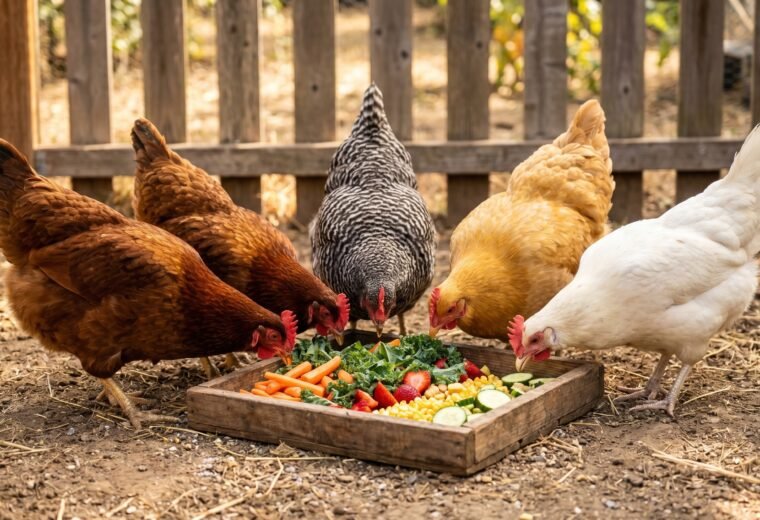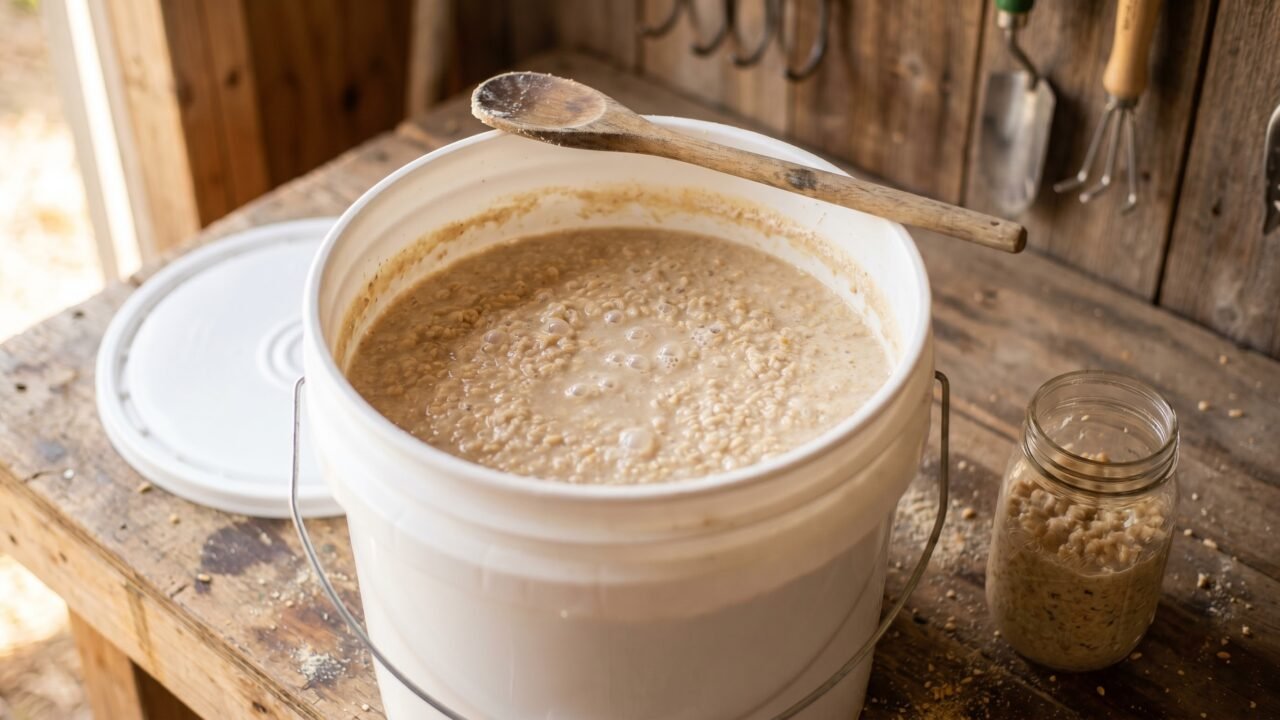
Backyard chicken forums are full of confident claims about fermented feed: it cures illness, doubles egg production, eliminates vet bills. Extension scientists are quieter and more precise. This guide sticks with what the peer-reviewed research actually shows, which is genuinely useful even without the hype, and walks through exactly how to do it safely at home. The HenAcre team compiled this from published studies rather than personal trials; where the evidence is strong we say so, and where it is limited we say that too.
Put dry layer pellets in a bucket, cover them with water by about an inch, stir once a day, and wait two to three days. That is genuinely all fermented chicken feed is. Lactic acid bacteria, already present on the grain and in the air, go to work without oxygen. They produce lactic and acetic acids, pulling the feed's pH down from roughly 6.5 to about 4.2, according to NC State University's Prestage Department of Poultry Science. That acidic environment is what drives most of what follows.
What fermentation actually does to the feed
The short answer: fermentation lowers feed pH, suppresses pathogens, breaks down anti-nutritional factors, and improves gut wall development - benefits backed by multiple controlled studies. The longer answer is that the gains are real but incremental, and some commonly repeated claims are not supported by the evidence.
Three things happen in those first two to three days that change the nutritional profile of the feed in meaningful ways.
First, the low pH suppresses pathogens. Research published in PMC shows that fermented liquid feed "significantly reduced the fecal shedding duration of Salmonella enterica subsp. enterica serovar Typhimurium by 53%" in broiler trials. Coliforms and Streptococcus counts in the ileum drop as well. The mechanism is partly direct acid inhibition and partly competitive exclusion, where beneficial bacteria simply crowd out the harmful ones.
Second, anti-nutritional factors are reduced. Grain-based feeds contain phytic acid, which locks up phosphorus in a form chickens cannot fully absorb. The lactic acid bacteria produce enzymes that break down phytate, freeing phosphorus for actual use. This is the same reason feed manufacturers pay for phytase supplementation, and fermentation accomplishes something similar at the kitchen-counter level.
Third, the gut wall benefits directly. A peer-reviewed broiler review found that fermented feed "significantly increased the VH in the mid-jejunum and mid-ileum by 23 and 16%, respectively," referring to villus height, the finger-like projections responsible for nutrient absorption. More surface area means better uptake across the board. Digestive enzyme activity is also elevated; trypsin activity in the duodenum roughly doubled in one controlled chicken study compared to birds on dry feed.
What fermentation does not do, at least not according to controlled trials, is dramatically boost shell thickness or dramatically increase egg numbers in already-healthy flocks. One laying-hen study found no statistically significant difference in "egg yolk color, eggshell thickness, eggshell strength, and egg shape index." Feed conversion ratio did improve significantly (the study confirmed a meaningful decrease, with approximate figures in the range of 2.27 to around 2.11, pending verification of exact values against the full paper), meaning hens produced the same egg mass on modestly less feed. Albumen quality, measured by Haugh unit, also improved significantly. Those are real benefits, just not the sweeping transformation some sources imply.
The core feed decisions you make, protein level, calcium supplementation, grit access for non-ranging birds, remain just as important with fermented feed as without it. Fermentation is an enhancement, not a replacement for a balanced ration.
How to ferment feed at home
Mix feed with dechlorinated water in a food-grade bucket, cover the grain by 1 to 2 inches, stir daily, and feed after 2 to 3 days at room temperature. That is the complete process; the detail below explains why each step matters and what to do when something goes wrong.
The steps below follow NC State's poultry extension guidance, which keeps the process low-risk when applied consistently.
- Fill a food-grade container about halfway. Leaving headroom matters because the feed swells and gases escape during fermentation.
- Pour filtered or dechlorinated water over the feed, covering it by 1 to 2 inches. Tap water with residual chlorine can slow or disrupt the bacterial culture, so either filter it or let it sit uncovered for 30 minutes first.
- Optionally add a starter culture: about 10% of a previous batch, or a splash of whey from strained yogurt. This speeds up the first cycle but is not required; wild lactic acid bacteria will colonize the batch on their own.
- Cover loosely with a cloth or a lid left ajar so fermentation gases can escape while debris stays out.
- Stir once or twice daily to keep the surface culture active and prevent any dry pockets from forming at the edges.
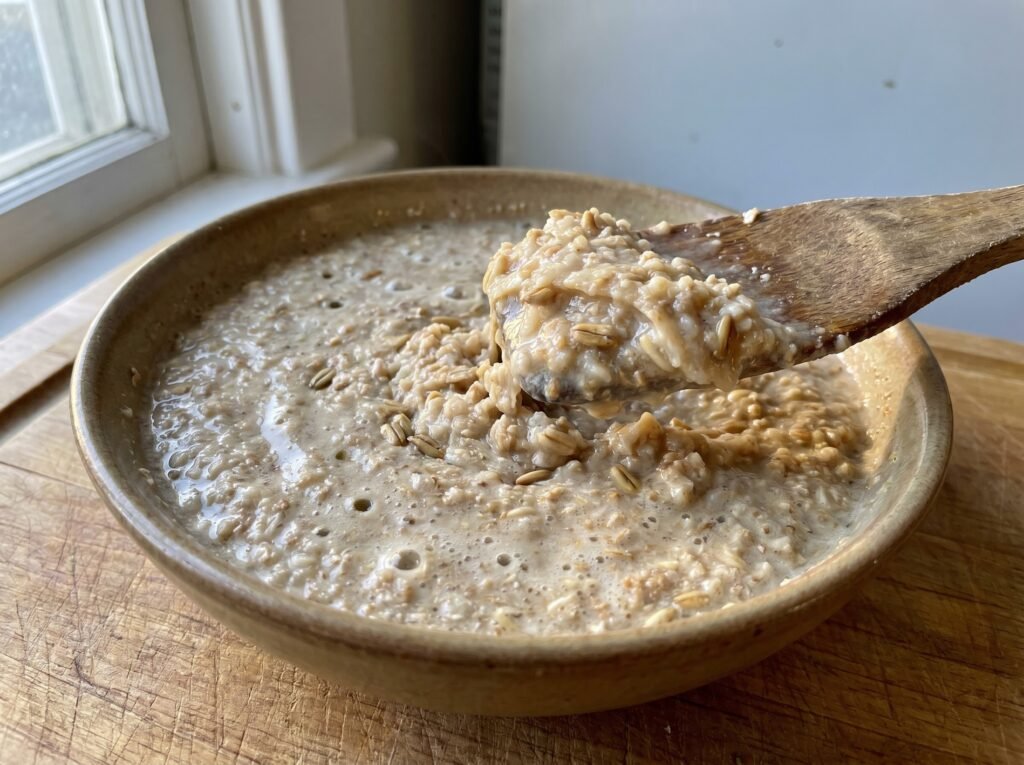
- After 2 to 3 days at 60 to 75°F, the feed should smell pleasantly sour, similar to sourdough or yogurt. It should not smell rotten, putrid, or like alcohol.
- Feed only what the flock will clean up that day. Remove any leftovers; do not let the wet feed sit in the coop.
For an ongoing supply, pull out what you need each day and add fresh feed plus a little water to top up the bucket. Running two or three containers on a staggered schedule means you always have a ready batch.
How much to prepare per bird
Plan on 3.5 to 4.5 ounces (100 to 130 grams) of dry-feed equivalent per laying hen per day; lighter breeds and average mixed flocks cluster toward the lower end, while large heavy breeds reach the upper end. Fermented feed is wetter, so you measure the dry portion first and ferment that amount - the birds' dry-matter intake stays roughly the same.
A laying hen eats roughly 3.5 to 4.5 ounces (about 100 to 130 grams) of dry feed per day, depending on breed size and energy output. Fermented feed is wetter and denser in volume, so the dry-matter equivalent is what you are actually targeting. A useful working rule: measure out the dry feed amount you would normally use, then ferment that portion. The birds eat less volume because the texture is compact and the feed has expanded with water, but their actual dry-matter intake stays roughly the same.
The table below translates that into daily batch prep for small to mid-size flocks.
| Flock size | Dry feed equivalent per day | Water to add (approx.) | Container size (min.) |
|---|---|---|---|
| 4 birds | 1 lb (450 g) | Enough to cover by 1-2 in | 1-gallon bucket |
| 8 birds | 2 lb (900 g) | Enough to cover by 1-2 in | 2-gallon bucket |
| 15 birds | 3.75 lb (1.7 kg) | Enough to cover by 1-2 in | 3-4-gallon bucket |
| 20 birds | 5 lb (2.3 kg) | Enough to cover by 1-2 in | 5-gallon bucket |
Fill the container only halfway full, even if the math says you could pack more in. The feed expands noticeably, and a bucket overflowing onto a coop floor is exactly the kind of mess that attracts mold and pests.
The complete feeding guide at what to feed chickens breaks down how protein needs shift from chick to layer stage, when to add oyster shell, and which treats are safe - useful background before you change anything about your ration.
The mold question - and why it is the most important part of this guide
If the pH drops below 4.5, fermentation suppresses mold. If it does not, the wet feed becomes an ideal growth medium for mycotoxin-producing molds that can sicken or kill birds. Discarding any batch that smells wrong or shows visible growth is the single non-negotiable rule in this guide.
Fermentation and mold are neighbors. If the lactic acid bacteria do their job and the pH drops below 4.5, mold is suppressed. If fermentation stalls, whether from too-cold temperatures, contaminated water, or a batch that simply did not culture well, the moist feed becomes an ideal growth medium for harmful molds that produce mycotoxins.
Mycotoxins are the real danger. They can be present even when no visible mold is obvious, and they are harmful to poultry at low concentrations. A peer-reviewed broiler review (PMC12248436) found that fermented feed carries "increased susceptibility to mold growth during storage" that "may pose additional health risks" - a caution worth taking seriously even when the ferment smells fine.
Throw away any batch that shows these signs - no exceptions:
- Visible fuzzy growth in any color (white, green, black, pink)
- A rotten or putrid smell rather than a clean sour one
- A slimy texture that was not there on day one
- An alcoholic or yeasty smell suggesting the ferment went the wrong direction
- Any unusual discoloration in the liquid
A batch that smells like sourdough bread or plain yogurt is doing exactly what it should. One that smells like something died is telling you something important. Trust your nose.
Temperature discipline matters more than most guides emphasize. At 60 to 75°F, the process takes 2 to 3 days. In a cold coop in January at 40°F, it can take four to five days and is more prone to spoilage. In summer heat above 80°F, fermentation runs fast and can overshoot into alcohol production within 24 hours. Adjust your schedule to ambient temperature, not the calendar.
Which feed types ferment well
Whole grains, mash, and plain starter ferment reliably. Pellets and crumbles work but turn to porridge. Avoid fermenting medicated chick starter - the process may alter the active ingredient, and manufacturers' guidance applies regardless of fermentation method.
Whole grains, cracked grains, rolled oats, and mash-style feeds ferment reliably. Pellets and crumbles work too, though they break down quickly into a porridge-like consistency, which some birds prefer and others ignore. Medicated chick starter should not be fermented because the fermentation process may degrade or alter the active ingredient (typically amprolium); follow manufacturer guidance on medicated feeds regardless of preparation method. Plain chick starter and grower feeds ferment without issue.
Layer feed is the most common choice and the one with the most supporting evidence for benefit. If your feed contains a balanced protein profile and calcium level for your flock's stage, fermentation adds the gut health layer on top without changing the nutritional target.
A week in the fermentation rotation
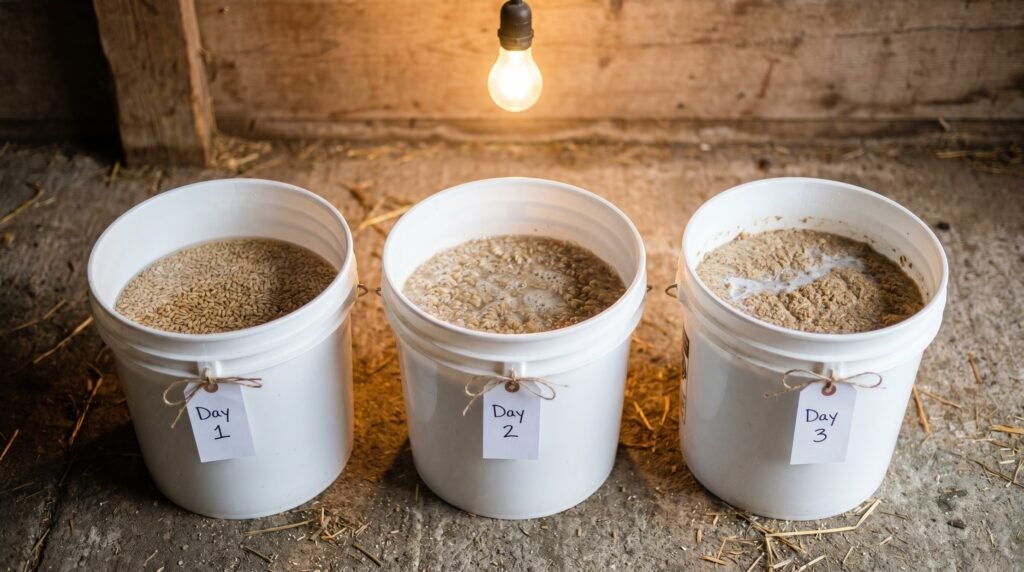
Use three staggered containers: start a new batch each day, stir the ones in progress, and feed out the oldest each morning. Once the cycle is running, you always have a ready batch and no container sits longer than three days.
Running three containers on a staggered schedule is the most practical approach for a flock of 10 to 20 birds. The table below maps the daily actions for each container once the rotation is established.
| Day | Container A | Container B | Container C | Action |
|---|---|---|---|---|
| 1 | Mix (fresh) | - | - | Start batch A |
| 2 | Stir (day 1) | Mix (fresh) | - | Start batch B; stir A |
| 3 | Ready - feed out | Stir (day 1) | Mix (fresh) | Feed A; start C; stir B |
| 4+ | Refill (back of rotation) | Ready - feed out | Stir (day 1) | Cycle continues daily |
This keeps a rolling supply without any batch sitting more than three days at room temperature. In warm weather, feed all of each batch the same day you open it rather than storing the rest in the bucket.
Is fermented feed worth the effort?
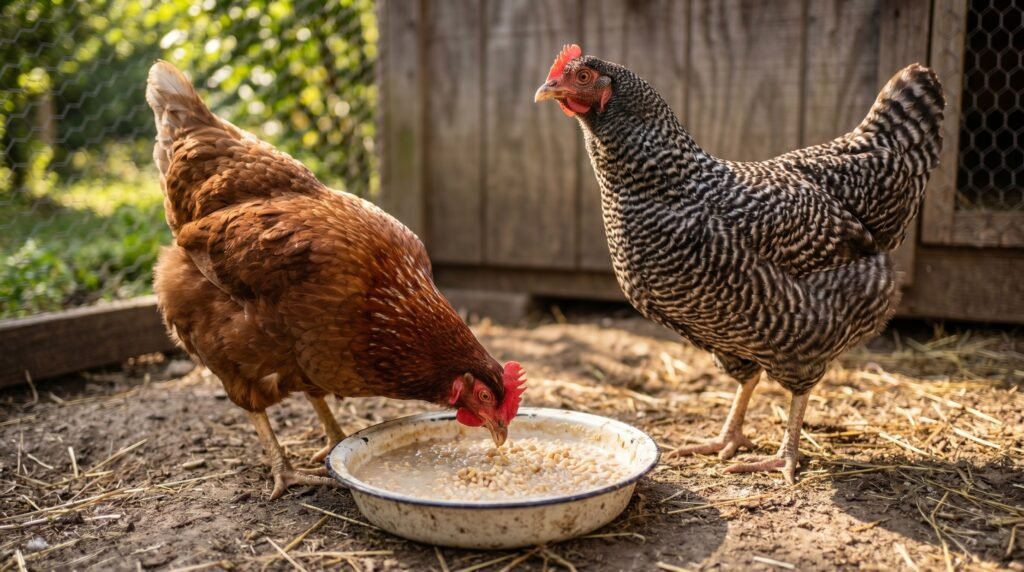
For most keepers with their basic husbandry in order: yes. The gut health and feed conversion gains are real and supported by multiple studies. The effort is low once the rotation is established. The main exception is broiler operations where moisture-related feed intake suppression at starter stage can offset early gains.
The research says yes, with conditions attached. The gut health benefits, particularly improved intestinal morphology and pathogen suppression, are supported by multiple controlled studies. Immune markers including IgA, IgG, and IgM rise measurably. Feed conversion ratio in laying hens improves modestly. Digestive enzyme activity increases.
What the research does not support is the claim that fermented feed cures illness, prevents disease definitively, or eliminates the need for good management elsewhere. A flock in a poorly ventilated coop with contaminated water is not going to be rescued by a fermented feed bucket. The gains from fermentation are real but incremental, layered on top of an already solid husbandry foundation. If your birds are struggling with something specific, that is a conversation for a poultry vet rather than a fermentation tweak.
A rough guide by situation: if you have a small backyard flock of 4 to 8 birds on layer feed and your husbandry basics are solid, fermented feed is worth the five minutes a day - the gut health and modest feed conversion benefits are real and the daily routine is simple. If you run 15 to 20 birds, the batch prep scales well with the three-container rotation above, and the feed savings are more noticeable at that volume. If you are raising broiler chicks in a starter phase, be more cautious - high moisture can suppress early feed intake at an age when growth rate matters most. In all cases, the daily stir is a small investment for a genuine and scientifically grounded benefit.