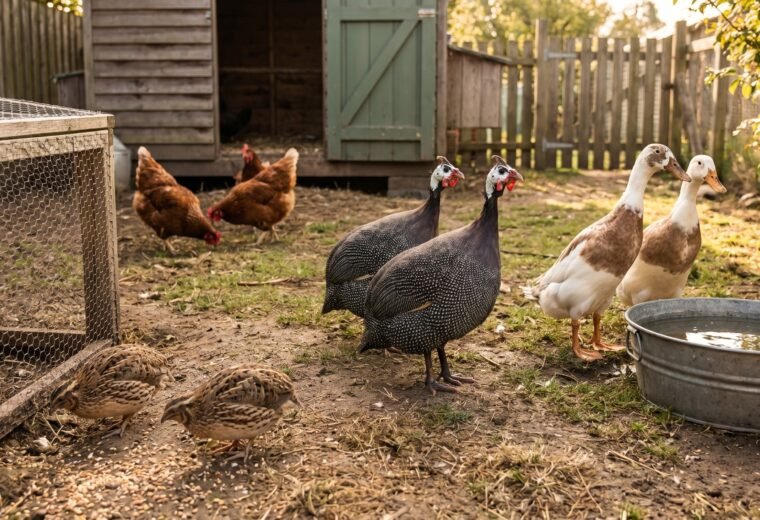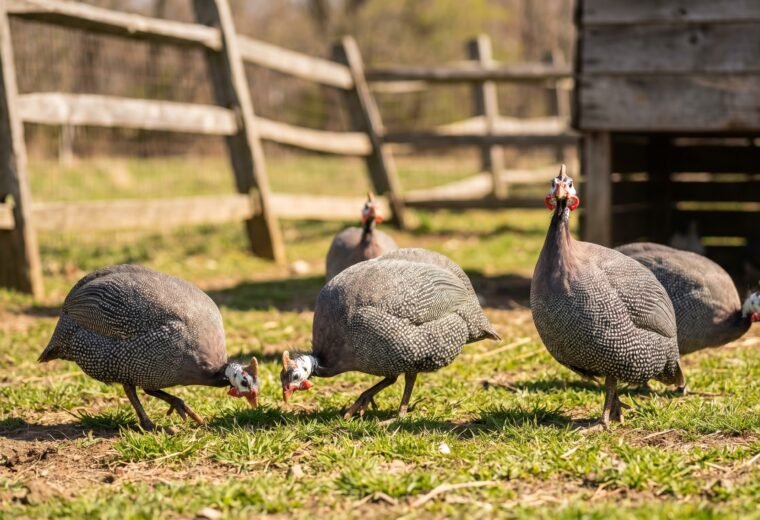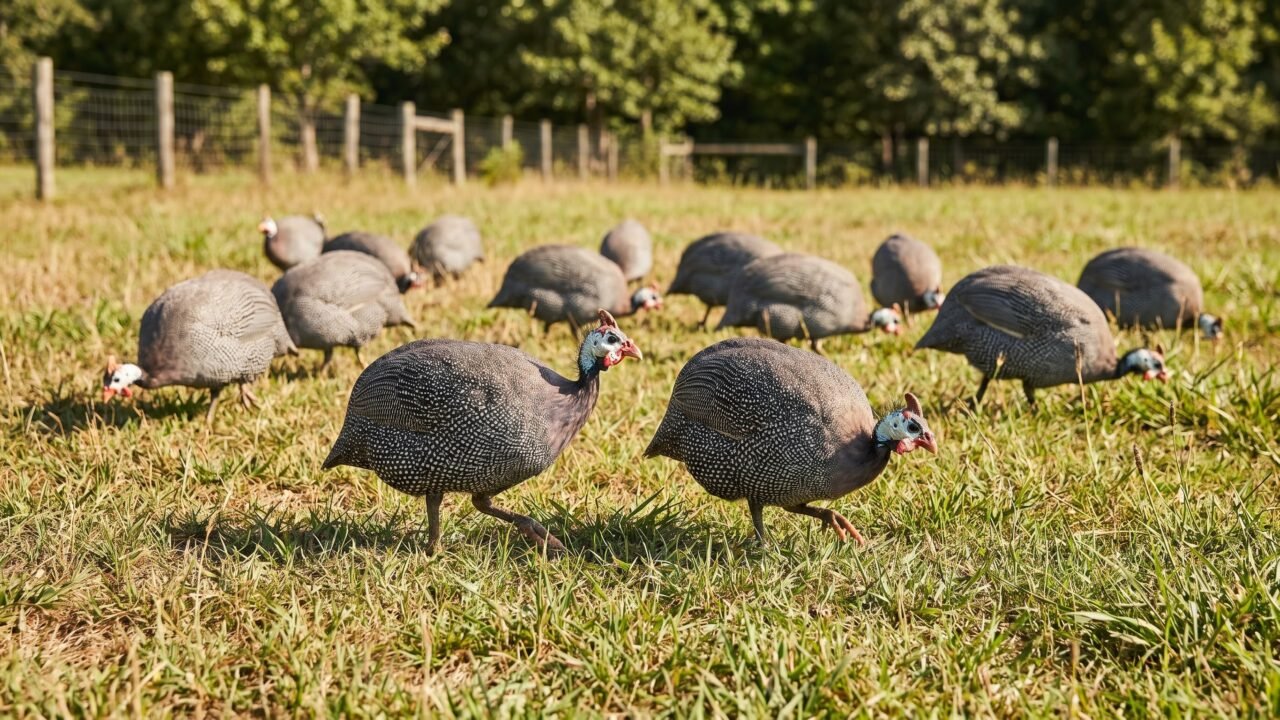
Somewhere between 12 and 20 helmeted guinea fowl can cover a few acres of pasture in a single afternoon, hoovering up grasshoppers, beetles, slugs, and anything else that moves. That's the draw. They patrol the ground constantly, they shriek when a hawk circles overhead, and they require almost no hand-holding once they're established. But they are not chickens, and treating them like chickens is how most people end up frustrated. This guide covers what guinea fowl actually need - housing, feed, the free-range reality, the noise, and how they mix with a chicken flock.
A quick note on the tick-control question: it comes up in nearly every conversation about guineas, so we address it directly in its own section below, including what recent research actually found.
Why people keep guinea fowl
Guineas earn their keep as insect managers. Free-ranging birds consume a wide variety of insects and arachnids - mosquitoes, ticks, beetles, and so on - along with weed seeds, slugs, worms, and caterpillars, per poultry extension guidance on small-flock species. When grasshopper pressure is high or Japanese beetles are hammering a garden, guinea fowl often make a visible dent. The University of Maine Cooperative Extension describes them as "quite effective in keeping your property and gardens clean of insect pests."
The alarm function is the other big draw. Guinea fowl are hard-wired to react to anything unusual. A shadow overhead, an unfamiliar person near the coop, a dog at the fence line - any of it triggers a loud warning call. For a mixed yard where chickens are otherwise oblivious to aerial threats, having guinea fowl around is genuinely useful. Extension research on small-flock species interaction notes that "people sometimes keep guineas with chickens to act as a sort of alarm system to warn the flock of predators in the air."
A third reason: the eggs. A well-managed guinea hen produces one egg per day through the laying season, which runs roughly March through October. A hen from a carefully managed flock may lay 100 or more eggs per year (eXtension). The eggs are smaller than chicken eggs, with a slightly richer yolk, and the shells are notably hard.
The tick-control question (what the research actually shows)
Guinea fowl and tick control are linked so often in homesteading circles that many people treat it as settled fact. The research is more complicated. Penn State Extension reviewed the North American studies and found that guinea fowl are not effective at controlling ticks or reducing the potential for acquiring tick-borne pathogens (Penn State Extension). A 2024 Journal of Medical Entomology study on lone star ticks found no significant reduction in tick populations on properties with free-ranging guineas, and it documented a genuinely uncomfortable finding: engorged lone star nymphs were recovered from guinea fowl roosting areas, with blood-meal analysis confirming the birds were serving as hosts. The same study notes that nymphal ticks "are smaller than adults, so there is a higher risk of a person being bitten without realizing it."
Earlier studies showed guineas consuming adult ticks on open lawn areas, and that is likely real. But adult ticks in fall and spring on open grass are a different exposure than nymphal ticks in summer in tall vegetation - which is when most people contract Lyme disease. So the picture is: guineas probably eat some adult ticks; they do not appear to reduce nymph populations; they may host some themselves. If tick management is the primary goal, landscape modifications, tick tubes, and perimeter acaricide applications have a stronger evidence base. If pest control more broadly - beetles, grasshoppers, slugs, weed seeds - is the goal, guineas deliver.
We flag this not to dismiss guinea fowl but because buying a flock of 15 birds specifically for Lyme prevention and then finding out it does not work is a real disappointment worth avoiding.
Housing: what guinea fowl actually need
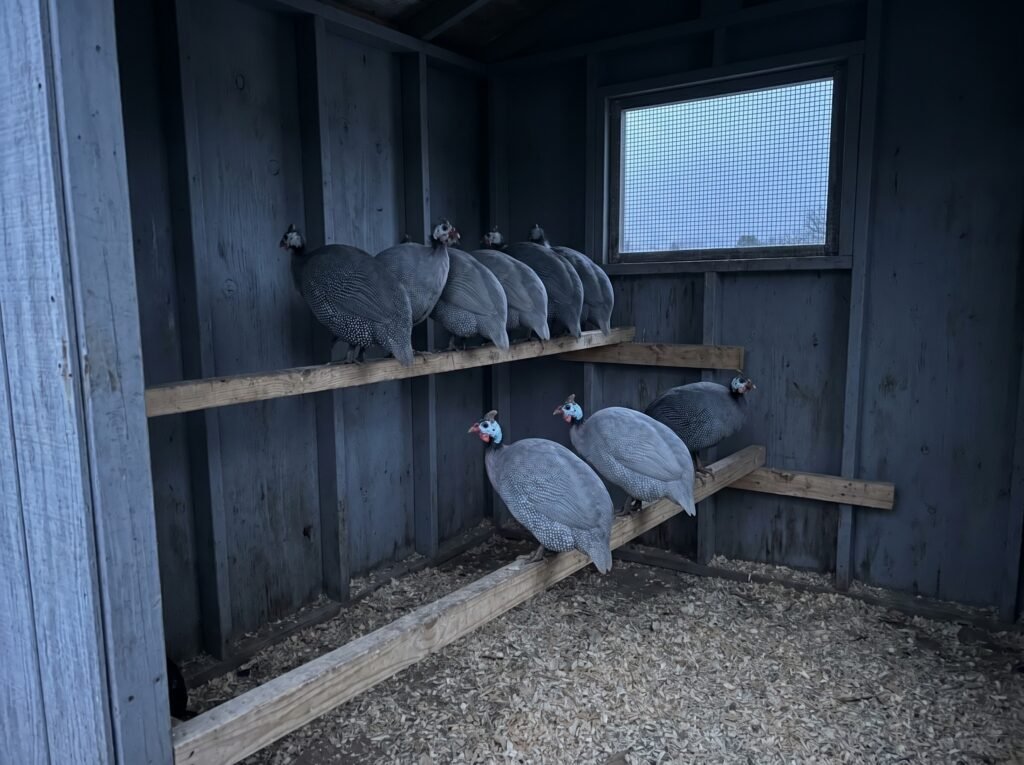
Guineas sleep in a coop but resist thinking of themselves as coop birds. They want perches - they roost high, and left to their own devices they will choose a tree branch at 20 feet over any man-made structure. The practical challenge is getting them to use your coop reliably at night rather than a branch 40 yards away where a great horned owl can pick them off.
For floor space, eXtension guidance for confined guinea fowl specifies 2 to 3 square feet per bird. That is a minimum for a coop the birds use only overnight; if you are confining them during the day for any period, aim for at least 4 square feet and add horizontal perches at multiple heights. Guineas are strong fliers - capable of covering 400 to 500 feet in a single flight - and they become stressed in tight quarters faster than chickens do.
The table below compares the main confinement scenarios to help match your setup to the right approach.
| Setup | Coop space per bird | Run space per bird | Key tradeoff |
|---|---|---|---|
| Free range by day, coop at night only | 2-3 sq ft minimum | Not needed (open range) | Best for bird welfare; loss risk from predators and road traffic |
| Daytime run, coop at night | 3-4 sq ft | 10+ sq ft | More control; needs high-walled or covered run (they will fly out) |
| Full confinement (meat/egg production) | 4-5 sq ft | 15-20 sq ft | Highest management intensity; birds more stressed without enrichment |
Covered runs matter more for guineas than for most other poultry. They can clear a standard 4-foot chicken fence without much effort. A fully covered run at 6 to 8 feet tall is the only reliable confinement option short of clipping flight feathers - and even that is a temporary fix on a bird that re-feathers each molt.
For bedding, guinea fowl do fine on the same materials as chickens - pine shavings, chopped straw - as long as it stays dry. Wet litter is harder on them than on chickens because their feet are less well-adapted to damp conditions.
Perches are non-negotiable. Provide 8-10 inches of roosting bar per bird, placed higher than the nest boxes, and understand that guineas often prefer the highest available perch. A flat 2x4 wide-side-up works well.
Feed: from keets to adults
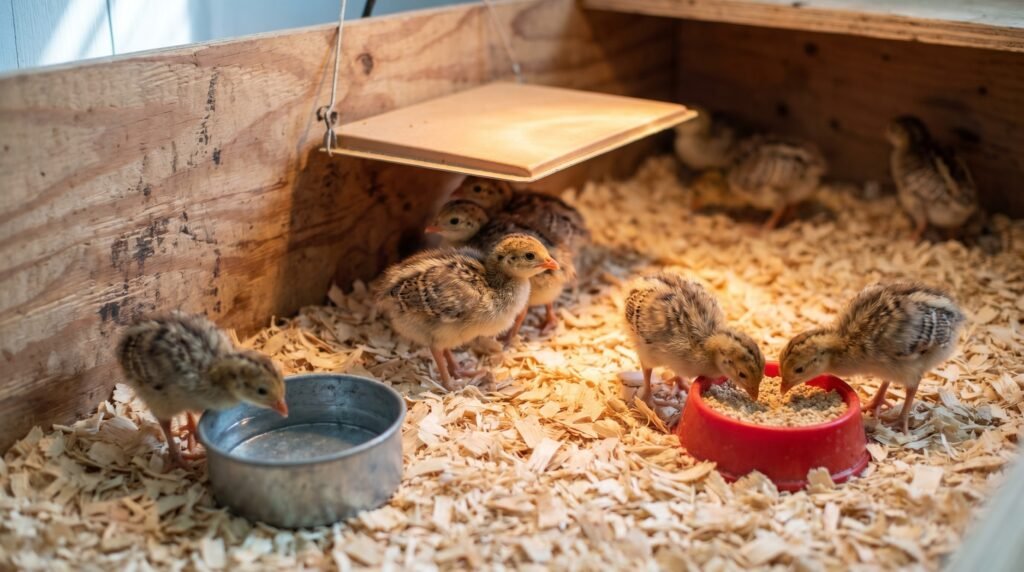
Keets are fragile in a specific way. The first two weeks are the most critical, and the two biggest killers are chilling and dampness. A brooder temperature of 95F in the first week, reduced by 5F per week as they feather out, is the standard starting point. Keets feather more slowly than chicks, so expect to keep supplemental heat going for at least six to eight weeks until they are fully covered.
On feed, keets need more protein than chicken chicks. The eXtension protocol:
- Weeks 1-4: turkey or game bird starter at 24-26% protein
- Weeks 5-8: grower at 18-20% protein
- After week 8: 16% layer mash or a standard layer feed
Feed form matters. Mash or crumbles work well; pellets are less suitable for keets. Because guinea fowl crops and beaks differ slightly from chickens', smaller particles reduce waste and competition at the feeder.
Adult guineas that free range through warm months largely feed themselves. Their natural diet - insects, arachnids, weed seeds, slugs, and tender vegetation - covers most of their nutritional needs when forage is available. When you do offer supplemental scratch or grain, wheat, sorghum, and millet are readily accepted. Whole corn kernels are largely ignored. If pest control is the reason you keep guineas, restricting supplemental feed during peak foraging hours pushes them to hunt harder for insects rather than waiting for scratch.
Through winter when forage is thin, a complete layer feed keeps condition up. Grit and oyster shell should be available free-choice, just as with chickens.
Free-range tendency: what you are actually signing up for
Guinea fowl are semi-wild birds. They were domesticated relatively recently compared to chickens, and that shows. Flocks naturally cover large territories, form pair bonds in breeding season, and the paired birds will wander off to nest in hidden spots - often far from the coop, and always on the ground where they are easy prey.
The free-range tendency is one of those things that is charming in theory and occasionally maddening in practice. Guineas do not stay in a lot. They follow the insects and the seeds, and a flock of 15 birds on an acre of mixed grass and woods will casually drift to the property line and beyond. Roads, neighbors' gardens, and neighboring flocks are all real issues. If your property is surrounded by busy road traffic, full free-ranging is genuinely dangerous for guineas.
Acclimation is the key tool. When you first bring guineas home - whether day-old keets or adults - keep them confined to the coop and run for two to six weeks before any free-range access. This period teaches them where home is. Releasing birds too quickly is the single most common reason flocks fail to return at dusk. After the initial confinement, release them in the late afternoon on the first few days, maybe 30 to 45 minutes before their natural roosting time, so they do not have time to wander far before dark pulls them back.
Training with a consistent treat helps enormously. Shake a container of millet or wheat every evening at the same time and call them in. Guineas learn the routine fast, and a flock that associates the sound of a bucket with a handful of grain will come running. The same techniques that work for ranging chickens safely apply directly to guineas.
Noise and temperament: the honest picture
Loud is an understatement for an alarmed guinea flock. The call - a repetitive, high-pitched screech that carries hundreds of yards - is hard to describe to someone who has not heard it. It is not a soft cluck or even the squawk of a startled chicken. It is closer to a car alarm that keeps going. On a large rural property with distant neighbors, this is an asset. On a suburban lot or a small parcel with houses nearby, guinea fowl are genuinely neighbor-unfriendly, and it is worth being honest about that before buying a dozen keets.
The female guinea hen has a distinctive two-syllable call that sounds like "buckwheat, buckwheat" or "put-rock, put-rock" - this is actually the reliable way to sex adults, since males only make a single-syllable cry. Both sexes produce the loud alarm screech when startled.
Beyond noise, guinea fowl are more skittish and independent than chickens. They are not birds that enjoy being handled, and most adults maintain a wariness of humans even if raised from keets. They are entertaining to watch and genuinely interesting to observe - their flock communication, their coordinated responses to threats, and their methodical ground-foraging are all compelling. But they are working birds more than companion birds, and expecting the calm temperament of a Buff Orpington will lead to disappointment.
They also hate being alone. A single guinea is an unhappy guinea, and a stressed guinea is a noisy guinea. Keep at least four together as a minimum, and understand that the flock dynamic is central to their wellbeing.
Guinea fowl with chickens: what works and what does not
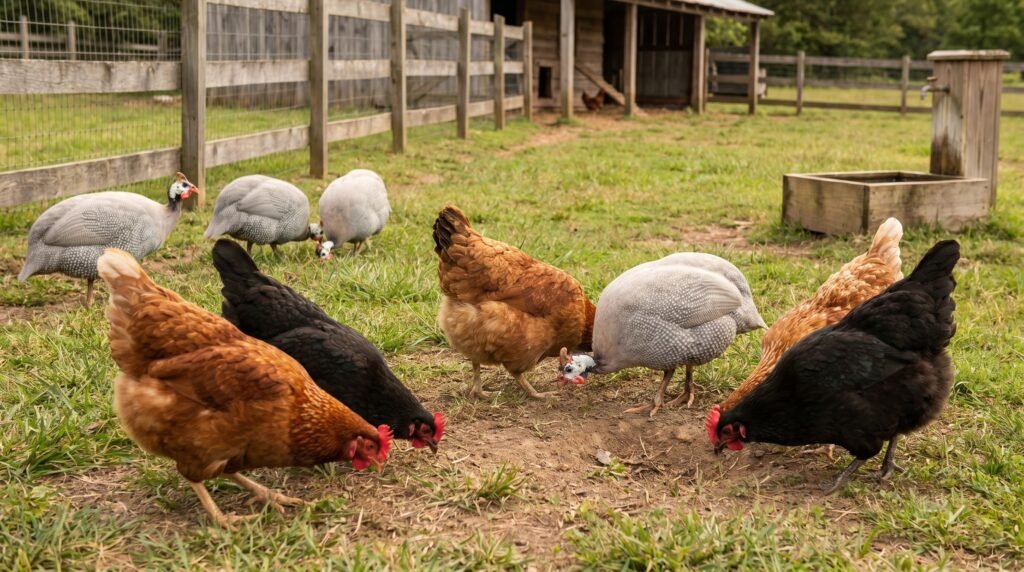
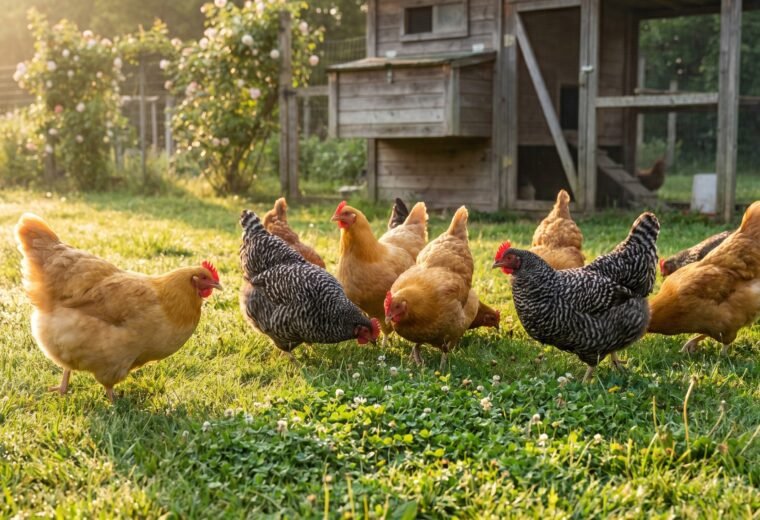
Mixed flocks of chickens and guinea fowl can absolutely work, with some specific conditions. Per eXtension research on species interaction: "Typically, chickens and guinea fowl do not interact much and get along well." The same source adds a caution - male guineas have been documented attacking roosters, particularly around food and water access, and confining guinea males and roosters in a small space full-time is asking for trouble.
The approach that works best in practice: raise keets and chicks together from the start. Birds that grow up alongside each other establish a shared pecking order and are far less likely to develop serious aggression as adults. Introducing adult guinea fowl to an established chicken flock, or vice versa, requires the same gradual see-but-not-touch period you would use for introducing new chickens - at least one week of visual access before direct contact, a process that applies equally to other backyard poultry species you may be mixing.
One real risk in shared housing is disease transmission. Histomoniasis (blackhead disease) is a concern in any mixed-species poultry setting - chickens are considered a reservoir host for Histomonas meleagridis in veterinary literature, and guinea fowl are susceptible. If you observe yellow or sulfur-colored droppings, lethargy, or head-drooping in birds from a mixed-species flock, consult a poultry vet promptly rather than attempting a home remedy. This is standard guidance for any mixed poultry operation, not a guinea-specific oddity. Any time you mix poultry species, observe closely for the first few weeks and have a quarantine plan ready.
Nesting is one area where the species separation matters. Guinea hens do not use standard chicken nest boxes reliably. They prefer ground-level, hidden spots, and in a mixed coop they will often ignore the boxes entirely and go lay elsewhere - or go broody somewhere on the property and not come home for weeks. If you want to collect guinea eggs consistently, keep nesting areas simple and low, and check corners and edges of the coop rather than the standard boxes. Whether the trade-offs of keeping guinea fowl alongside chickens are worth it depends heavily on your property and goals - the full species trade-off breakdown is on the guinea fowl pros and cons page.
Starting with keets vs. adult birds
Day-old keets are cheaper and, if you want tame, people-tolerant birds, raising from the start gives the best chance. The downside: keets are more fragile than chicks for the first two weeks. Dampness and temperature drops kill keets faster than almost anything else. If you are new to guinea fowl, buying point-of-lay or adult birds is a lower-risk entry point, though adults will be wilder and the acclimation period before free-ranging becomes more important.
If you incubate guinea eggs yourself, the incubation period is 26 to 28 days (compared to 21 days for chickens), and the eggs have notably thick shells that make candling difficult before day 10. Incubation temperature in a forced-air incubator follows the same general guidance as chicken eggs - around 99-100F - and turning should continue until lockdown at approximately day 23, three days before the earliest expected hatch.
Frequently asked questions
How many guinea fowl should a beginner start with?
Start with at least four to six birds. Guineas are social and flock-dependent; fewer than three leads to stress and constant noise. A starter group of six gives you a functional flock, room to lose a bird or two to predators without destabilizing the group, and enough variation to observe which birds are dominant without the chaos of a large flock.
Can guinea fowl survive winter outdoors?
Yes, in most temperate climates, provided the coop is dry and draft-free. Like chickens, guinea fowl tolerate cold better than wet and wind. A well-ventilated coop with dry bedding and perches above the floor is adequate in most US winters. In extreme cold below about 0F, a heated coop helps - particularly to protect wattles and the bare facial skin, which can get frostbitten in ways that a feathered chicken face generally does not.
Do guinea fowl destroy gardens?
Less than chickens, but not harmlessly. Guinea fowl are lighter on their feet and less likely to scratch up established plants the way chickens do. They focus on insects and seeds. Seedlings and soft new growth are at some risk, and a flock that gets into a vegetable garden will sample whatever looks interesting. Fencing young plants or the garden perimeter is the practical fix.
What is the best sex ratio for a guinea fowl flock?
One male per four to five females works for a typical free-ranging flock; in close confinement, eXtension guidance suggests one male per six to eight females to reduce fighting. The clearest signs that your ratio is off: hens with bare or thinning feathers on the back and neck (overworked by male attention), persistent chasing that prevents hens from reaching feed and water, and males fighting each other more than once or twice a day. If you are starting from a straight-run hatch and cannot sex birds reliably early, listen for the female "buckwheat" two-syllable call at around 8 to 12 weeks to identify hens. Buying sexed adults from a reputable breeder is the most reliable way to hit your target ratio without waiting through a grow-out period.