Quarter pound. That is the number most backyard keepers can carry in their heads: a standard laying hen eats roughly 0.25 lb (100-150 grams) of complete layer feed every day, according to Auburn University's Cooperative Extension. Scale that up and the arithmetic gets practical fast. A flock of 15 hens needs about 3.75 lb of feed daily, or just over 26 lb a week, meaning a 50-lb bag disappears in roughly 13 days. (The bag-duration table below starts at 4 hens and steps to 20; for flocks in between or above, the same 0.25-lb-per-bird math scales linearly.)
But that single number comes with real caveats. A bantam Silver Sebright eats far less than a Jersey Giant. A hen brooding through a January cold snap burns more energy than the same bird on a mild October morning. And the moment scratch grains or kitchen scraps creep past 10% of the diet, that "complete" layer feed stops being complete in any meaningful sense. The sections below break down each variable so you can dial in the right amount for your specific flock.
How much feed a laying hen actually needs each day
Auburn University Extension puts the range at 100-150 grams (roughly 0.25 lb) per bird per day for a mature laying hen. The Merck Veterinary Manual's nutritional tables for laying flocks show a similar band: 80-120 grams per bird depending on body size and production level. Both sources converge on 100-110 g as a reasonable midpoint for a mid-size dual-purpose breed like a Rhode Island Red or a Barred Rock.
Body size is the biggest single driver of that spread. Light Mediterranean breeds (Leghorns, Minorcas) sit toward the lower end. Heavy dual-purpose and exhibition breeds push toward the upper end. True bantams run roughly half the consumption of their standard counterparts - a good rule of thumb when you have a mixed flock.
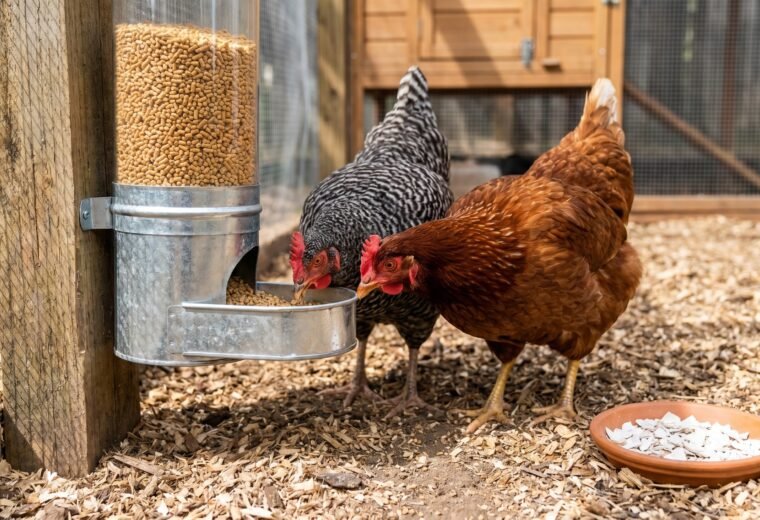
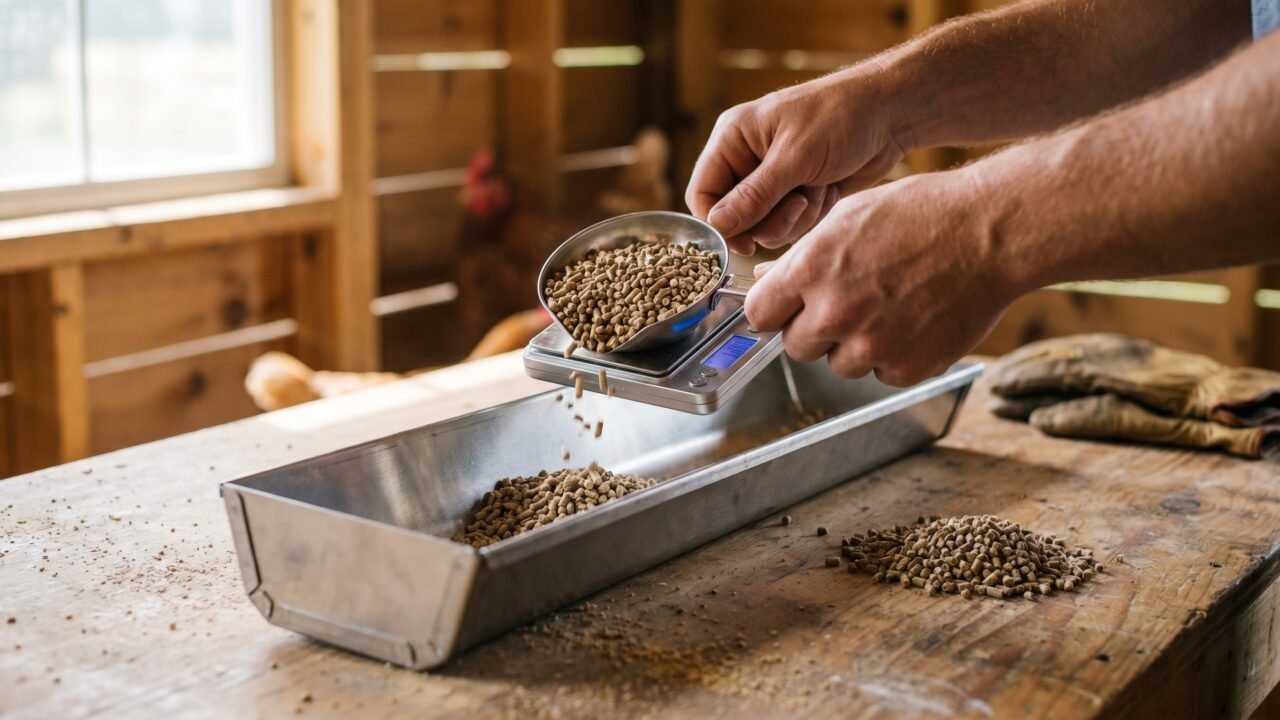
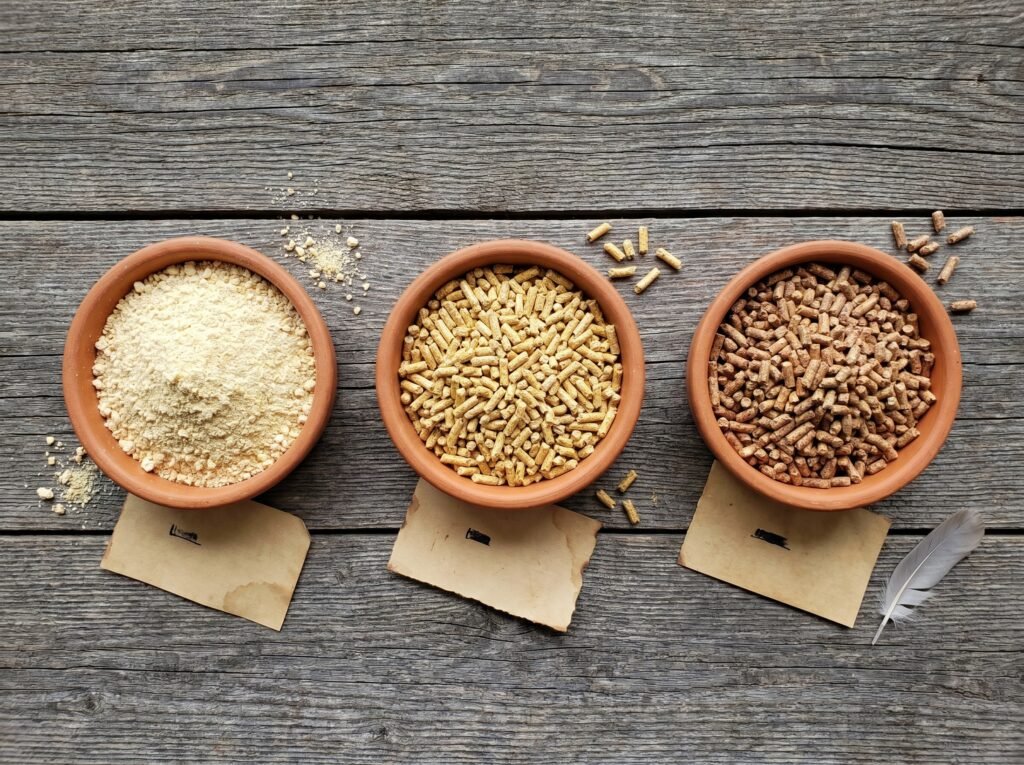
In volume terms, 0.25 lb works out to about half a cup of pelleted or crumbled layer feed. Mash is lighter by volume, so the same weight fills a bit more of the feeder trough. Always go by weight when you want precision; cups are a rough field guide, nothing more.
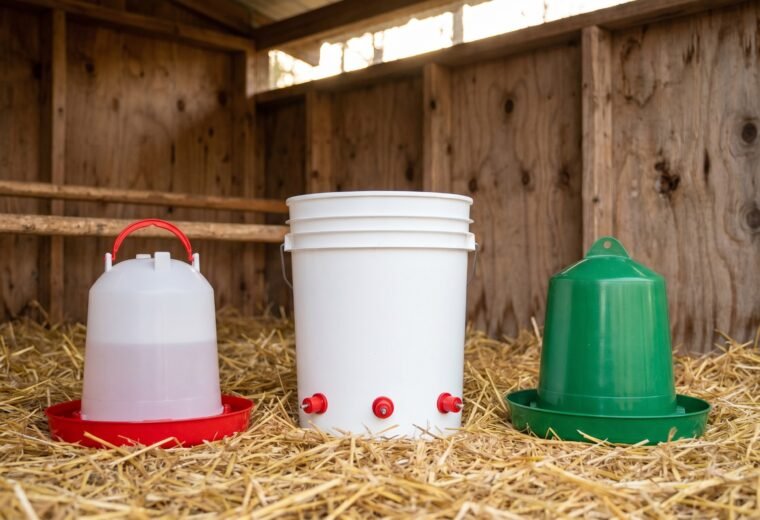
Water follows feed intake closely. Auburn Extension notes that "under normal circumstances, chickens consume twice as much water (by weight) as they do feed." For a 15-hen flock eating 3.75 lb of feed, that translates to roughly 7.5 lb (about one gallon) of water per day - conveniently close to Auburn's own benchmark that one gallon sustains approximately 16 laying hens. Keep that ratio in mind during summer heat, when water consumption rises faster than feed consumption falls.
Feed by life stage: starter, grower, and layer amounts
The daily 0.25 lb figure applies only to mature hens. Young birds eat differently, and feeding them the wrong ration at the wrong stage creates problems that show up weeks or months later.
Day-old chicks through 6 weeks: chick starter
Newly hatched chicks start small and grow explosively. eXtension's poultry program pegs total starter consumption at 20-29 lb per 10 chicks across the entire 0-6 week period - that is 2 to 2.9 lb per chick total (just under 3 lb at the high end), or about 0.05-0.07 lb per chick per day on average as they ramp up. Ask Extension's expert Q&A cites about 2 lb total for a Barred Rock chick on an 18-20% protein starter over those six weeks.
Starter feed must run at least 18-20% crude protein (Mississippi State Extension). The high protein supports bone, organ, and feather development during a period when chicks can double their weight in a matter of days. Medicated starter (with amprolium) is a common choice when chicks have not been vaccinated for coccidiosis; unmedicated works fine for vaccinated birds. Our guide to chick starter feed goes into the medicated-vs-unmedicated decision in detail.
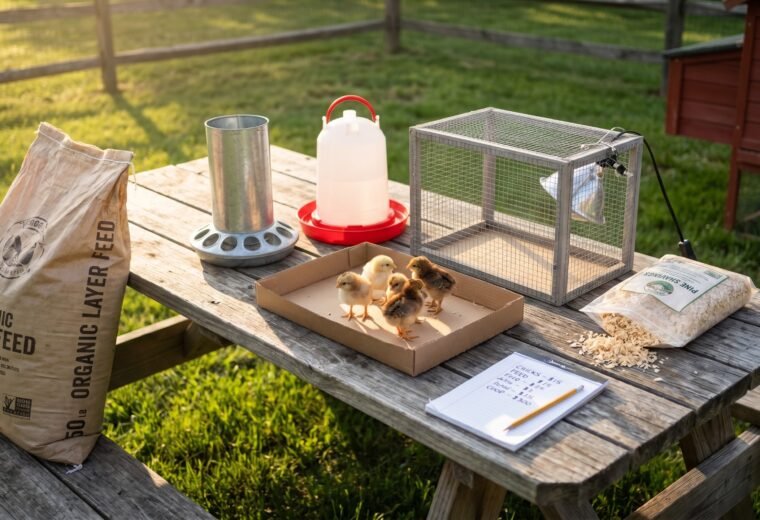
Offer starter on a free-choice basis and keep feeders freshly stocked. Chicks will self-regulate, and running out of feed for even a few hours at this age stresses young birds. Keep the brooder waterers topped up too - brooder heat drives faster water turnover than most beginners expect. For brooder setup and week-by-week temperature targets, see our raising chicks week by week guide.
Weeks 6 through 18-20: grower or developer feed
Once chicks are fully feathered (around 6 weeks) and move out of the brooder, they transition to a grower or developer ration. eXtension reports 120-130 lb per 10 pullets over the full 6-to-20-week growing period - roughly 12-13 lb per bird total, or an average of 0.12-0.13 lb per pullet per day, trending upward as they grow.
Grower feed drops protein to typically 15-16% (check the label on your chosen product, as formulations vary) and, critically, keeps calcium low. This point matters. Layer feed carries around 3% calcium (or higher when supplemented with oyster shell) to support eggshell production - right for a laying hen but too high for a pullet whose kidneys and bones are still developing. Feeding layer ration to young pullets before they start laying is one of the more common beginner mistakes, and it can damage kidney function before the first egg appears.
Grit becomes important during this stage if pullets are not on bare dirt or pasture. Whole grains and fibrous kitchen scraps require grit to grind properly in the gizzard. Oyster shell, by contrast, should stay off the menu until the bird is actively laying.
From first egg onward: layer feed
Switch to a layer ration when pullets begin laying, typically around 18-24 weeks of age. Layer feed provides roughly 16% crude protein plus the calcium that shells require. Mississippi State Extension's standard formulation specifies exactly 16% protein, 3% calcium, and 0.5% phosphorus - that 3% figure is the baseline layer ration; offering free-choice oyster shell alongside layer feed allows high-producing hens to draw additional calcium as needed without reformulating the base ration.
Mature hens return to that quarter-pound-per-day baseline and stay there through most of their productive life - adjusted for season, body size, and production rate (see below). Our complete layer feed guide covers the protein, calcium, and amino acid requirements in depth, including the case for oyster shell as a free-choice supplement alongside layer feed.
Free-choice feeding vs. measured meals: which works better
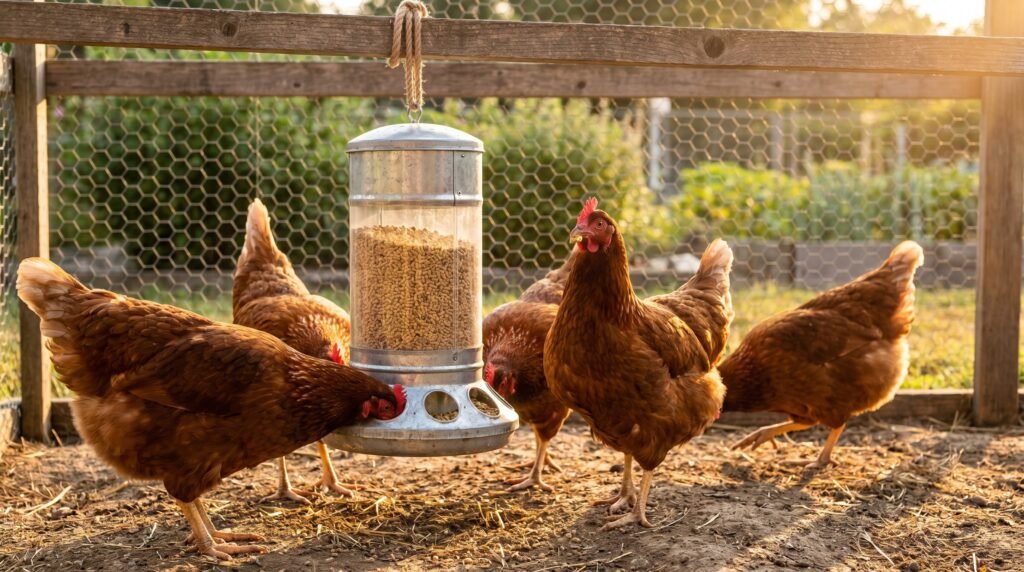
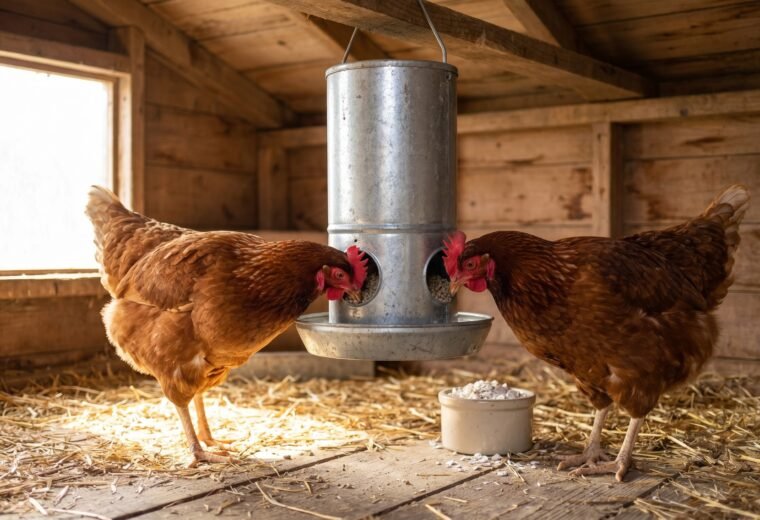
Mississippi State Extension is direct on this: "Full feeding (offering a constant supply of feed) is the best method for attaining maximum production." Restricting feed causes hens to stop laying. For most backyard flocks, a feeder that holds a day or two of supply and refills as birds eat is the standard setup.
Some keepers prefer twice-daily meal feeding - typically morning and late afternoon - because it gives a clear picture of how much each bird is actually consuming and forces better monitoring of flock health. Auburn Extension allows this approach with one practical constraint: offer enough feed for hens to clean up in 30 minutes to one hour per meal. Anything left over after that window suggests you are overfeeding; birds cleaning the feeder in under 10 minutes suggests too little.
Measured meal feeding also reduces the risk of stale feed sitting in the feeder during hot, humid weather, where wet mash can mold quickly. The tradeoff is time: someone has to be home morning and evening. For most two-job households, a hopper-style feeder on free choice is the practical default. Our chicken feeder guide covers capacity sizing and feeder design for both approaches.
One genuine concern with free-choice layer feed: calcium overconsumption is not a real risk because hens self-regulate calcium intake effectively. Energy overconsumption is more plausible with very energy-dense rations or unlimited scratch access - but with a standard 16% layer pellet, obesity from free-choice feeding alone is uncommon in active laying hens.
How long a bag of feed lasts: the flock math table
Auburn Extension's worked example is the clearest starting point: 10 hens eating 0.25 lb each consume 2.5 lb/day and empty a 50-lb bag in about 20 days. Scale from there using the table below.
| Flock size | Feed per day (lb) | 50-lb bag lasts | Bags per month (approx.) |
|---|---|---|---|
| 4 hens | 1.0 | ~50 days | 0.6 (1 bag covers ~7 weeks) |
| 8 hens | 2.0 | ~25 days | 1.2 |
| 12 hens | 3.0 | ~17 days | 1.8 |
| 20 hens | 5.0 | ~10 days | 3.0 |
These figures assume standard-size hens eating 0.25 lb/day and no significant free-ranging. If your birds forage for several hours daily on good pasture, real consumption can drop 10-20% below the table values during the growing season. Bantam-only flocks eat roughly half the figures shown. Mixed flocks of standards and bantams fall somewhere in between.
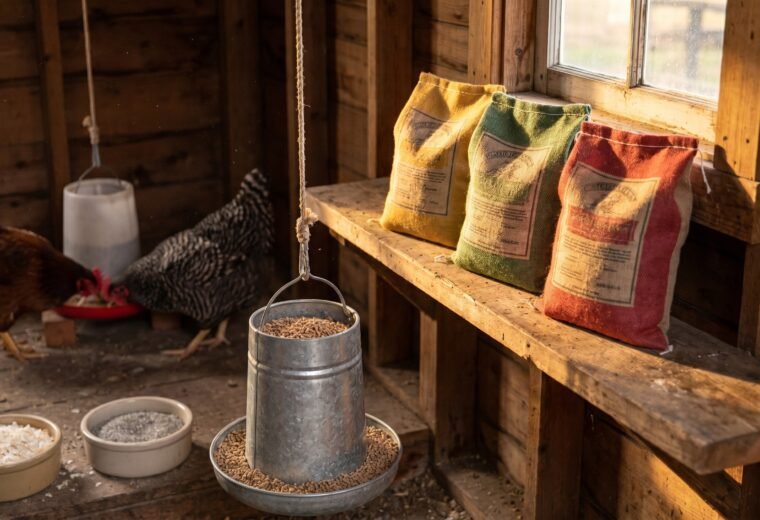
Bag freshness matters. eXtension recommends using feed within two months of the milling date and storing it in a cool, dry place. Vitamins - especially fat-soluble ones - degrade in heat and humidity. A bag that sat in a hot shed for three months is nutritionally compromised even if it looks fine. Buy in quantities your flock can consume in six to eight weeks and store in a sealed metal or hard-plastic bin to block rodents and moisture.
The cost side of this math connects directly to your total flock budget. For a complete picture of what backyard chickens actually cost month to month, including feed, bedding, and veterinary reserves, see our breakdown in how much it costs to raise chickens.
Adjusting for season and treats
Cold weather: they eat more
Chickens are homeotherms and burn extra energy in cold weather to maintain body temperature. eXtension's poultry program documents this directly: feed intake rises in winter as birds compensate for the energy cost of thermoregulation. The practical implication is that your flock may consume 10-15% more feed per day during a genuine cold snap than the table above predicts. Keep feeders fully stocked in freezing weather and check them more frequently than you would in summer.
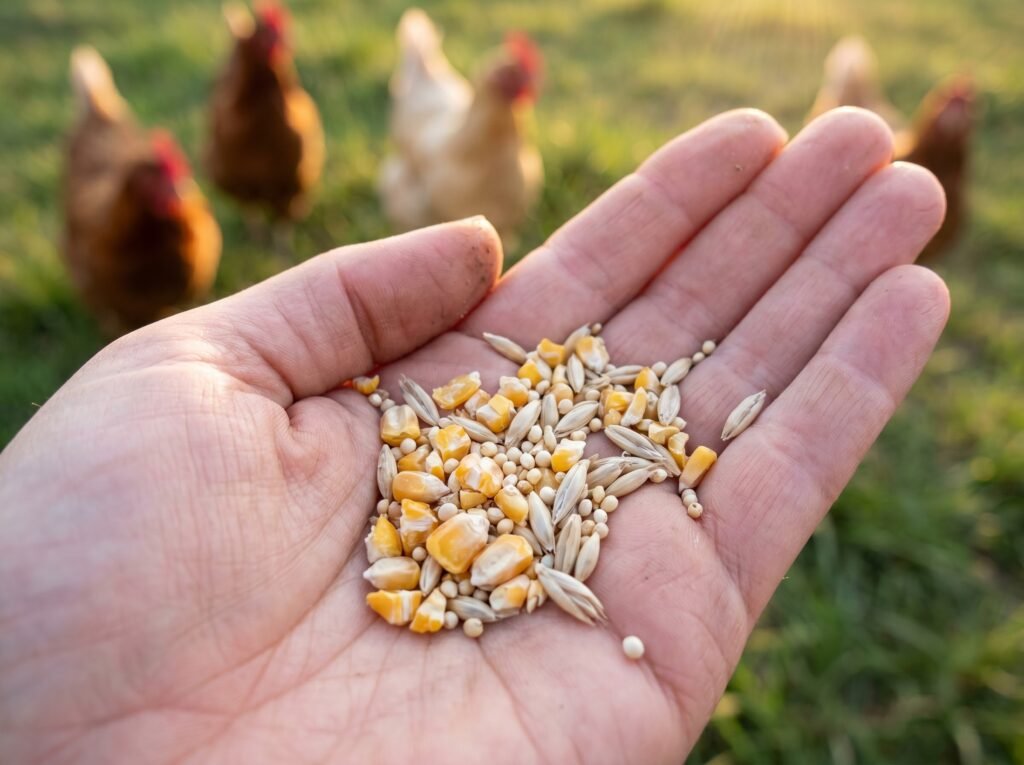
Whole grains (corn, oats) generate more metabolic heat during digestion than pellets and are a traditional winter supplement. Offer them in the late afternoon so hens go to roost with a slow-burning energy source. Keep the amount small - no more than what the flock can finish in 15-20 minutes, per eXtension's guidance - so scratch does not crowd out the complete layer ration.
Hot weather: they eat less, but water needs spike
In hot weather the reverse happens: feed intake drops as hens minimize heat production from digestion. This is normal and self-correcting. What demands active management is water. Birds that run low on water in heat reduce feed intake further and can go into heat stress within a few hours. Keep waterers in shade, refresh them at least twice daily in temperatures above 85°F, and consider adding a second waterer. Signs of heat stress - panting, wings spread, pale combs - warrant immediate shade and cool water; for birds that do not recover quickly, a call to a poultry vet is appropriate.
The 10% treat ceiling
A widely cited manufacturer guideline states the standard clearly: "90% complete layer feed and 10% chicken treats." When treats exceed that threshold, hens fill up on nutritionally incomplete foods and reduce their intake of the balanced ration - exactly the problem, because layer feed is formulated to hit precise amino acid, vitamin, and mineral targets in a 0.25-lb daily serving. Dilute it past 10% and those targets fall short.
In practice, 10% of a 0.25-lb daily ration is 0.025 lb (~11 grams) - about one tablespoon (or one heaped tablespoon) of scratch or kitchen scraps per hen per day. That is a smaller amount than many keepers picture: two tablespoons of scratch grains weigh closer to 20-25 grams, which would already be double the ceiling. One tablespoon is the honest measure. Scratch grains, fruit, and table scraps are fine in that window; avocado, raw or dried beans, chocolate, onion in quantity, and moldy food are off the list entirely regardless of volume. Our full reference on what to feed chickens covers both the safe list and the items to avoid.
A related rule from eXtension: always offer scratch in the afternoon, after hens have eaten their fill of complete feed for the day. Morning scratch competes with the morning feeding push when hens are hungriest.
The single biggest feeding mistake to avoid
Running out of water - not feed - is what sends laying hens off production fastest. Even a relatively short period without water can measurably reduce egg production, and extended deprivation significantly raises mortality risk. A hen can tolerate a skipped feeding far better than a dry waterer on a hot day.
Check waterers every day. In freezing weather, a heated waterer or twice-daily fresh-water swap prevents the silent production crash that comes from a bird who has been rationing herself because the water froze overnight. Our picks for chicken waterers include options for every season.