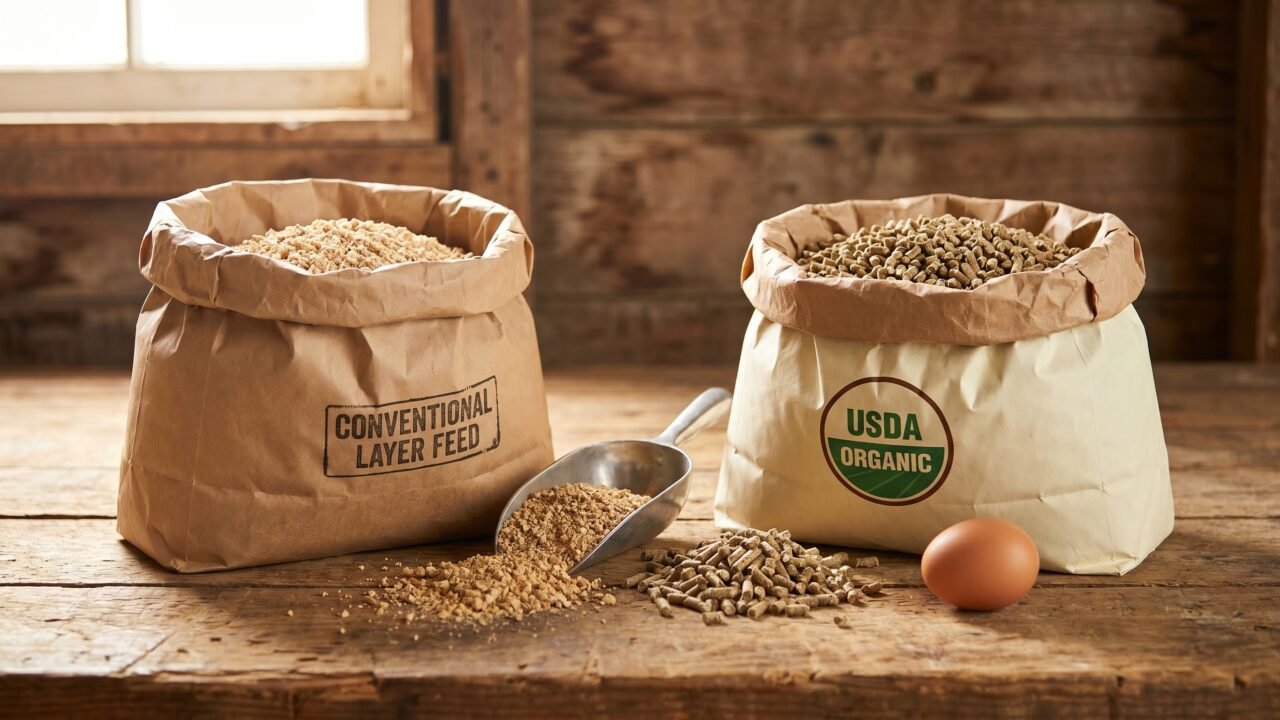
Spend a few minutes in the feed aisle and you will see bags labeled "organic," "non-GMO," "all-natural," and plain conventional side by side, often at wildly different prices. For a small flock of eight hens, the gap between conventional and certified organic layer feed can run $12-$20 extra per month, or $140-$240 over a year. Whether that premium is worth it depends on what the label actually guarantees, and what it does not.
Both feed types are formulated to the same nutritional targets: around 16% crude protein and 3.0-3.5% calcium for laying hens, per standards cited by Mississippi State University Extension and Penn State Extension. The real difference is in ingredient sourcing and what the growing process was prohibited from using, not the macronutrient numbers on the tag.
What "USDA organic" on a feed bag actually requires
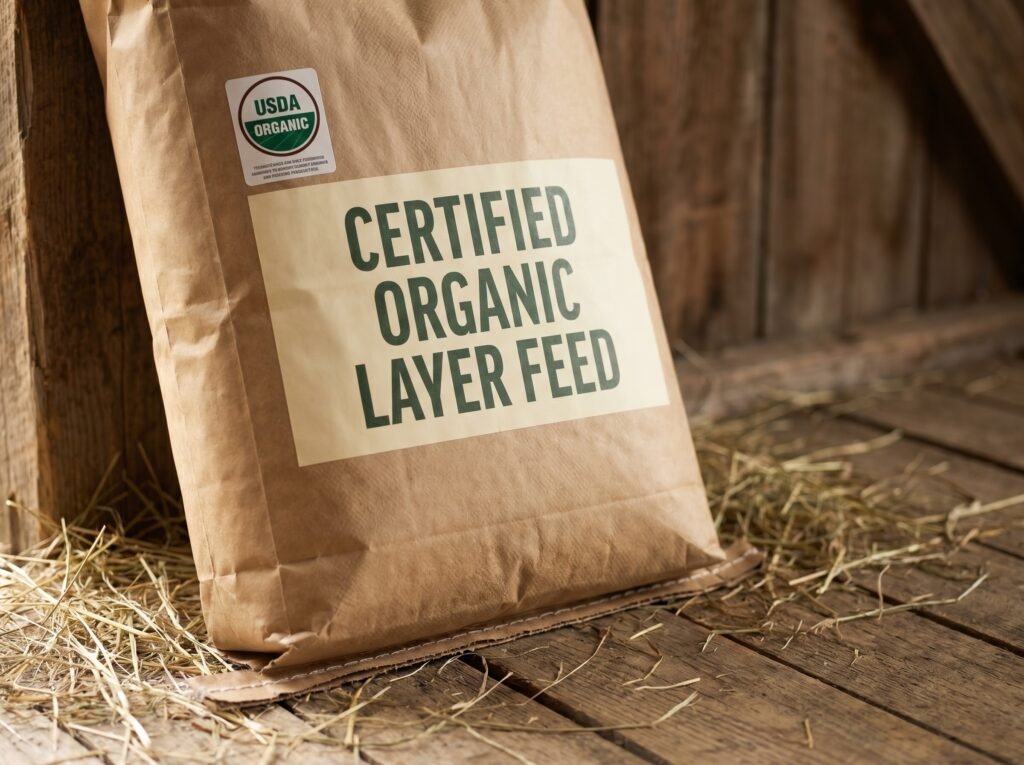
A bag labeled "organic" must contain at least 95% certified organic ingredients by weight; "100% organic" allows nothing else. Every grain must come from a farm certified free of synthetic pesticides and fertilizers for at least three consecutive years, and the NOP prohibits GMOs, growth hormones, antibiotics, and slaughter byproducts from the entire formula.
The USDA National Organic Program (NOP) sets three distinct labeling tiers for multi-ingredient products. A bag stamped "100% organic" must contain nothing but certified organic agricultural ingredients. A bag labeled simply "organic" must be at least 95% certified organic by weight, with the remaining 5% drawn only from the NOP National List of approved non-organic substances. "Made with organic" means 70% or more organic content and cannot display the USDA seal at all.
For a bag of layer pellets to carry the USDA seal, every grain in it, including the corn and soybean meal that form most of the formula, must come from a farm that has been free of synthetic pesticides and fertilizers for at least three consecutive years and that holds current certification from a USDA-accredited agency. The NOP also prohibits genetically engineered ingredients (referred to in the regulations as "excluded methods"), growth hormones, antibiotics, synthetic colorings, and slaughter byproducts from all certified organic feed.
One notable exception is the amino acid methionine. Corn-and-soy rations naturally fall short of the methionine laying hens need, so the NOP National List permits a small amount of synthetic DL-methionine: up to 2 lb per ton of feed for laying and broiler chickens, per eOrganic's guidance on organic poultry diets. Reputable organic layer feeds account for this. Where a formula comes up short, hens show reduced egg production and can develop feather-pecking behavior - methionine deficiency is the most common silent performance drain in poorly formulated organic rations.
Non-GMO is not the same as organic
Non-GMO certification covers seed genetics only. The grower can still apply synthetic herbicides, pesticides, and fertilizers on a non-GMO crop with no restriction. Organic certification addresses all of those inputs on top of the GMO prohibition - making organic the broader standard. A non-GMO label is not a substitute for organic if avoiding synthetic field inputs matters to you.
This is the distinction that trips up more buyers than any other. Non-GMO certification only means the seed genetics were unmodified. The grower can still apply synthetic herbicides, pesticides, and fertilizers freely. Organic certification covers all of those inputs, on top of the GMO restriction. As Kalmbach Feeds, a feed manufacturer, puts it plainly: "Organic is non-GMO but non-GMO is not organic."
A bag labeled "all-natural" carries no federal definition for feed and means essentially nothing enforceable about growing practices, GMO status, or pesticide use. When you see it on a feed bag, look past it to the ingredient list and any third-party certification logos.
The cost premium, in real numbers
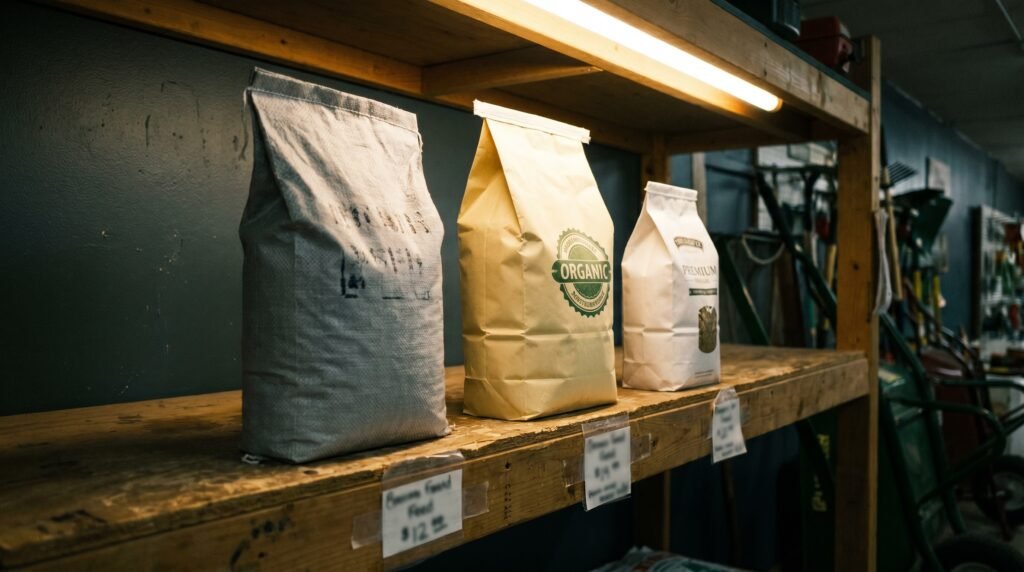
Certified organic layer feed costs 30-50% more per pound than conventional at retail. For a flock of eight hens, that gap works out to roughly $16-$19 per month, or $192-$228 per year. Corn-and-soy-free organic costs even more - up to 85% above conventional prices for the same flock size.
An adult laying hen eats roughly 0.30 lb of feed per day, or about 8 lb per month. For a flock of eight hens, that is 64 lb per month. Here is what that translates to across feed types, using retail price ranges from Mile Four, an organic feed manufacturer that publishes detailed cost breakdowns:
| Feed type | Price per lb (retail) | Monthly cost, 8 hens | Annual cost, 8 hens |
|---|---|---|---|
| Conventional layer | $0.55-$0.70 | $35-$45 | $420-$540 |
| Certified organic layer | $0.80-$1.00 | $51-$64 | $612-$768 |
| Organic, corn and soy-free | $1.00-$1.30 | $64-$83 | $768-$1,000 |
That is a 30-50% premium for standard organic, and up to 85% more for corn-and-soy-free organic. The extra cost reflects three things: the three-year certification burden on grain farms, smaller-batch production runs compared to commodity feed mills, and ingredient substitution when organic corn or soy is in short supply.
Penn State Extension notes that certified organic feeds are "sometimes difficult to find and more costly," which is an understatement for rural areas where the nearest organic option may be mail-order only. Shipping a 40 lb bag adds another $15-$25 in some regions.
Do organic-fed hens lay differently?
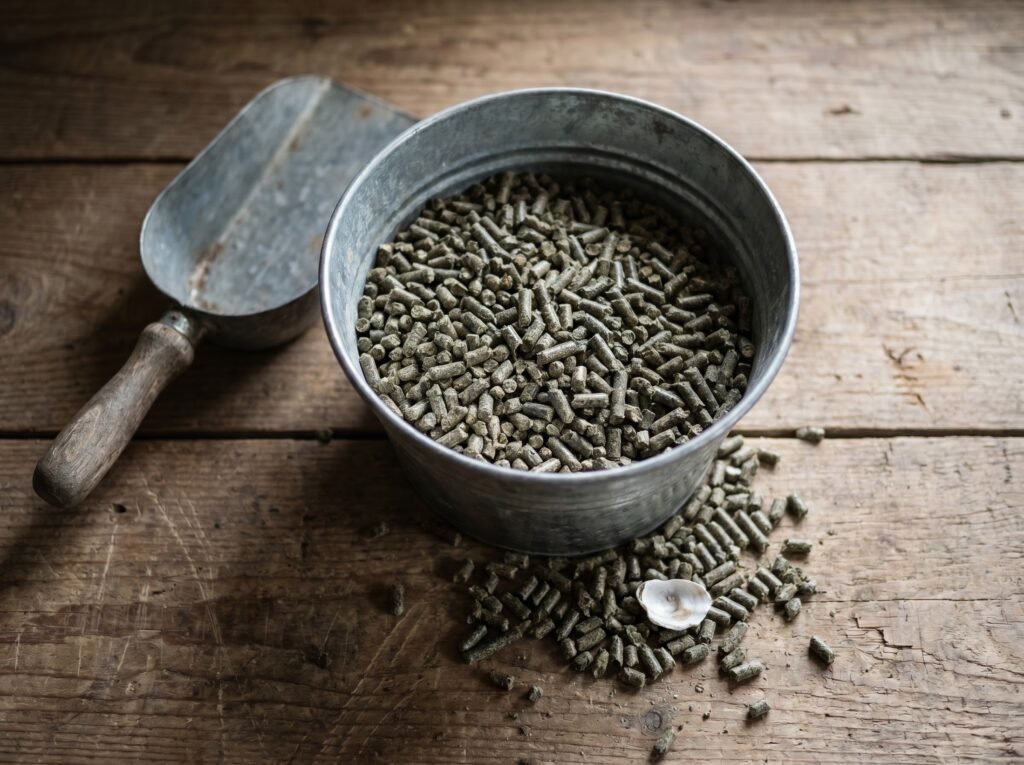
In terms of egg output and shell quality, no - not meaningfully, when both rations are properly formulated. Peer-reviewed research found comparable metabolizable energy between organic and conventional diets. Where organic feed can underperform is in substandard formulations that skip the permitted synthetic methionine, which depresses lay rate and feather quality.
A peer-reviewed study published in the British Journal of Nutrition compared chickens fed organically and conventionally produced diets and found the feeds were "comparable with respect to metabolisable energy," though the conventional ration had about 10% higher protein content. Birds on organic feed showed "enhanced immune reactivity" and a slightly stronger recovery of growth rate after an immune challenge, while birds on conventional feed had higher overall weight gain through the life span.
What the data does not show is a dramatic difference in egg output or shell quality when both feeds are properly formulated. A complete, well-balanced conventional layer ration and a complete, well-balanced organic layer ration will both produce healthy eggs at comparable rates, provided the organic formula meets the methionine requirement. Where organic feed sometimes falls short is in substandard formulations from small mills that rely only on natural protein sources and do not use the permitted synthetic methionine - that is when you start seeing reduced lay rates and feather quality issues.
It is worth knowing that pasture access, genetics, and season affect egg yolk color, omega-3 content, and shell thickness far more than the organic-vs-conventional distinction in the feed bag. If richer yolks matter to you, the more meaningful variables are access to fresh greens and sunlight. Our layer feed guide covers how diet composition shapes egg quality more broadly.
A decision table: which feed suits which situation
If you sell or label eggs as "organic," certified organic feed is not optional - it is a USDA requirement. For a personal flock with pasture access, a well-formulated conventional ration covers what foraging does not. Confined birds with no pasture access benefit most from the guarantee organic certification provides on synthetic inputs.
The choice is rarely about nutrition quality alone. Here is how the decision breaks down across common keeper situations:
| Your situation | Feed to consider | Why |
|---|---|---|
| Selling eggs as "organic" at a farmers market or CSA | Certified organic only | USDA rules require certified organic feed for eggs sold as organic; no exceptions |
| Personal flock, tight budget, birds free-range on pasture part of the day | Quality conventional | Pasture time adds natural inputs; a well-formulated conventional ration covers the rest |
| Personal flock, confined or small run, want to avoid pesticide residues in feed | Certified organic | No pasture foraging means all inputs come from the bag; organic certification is the clearest guarantee |
| Known soy sensitivity in the flock or keeper preference | Organic corn-and-soy-free | Soy-free rations exist in both organic and conventional; organic version costs more but removes both concerns |
| Eggs for personal use, birds on dirt/partial pasture, no sales | Either; budget decides | Both produce healthy eggs when properly formulated; prioritize a complete ration over the label |
Reading the bag: five things to check before you buy
Any layer feed, organic or conventional, should show at least 16% crude protein, 3.0-3.5% calcium, and a methionine entry in the guaranteed analysis. For an organic bag, verify the USDA Organic seal and the name of the certifying agency - both must appear on the label under NOP rules. Without the certifying agent name, the organic claim is unverified.
Regardless of organic status, a layer feed should meet these minimums. Our overview of layer feed goes into full detail, but these are the numbers that matter at the shelf:
- Crude protein: at least 16% for laying hens.
- Calcium: 3.0-3.5% minimum; this is what builds eggshells.
- Methionine listed in the guaranteed analysis or as a named ingredient, especially on organic bags.
- Freshness: Most manufacturers recommend using feed within 60-90 days of the milling date; mold in stale feed is dangerous and old feed loses vitamin potency.
- Complete feed designation: "complete" means no supplemental grains are needed. Adding scratch or whole grains to a complete ration dilutes its balance and can tip calcium and protein ratios in the wrong direction.
For an organic bag specifically, look for the USDA Organic seal plus the name of the certifying agency, which is required to appear on the label. A bag that says "organic ingredients" or "grown organically" without a certifying agent name has not been verified under the NOP.
Once you settle on a formula, chicken feed storage matters as much as the bag itself. Cool, dry, and rodent-proof conditions are non-negotiable. Getting the feeder design right keeps feed fresh and reduces waste; our best chicken feeders roundup covers the options that hold up in wet climates.