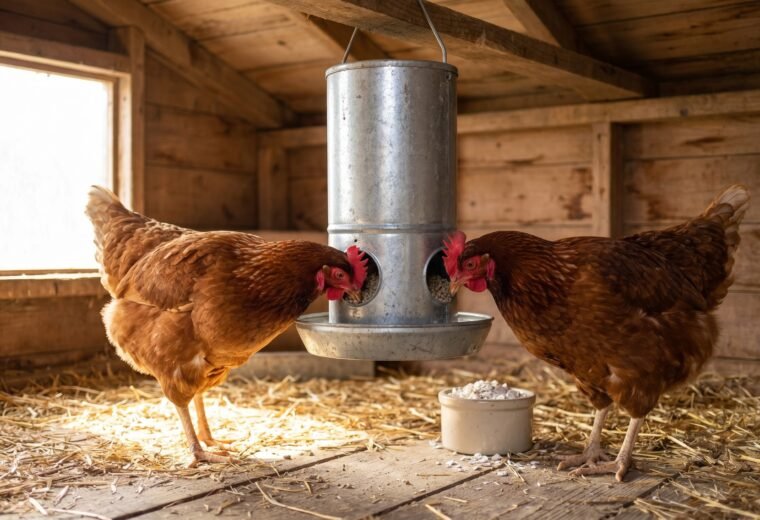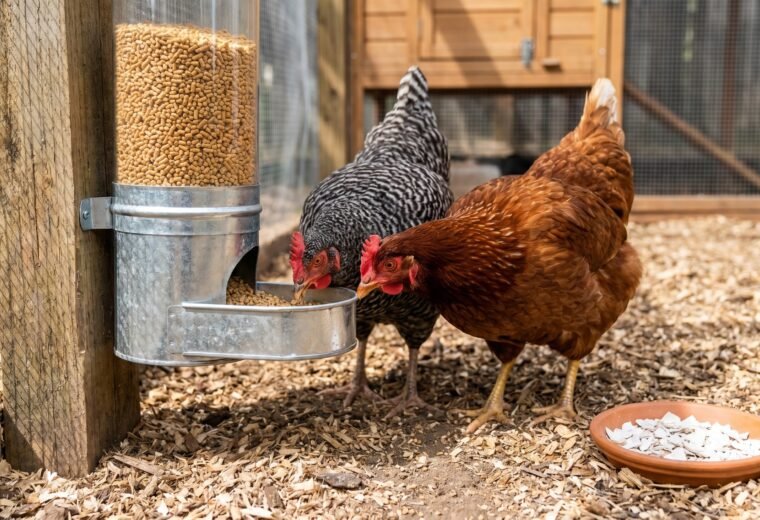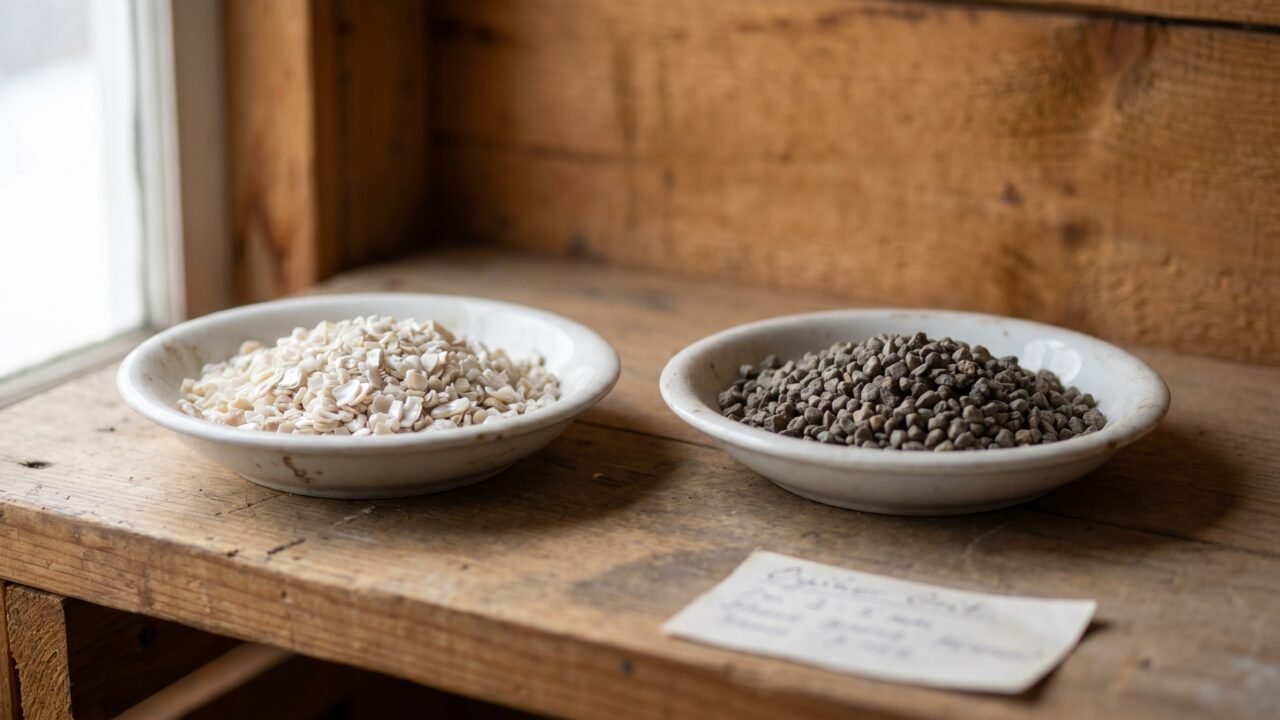
Your laying hen keeps a bag of ground oyster shell on one side of her feeder and a little tray of granite grit on the other. Confuse the two and you either leave her calcium-starved or give her a grinding stone that dissolves before it does any work. These are two entirely separate supplements serving two entirely different systems in the same bird.
Oyster shell is a calcium source - it dissolves in the digestive tract and the calcium gets absorbed into the bloodstream, where it funds eggshell production. Grit is an insoluble grinding medium that stays in the gizzard and acts like a set of teeth. One is food. The other is hardware. Neither can substitute for the other, and the confusion between them is one of the most common feeding errors in backyard flocks.
What each one actually does
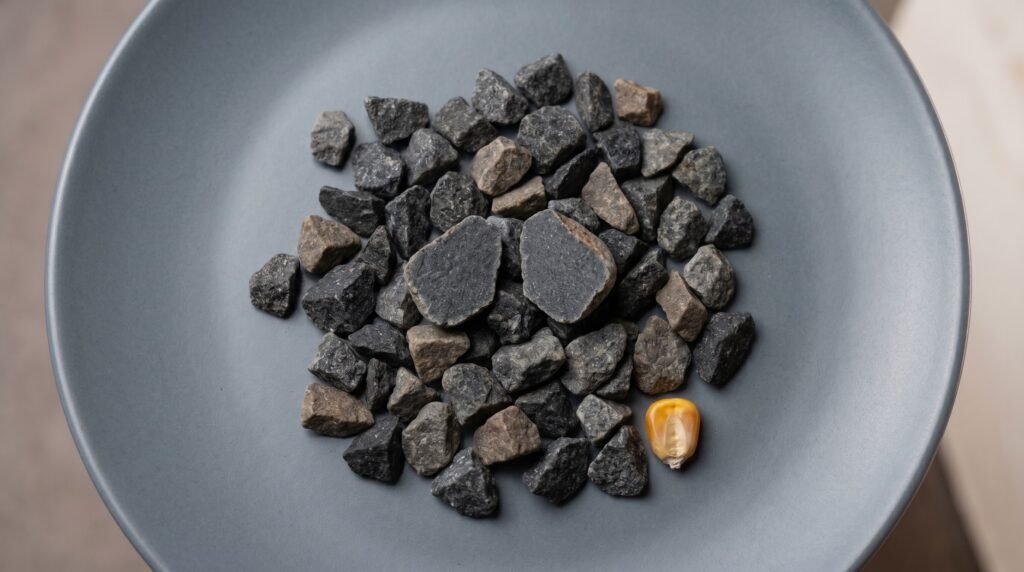
A chicken has no teeth. Food - whole grains, seeds, grass, insects - travels from the beak into the crop, then into the gizzard, a muscular stomach designed to pulverize whatever arrives. That pulverizing only works efficiently when the gizzard contains small, hard, insoluble stones, which is what grit is. As the University of Maryland Extension explains, "An insoluble grit should be provided when feeding scratch grain so the birds can grind and digest the grains properly." Peer-reviewed research backs this up: while grit is not strictly required for survival, studies consistently show it improves digestion efficiency, especially when birds eat coarse or fibrous food (PMC7666813, 2020).
Oyster shell does the opposite of staying put. It dissolves in the acidic stomach, releases calcium into the bloodstream, and that calcium travels to the shell gland where it is laid down over the egg during the 20-hour shell-building window. Eggshell is roughly 96% calcium carbonate (Alabama Extension). Layer feed alone often cannot cover that demand at peak production - which is why free-choice oyster shell exists.
The Alabama Cooperative Extension System is explicit about why you cannot swap one for the other: "Because of the rather high acid level in the gizzard, calcium grit dissolves quickly, and there is little opportunity for it to function as a grinding material." And the eXtension poultry team puts it symmetrically: "Oyster shell should not be used as grit since it is too soft and does not aid in grinding." Both fail at the other's job by design.
Who needs what - and when
The short version: every laying hen needs oyster shell available, and she needs grit only if she is eating anything other than commercially milled, complete pelleted or crumble feed.
Here is why. Commercial layer feed comes pre-ground. The gizzard can handle fine meal and pellets without grinding stones. Free-range hens, meanwhile, typically pick up natural grit from the soil as they forage. Confined birds eating a diet of pellets and nothing else rarely need grit at all. The moment you add scratch grain, whole corn, sunflower seeds, kitchen scraps, or any forage to the ration, the gizzard needs help - and that is when you put out grit.
| Supplement | What it provides | Who needs it | Who does NOT need it | Separate feeder? |
|---|---|---|---|---|
| Oyster shell | Calcium (soluble, absorbed into blood) | All laying hens; especially on all-flock or non-layer complete feed | Chicks and pullets under ~18 weeks - excess calcium damages kidneys | Yes - free-choice, always available |
| Insoluble granite grit | Grinding medium (stays in gizzard) | Hens eating scratch, whole grains, garden greens, or forage; confined birds not touching soil | Hens on 100% commercial pellets/crumble with no whole-feed additions | Yes - separate from feed; offer 2-3 days per month or keep a small dish topped off |
| Calcium grit (limestone, soluble) | Calcium (dissolves too fast to grind) | Sometimes offered as a dual-purpose product, but it performs poorly at both jobs | Anyone who needs reliable grinding action | Can supplement calcium if granite grit is unavailable, but not a substitute for either |
The calcium picture for laying hens
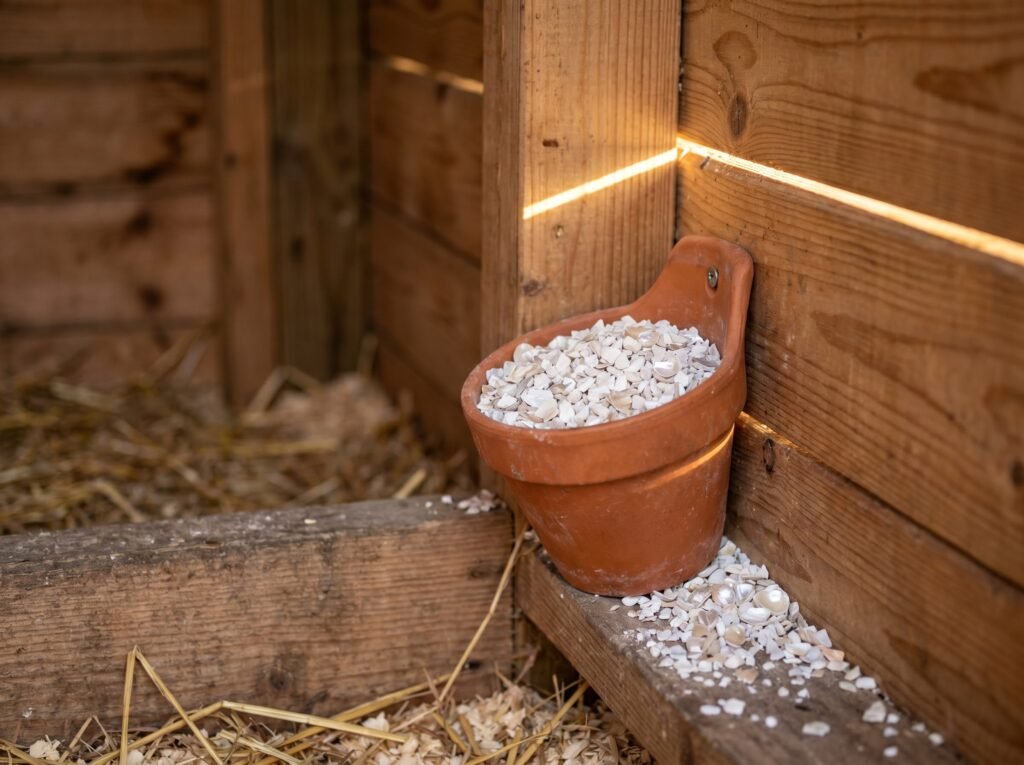
Layer feed is formulated with roughly 3.5-4.0% calcium (UF/IFAS Extension). That sounds like plenty until you factor in hot weather (hens eat less feed), peak production, older hens with declining absorption, or a mixed flock where some birds are not laying. Free-choice oyster shell closes the gap. Because a hen has what researchers call a calcium appetite, she will eat more oyster shell when she needs it and ignore it when she does not - which means you cannot really overfeed it by leaving a dish available.
What you absolutely can do wrong is feed oyster shell to chicks. UF/IFAS Extension is unambiguous: birds under roughly 18 weeks need only about 1% calcium in their diet. Layer-level calcium - whether from layer feed or loose oyster shell - disrupts the calcium-to-phosphorus ratio and can cause kidney damage and poor bone development. Keep the oyster shell dish out of reach of young birds, or use a separate area for your laying flock. This is also why the eXtension poultry resource lists it directly: "Growing chickens require only 1.2% calcium in their feed. If you feed high-calcium diets to growing chickens, kidney damage can result."
Mixed flocks - layers and growing pullets together - are the trickiest scenario. The safest approach is to feed an all-flock or grower ration (lower calcium) to everyone, then offer oyster shell free-choice in a dish the younger birds cannot easily reach, or that adults preferentially visit. Layers will seek it out. Chicks rarely will. For a deeper look at how feed type affects the flock at different life stages, the chicken feed guide breaks down the full progression from starter through layer.
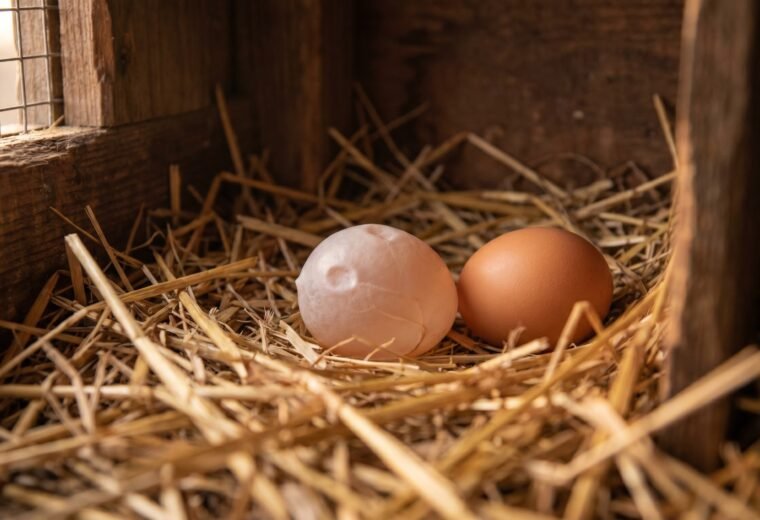
When shells start coming out thin, pitted, or soft, the cause is almost always insufficient calcium - either the feed formulation is borderline, the hen is eating too little of it, or she is at a production peak that outpaces supply. Before assuming a disease problem, try offering fresh oyster shell free-choice for two weeks and watch whether shell quality improves. More detail on diagnosing the causes is in our article on soft or thin-shelled eggs.
How to offer each supplement
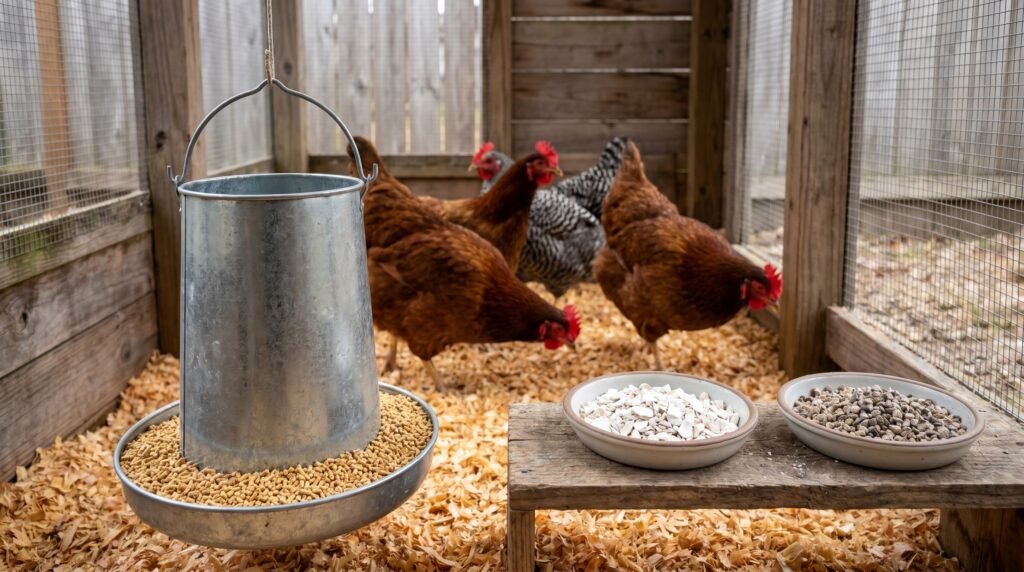
Both supplements do their best work when they are always available and separate from the main feed. Mixing oyster shell into feed sounds convenient but it means every bird - including young ones - gets whatever the blend delivers, with no ability to self-regulate. A small dedicated dish or feeder for each does the job cleanly.
Grit sizing matters. Chick-sized grit (roughly 1-2 mm) suits young birds up to roughly 6-8 weeks old - a guideline that matches commercial chick-grit packaging. Hen-sized grit (roughly 3-5 mm) is right for adult layers. Using hen grit on chicks risks impaction; chick grit on adults provides almost no grinding benefit because adult gizzards need larger particles to work against. Most feed stores stock both.
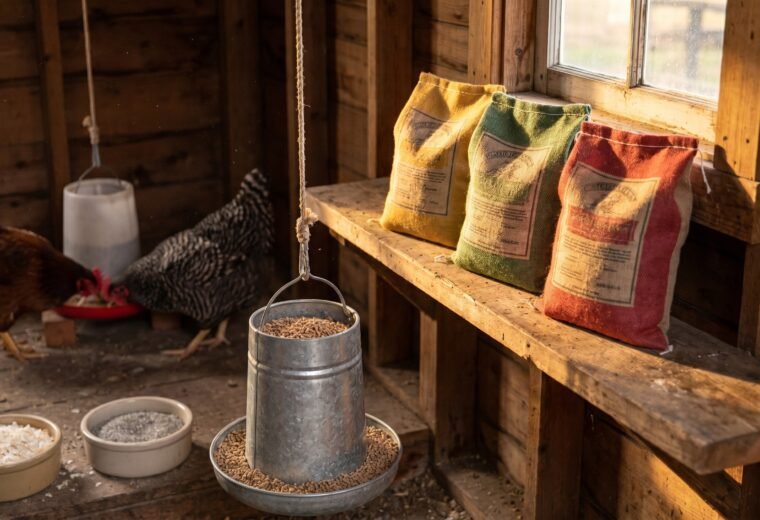
For confined adult hens eating scratch grains or table scraps, Alabama Extension recommends making grit available free-choice for about two to three days per month rather than keeping a full dish topped up continuously. Free-range hens picking up natural stones from the soil are usually covered on their own. If you run a truly mixed diet - pellets plus daily scratch plus kitchen trimmings - keep a small dish of hen granite grit available at all times and top it off every week or two. It disappears slowly.
On the oyster shell side, refill the dish whenever it drops below half. A flock of 15 active layers will work through a pound or two of oyster shell in a week or two depending on feed quality and production rate. Buy in 5-pound or 10-pound bags rather than a single cup at a time - it stores indefinitely if kept dry.
For the broader feeding framework - feed types, protein levels, scratch ratios, and what treats are safe - the what to feed chickens guide and the layer feed guide cover the full picture.
Common mix-ups worth knowing
The biggest one: assuming any white granular supplement in a bag is the same thing. Oyster shell is white and granular. Limestone grit is white and granular. Crushed eggshell is white and granular. Granite grit is gray-brown. They behave completely differently in the bird. Read the bag. If it says "soluble" or lists calcium percentage prominently, it is a calcium source. If it says "insoluble" or "granite," it is for grinding.
Second common error: feeding layer pellets to the whole flock, including pullets and roosters. Roosters and non-laying hens have no outlet for excess calcium, and high dietary calcium stresses their kidneys over time. If your flock includes non-laying birds, use an all-flock feed and offer oyster shell free-choice only to the layers. It is a workable system once you separate the supplement dish from the communal feeder.
Third: believing that more oyster shell produces thicker shells indefinitely. A hen can genetically incorporate only so much calcium into her eggshell at any given age - extra calcium beyond what she needs has only marginal effects on shell thickness. Once she has enough, she stops eating it. If shells are still thin after two weeks of free-choice oyster shell, the cause is more likely age, heat stress, disease, or a lighting issue than calcium shortage.
Grit is not a calcium supplement and oyster shell is not a grinding stone. Each does one job well and fails at the other by design. Keep both available in separate dishes, match the size to the bird's age, and let the hens self-regulate - they are remarkably good at it.