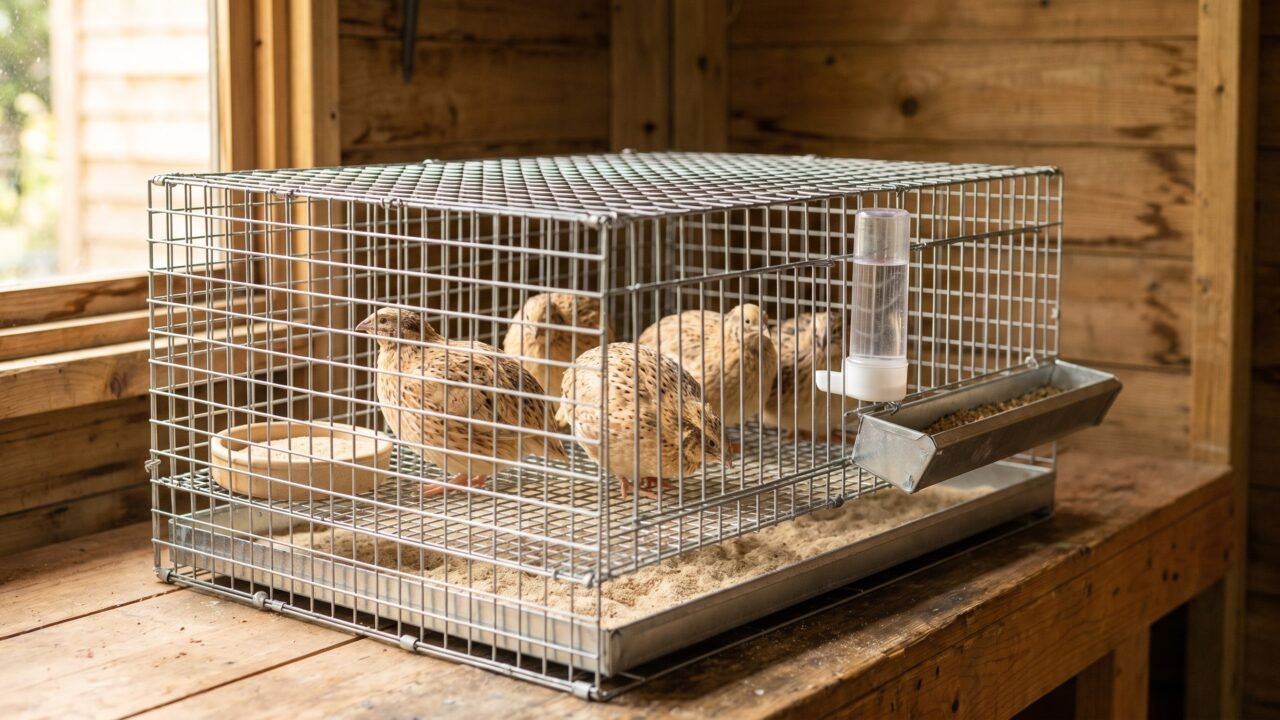
Fourteen adult coturnix in a well-designed cage take up less square footage than a single chicken run panel - but get one detail wrong and birds start injuring themselves within days. Quail housing is a precision exercise. The stakes on ceiling height alone are high enough that every keeper should understand the mechanics before buying a single piece of wire.
This guide covers the full quail cage setup picture: how to choose between a cage, a hutch, and a walk-in aviary; exact floor space and height figures; wire gauge; bedding; predator-proofing; and cleaning. If you are coming from a chicken-keeping background, a few of the rules here will surprise you.
Cage, hutch, or aviary: how to choose
Three housing styles dominate backyard quail keeping, and each one involves a real trade-off rather than a clear winner.
Wire-floor cages (stacked or single-level units with a wire mesh bottom over a droppings tray) are the most common setup for coturnix kept for eggs. Droppings fall through, eggs stay cleaner, and daily sanitation is a five-minute tray swap. The Merck Veterinary Manual notes that ulcerative enteritis - the disease most likely to wipe out a quail flock quickly - spreads fecal-oral, and wire floors cut that transmission route by keeping birds off their own waste. The downside is the environment is spartan. Birds cannot scratch, dust-bathe freely, or exhibit much of the ground-foraging behavior quail actually prefer.
Hutches are solid-sided wooden or PVC enclosures, usually raised off the ground, with a wire front panel and either a wire or solid floor. They sit between a bare cage and a true aviary in terms of environmental richness. A wire-floor hutch handles droppings almost as neatly as a cage while offering more weather protection. A solid-floor hutch with bedding gives birds a more natural surface but requires frequent cleaning.
Walk-in aviaries (floor-to-ceiling enclosures where the keeper walks inside) let quail behave like quail. A 2024 peer-reviewed welfare review published in a scientific journal found that quail spent almost half their time - 48% - seeking cover even when cover occupied only 17% of the floor space. An aviary with leaf litter, low shrubs, or wood-chip patches satisfies that need. The cost is daily litter management: without wire floors, ammonia builds fast. Aviaries also demand more robust predator barriers on every surface, including the roof.
A quick decision table:
| Setup | Floor type | Egg cleanliness | Natural behavior | Daily cleaning load | Best for |
|---|---|---|---|---|---|
| Wire cage (stacked) | Wire mesh + tray | High | Low | Very low (tray pull) | Egg or meat production, small space |
| Raised hutch - wire floor | Wire mesh | High | Low-moderate | Low | Backyard flocks, weather exposure |
| Raised hutch - solid floor | Solid + bedding | Moderate | Moderate | Moderate (bedding changes) | Small hobby flocks wanting more naturalism |
| Walk-in aviary | Ground/litter | Lower | High | High (daily monitoring) | Keepers prioritizing welfare and behavior |
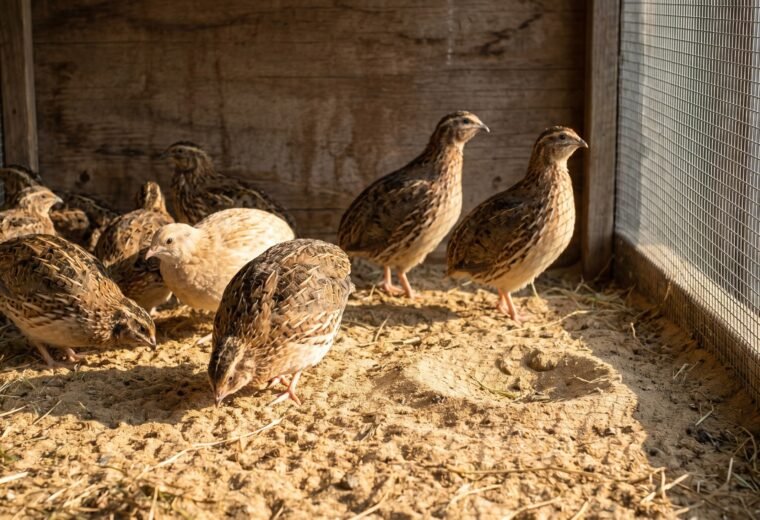
Quail differ from chickens in one structural way that the table does not capture: they do not roost. No perch bars, no elevated sleeping spots. Every bird sleeps on the floor, which means you can design the full enclosure from ground level up.
Floor space and the numbers that actually matter
The widely cited rule is 1 square foot per adult coturnix in a cage. That figure is a workable minimum for a wire-floor production setup (a widely cited practical minimum for coturnix in wire-floor cage production), though it is worth noting the Mississippi State University Extension Service document on quail space needs focuses specifically on Bobwhite quail and gives 0.75 sq ft per bird at 6-12 weeks and 2 sq ft per breeder bird - neither of which maps directly to adult coturnix at laying age. Crowd below it and you risk the two classic outcomes: feather pecking that escalates into injuries, and elevated fecal loading that raises disease pressure even with wire floors.
For aviary-style ground housing, more space per bird consistently produces calmer flocks. A peer-reviewed welfare analysis found that stocking densities below 232 cm² per bird (about 0.25 sq ft) were associated with increased mortality, and recommended a minimum of 372 cm² (about 0.4 sq ft) as a production trade-off threshold. In walk-in aviary conditions - where birds have room to spread out and establish loose territories - most keepers report noticeably less aggression starting around 1.5 to 2 square feet per bird.
Heat matters here too. Mississippi State Extension is specific: when ambient temperatures regularly exceed 90°F, increase your space allotments by 25%. Heat-stressed birds crowd, and crowding accelerates both aggression and ulcerative enteritis outbreaks.
Group composition matters as much as square footage. The same welfare review found that quail breeding groups should stay small, with one male and 8-12 females, because no housing condition alone consistently reduced male aggression in larger mixed groups. If you are running a flock for eggs only, all-female groups are the low-drama option.
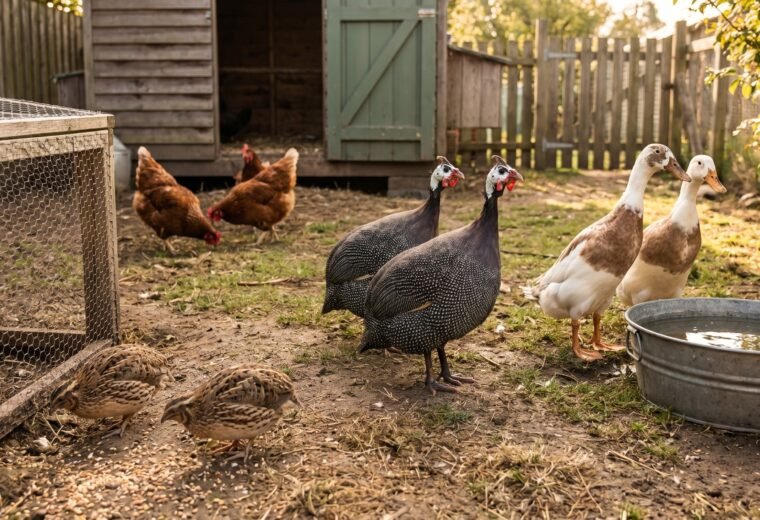
Keepers adding quail to a mixed small-poultry setup will find space requirements and social dynamics across species compared in the other poultry guide.
The height problem: why quail ceilings are nothing like a chicken coop
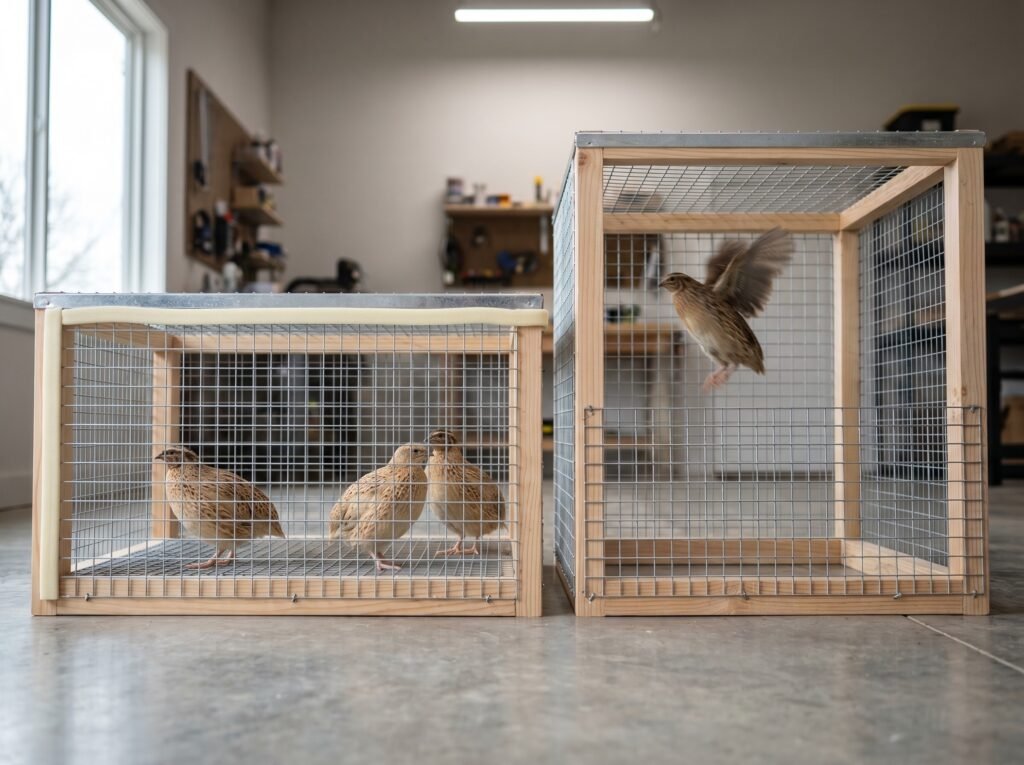
This is the detail that catches chicken keepers off guard more than any other.
Coturnix quail - and quail generally - respond to sudden noise or movement by launching straight up with almost no horizontal component. A peer-reviewed welfare review describes this directly: "If they can't run away for cover, they will throw themselves up into the air to escape. This vertical escape mechanism in quail can lead to serious traumatic head injuries if the roof is at an inappropriate height." The same review confirms that low ceiling height prevents injury specifically by limiting the speed the bird can build before impact.
The practical result is a ceiling height rule that sounds counterintuitive: keep cages low or go very tall, with nothing in between.
- 10-12 inches interior height is the standard target for wire-floor cage systems. At this height, a bird that flushes upward hits the ceiling before it builds dangerous momentum. A soft barrier - foam weather stripping, rubber matting, or heavy fabric stapled to the inside ceiling - absorbs impact further.
- 6 feet or taller works for a true walk-in aviary. At that height, the bird typically runs out of upward energy and drops back down before reaching the roof.
- 18 inches to 5 feet is a danger zone. Cages in this range let quail accelerate enough to cause real injury without giving them room to abort the flight. Avoid it.
Chicken coops are designed for 18-24 inch roost heights and 4-foot+ interior clearance. Those dimensions are directly dangerous for quail in a cage setting. If you are repurposing a chicken hutch for quail, measure the interior ceiling before you transfer any birds.
Wire size and predator-proofing
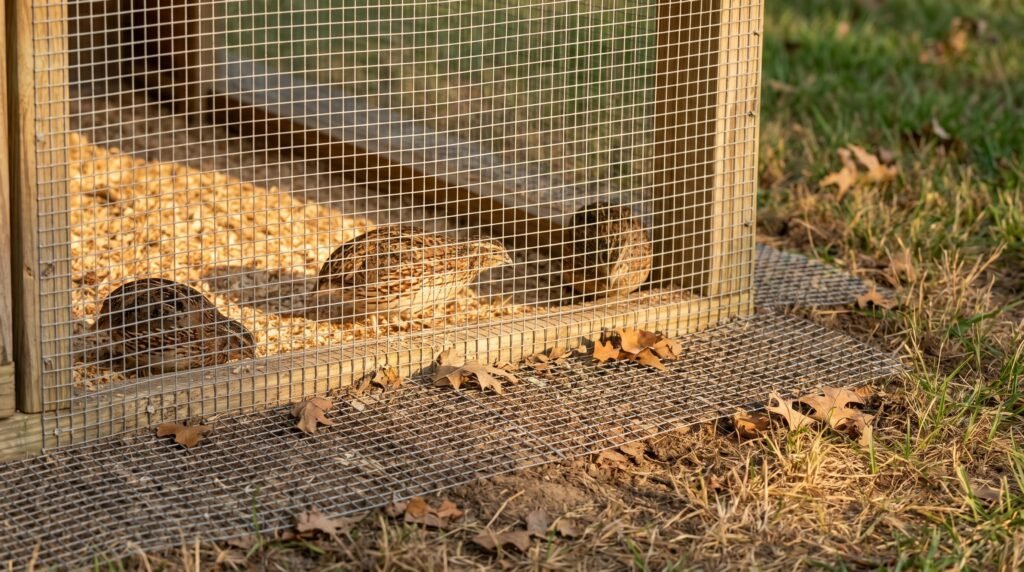
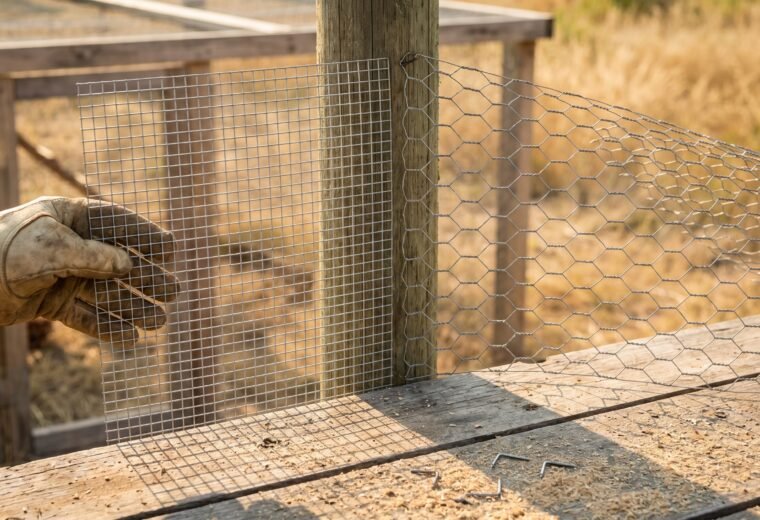
Quail are smaller than chickens, and so are the gaps in their predator threat profile. The general framework from extension resources: hardware cloth (welded wire) rather than hexagonal chicken wire on every surface that contacts the outside, including the roof.
Wire gauge and mesh size recommendations for quail enclosures:
- 1/2-inch mesh hardware cloth on walls and roof stops raccoons, opossums, and most snakes from reaching through. Raccoons in particular can reach through larger openings and injure or kill birds through the wire. Nineteen-gauge galvanized mesh is a practical minimum for strength.
- 1/4-inch mesh on any surface where the threat is smaller - least weasels, rats, or young snakes. Extension sources note that weasels can squeeze through openings as small as 1/4 inch in diameter, so the choice between 1/2-inch and 1/4-inch on a given surface depends on your local predator pressure. If rats or weasels are active in your area, 1/4-inch mesh on all sides is worth the added cost.
- Chicken wire is not an adequate substitute. It corrodes faster, deforms under pressure, and the hexagonal openings are large enough for a determined predator's paw or a snake's body. A detailed comparison of wire types is in the hardware cloth vs chicken wire guide.
For ground-level and aviary setups, bury a hardware cloth apron at least 12 inches straight down around the perimeter, or run it horizontally outward 12 inches at the base (an L-apron). Extension guidance on predator management is direct on this measurement: 30.5 cm (12 inches) of buried depth deters the common digging predators - foxes, raccoons, and skunks.
The roof must be covered too. Unlike chickens, which can sometimes shelter under cover from aerial attacks, quail in an aviary are sitting targets for hawks. Solid or netted roof coverage is not optional for any outdoor enclosure.
Feed, sexing, egg production, and flock health - everything beyond the housing shell - are covered together in the raising quail guide.
Bedding for solid-floor and aviary setups
Wire-floor cage systems sidestep the bedding question almost entirely - droppings fall through and the birds stand on mesh. The droppings tray beneath typically holds an inch or two of sand, granulated lime, or absorbent litter to reduce ammonia and simplify tray disposal.
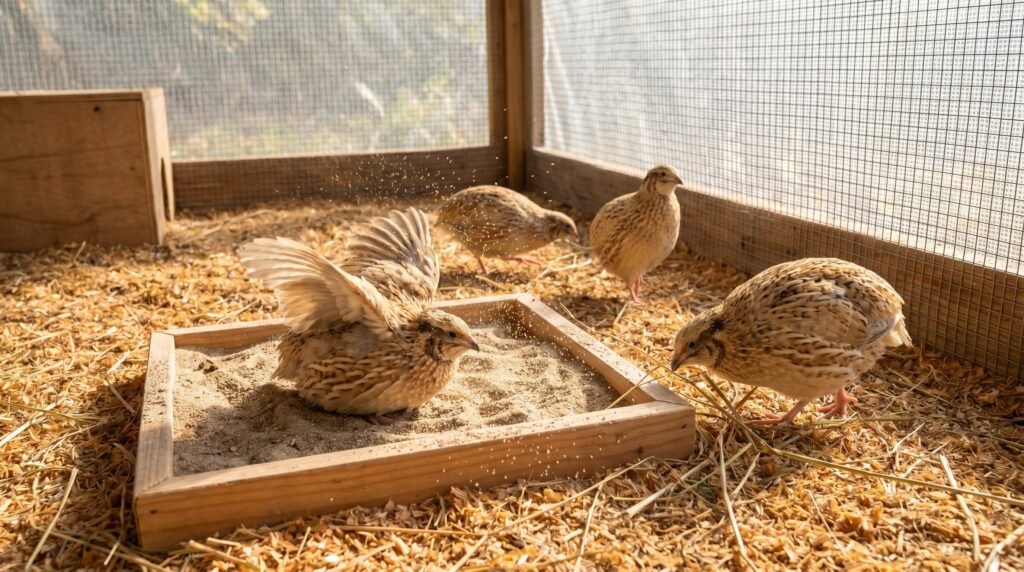
For solid-floor hutches and aviaries, substrate choice matters. A welfare review that tested sand, dried mud, sawdust, wheat straw, and rice straw found that quail reared on sawdust showed the lowest rates of feather pecking and the best growth performance of the tested options. Pine shavings (not cedar - cedar's aromatic oils irritate the respiratory tract) are the most widely available equivalent. Sand works well too: it dries droppings quickly, reduces ammonia loading, and doubles as a dust-bathing medium, which quail need to maintain feather condition and manage external parasites.
Whatever substrate you use, wet litter is the primary enemy. Ammonia from damp droppings builds fast in a small enclosure - faster than in a chicken coop because quail output is dense relative to body weight. If you can smell ammonia at nose level, the birds are already breathing it at dangerous concentrations closer to the floor. Spot-clean daily, replace fully when moisture accumulates, and ensure the enclosure has enough airflow to dry the substrate between waterer spillages.
A 2-inch base of dry shavings or sand is enough to start. Avoid the deep-litter composting approach used in chicken coops - quail enclosures are too small for the biological activity to stabilize, and the result is usually a smelly, high-pathogen mess rather than beneficial decomposition.
Setting up a quail cage: a configuration reference
The table below pulls together the core parameters for three common setups. Numbers marked [general guidance] reflect widely reported practice where a single authoritative standard does not exist for coturnix specifically.
| Parameter | Wire-floor cage | Solid-floor hutch | Walk-in aviary |
|---|---|---|---|
| Floor space / bird | 1 sq ft minimum [general guidance] | 1-1.5 sq ft [general guidance] | 1.5-2 sq ft [general guidance] |
| Interior ceiling height | 10-12 in (danger zone: 18 in - 5 ft) | 10-12 in (danger zone: 18 in - 5 ft) | 6 ft or taller |
| Wall wire | 1/2-in hardware cloth, 19 gauge min | 1/2-in hardware cloth, 19 gauge min | 1/2-in or 1/4-in hardware cloth |
| Floor mesh (wire floor) | 1/2-in welded wire (droppings fall through) | N/A - solid floor | N/A - ground or litter |
| Ceiling soft lining | Recommended (foam strip or fabric) | Recommended | Not needed at 6+ ft |
| Bedding / substrate | None (droppings tray: sand or lime) | Pine shavings or sand, 2+ in | Sand, sawdust, or shavings, 3+ in |
| Perches / roosts | None needed | None needed | None needed |
| Dust bath | Small tray of sand or dry dirt | Small tray or corner patch | Dedicated sand area or built-in |
| Ground apron / burial | N/A (raised) | N/A if raised; 12 in if ground-level | 12-in buried apron or L-apron |
| Cleaning frequency | Tray: daily to every 2 days | Spot daily; full change every 5-7 days | Spot daily; full replace as needed by smell |
Cleaning and ammonia control
Quail are compact animals that produce a surprising amount of waste per square foot. In a wire-floor cage, the droppings tray is the daily focal point: pull it, scrape it into compost or a bag, wipe it down, and slide it back. In warm weather or with high stocking density, that becomes a once-a-day task rather than every-other-day. Letting the tray overflow defeats the entire purpose of the wire floor - soiled tray material begins outgassing ammonia upward into the birds' breathing zone.
For solid-floor and aviary setups, your nose is the best monitoring tool. Ammonia is detectable by smell well before it reaches concentrations that damage the respiratory epithelium, and quail are smaller than chickens, meaning they breathe air closer to the litter surface. Smell ammonia? Clean the floor today, not this weekend.
Between full cleanings, food-grade diatomaceous earth or agricultural lime worked into the top layer of litter reduces moisture and slows ammonia off-gassing. If using diatomaceous earth, apply sparingly and avoid raising a visible dust cloud - DE particles are a respiratory hazard for small birds if inhaled, and quail breathe close to the litter surface; ensure good ventilation before applying indoors. Zeolite-based products (often sold for livestock ammonia control) also bind ammonia molecules in the litter. Neither replaces actual bedding changes - they extend the interval.
Disinfect the enclosure frame and any hard surfaces with a poultry-safe disinfectant when doing a full clean, and let it dry completely before returning birds. Ulcerative enteritis spores can persist in wood and soil for extended periods; thorough drying and UV exposure (sunlight) are the most practical tools a backyard keeper has against environmental persistence.
How housing design affects laying rates - alongside feed schedules, lighting cycles, and what realistic production numbers look like - is all in the raising quail for eggs guide.
How quail housing differs from a chicken coop
Experienced chicken keepers sometimes assume quail housing is just a smaller version of what they already know. Several assumptions transfer poorly:
- No roost bars. Coturnix sleep on the floor. A perch wastes space and can become a falling hazard in a low cage.
- Ceiling height logic inverts. Chicken coops are built tall for human access and ventilation. Quail cages must stay under 12 inches or go above 6 feet - the middle range is the injury zone, not a safe option.
- No nest boxes in the traditional sense. Coturnix scatter eggs on the floor. They do not use discrete boxes the way hens do, though a low, partially covered corner (a boot tray with a lip, a shallow wooden hide) encourages them to lay in one spot for easier collection.
- Wire mesh on the floor is an asset, not a welfare concern. Chickens on wire develop foot problems because they are heavier and stand differently. Coturnix at appropriate stocking density tolerate wire floors well and benefit from the sanitation advantage.
- Dust bathing requires a deliberate container. A chicken run usually provides enough bare earth for birds to find their own dust bath. Caged quail need a shallow tray (a boot tray or pie dish works) of dry fine sand or dry dirt, swapped out or dried when it gets damp.
- Group dynamics are driven by male ratio. A backyard chicken flock can absorb multiple roosters with management. Quail male aggression scales with male-to-female ratio and available space much more sharply. One male per 8-12 females in breeding setups keeps injury rates down.