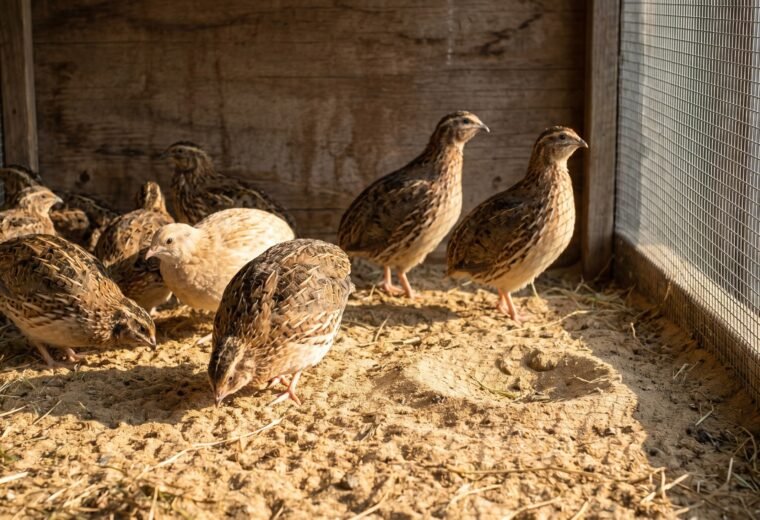
Six weeks. That is how fast a day-old coturnix chick can reach laying age - roughly one-quarter the time it takes a standard chicken pullet. If you want fresh eggs on a small footprint with minimal noise, few birds match the coturnix (also called Japanese quail, Coturnix japonica). Mississippi State University Extension confirms they "may begin laying eggs as young as 6 to 8 weeks of age," compared to the 20 to 24 weeks a chicken typically needs. Keepers widely report that most pullets drop their first egg between day 42 and day 48 - which still catches you off guard the first time.
Peak production runs about five to six eggs per hen per week, or roughly 250 to 300 eggs per year in the first laying season. A flock of 12 hens - a comfortable number for a standard 4-foot-by-3-foot wire cage - can put around 60 to 70 eggs on your counter every week. Compared to managing chickens, the math, the footprint, and the noise level all tilt strongly toward quail for anyone working in a tight space.
When do coturnix quail start laying, and what keeps them laying consistently?
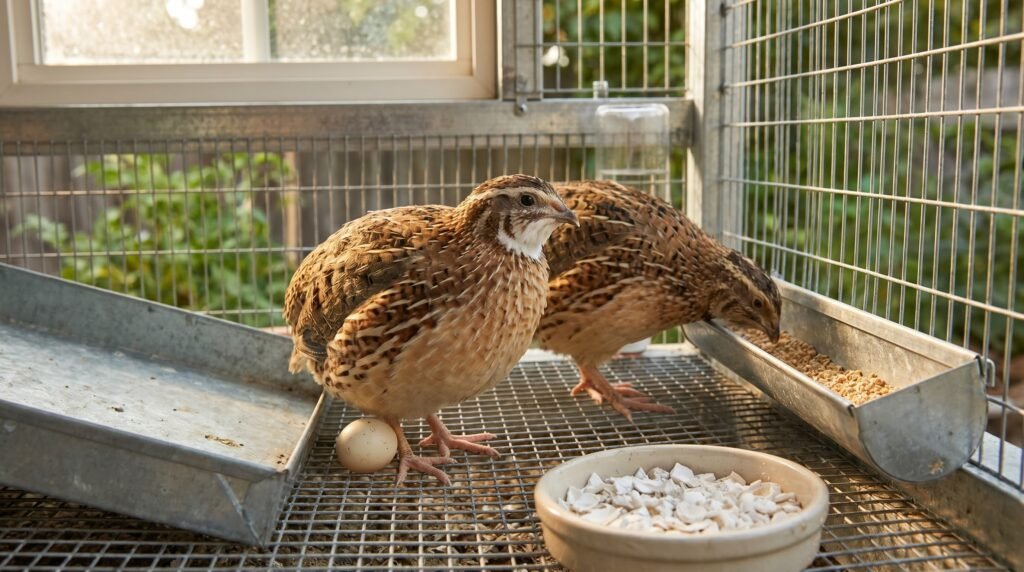
Most coturnix pullets drop their first egg between days 42 and 48. Sustained production depends on three factors: 14 to 16 hours of light per day, 21-25% protein in the feed, and enough cage space to prevent chronic stress. Pull any one of those below threshold and output falls within a week or two.
Coturnix hens are photoperiod-sensitive, meaning daylight hours trigger their reproductive cycle the same way they trigger laying in chickens. To sustain or boost production indoors, keepers widely add supplemental lighting to reach 14 to 16 hours of combined natural and artificial light per day. Drop below 12 hours and expect a visible slowdown. Keepers who have tracked winter production without supplemental light consistently report a 25-35% dip in daily egg counts during short-day periods.
Production peaks in the first year and then gradually softens. Most keepers who have run multi-year flocks report that second-year hens still lay consistently - perhaps five eggs per week rather than six - but commercial quail operations typically rotate new pullets in annually to maintain high output. If steady volume matters more than carrying individual birds long-term, plan your replacement hatch schedule accordingly.
Three things suppress laying faster than anything else: low protein in the feed, inconsistent or short light periods, and stress from overcrowding. Fix any one of those and most keepers report a recovery within seven to ten days. If you are still setting up your flock, the raising-quail guide walks through housing and daily management before you reach the egg-production stage covered here.
What do coturnix quail need to eat to keep laying?
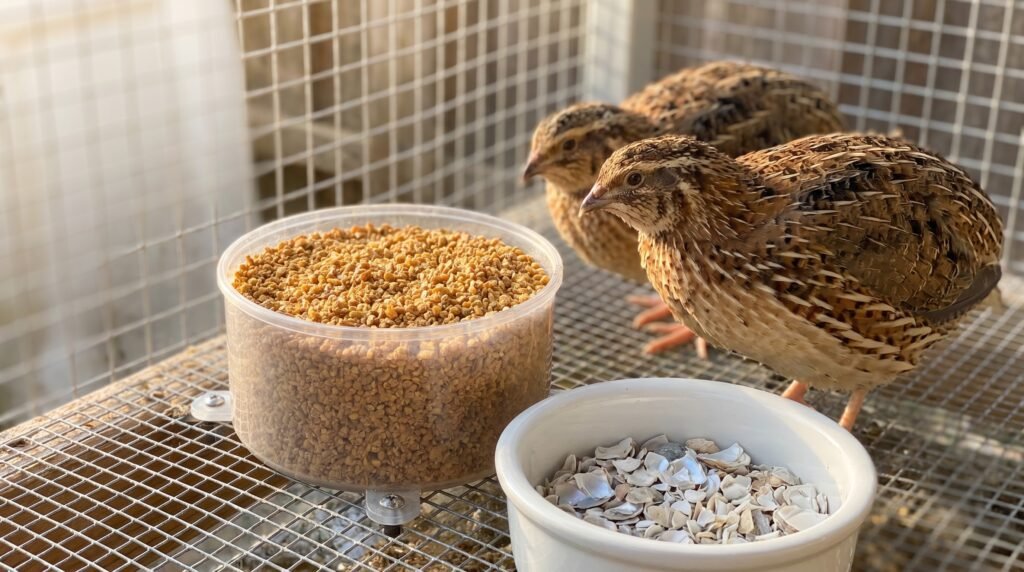
The short answer: a game bird crumble or turkey maintenance feed with 20-25% crude protein, free-choice oyster shell for calcium, and insoluble grit if the birds are on wire floors. Chicken layer pellets are not a substitute - the protein gap is wide enough to hurt egg output and shell quality within weeks.
Coturnix need 21-25% crude protein through their laying life - well above the 16-18% a standard chicken layer ration delivers. Mother Earth News, drawing on production literature, puts it plainly: "Coturnix require a feed containing 21% to 25% protein." Chick starter for quail should run even higher - most game bird starters land at 24-30% - because those first six weeks of rapid growth happen almost entirely on that starter diet. Drop below the threshold and egg output, shell strength, and body condition all decline within two to three weeks.
For laying adults, a dedicated game bird layer crumble or a turkey/game bird maintenance feed with 20-22% protein is the standard choice. Chicken layer pellets do not deliver enough protein and over time will pull down both egg output and eggshell quality. Offer free-choice oyster shell alongside the main feed; quail shells are thin and the calcium demand per egg is real. Adults eat roughly 18-20 grams of feed per bird per day - about two tablespoons - so feed costs stay low even at a dozen or more birds.
Grit is necessary if your birds are not on a free-range or dirt-floor setup. Most wire-floor cage setups keep quail entirely off the ground, so insoluble grit should go in a small dish alongside the feed.
How much space do coturnix quail actually need?
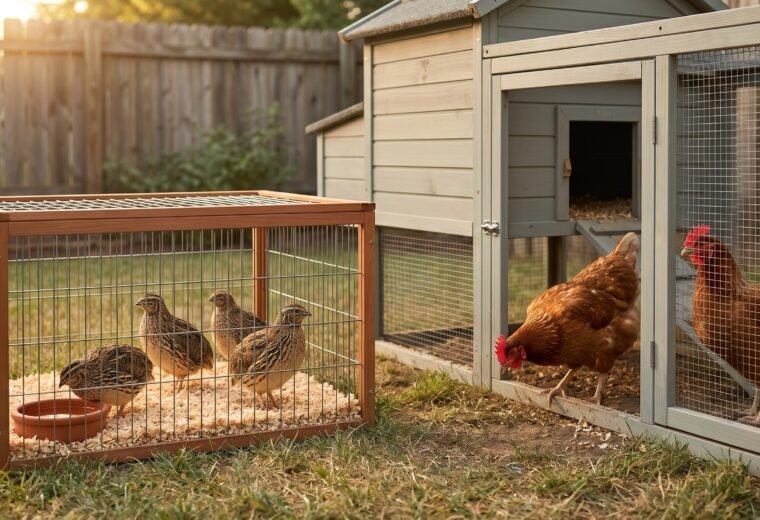
Coturnix need 40 to 50 square inches of floor area per bird - about one-tenth the indoor space a chicken requires. A standard 4-by-3-foot wire cage holds 30 to 35 birds at maximum density; most backyard keepers run 12 to 20 for lower stress and better egg output. Wire floors, a covered top, and a 12-16 inch cage height round out the basic setup.
Per Mother Earth News, coturnix need "40 to 50 square inches of floor area per bird" - roughly 0.28 to 0.35 square feet each. A 4-foot-by-3-foot footprint (12 square feet) can comfortably hold 30 to 35 laying hens, though most backyard keepers run 12 to 20 birds in that space to leave room for feeders, waterers, and a lower-stress density. Compare that to chickens, where 3 to 4 square feet per bird indoors is the standard starting point.
Wire-floor cage systems are the most common approach, and 1/2-inch hardware cloth works for the floor and sides. Use 1/4-inch mesh if rat pressure is high in your area - rats can reach through 1/2-inch wire and will kill birds or steal eggs overnight. A covered top is mandatory because coturnix flush hard when startled and will injure themselves on an uncovered ceiling. Keep cage height to 12-16 inches; taller is unnecessary and a startled bird hits the ceiling harder in a tall cage.
For anyone weighing the broader comparison between these two birds, our quail vs. chickens breakdown covers temperament, cost, and regulatory differences across urban and suburban settings.
How do you collect and store quail eggs?
Collect eggs at least once daily from a sloped wire floor or tray. Do not wash them - the natural bloom coating extends shelf life. Unwashed eggs keep one to two weeks at cool room temperature; once washed, refrigerate and use within three weeks. Store point-down to keep the air cell correctly positioned.
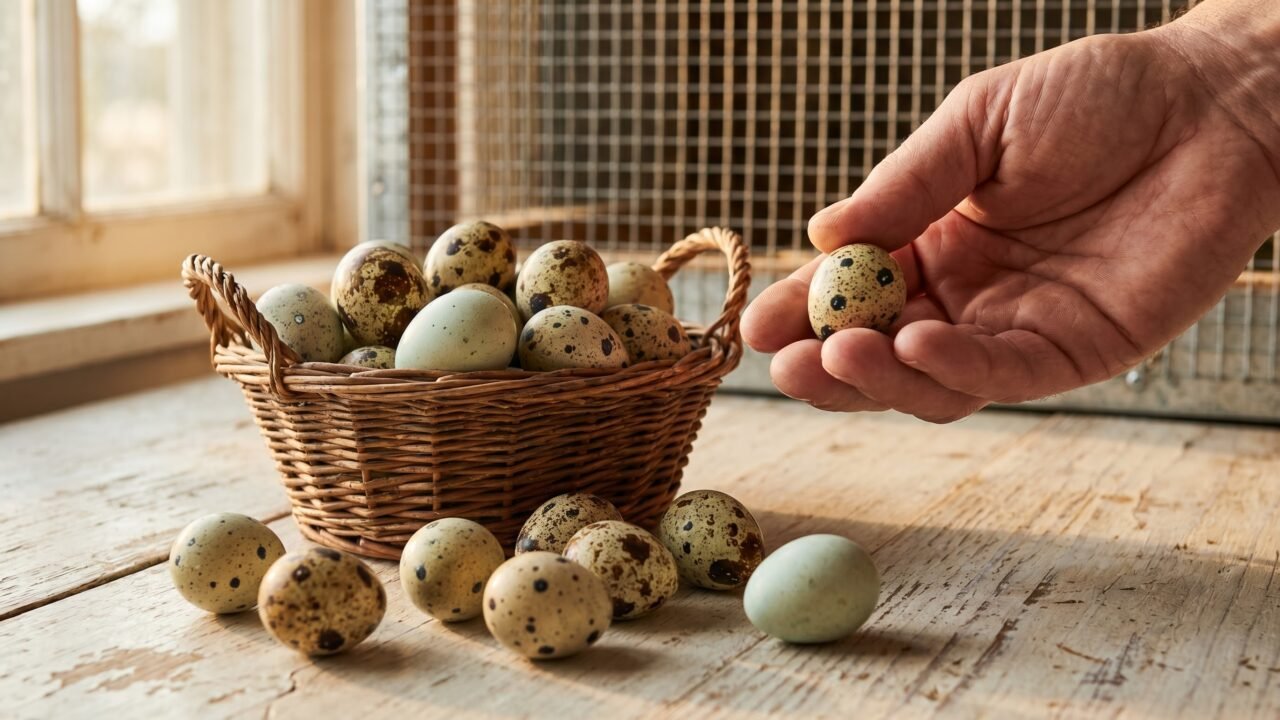
Quail rarely use a designated nest box; hens drop eggs wherever they happen to be standing. Most keepers wire a sloped floor (about a one-inch-per-foot tilt) so eggs roll gently to a collection tray at the front. Collect at least once a day - twice a day in summer when cracking from heat is a risk, or if you have a crowded pen where trampling is possible.
Do not wash the eggs before storage. The bloom, a natural protein coating deposited during the final moments of shell formation, seals microscopic pores and slows bacterial entry. USDA Agricultural Research Service data shows that unwashed eggs kept at room temperature (72°F) dropped from Grade AA to Grade B quality in a single week, while washed refrigerated eggs held Grade A quality for 15 weeks. If you skip washing, quail eggs keep well at room temperature for one to two weeks in a cool pantry (below 65°F). Once washed, refrigerate immediately and use within three weeks.
Store unwashed eggs point-down, which keeps the air cell at the broad end and slows yolk drift toward the shell. A standard egg carton works fine - quail eggs are about the size of a large grape, so you can fit 18 to 20 per standard dozen-egg slot if you lay them on their sides. More on general egg handling and the US bloom/refrigeration debate is in our collecting and storing eggs guide.
How do quail eggs compare to chicken eggs in nutrition?
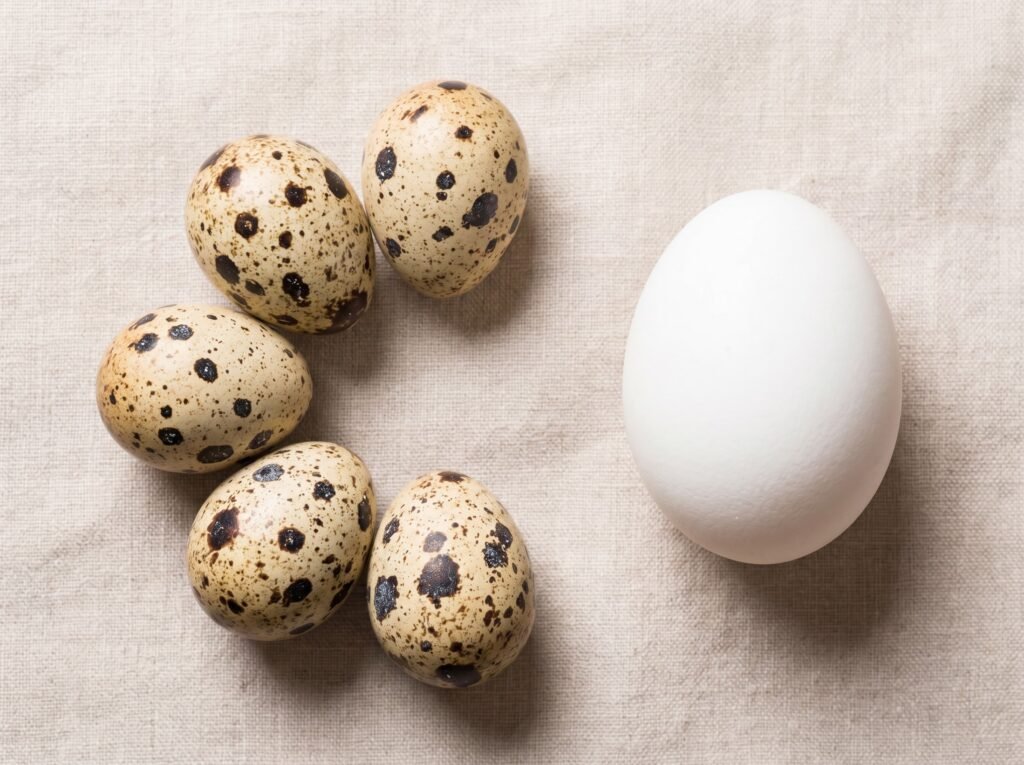
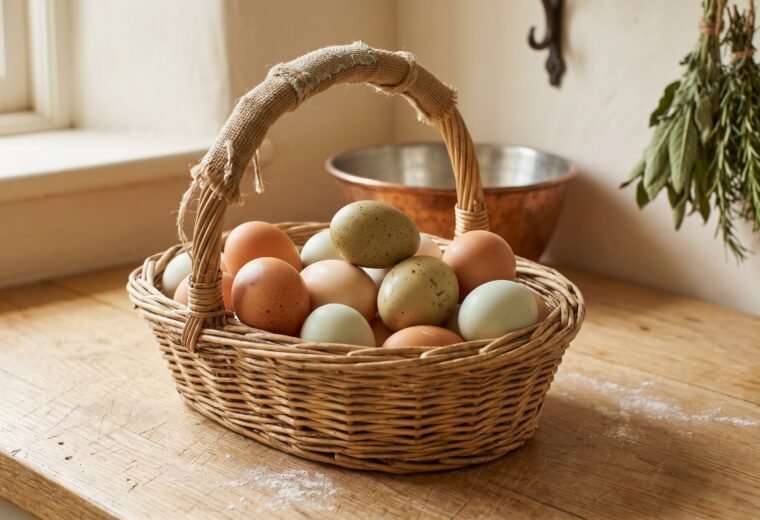
Quail eggs weigh 9-11 grams each - you need four to five to match one chicken egg by volume. Per 100g they deliver similar protein (~13g) and slightly more calories (~156 kcal). The notable difference is iron: quail eggs contain roughly 75% more iron per gram, driven by a larger yolk-to-white ratio. Cholesterol per individual egg is lower than a chicken egg because the egg itself is smaller.
Where quail eggs pull ahead is iron. A 2024 peer-reviewed study in the journal Foods (Chwastowska-Siwiecka et al., PMC11121015) measured quail eggs at 2.20 mg iron per 100g whole egg versus 1.26 mg for chicken eggs - roughly 75% more iron per gram. The higher yolk-to-white ratio in quail eggs (closer to 50/50 vs. the slightly whiter split in chicken eggs) accounts for much of this difference, since iron concentrates in the yolk.
Cholesterol is higher in quail eggs per 100g (around 545 mg vs. 385 mg for chicken), but per individual egg - the serving size that actually matters at the table - the numbers flip: one quail egg has about 55 mg cholesterol vs. roughly 193 mg in a large chicken egg. Eating four quail eggs to replace one chicken egg delivers a similar total, so there is no dramatic advantage or disadvantage on that count.
The table below reconciles the numbers that often get misquoted when quail eggs are discussed. Sources are USDA Standard Reference (quail) and the 2024 Foods journal study for the iron and cholesterol comparison.
| Metric | Quail egg (per 100g) | Chicken egg (per 100g) | Per single quail egg (~10g) | Per large chicken egg (~50g) |
|---|---|---|---|---|
| Calories | ~156 kcal | ~143 kcal | ~16 kcal | ~72 kcal |
| Protein | ~13 g | ~13 g | ~1.3 g | ~6.3 g |
| Total fat | ~11 g | ~10 g | ~1.1 g | ~5 g |
| Iron | 2.20 mg* | 1.26 mg* | ~0.22 mg | ~0.63 mg |
| Cholesterol | 545 mg* | 385 mg* | ~55 mg | ~193 mg |
| Yolk-to-white ratio | ~50/50 | ~38/62 | Quail eggs taste richer because of this | |
* Iron and cholesterol from Chwastowska-Siwiecka et al., Foods 2024 (PMC11121015); protein and calorie data from USDA Standard Reference (USDA National Nutrient Database, food ID 172191).
One practical note on cooking: quail eggs take about 2 minutes to soft-boil and 3 to 3.5 minutes to hard-boil in gently simmering water. They peel easier when very fresh (the membrane is tight) or after sitting two to three days.
What is the most common mistake that stops quail from laying?
Switching adult coturnix to chicken layer pellets to cut costs. The protein drops from the required 21-25% to around 16-18%, and egg output falls within two to three weeks - gradually enough that many keepers blame other causes. Recovery on correct feed takes another two to three weeks. The second most common error is ignoring temperature drops in outdoor wire cages, which stall laying within days.
New quail keepers lose production most often not from disease or predators but from switching adult birds to a chicken layer ration to save money. The protein shortfall shows up as a gradual drop in eggs over two to three weeks, thinner shells, and eventually a full stop. By the time the connection is obvious, the birds may need two to three weeks on correct game bird feed to fully recover output. Stick with 20-22% game bird crumble from the start; the cost difference per dozen eggs produced is negligible.
The other common silent killer is sudden temperature swings in wire cages. Coturnix are hardy from about 40°F to 95°F but they are small - a standard adult weighs roughly 3.5 to 5 ounces (100 to 140 grams), with only jumbo-selected lines approaching heavier weights - and a drop from 70°F to 35°F overnight in a poorly insulated cage stresses them enough to pause laying for days. A simple wind-block panel on three sides and a tarp on freezing nights keeps most outdoor cages in the safe range without a heat source.
If a bird looks lethargic, sits fluffed, or has loose droppings that persist beyond a day, see a poultry vet rather than trying to diagnose or treat at home. Quail hide illness well until they cannot, and a sick bird in a densely-housed pen is a risk to the whole flock.
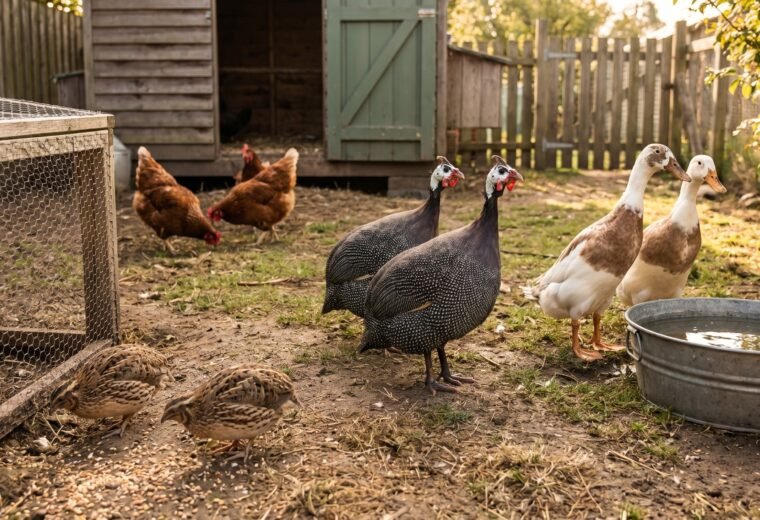
For an overview of the other small poultry species that work well alongside quail - ducks, guinea fowl, and bantam mixes - our other poultry guide lays out the compatibility and management notes you need before mixing species.