Six to eight weeks. That is how long it takes a coturnix quail to go from hatch to laying eggs on your kitchen counter. No other common backyard bird comes close to that turnaround, and it is the main reason so many poultry keepers who started with chickens eventually add a small quail pen to the yard. If you have a spare 10 square feet and access to high-protein game bird feed, you have what it takes to get started.
What follows is a practical walkthrough covering housing, feed, brooding, egg production, incubation, and the few things that trip up most first-time quail keepers.
Why coturnix quail are the easiest quail to keep
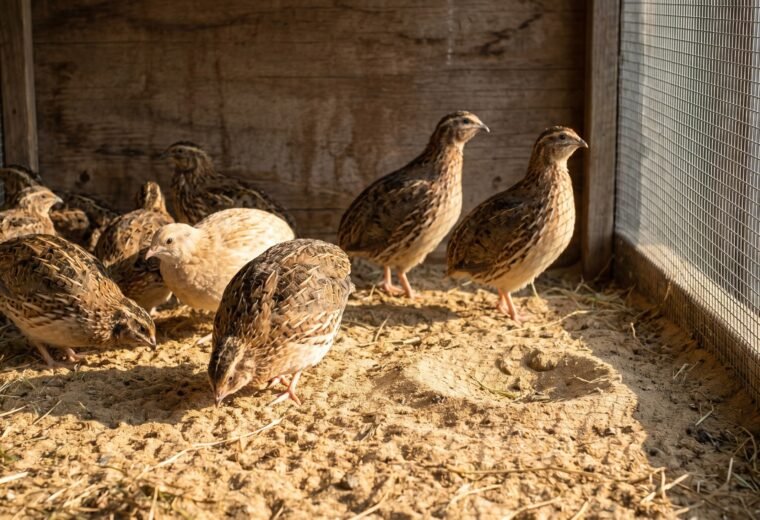
There are dozens of quail species, but coturnix (*Coturnix japonica*, the Japanese or pharaoh quail) sits at the top of the beginner list for several converging reasons. Mississippi State University Extension notes that coturnix "mature at an earlier age than bobwhite quail and may begin laying eggs as young as 6 to 8 weeks of age" - a pace that makes them feel almost more like a garden project than a livestock commitment. Bobwhites, by comparison, take five to six months.
They are also compact. A standard adult coturnix weighs roughly 3.5 to 4.5 ounces and stands about five inches tall (selectively bred Jumbo Coturnix lines run heavier, reaching 5 ounces or more, but the birds most backyard keepers start with fall in the lower range). That small footprint means you can keep a productive flock in a space that a single chicken would barely notice. They do not need a rooster to lay (just like hens), the males crow softly - much closer to a songbird than a rooster - and in many urban areas they slip under ordinance radar entirely.
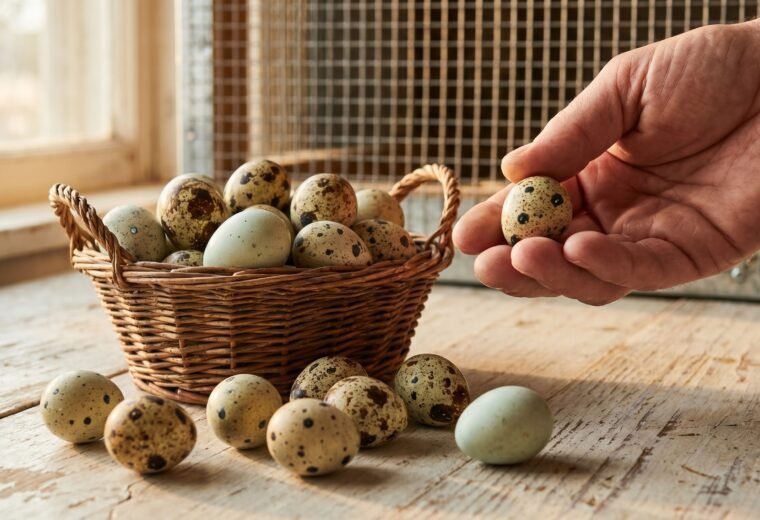
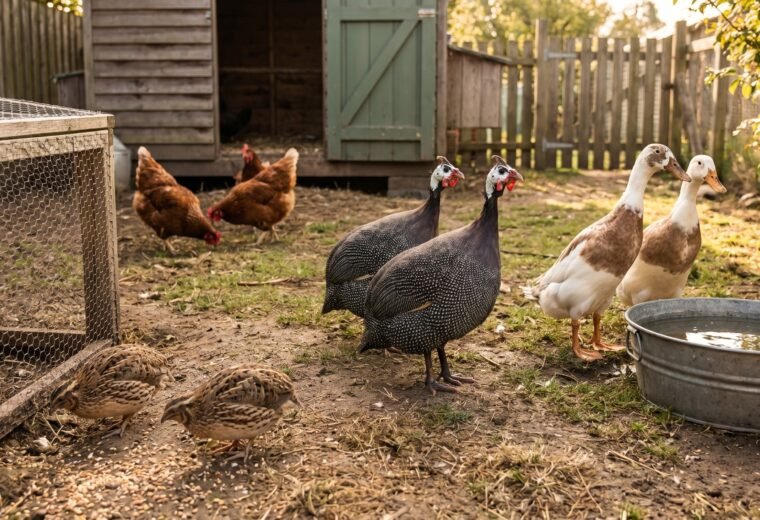
Peer-reviewed production data (Veterinary World, 2016) confirms that females "can lay between 250 and 300 eggs a year," starting around six weeks of age. Each egg weighs roughly 10 to 14 grams - about a third the size of a large chicken egg - so three quail eggs substitute for one chicken egg in a recipe. If comparing quail to other species interests you, the quail vs. chickens breakdown covers that tradeoff in depth, and our other poultry guide puts coturnix in the wider context of ducks, guineas, and game birds.
Housing: small footprint, specific requirements
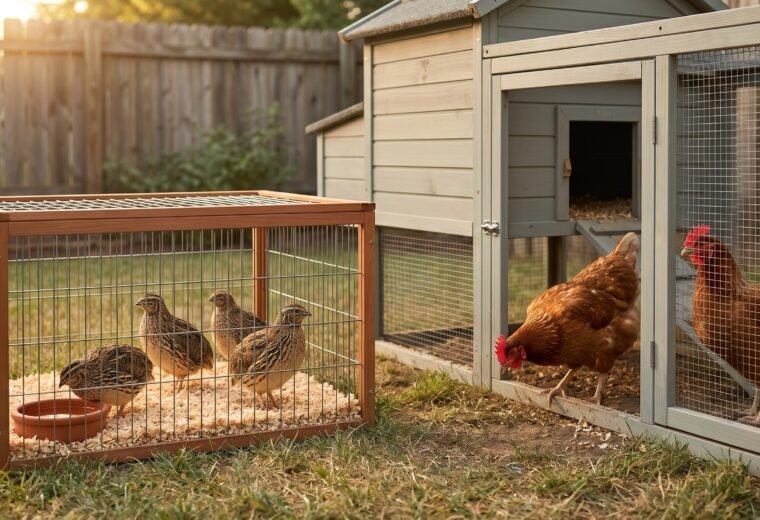
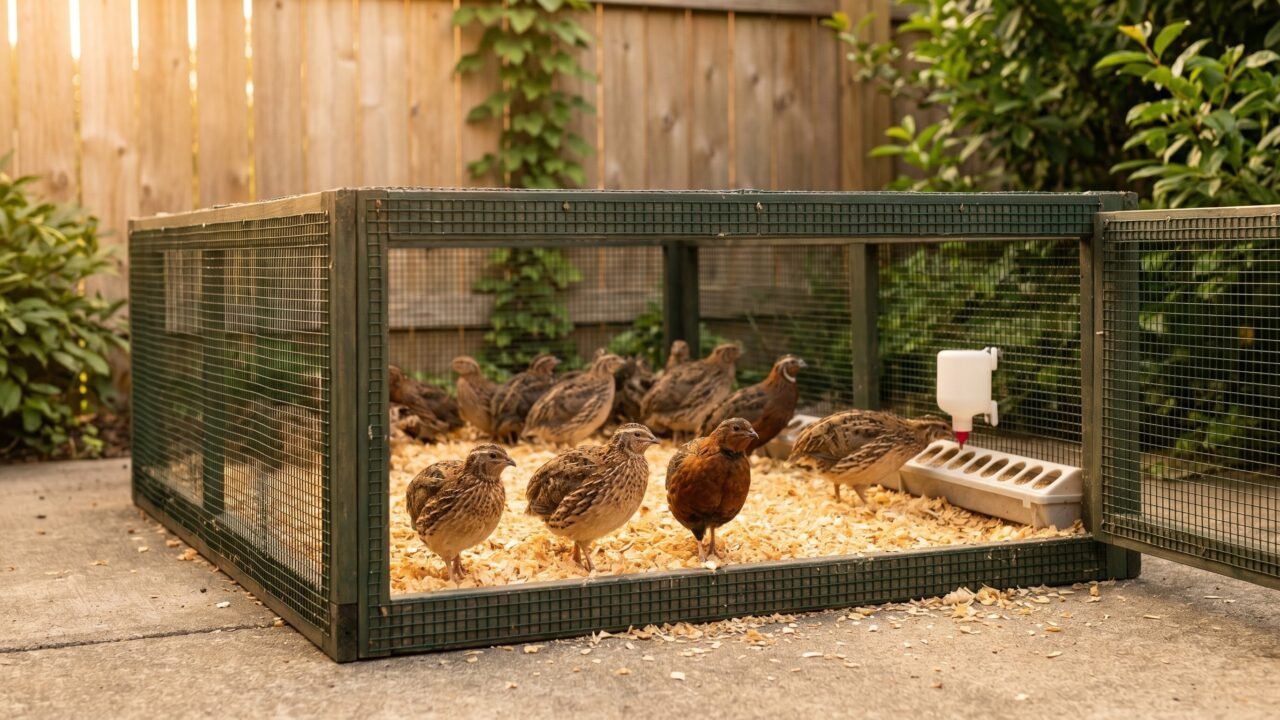
Coturnix thrive in wire cages, hutch-style pens, or ground runs - but the setup has to account for one behavior most beginners never anticipate. When startled, coturnix flush straight up with impressive force. In a cage 36 to 50 inches tall, that vertical launch can snap a bird's neck. Keep cage height under 12 inches for tabletop or stacked wire setups, or go full walk-in at 6 feet or more so birds have room to arc safely. The danger zone is everything in between.
Space per bird depends on the setup:
| Housing type | Space per bird | Notes |
|---|---|---|
| Stacked wire cage | 0.33-0.5 sq ft | Keep ceiling under 12 in; wire floor with drop tray |
| Ground pen or hutch | 1-1.5 sq ft | Litter required; more enrichment options |
| Walk-in aviary | 1.25-1.5 sq ft | Ceiling 6 ft+; cover top with hardware cloth |
A 15-bird laying flock in a ground pen needs roughly 18 to 22 square feet - a 3x6 or 4x6 footprint. That fits against a garage wall, on a patio, or in a corner of an existing chicken run (though coturnix should not share space with chickens, which will bully and injure them).
For mesh, use 1/2-inch hardware cloth on all sides and the top. Chicken wire keeps nothing out. Raccoons tear through it, weasels reach through the gaps, and even house cats can breach it. Half-inch welded wire stops most mammalian predators. Bury or fold an L-shaped apron 12 inches out along the base to block diggers.
Ventilation matters more than warmth. Coturnix droppings are voluminous relative to body size, and ammonia builds fast in a poorly aired pen. Any time you can smell ammonia at standing height, the concentration at bird level is far higher - eye damage and respiratory problems follow quickly. Cross-ventilation on opposite walls, or a slatted top panel, keeps air moving without chilling the birds.
Litter for ground pens: 2 to 3 inches of pine shavings works well. Wet litter is the enemy - pull damp patches before the smell starts, not after. Coturnix also appreciate a small dust-bathing tray (a low-sided box of dry sand or dry dirt keeps feather condition good and reduces external parasite load).
Feed: protein drives everything
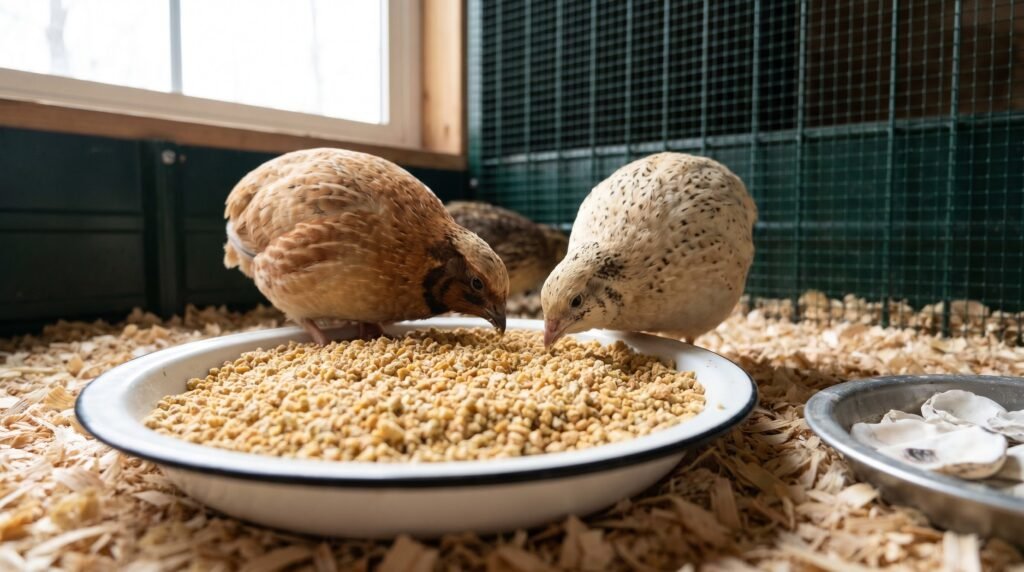
Coturnix have higher protein needs than chickens at every life stage. A standard 16% layer pellet will not cut it. The Alabama Cooperative Extension System specifies 24-26% crude protein for Japanese quail during the starter and grower phase (0-6 weeks), dropping to 18-20% crude protein for laying breeders with 2.5% calcium to support eggshell production.
In practice, the feed path looks like this:
| Stage | Age | Protein target | Feed type |
|---|---|---|---|
| Starter / grower | Hatch to ~6 wk | 24-26% | Game bird starter, milled finer for week 1 |
| Layer / breeder | 6 wk onward | 18-20% | Game bird layer or high-protein layer blend |
Mississippi State Extension warns that feeding laying birds anything other than a proper layer diet will cause "reduced egg production and increased numbers of thin-shelled eggs." Calcium is not optional once hens come into lay. If you cannot find a dedicated quail layer ration, a quality turkey or game bird starter (typically 26-28%) works for chicks; transition adults to a formulation with added calcium or offer ground oyster shell free-choice once laying begins.
One practical note on the starter: day-old coturnix chicks are tiny - smaller than a golf ball - and most commercial game bird starters are too coarse for them to pick up cleanly in the first week. Run the pellets briefly through a blender or use a mortar and pestle to break them to a finer crumble. By week two, they handle standard crumble texture fine.
Feed free-choice at all times. Quail do not gorge and come back to the feeder dozens of times a day. Grit helps birds digest whole or coarse feed; offer it separately in a small dish rather than mixed into the ration.
Brooding chicks: the first six weeks
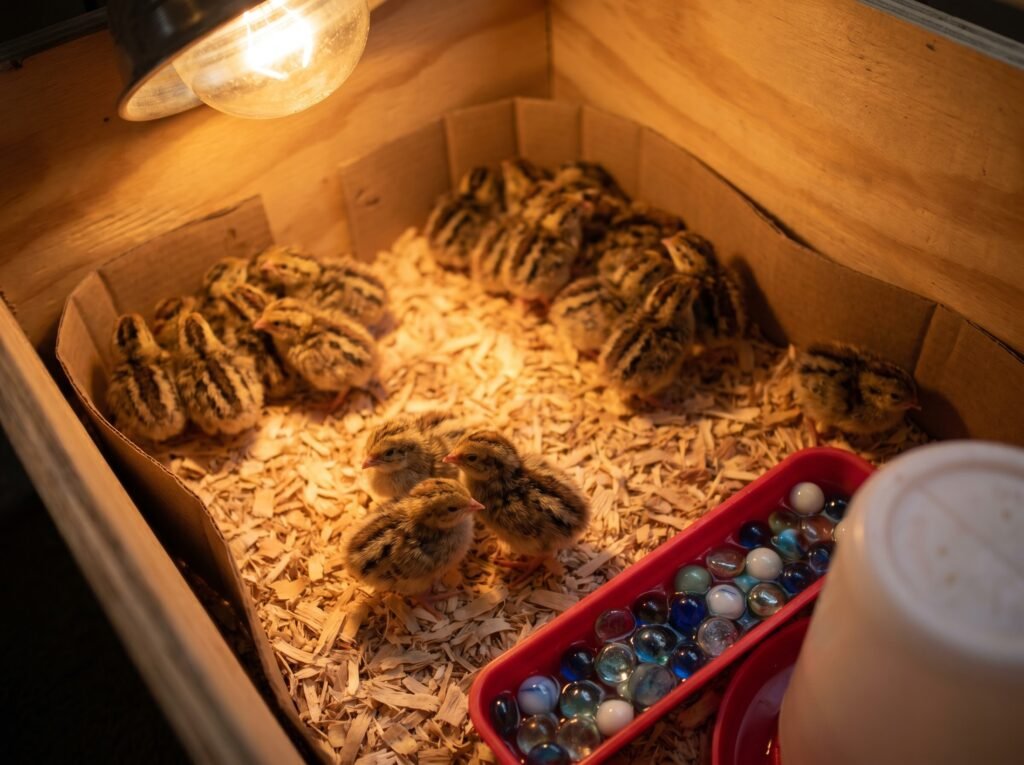
Coturnix chicks are impressively self-sufficient for their size, but they need careful temperature management and one specific waterer setup to get through the first week safely.
Mississippi State University Extension gives this brooder temperature schedule, reducing by 5°F per week:
| Chick age | Brooder temp at chick level |
|---|---|
| Days 1-7 | 90-95°F |
| Days 8-14 | 85-90°F |
| Days 15-21 | 80-85°F |
| Days 22-28 | 75-80°F |
| Days 29-35 | 70-75°F |
| Day 36+ | 70°F (room temp) |
Read the chicks, not just the thermometer. MSU Extension puts it this way: "Contented peeping and even distribution of chicks around and under the brooder indicate comfortable conditions." Huddling and sharp chirping means too cold; chicks moving to the edges and panting means too hot. They will tell you clearly.
Drowning is the biggest first-week killer. Extension guidance is explicit: "Young quail also have a tendency to drown in shallow water." Fill the lip of any standard waterer with clean marbles or small pebbles. The marbles take up enough trough space that a chick cannot submerge its head. Remove them once birds are two weeks old and obviously larger than the gaps. Many keepers use bottle caps as individual waterers for the first several days - one cap per two or three chicks, a marble dropped in the center.
Round out brooder corners with cardboard strips. Square corners cause chicks to pile up when they startle, and a pile of panicked quail chicks can suffocate the birds on the bottom in minutes. Extension recommends this specifically: "Make sure all the corners of the brooding area are rounded to prevent piling of the chicks."
By five to six weeks, chicks are fully feathered and can regulate their own body temperature in a room held near 70°F. That is when they move to the adult pen. For a deeper look at general quail getting-started decisions - including whether to buy chicks versus hatching eggs - our raising quail overview covers the options.
Egg production: what to expect, realistically
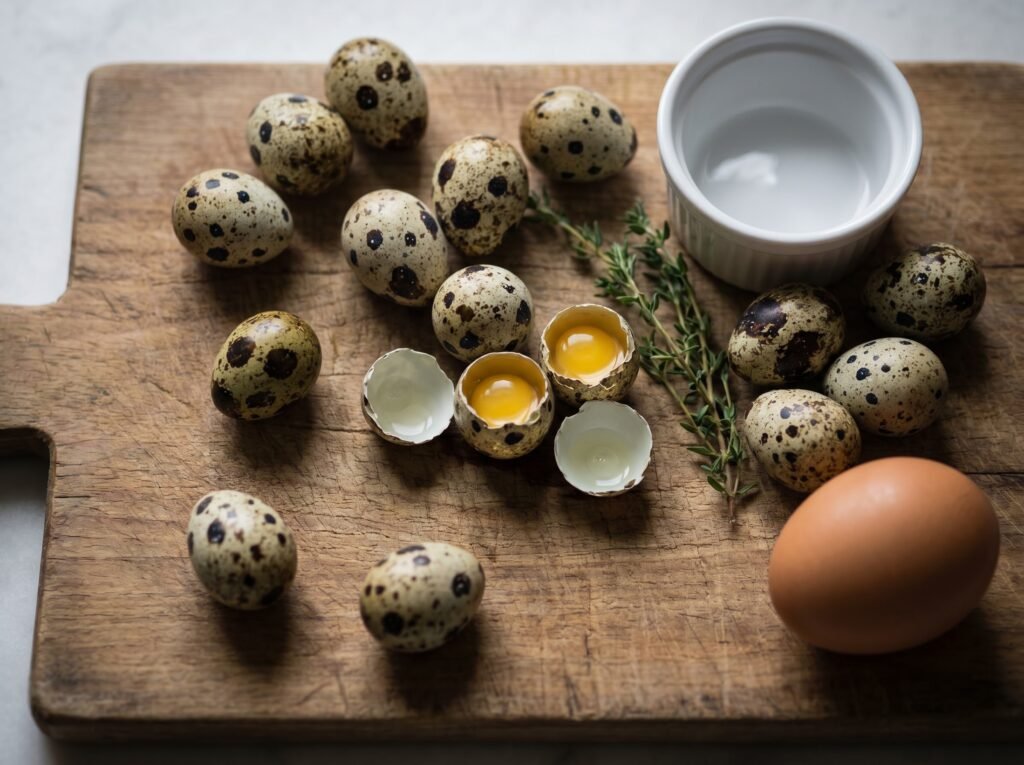
A well-managed coturnix hen lays roughly five to six eggs per week at peak production. Over a full year, 250 to 300 eggs per bird is a reasonable expectation (PMC/Veterinary World, 2016). Production peaks in the first laying season and begins declining after the first birthday. By the second year many birds lay noticeably less, which is why production-focused keepers stagger batches - hatching a new group every few months to keep steady output.
Light is the lever. Hens need roughly 14 hours of light per day to maintain full production. Natural daylength alone will cause production to drop through late fall and winter in most of North America. A simple timer and a low-wattage bulb in the pen keeps things consistent. Bear in mind that running hens under artificial light year-round shortens their overall laying career; some keepers give birds a natural winter rest to extend productive life.
Egg production also drops during molt (usually late summer into fall) and during heat stress above roughly 90°F. These are normal pauses, not illness. Our raising quail for eggs guide goes deeper into managing seasonal production swings and lighting strategies.
One arithmetic note worth keeping straight: a 15-hen flock at peak production yields about 75 to 90 eggs per week. Each egg is small, but volume adds up fast. Plan storage accordingly - quail eggs refrigerate well for several weeks once washed, or keep unwashed eggs at room temperature for a shorter window following the same food safety logic as chicken eggs.
Incubating coturnix eggs
Coturnix are not broody - hens lay everywhere and show no interest in sitting on eggs. If you want to hatch, an incubator is the only path.
The incubation period is 17 days (Mississippi State University Extension). The 17-day figure is also recorded in peer-reviewed sources (AnAge); separately, females reach sexual maturity at about 63 days - a distinct biological fact from the same database, not a consequence of incubation length. A forced-air unit set to 100°F works well. Humidity runs 45-55% for days 1 through 14 - consistent with general extension guidance for small quail - then rises to 65-75% at lockdown on day 15. Stop turning eggs at lockdown and do not open the incubator until hatch is complete or nearly so.
Coturnix chicks hatch fast once they start - often within a few hours of each other. They are tiny (some keepers describe them as "bumblebee-sized") and will squeeze through almost any gap in a brooder. Check your setup before chicks arrive. Wire mesh finer than 1/4 inch, or solid-sided brooders with hardware cloth tops, prevents escapes and the cold drafts that small chicks cannot handle.
Lifespan and flock planning
Coturnix can live up to six years in captivity, but production tells a different story. Research notes that "signs of ageing are visible at little over one year of age" in Japanese quail, and most backyard keepers find egg output drops meaningfully in year two. The honest planning framework for egg production is this: treat each bird's prime as roughly 12 to 18 months of strong laying, then decide whether to retire individuals to a non-production pen or replace them.
For meat production, coturnix reach harvest weight around six to eight weeks - the same window as first eggs. Standard birds come in at roughly 3.5 to 4.5 ounces live; Jumbo Coturnix lines bred specifically for meat reach 5 to 6 ounces in the same timeframe. That dual-purpose efficiency is part of what makes them attractive to small-scale producers who want to keep flock numbers manageable.
Sex ratio for breeding pens: one male per three to five females. Too many males in one pen means fighting; too few means fertility drops. Males can be identified visually once feathered - most coturnix varieties show a rust-brown bib on males and a speckled cream chest on females, though the exact pattern varies by color variety. Vent sexing is reliable at any age if you learn the technique (or buy already-sexed birds from a hatchery).
The two mistakes that sink most beginners
After all the gear is in place, two errors account for the majority of first-year failures:
Low-protein feed. Grabbing a bag of chicken layer pellets at 16% protein is the most common mistake. Coturnix chicks fed below 24% protein grow slowly, feather poorly, and reach laying age late or not at all. Adults on insufficient protein produce fewer eggs with thinner shells. Game bird starter is not optional - it is the foundation of the whole enterprise.
Poor ventilation. Even with dry litter, a closed pen in cold weather can accumulate ammonia fast. Ammonia is heavier than air; birds at floor level are breathing concentrations far higher than what you detect when you lift the lid. Cross-ventilation on two walls, or a slatted panel, should stay open even in winter - just redirect the airflow so it does not blow directly onto the birds. If you smell ammonia when you crack the pen, add ventilation before anything else.
Wet litter. Wet litter compounds the ammonia problem but is also its own hazard - damp bedding harbors fungal spores and bacteria that cause respiratory illness and foot sores. The fix is simple: pull damp patches every day, not every week. A dust-bathing tray filled with dry sand also gives birds a way to manage their own feather and skin condition. A sick bird should be isolated and seen by a poultry vet; quail are stoic and often mask illness until it is advanced.